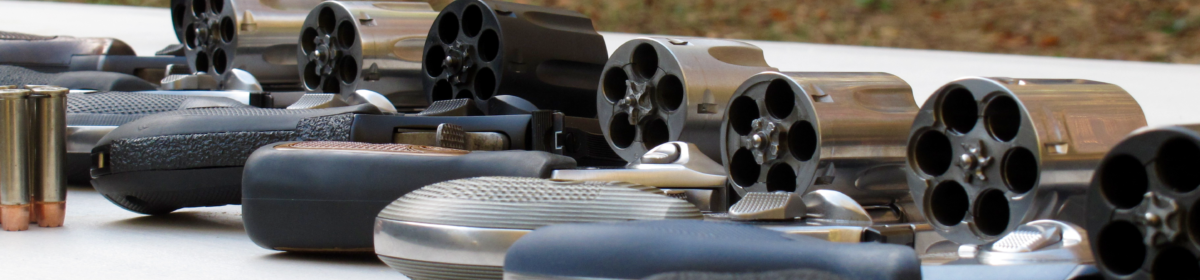
I would like to start this off by saying, I am graciously humbled by the opportunity to present on this venue. I am not what you would consider the typical “RevolverGuy,” but I have some experience with the platform and religiously carry one for personal defense daily.
Editor’s Note: I’m very excited to welcome my good friend Jeremy to the pages of RevolverGuy. As you’ll soon discover, Jeremy is a Gun Guy of the highest caliber (and an excellent instructor, too—I’ve had the pleasure of working alongside him and can personally attest to his talent and enthusiasm), but it took him a while to catch the revolver bug. He’s making up for lost time now, and I thought it would be fun to let him share his story of discovery and allow all of us old-heads to see things through a new set of eyes, again. We’ve all taken different paths, but find ourselves in the same place, appreciating these guns for their special qualities. No matter where we came from, we’re RevolverGuys, each of us!
-Mike
A little background on me, I am a 23-year law enforcement officer with an additional three years of law enforcement experience from my time in the military. I am a 17-year law enforcement firearms instructor and I have been relying on a short-barreled revolver for the past five or six years as a back-up to a full-sized 1911 variant I normally carry as a duty pistol. The following is my experience with “revolvers” and how I came to be a “New” RevolverGuy.
EARLY EXPOSURE
Thanks to my uncles, my grandfather and my step-dad, I have had an affection for guns since I was a boy. Like most, I got my first BB gun at six or seven, progressed to a pellet rifle at nine or ten, and began shooting rimfire shortly thereafter. Some 35-plus years ago, I experienced my first encounter with a revolver when my step-dad allowed me to fire his .357. Unfortunately, I don’t know the make/model, but I do remember it was stainless with a 3” barrel. My best guess is it was a Ruger SP101, but again, I cannot be certain.

My dad let me shoot a cylinder through the little 3”, but I likely doubt I could have hit the broadside of the barn. After cranking out a cylinder of full-house .357, he handed me a .44 Magnum. Now, I know the old man had an affinity for Rugers, so I would assume this was a Ruger Redhawk, but again I am not certain and my knowledge base and reference for guns back then was extremely limited. I remember torching off one round of full-house .44 and that was enough for me at that time in my life. I recall standing in front of his open gun safe in his basement, some years later, and meeting that stainless steel beauty a second time, but, unfortunately, I never got the chance to shoot it again.

FIRST REVOLVER
Fast-forward some 10-12 years, I found myself completing a 16-week police academy in Arizona and going to work as a full-time Police Officer. I had experience with pistols from my time in the military, with the Beretta 92, but I truly learned to shoot and fight with a Glock 22, my agency-issued duty pistol at the time. My instructors all professed the need for a back-up gun during my time in the academy and when I could afford to buy one, I purchased a Glock 27. I carried the “Baby Glock” in a leather DeSantis ankle rig for a little over a year, until I started having hip pain on my left side due to the weight of the pistol and some 11 rounds of 180 grain Federal Hydra-Shok ammo.

Some of the “Old-timers” (fitting now, seeing as how I am now one of the “Old-timers” where I work), carried some version of a J-frame or other brand/model snubby in an ankle rig or on a vest holster under their duty shirt, and I began to inquire with them about their choices. Eventually, I settled on a Smith & Wesson 442 (fully equipped with the “internal lock,” and all), purchasing it from Cabelas, in Phoenix, AZ. I bought some .38 Special ammo and eventually ordered a Galco ankle holster for duty carry.
My experience with that gun was reminiscent of my childhood, and my lack of success with my first revolver experience, as my accuracy had only marginally improved since then. I tried to teach myself how to shoot it, and eventually I was able to keep my rounds within the silhouette-sized target we used for qualification purposes, but I could only manage to get good, high-center chest hits, inside of seven-yards. Most of my department firearms instructors told me it was a “belly gun,” and it was not real accurate past five or ten yards. I carried that little J-frame for a number of years in the Galco rig, or a Mika’s Vest holster on my support side internal vest carrier.
HITTING THE PAUSE BUTTON
Circa-2009, I attended my first firearms instructor course and we spent a whopping “whole day” learning about the double-action sixgun. I used a borrowed Smith & Wesson Model 10 to get me through the class. Though this was my first “organized” training with a sixgun, I didn’t learn much beyond the basics of how to run a range with revolver-armed students, if called upon to do so in the future. With respect to the little J-Frame I carried, my accuracy never improved, and I sent it down the road to another co-worker when I left the agency for the agency I currently work for now.

I began working with my current agency and was accepted as a firearms instructor almost immediately (an ancillary duty outside of Patrol), but my experience with revolvers stagnated for quite a while. I carried a Colt Series 80 1911 as my primary duty gun and I acquired a Ruger LCP as a back-up gun. The LCP rode inside a leather holster I had made by a local boot repair guy, which was sewn into the shock plate pouch of my external vest carrier. I retained the original “Baby Glock” I had purchased some six years prior, carrying it as my “off-duty” piece, and my LCP was carried in pocket holster in my off-side front pocket as a backup when I was off-duty.
I SEE THE LIGHT!
Like most “gun guys,” I went through a number of off-duty guns, over the years, to include the full-size Colt I had been issued. That little LCP was my constant back-up gun, however, until I took a Tom Givens class in 2012, where he showed me the light, and encouraged me to carry a “full-size” duty pistol as primary gun, and a snubby as a backup. As I recall, he carried a six-shot Colt Cobra as a backup to his Glock, at the time. He discouraged me from carrying the LCP as a backup gun, due to concerns about the effectiveness of the .380 ACP cartridge, and using a semiauto for close quarters work. I learned a lot from his instruction, in many areas, but this was something I truly took to heart.

I revisited Smith & Wesson, and purchased another J-Frame–this time a Model 642. I reverted to ankle carry with this gun, while on-duty, and pocket carry when off-duty, with a full-size 1911 as my main pistol. This time, I actually learned how to shoot the little revolver (thanks to YouTube and places like RevolverGuy.com), and found it to be tremendously accurate. I shot it out to 25 yards on the state-mandated “50-Round Revolver” course, and made my hits.

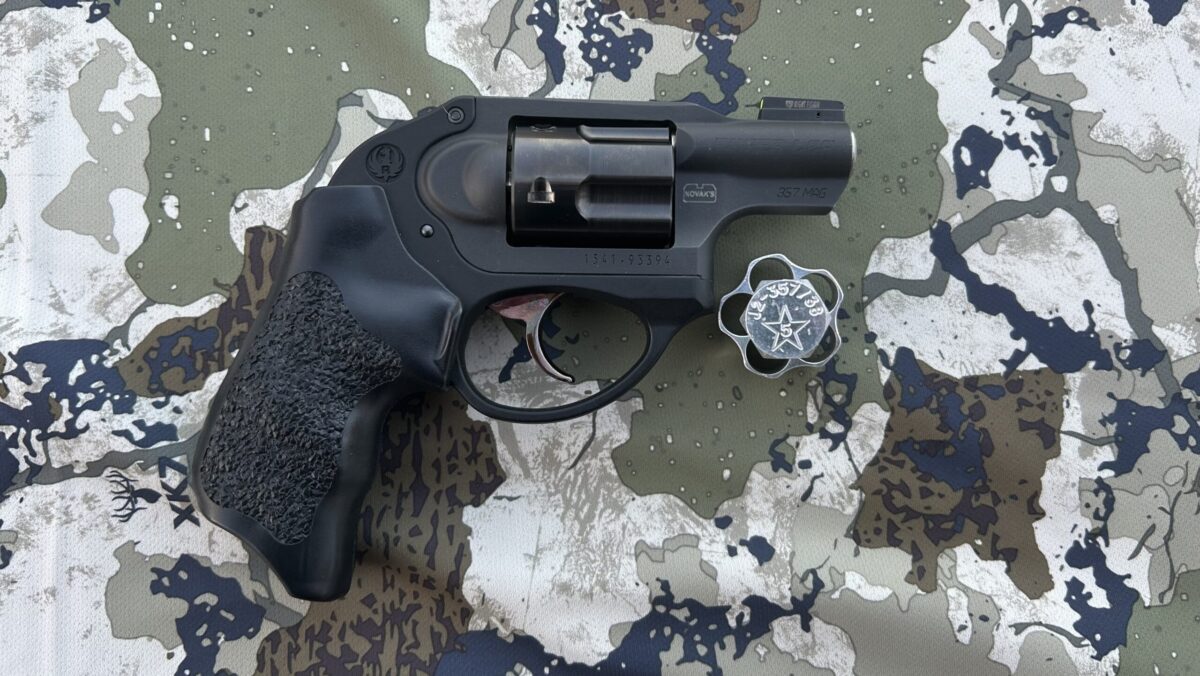
At some point, I also acquired a Ruger LCR in .357 Magnum and it, too, shot very well for its intended purpose. Unfortunately, a steady diet of .38 Special +P through the little 642 took its toll, and eventually the hammer pin snapped from the frame of the gun. With an estimated repair bill from Smith & Wesson of $170 (over half the value of what I paid for the gun), I decided to part ways with it and sold it to a start-up gunsmith for a “parts” gun.

CONVERSION!
This carried me to my first formal revolver-specific training class. I attended the first Gunsite 250 Revolver Class in 2020, taught by Ed Head and Pete Feeney, two phenomenal Gunsite Rangemasters. It was my first Gunsite “shooting” experience class and I took it with the desire to learn all I could about the double-action sixgun, using a 4” Ruger GP100 in .357 Magnum. It was a great experience, the training was excellent, and I became hooked on the revolver.


I discovered that if you know how to manage a double-action trigger, these guns truly shoot like laser beams, and I have continued to use, carry, and train with them ever since. During the class I met several phenomenal revolver shooters, including some I would join as a brother Shootist, in the future. With their help and encouragement, I have become fully immersed in the revolver sub-culture.


Mike is one of those brothers who influenced me, and when he asked me to write something for RevolverGuy, during the 2025 Pat Rogers Memorial Revolver Round-Up, I knew I had to write this story. Mike said, “it’s a good start,” so I guess I’ll probably return to the pages of RevolverGuy in the future.

Welcome aboard, Jeremy. The experience of migrating from bottom feeders to revolvers is particularly appreciated by those who understand the functional and physical shooting advantages revolvers have. The user controls every minute function of the revolver.
In the early 1960s, I was introduced to revolvers, both single and double action. Seeing them in TV westerns of the 1950s-1960s was one thing. Handling the real things was something else.
Over time, learning the revolver’s inner workings gave a great appreciation of their inherent simplicity (except for the old models of Colt’s double action nightmares) and reliability. Starting on the job in 1972, the revolver was like second nature. I carried my issued S&W M27 with total confidence in its ability to hold up its end of the job. I held out against the duty autoloader until the mid 1990s. It’s not that I didn’t like semi autos. It’s not that I didn’t trust them, especially after the Beretta M9 came on the scene. I owned and enjoyed several autos, including the Beretta. It’s just that in my experience, the service size .357 Magnum had impeccable street creds, much like the lightweight J-frame is just dandy with wadcutters. Nothing else had that reputation.
Folks who become proficient with double action revolvers soon realize that they generally shoot far more consistently and accurately than the average autoloader. All one needs is loose ammunition to feed it, rather than being dependent on separate magazines. Ruger builds revolvers that can withstand anything you can feed it, so never be hesitant about loading up.
Give it time, Sir . . revolvers will show up in your dreams.
Hello s. bond,
Thank you for the kind words. Revolvers, particularly the Rugers, hold a special place in my heart. I wholeheartedly agree with your comments regarding the trigger management of the double action revolver shooter making you a better shooter overall. DB from AFR likes to speak on this as well, without butchering his words, he indicates if you can manage a double action trigger on a revolver, you will have no problem managing a striker fired trigger.
-Jeremy
Thank you for sharing your journey with us. I too started with semi-autos and switched over to revolvers, though I did so a little earlier in my journey. I’m glad you have learned to appreciate these “elegant weapon[s] for a more civilized age.”
Greyson,
Indeed Sir…they are wonderful works of art in an era of convenience and polymer.
-Jeremy
As a gun owner who has owned quite a few revolvers and semi-auto pistols for most of his seventy-plus years, my carry piece in the city is always a double-action snub revolver, and in the woods either a .357 Magnum or .44 Magnum large-frame belt revolver, single- or double-action, depending on my mood. All are accurate, reliable and simple to use if things (God forbid) go sideways in a hurry.
Hello Spencer-
All good information and I agree completely with the simplicity aspect of a duty-size revolver. I frequently carry a 3” GP and never felt “under” armed at any time.
-Jeremy
I find it funny when people call J-Frames or any other snubnosed revolver a “belly gun”. Clearly, they’ve never seen a High Standard Derringer.
Well done, Jeremy! I enjoyed you detailing your “path to enlightenment”. I’m glad Mike had you write it up! Cops today are far removed from the old timers that knew to suggest a J frame or similar as the right back up gun. It’s on us to try and keep that wisdom alive- there are a lot of chores that are still best served by the revolver. Keep up the good work, Sir!
Hello Kevin,
Thank you for the kind words Sir. I am looking forward to providing a little knowledge on this venue in the future. Every academy class I run a little drill with my revolver to show the importance of a back-up versus running a protracted malfunction clearance. I try to impress the value of this upon the “young” impressionables. A few heed what I have to say, others do not, it is what it is.
-Jeremy
Very cool story Sir! I went into Police Work being issued a Gen 2 Glock 17. I was thrilled to even be welcomed to the profession but had hopes of eventually being allowed to carry a revolver. It was the late 90s and my agency only had one hold out still carrying a Smith and Wesson M66. I learned alot from him and as soon as I was off probation, I was allowed to qualify with and carry my Smith M19. I couldn’t afford much back then when I went to purchase a back-up but I found a well used, almost no bluing left, J frame Model 36 I carried in a vest holster under my shirt. The lessons of the veteran officer who relied on his revolver stay with me. Thank you again for sharing your journey!
Out here on the Left Coast, it seems the use of BUGs is becoming less common in the age of the 20-round magazine. When I do encounter them, they’re typically one of the 9mm subcompacts. Those are excellent guns, for sure, but they’re not as good as a snub revolver in some critical ways, as I explained many years ago when I was writing for the cop mags:
15 Reasons To Consider a Snub For Your Backup Gun
A friend down in SoCal says it’s common at one of the large agencies down there to modify uniform pants pockets so the opening will “break away” and allow one of those subcompacts to come out. A snub will do that without modification, of course.
I think Kevin’s definitely right–the old breed of coppers who would normally steer a rookie towards a snub BUG is mostly gone, so it’s up to folks like Jeremy and us to carry the torch!
I’m going to touch briefly on some of the points brought up here:
I grew up on revolvers. My first metallic-cartridge handgun (I started out on cap-and-ball pistols; no, I’m not that old, I just like them) was an H&R .22 revolver my dad gave me when I was a teenager. He also taught me how to shoot it.
When I was sworn in as a LEO in 19(mumble-mumble), I was issued a 2-inch pre-Model 10 M&P that was older than I was. (My agency was plainclothes, all concealed all the time.) Since we could carry personally-owned guns off an approved list, after I got off probation I bought a 2.5-inch Model 66 (for $176). During the next 20-plus years I carried K-frames for primaries, with J-frames or D-frames as backups.
In the early 2000s my agency started issuing backup guns, and we had a choice: Glock 26 or steel J-frame. I took a 640 (a steel-framed .357 Centennial). The whippersnappers told me it was inaccurate, but on our quarterly quals, on a 50-round course that went from 1.5 to 25 yards with duty 125-grain .357s, my personal best was 248/250, and I never went below 240. I’m not saying this to brag (I was far from the best revolver shooter in my office) but to show that a 2-inch J-frame or similar gun can be a serious tool in the right hands. (I did outshoot a lot of the kids with their Glock 26 backups, though.)
In my retirement I may carry a 9mm or a revolver, but I always have a J-frame in my pocket. In my opinion, a non-LE armed citizen who’s not in a high-risk job is well-served with a good revolver. I have to admit, in these troublous times I keep a Glock 19 handy, but most of the time I’m a revolverguy. And Jeremy, welcome to the club.
Dayum. I started out trying to welcome Jeremy to the fold of wheelgun lovers and ended up making it about myself. I’ll try again.
My handgun journey is about the opposite of Jeremy’s; I started shooting revolvers at a relatively young age and didn’t get into autos till I’d been a LEO for a while. I still think autos are the best tools for LE, but if you’re a non- or retired LEO and your job is to get away from trouble instead of looking for and confronting it, you’re well served with a good revolver. That’s what I mainly carry these days and I haven’t been kilt in da streetz yet.
And revolvers are fun. They feel more mechanical than striker-fired autos, kind of in the same way that manual-transmission cars are more responsive and more fun than PRNDL cars. So I want to welcome Jeremy to the fraternity of revolverguys and gals, and wish him a rewarding and fun journey.
What makes revolvers fun carries over to TDAs as well. You can pull the trigger straight through, or cock the hammer and drop it via trigger or decocker/safety. Click, click, clickety click–and all without pulling back the slide.
And you can tell yourself all the while that you’re strengthening your grip and your trigger finger, and not just fidgeting.
Lobo, my first centerfire pistol was a Tyson’s Corner-marked P-226, and I don’t think there’s a better TDA pistol out there! I’m with you, on your appreciation of this class of gun, and the Sig in particular. I’ve been unimpressed with all the Sig pistols that followed the classic P-220-series.
I have owned revolvers since 2010 when my wife told me to ‘pick a hobby!’ I picked a 357 magnum 4” for my first firearm. I loved the versatility, and never really changed my opinion since then. I’ve since graduated to my current favorite, model 57 41 magnum 4”. I have a few 9s I use as training guns for the kids. A couple 1911s.
Even as recently as a weekend ago, I thought I’d try a 1911 on a mini-vacation. I shoot it fairly well. I am comfortable with it protecting me and the family. The thing is… I kept missing my revolver. It’s just more comfortable, I trust it, and it will do whatever I need from a defensive or offensive standpoint. Just feels right in my hand.
Jeremy, good story. Thanks for sharing your road trip to the revolver. I grew up with my dad’s 4″ 38 Spl (1949) which he purchased used before S W went to model numbers. It was a model 10 later on. Can still remember it in their bookcase bed headboard lying there loaded with 38 Spl R N ammo and ready for service.
Been through all the autos also but still carry a Taurus 7 shot SS 38/357 in a (modified DeSantis Nemesis) pocket holster even today. I came in handy, about 15 years ago, and saved me from a very “severe” beating or maybe even death by 3 drugged out punks. My neighbor was not so lucky. He passed after a 3-week hospital stay and lived 6 days after returning home. Sherriff said he died of old age and not the terrible beating he underwent from 3 guys. Those same 3 guys were in my front yard that same morning. They never have found them. Very sad.
Loved the article! I always like hearing other Gun Guys tell their stories through the guns they’ve carried and used.
I know this is Revolver Guy, but I’m actually just as interested in hearing the story of that Colt you carried on duty.
Tom Givens got me on the snubby back up train as well- when I did my first class with him, he showed us other favorite snubby, his Model 12 with Grashorn Stocks. Guess what I’m carrying as I type this.
Oh, and I love the Rogers Enhanced LCR grips as well, they kinda fly under the radar, but my buddy had a set on his .32 LCR that I loved.
Hello pop pop,
Thanks for the kind words and thank you for sharing your perspective. I am glad you won your encounter. What a tragedy for your neighbor, I am sorry to hear that.
I have many fond memories like yours from my childhood. I like to hear you are carrying good hardware.
Respectfully,
Jeremy
Hello Darren,
I’m working on putting something together related to this journey, but if the boss allows it, I’ll gladly discuss the “old slab sides”. Thanks for the kind words and thank you for sharing your insight as well.
Jeremy
Self-taught shooter here, learning from books and articles as I got my hands on the tools, with the faults that come from primacy of learning.
Bought an M10 HB 4″ first, all I could afford, but had a friend who needed fifty bucks in a hurry and sold me a Rem Rand 1911A1. So learning proceeded on parallel tracks with each system.
50 plus years later, still schizophrenic. Love revolvers and carry them as BUGs, as I did while I wore the badge. Carry a TDA as a primary, having bounced between 1911s and striker guns on duty and off until the SIG 22* guns caught me in their web. Flirted briefly with CZs, and have a long-running affair with Smith TDAs–the guns next door.
I was lucky. Or maybe cursed. I can’t resist a good wheelgun, and my bank account shows it.
Anyway, thanks for this article. I’ll spare you the detailed reference to Musashi.
Great article Jeremy. We had kind of the same start. My dad was a policeman and I bugged him to shoot his ( now my) Smith model 19. One day when I was bugging him he said ok, pulled off the street into the “river bottoms” in Dallas, took the revolver out of the glove box, and said “ok, shoot it. Point it away from the street though.” It was loud, my hand hurt, and a wall of flame came from the barrel all six times I pulled the trigger. My ears are still ringing 45 + years later and I’m still hooked.
Revolvers are great to protect yourself. When I became a policeman in the late 80’s we won a lot of gun fights with them. They always worked. The “higher ups” called them “idiot proof.” Accurate, but maybe we can find a nicer word. Any ways, I’m glad there’s still revolver guys wearing badges. I was beginning to feel lonely.