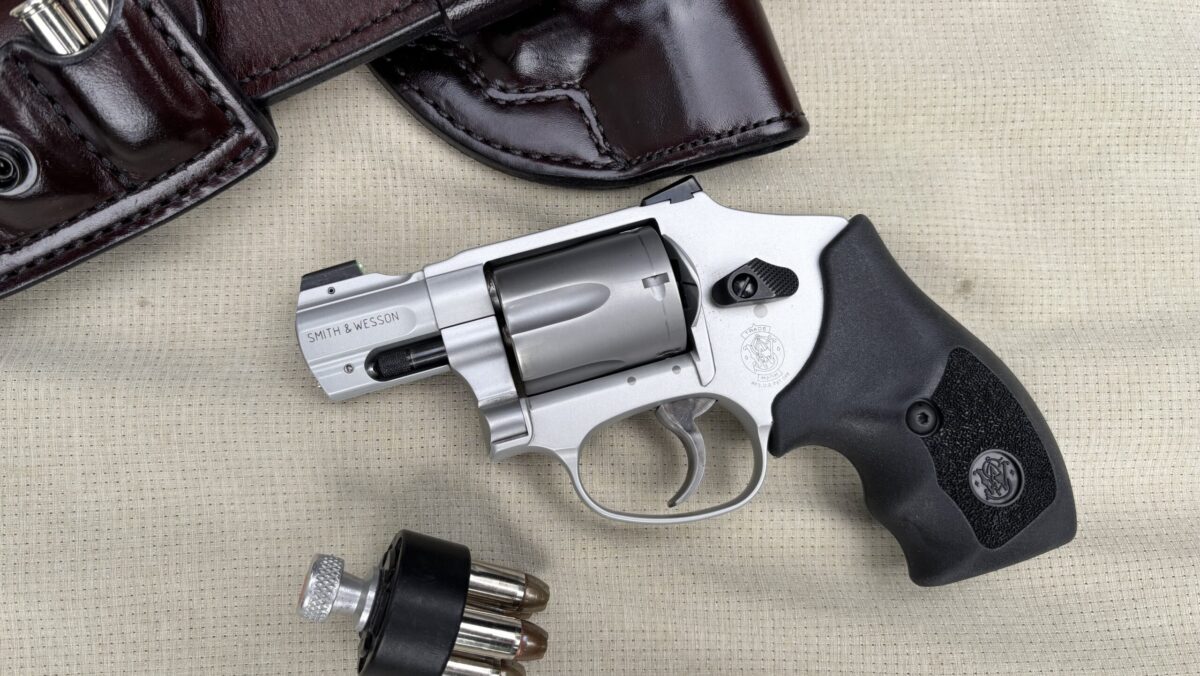
Smith & Wesson surprised many shooters with a new, Enhanced Boot Grip design for J-frame Centennial revolvers at the 2026 SHOT Show, which represents an upgrade over the standard Synthetic Boot Grip that has been shipping on its small frame revolvers for decades.
I’ve been working with the new grip, and thought the RevolverGuy audience would appreciate a report on it.
GENESIS
The Enhanced Boot Grip actually got its start in early 2024, shortly after that year’s SHOT Show.
Many RevolverGuys will recall the Lipsey’s Exclusive S&W Ultimate Carry revolvers were launched at the 2024 show, and sucked up most of the oxygen in the convention center. Shooters were excited about the long-needed improvements to the classic Airweights, including the no-lock frames, the improved sights, the durability package, and the improved action.
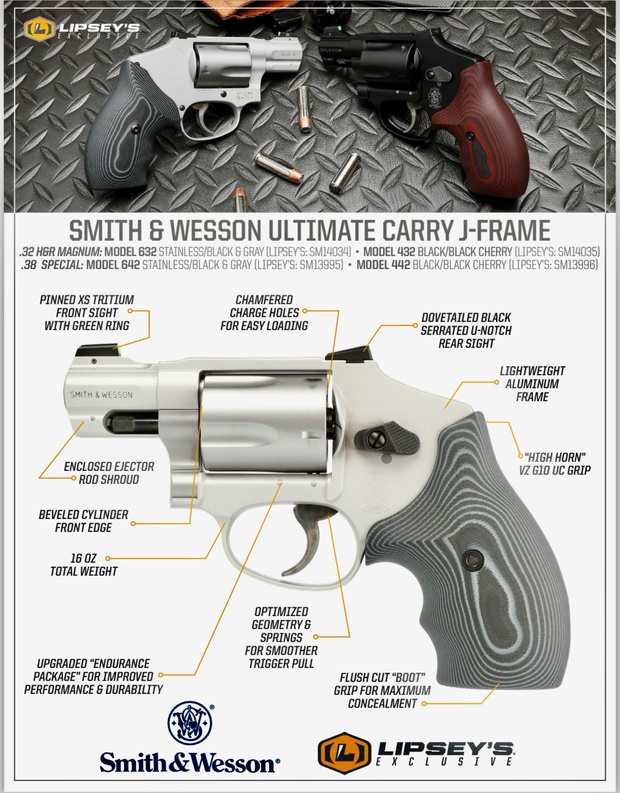
An additional feature that made the Ultimate Carry revolvers quite attractive was the G10 “High Horn” boot grip, manufactured by VZ Grips. This custom grip was designed in collaboration with the Lipsey’s-S&W team, as we detailed in our story on the development of these guns, and was immediately popular with the buying public. In fact, the new VZ grip was one of the most popular features on the guns, and there was an instant demand for them to be sold as accessories, so older guns could be fitted with them.
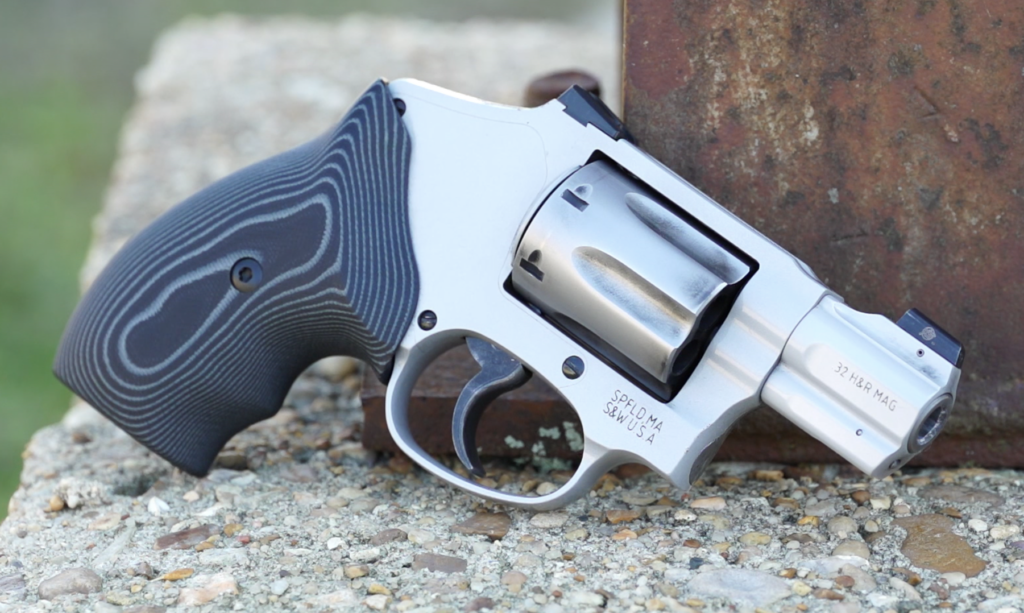
The new VZ grip spurred a lot of conversation with the Lipsey’s-S&W team during the show, and encouraged even more discussions about potential improvements to the grips featured on other S&W products. The excitement surrounding the new grips was a good indicator that the market was ready for something different, and would pay for it.
POST-SHOT
The buzz lasted long after SHOT Show, too. As the guns got out into the market, the feedback on the VZ High Horns was very positive, and demand for them grew. Lipsey’s and VZ Grips were fielding hundreds—no, thousands–of requests for the grips to be sold as accessories.
All of VZ’s production was dedicated to S&W, however, so they could build the new guns. There was no surplus available for the accessory market. As a result, a hot secondary market sprang up, where some early buyers of the Ultimate Carry revolvers made a little extra cash by selling the grips that had been shipped with their guns. They often made a substantial profit, which helped to offset the cost of the new gun!
This heightened interest in the grips didn’t escape the notice of Smith & Wesson, whose new Handgun Product Manager, Andrew Gore, had previously decided that the company needed to improve their revolver grip offerings. Since I’d been an enthusiastic supporter of the idea during our conversations at the show, we naturally continued to talk grips after we got home from Vegas.
Andrew already had a good idea of where to start, but was kind enough to allow me the opportunity to share my thoughts on grip design with the S&W Engineering team that was assigned the job of creating a new J-frame grip. I was grateful for the opportunity to speak with them, especially when I considered the talent and experience of the other industry experts who were also invited to weigh-in on the project.
THE REVEAL
Armed with a variety of inputs, Andrew and his Engineering team got to work on the new J-frame grip. I know they went through multiple revisions of the design, and worked with a variety of materials, as they refined the new grip.1 Prototypes were made both with and without finger grooves, to see which would work best (the finger grooves were almost universally favored by a test group).
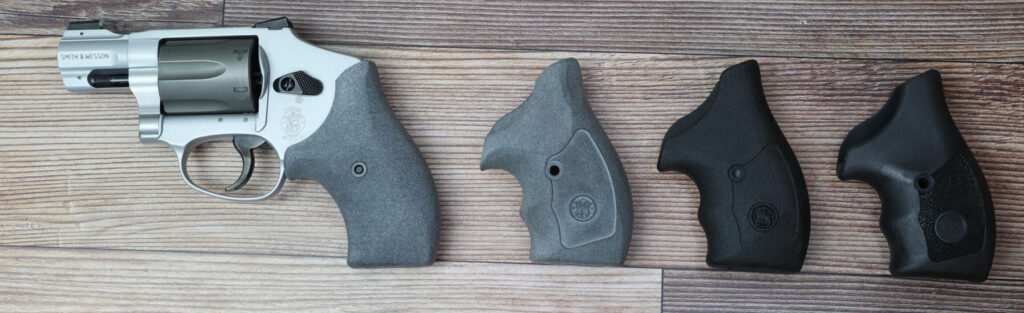
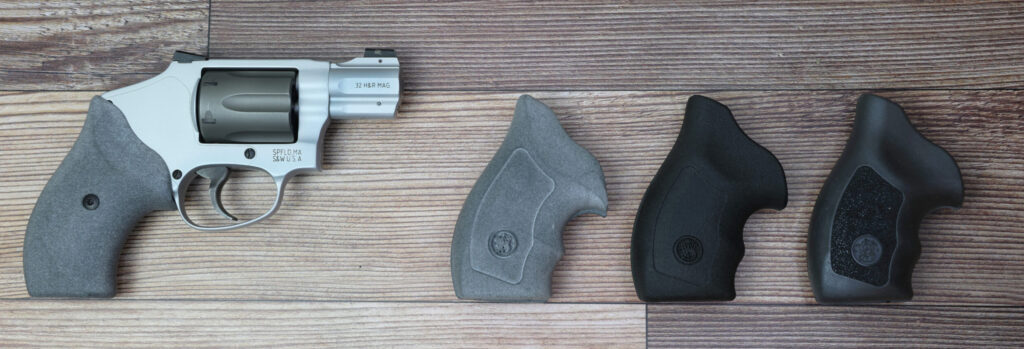
All of that happened out of my sight, though. I never saw any of the prototypes, or had any communications with the team after that initial consultation. I knew they were working on the new grip, but didn’t know what it would look like, or when it would come to market.

As a result, I was as surprised as anyone when the new grip made its official debut shortly before the 2026 SHOT Show, as the grip on the newest of the Lipsey’s Exclusive Ultimate Carry revolvers. The Model 432 / 632 / 442 / 642 Ultimate Carry Revolver with S&W Boot Grips2 may have been overshadowed by the concurrent introduction of the Lipsey’s Exclusive S&W Nightguard series (which, similar to the UCs, two years before, were the talk of the show), but I was no less interested to see what S&W had done with the UC’s new shoes.
GETTING THE BOOT
The Enhanced Boot Grip (EBG) didn’t disappoint, but there were still some surprises in store for me.
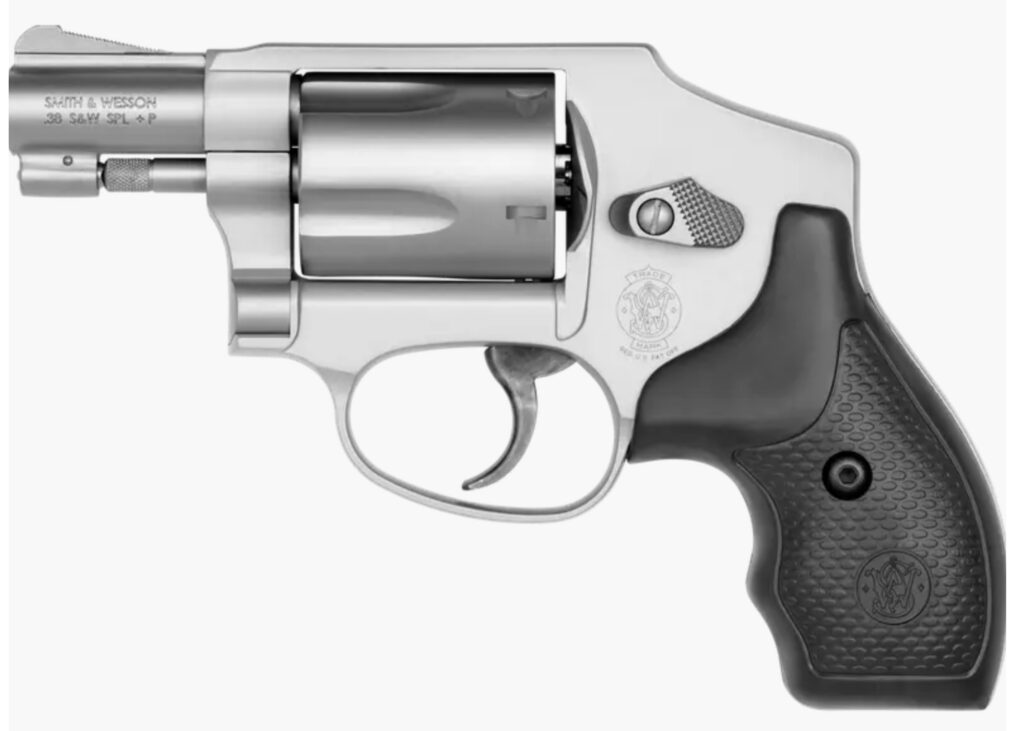
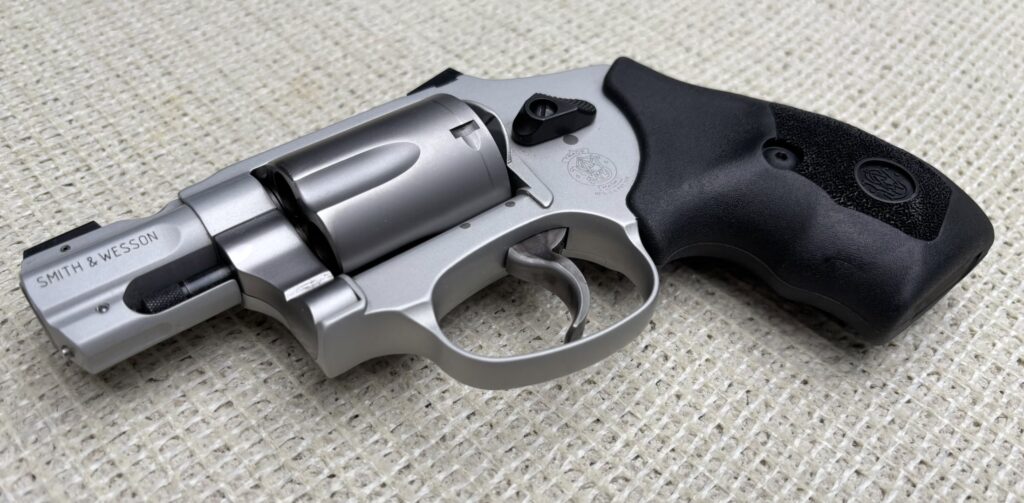
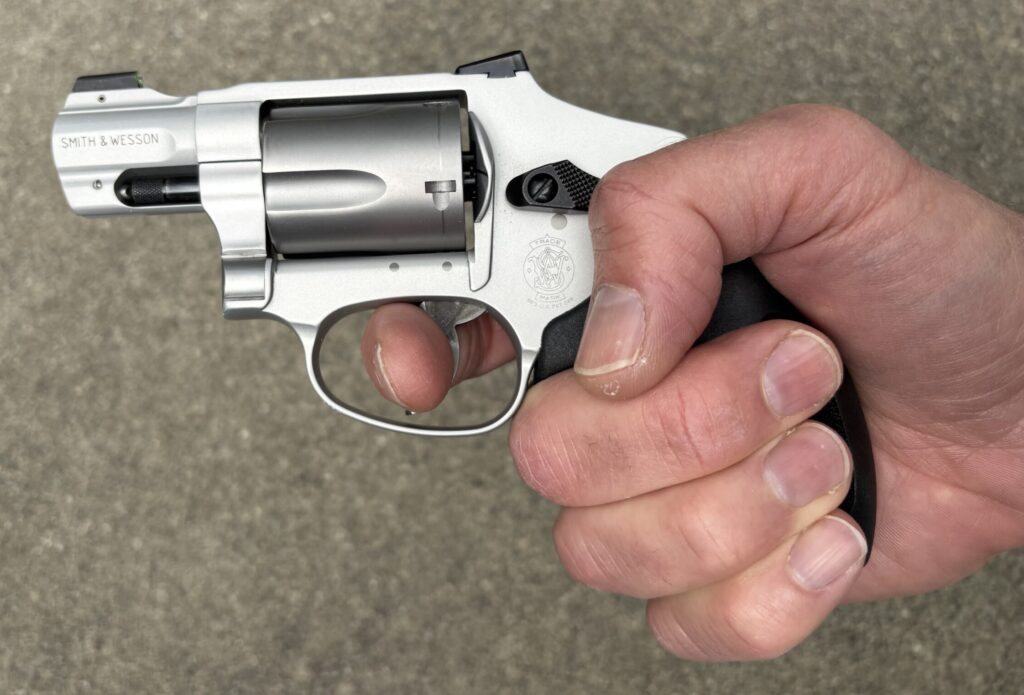
In general terms, the EBG is a closed-back, boot-style grip, whose backstrap reaches up to meet the recoil shoulder on the Centennial frame. It has a pair of finger grooves on the frontstrap for the middle and ring fingers, and a smooth finish overall, with just a small, textured panel on either side.
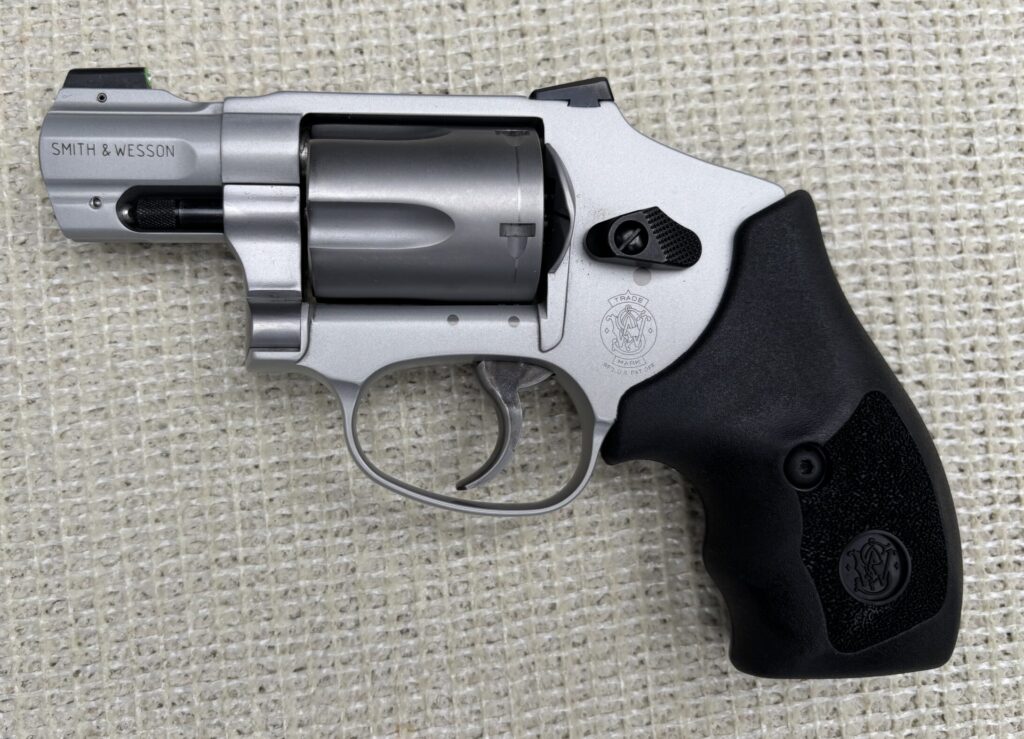
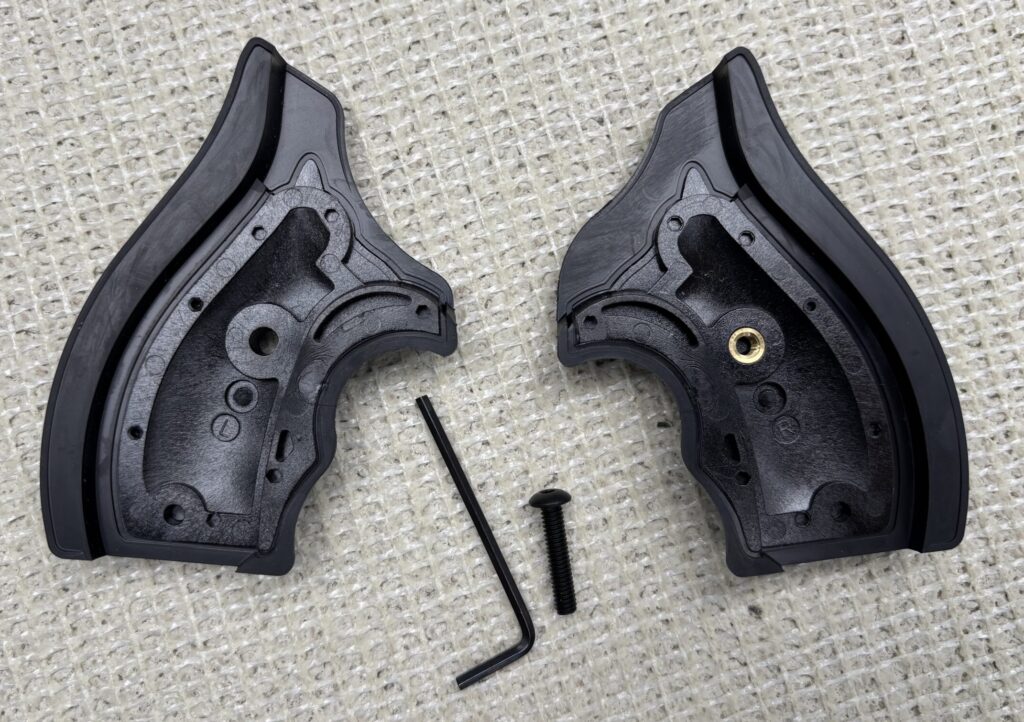
The grip is made of rubber, and is secured with a hex-head screw, whose tip is blind on the right-side panel. A speedloader relief cut is included on the left panel.
I immediately liked the overall design and feel of the EBG at first blush, but must admit I was surprised by the choice of material. The rubber used in the EBG is harder than I thought it would be, and I wondered if this would have a negative effect on the grip’s shooting qualities. I appreciated the apparent durability of the material (which seemed much more robust than the previous OEM grip), and its lack of “tackiness” (which would enhance concealment), but worried it might not provide enough cushion for the Airweight’s recoil.
JUST A TASTE
I was eager to shoot the grip and see for myself, about that. Fortunately, I didn’t have to wait long, as I got a chance to shoot the new Lipsey’s Exclusive 442UC and 432UC with the Enhanced Boot Grip at the invitation-only, S&W Media Night on the first evening of the show (thanks for the invite, Alexa!).
I started with the 442UC, and happily, I experienced less felt recoil than I expected with the new grip. Although my time with the gun was limited, I was able to shoot several cylinder’s worth of .38 Special 130 FMJ with the new grips installed, and it seemed like they did an excellent job of taming the aluminum gun’s recoil. They were even more comfortable on the soft-shooting .32 H&R that I fired next.
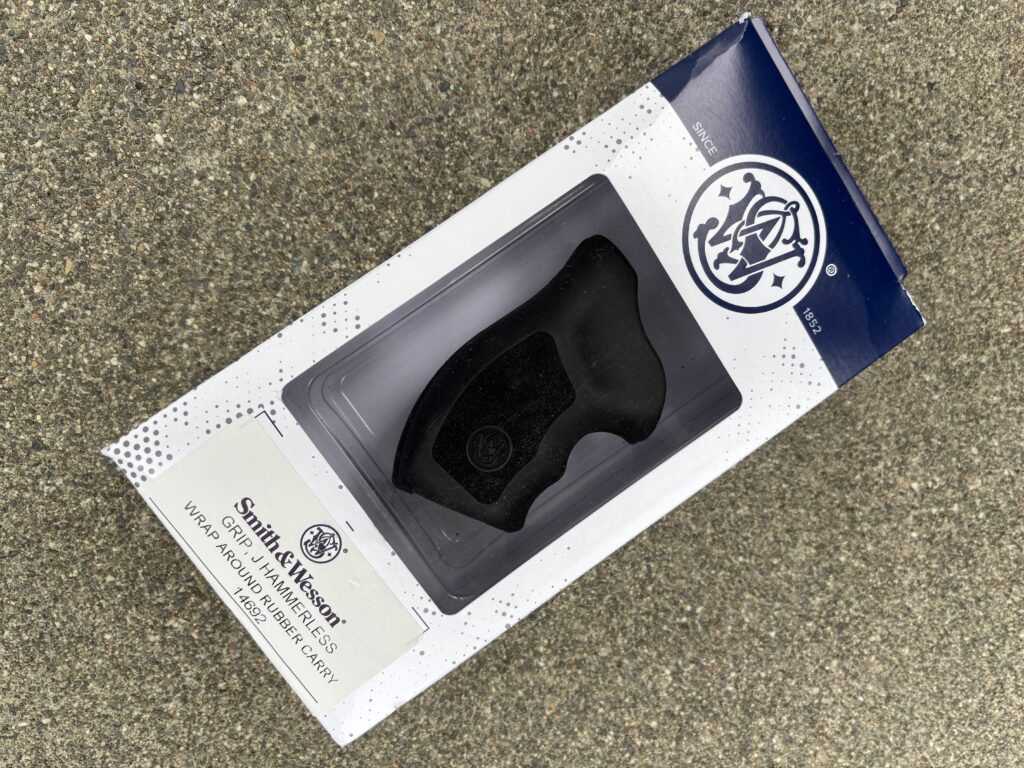
I was eager to get a set of these so I could work more with them at home. Fortunately, S&W’s production schedule would allow them to start offering these as accessories from the start, and I wouldn’t have to buy a new gun just to get my hands on the grips. It took VZ Grips about a year before they were able to offer their UC High Horn grips for individual sale, but the S&W Enhanced Boot Grip would be available right out of the chute.
HANDS ON
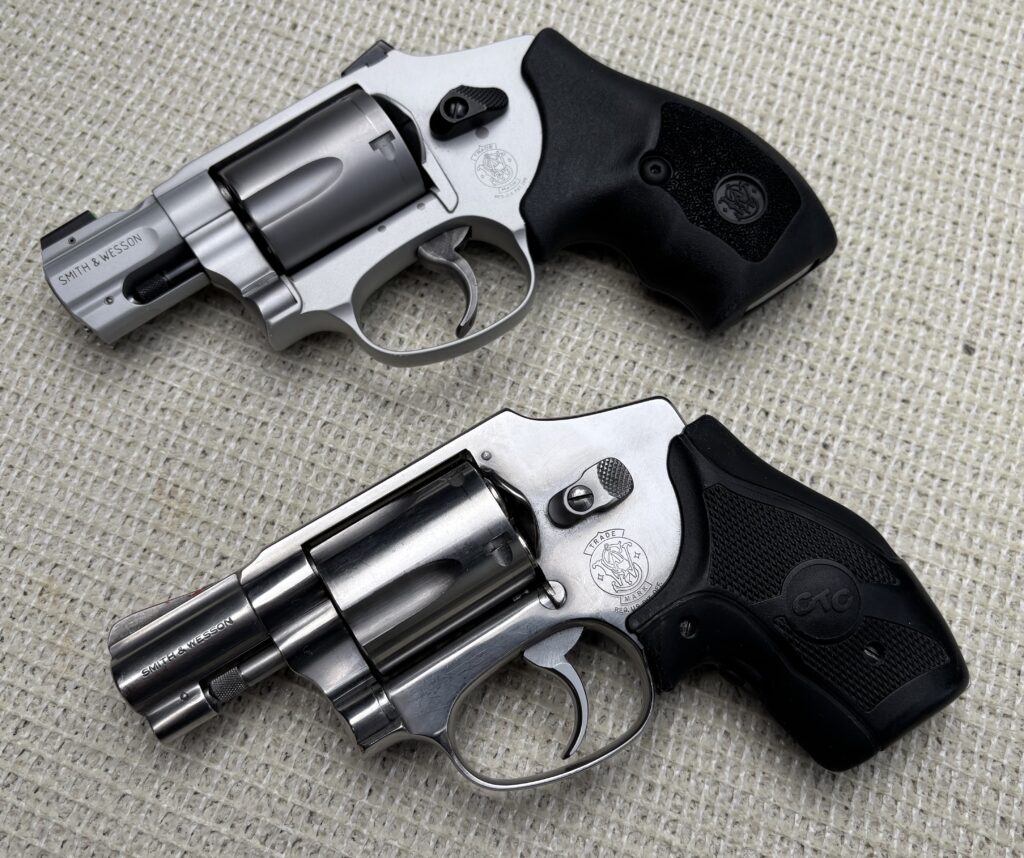
When I got my sample of the EBG, I immediately put it on an old Model 642 to serve as my “control” for a test of the new RevolGrips J-frame Classic Contour (C2) Boot Grip. Even though both of these grips were new designs, the EBG has more traditional styling and I figured it would offer a good comparison to the more radical RevolGrips design. I could have used the Crimson Trace LG-405 boot grip that I have long preferred on my J-frames, but I was eager to get some rounds downrange through the EBG.
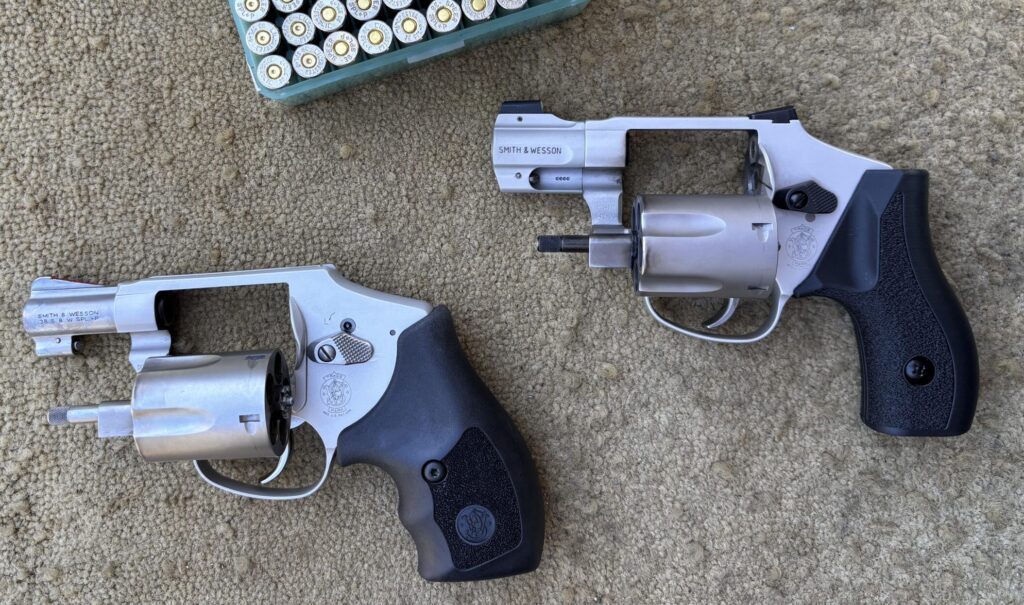
In my first session with the EBG, I shot about 50 rounds of standard pressure, 147 grain TMJ .38 Special with the grips. On a second session, I fired 50 rounds of 148 grain WC and another 25 rounds of 130 grain FMJ with the grips installed on my old Airweight. Very quickly, I determined the Enhanced Boot Grip had exceeded my expectations in almost all areas.
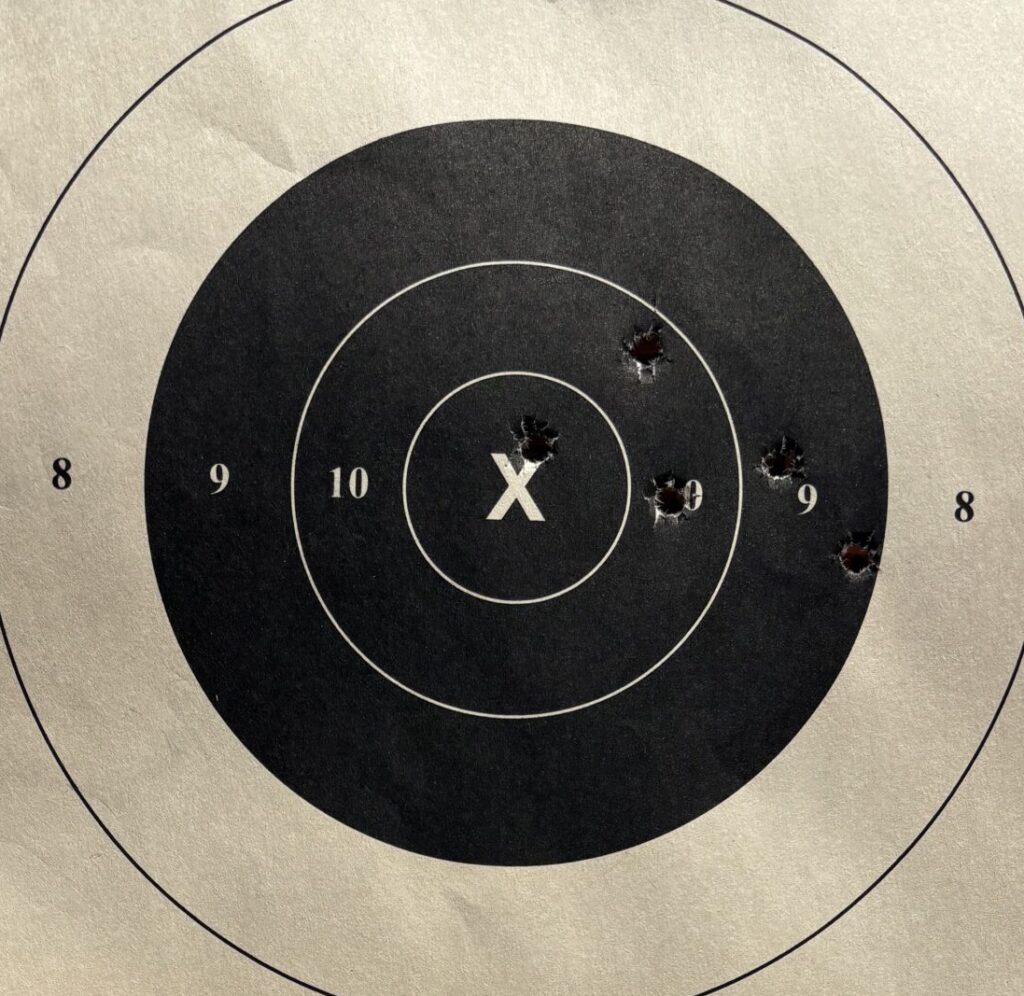
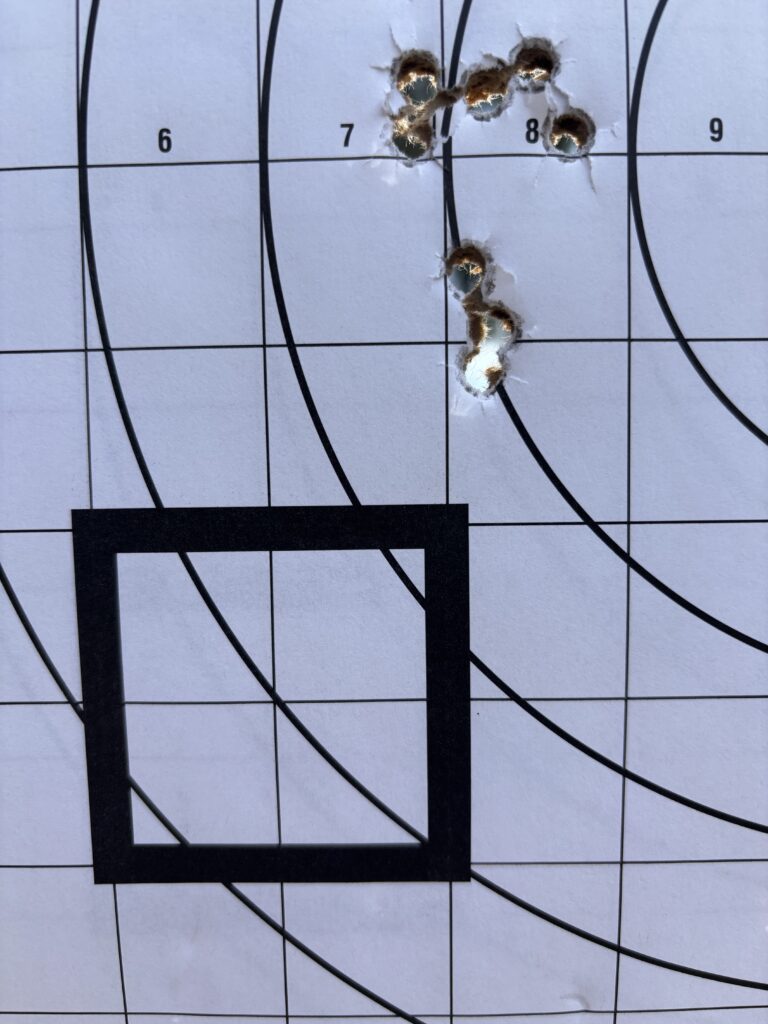
That opinion has remained unchanged, as I’ve continued to shoot the grips with a variety of ammo through both aluminum and steel frame J’s.
LIKES
What makes the EBG so good? Let me break it down into a handful of areas.
Wide, covered backstrap—The EBG covers the backstrap of the small J-frame, which has several benefits for a shooter like myself. First, it provides some cushion for the felt recoil of these powerful, but lightweight guns. More importantly, it increases the trigger reach, which makes the small-frame gun fit average-to-large hands much better.
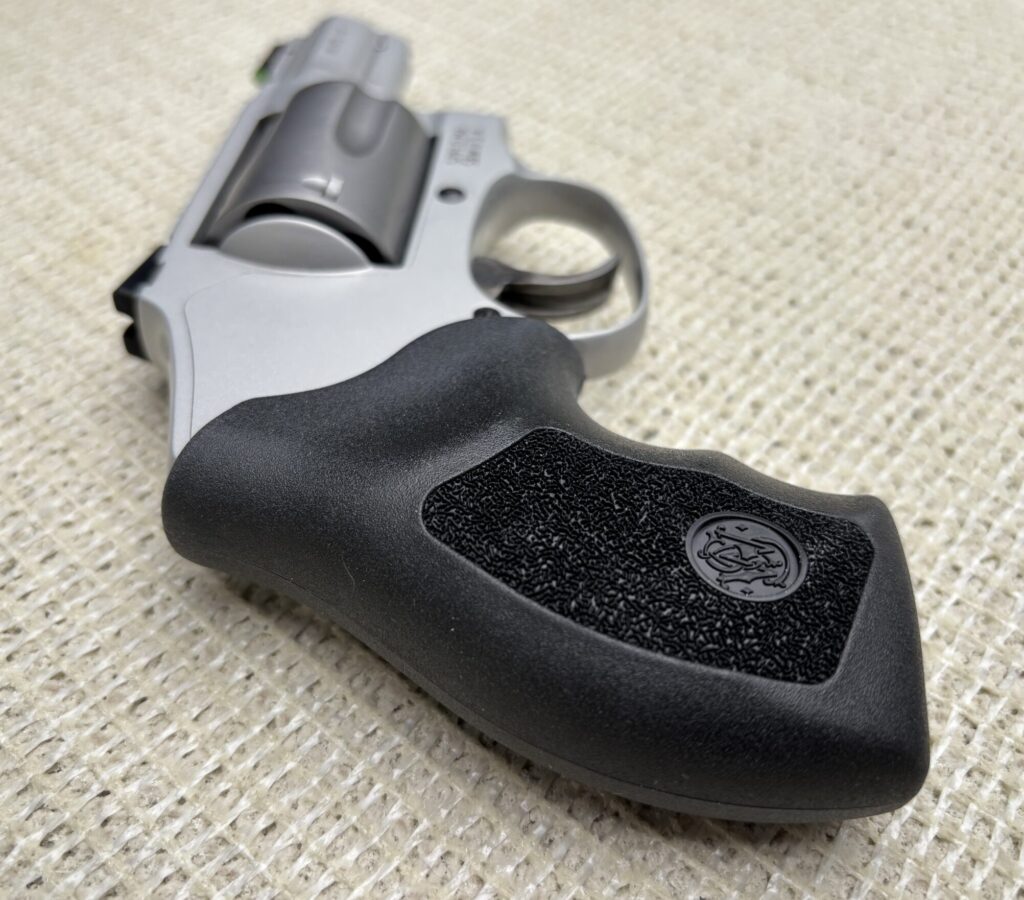
With open backstrap grips, I’m always getting cramped on the gun, because there’s just not enough gun to fill the hand. My trigger finger is “too long” and lands awkwardly on the trigger face. The added reach from a covered backstrap allows my finger to contact the trigger in a better location, and improves my ability to press it straight to the rear.
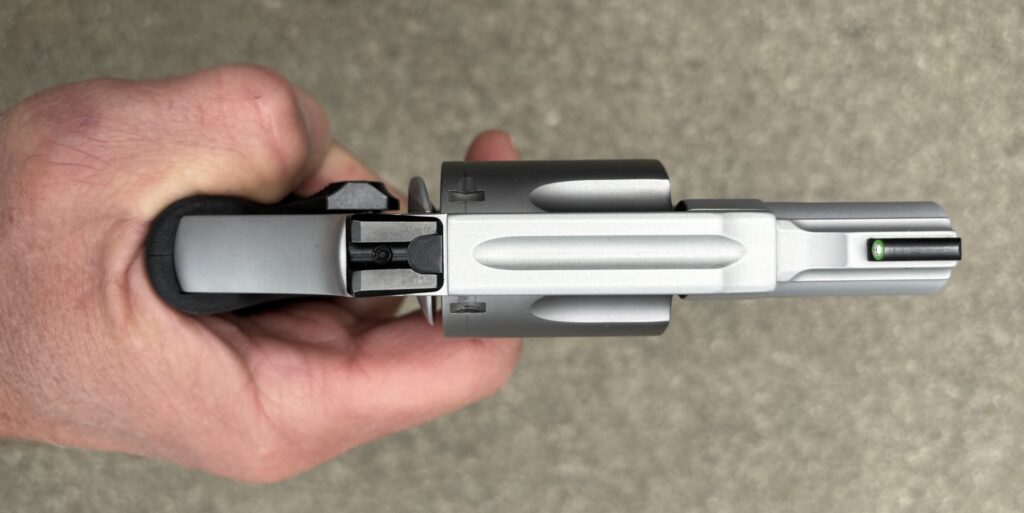
Since the EBG’s backstrap is sufficiently wide, it helps to distribute the recoil forces across a larger portion of your hand. The recoil doesn’t go away, but it does feel like it’s reduced when it gets spread across a larger area. Your palm won’t get stung as much as it would from a narrow grip profile that concentrates the force in a smaller area.
High shoulder—The EBG, like the VZ grip, reaches right up to the recoil shoulder along the backstrap of a Centennial-framed gun. This “High Horn” design (actually, more of a “High Shoulder” than a “High Horn”—the difference is apparent when you look at a pair of High Horn Spegels) widens the area where the web of the hand contacts the gun’s frame, which helps to distribute the recoil better, as previously explained.
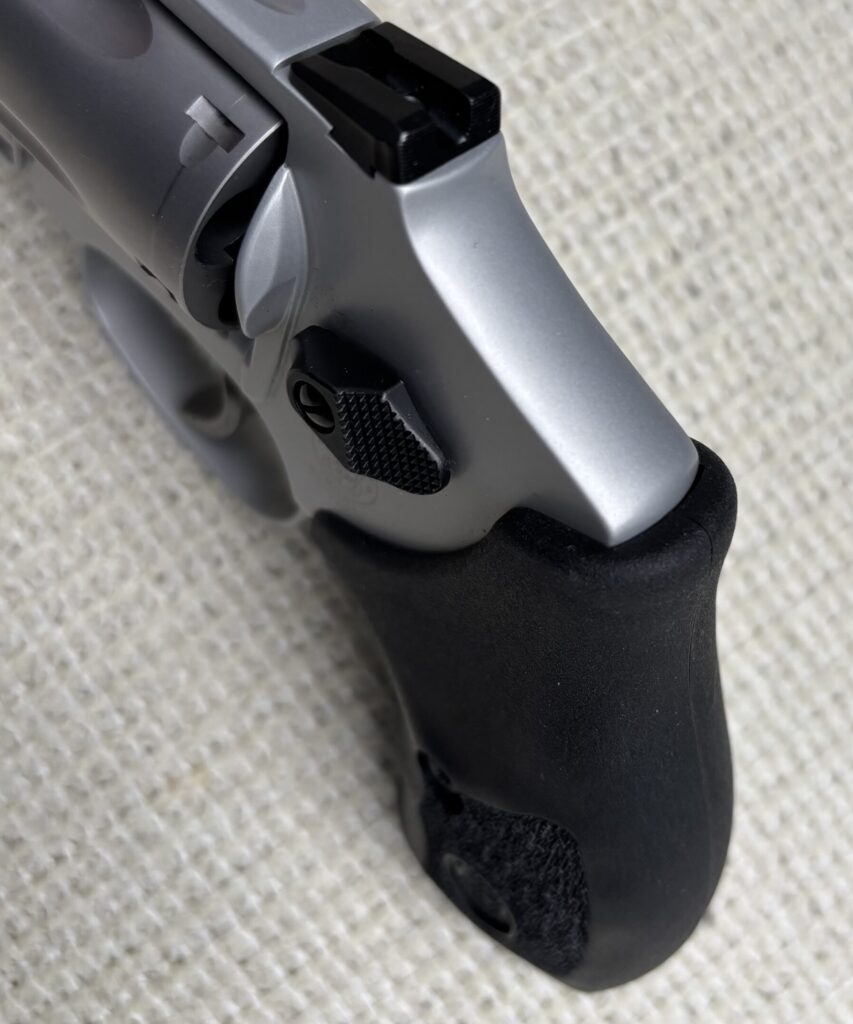
This high shoulder also assists the shooter in taking a higher grip on the gun’s frame, to lower the bore axis and control muzzle rise. This is something I frequently do with my Centennial-frame revolvers, and the high shoulder design of the EBG enhances my ability to do it. Please note while this feature is a bonus for the Centennial (“hammerless”) frames, it also prohibits these grips from fitting J-frames with external hammers, like the classic Chiefs Special or Bodyguard designs.
Sufficient palm swells—The EBG has rather thick palm swells on either side of the grip, which do a nice job of maximizing contact between the grips and the hand that holds them. They fill the hand much better than skinny panels, and enhance the overall feel and control. A small J-frame feels like a bigger gun, thanks to the ample palm swells of the EBG.
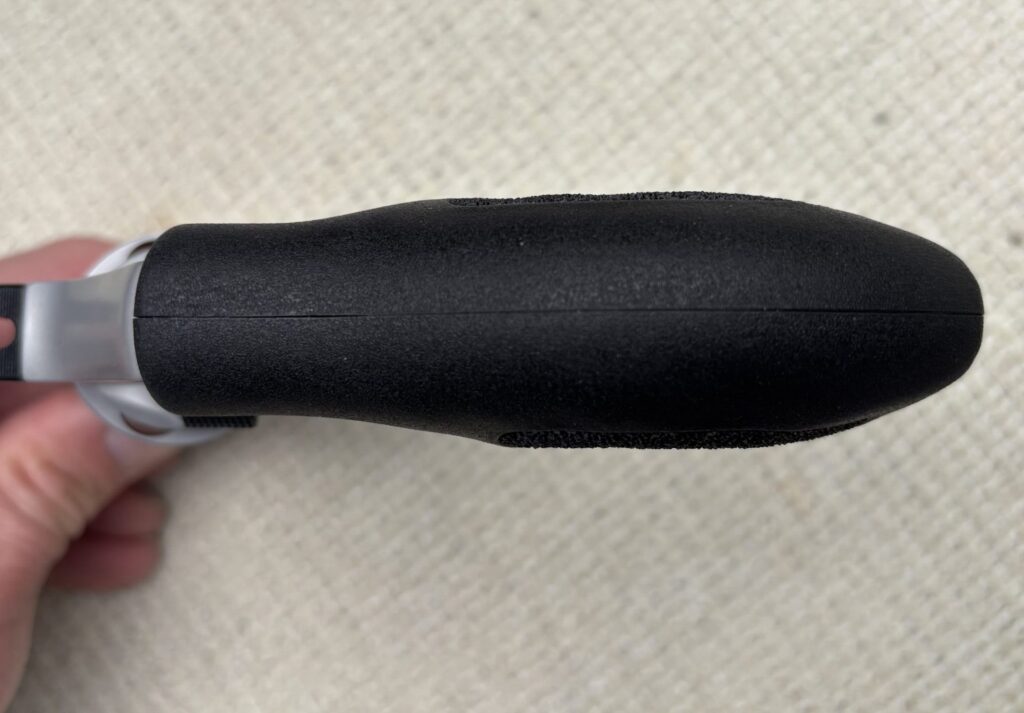
The palm swells also help to create a nice “shelf” for a thumb rest on either side of the gun, which is useful for getting a strong grip on the small gun. You can really lock down on the grip by bearing down on the thumb rest with your hitchhiking tool. Sometimes a grip maker will ignore the right-side panel and fail to include a thumb rest on that side, but I really like having one there for weak hand-only shooting.
Good material—The rubber used to cover the EBG’s skeleton is soft enough to provide some cushion against the recoil, but no so soft that it will lack durability. I thought it might be a little too hard to provide much relief (as a comparison, it’s harder than a Pachmayr, and much harder than a Hogue), but the combination of the material and the wide, properly-shaped grip do a strong job of mitigating felt recoil.
Good texture—The texture on the EBG was well-planned. The majority of the grip is “smooth,” and the only traces of checkering (it’s actually more like stippling) are found on the small panels that adorn either side of the grip. Those panels offer enough surface roughness for fingertips and palms to get some additional traction, but they’re not very aggressive at all, and won’t irritate skin when they rub against it.
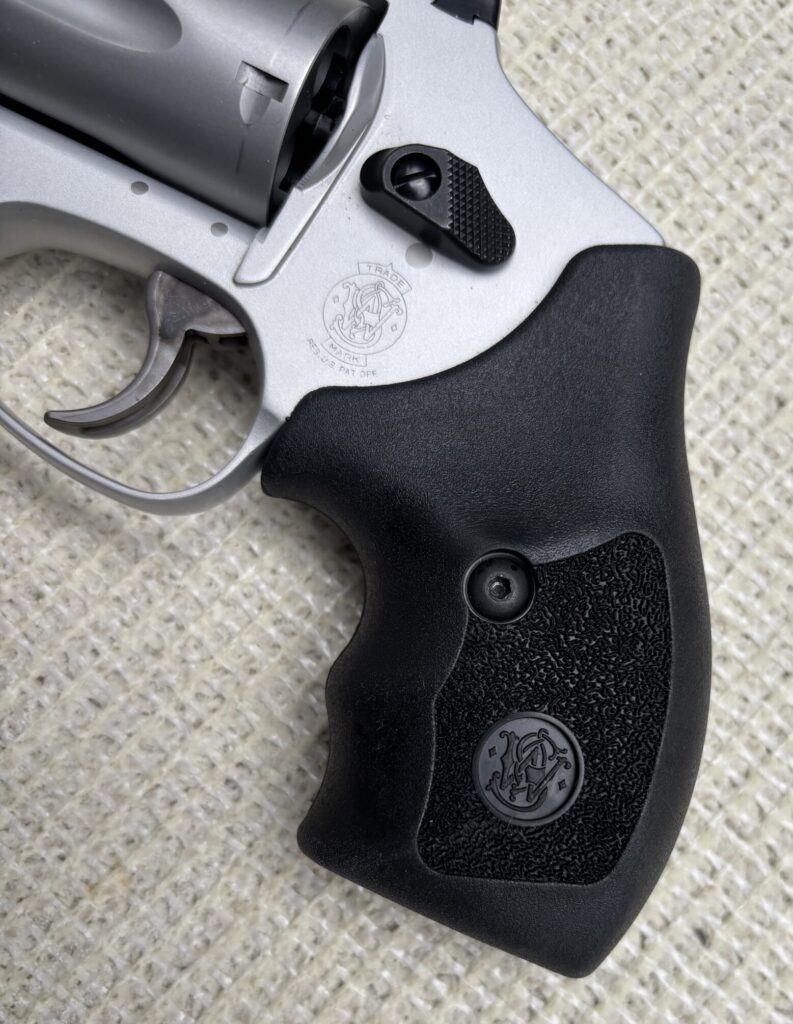
The “smooth” areas have a subtle texture of their own, but they’re functionally smooth, and won’t grab clothing or prevent your hand from making necessary adjustments to your grip. Basically, you get enough traction on these grips to be useful in controlling recoil, but not so much that it negatively affects comfort or concealment.
Proper taper—One small, but important, detail on the EBG is the gently-rounded taper at the foot of the grip. This taper makes it possible for your pinky finger to get some purchase underneath the stubby grip, without encountering any sharp and painful edges that will abuse it during recoil. There are some boot grip designs out there that look like someone took a hacksaw and cut off the bottom of a full-size grip, leaving the sharp corner in place, and I think they’re pretty miserable examples of the breed. I was very glad to see S&W paid proper attention to this critical area on the EBG.
GRIPES ABOUT GRIPS
The combination of all these attributes adds up to one heck of a good shooting grip, in my opinion, but there are still some things I’d like to change about it.
The first is a minor gripe, and while some of you may disagree, I stand by it. The EBG uses a hex-head screw that requires a 3/32 Allen wrench to remove it, and I think that’s too bad, as I’d prefer a traditional slotted screw or a Phillips screw, instead. I understand the hex is designed to improve cosmetics and eliminate damaged screw slots and all that, but it’s a real pain in the neck to go searching for the proper Allen wrench every time you want to take the grips off.
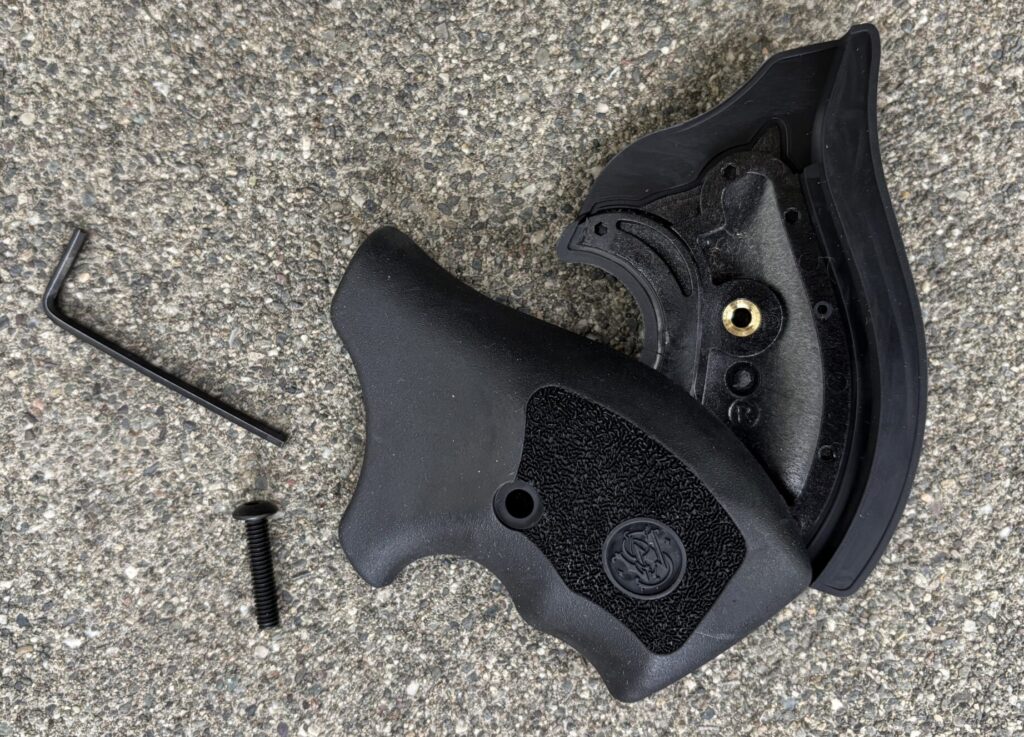
The Gunsmith Gods may eventually strike me down for my sins, but there have been plenty of times when I’ve used an improperly-fitting screwdriver to tighten a grip screw when I was out on the range. While my multi-tool wasn’t the exact size I needed, it worked well enough to let me snug things up, and prevent the screw from falling out and becoming lost. I like that flexibility, to fix things with commonly-available tools, and wish S&W hadn’t used a specialty screw on these grips. On the bright side, the screw is easily replaced with another design that’s more screwdriver-friendly . . . and at least it’s not a Torx!
The other complaint about the EBG is more substantial. The speedloader clearance on the EBG is pretty good, but it’s still not 100% perfect. The ubiquitous HKS-36 speedloader will sometimes hang up a little when I try to remove it after discharging the payload—not as bad as on some other grips, but still frequently enough to earn a complaint. The loader goes into place smoothly, but when it’s withdrawn, it can catch the leading edge of the grip just a bit, and snag. It happens less frequently with the Safariland Comp I or the Revision CV speedloader (a low profile, push-style loader, shaped similarly to the aluminum 5-Star), but I still get an occasional hangup from them, too.
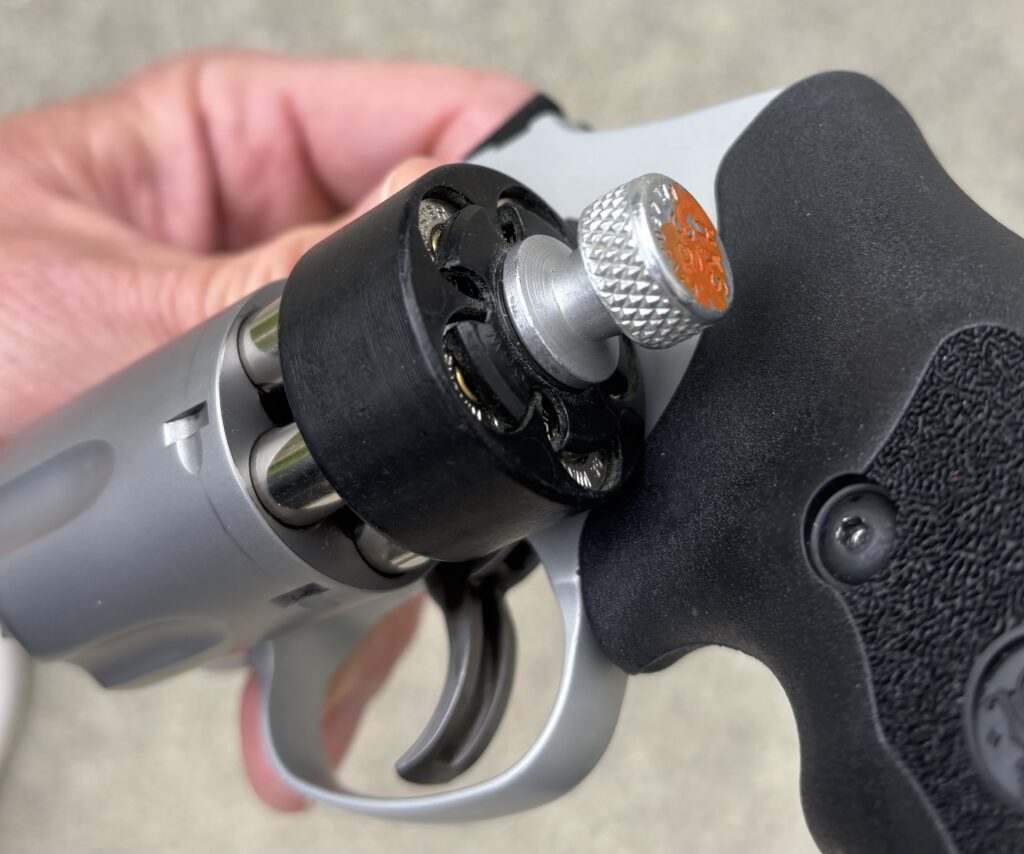
The issue here, is one of space. There’s enough clearance to allow the speedloader to mate with the cylinder without difficulty, but once it’s in place, there’s very little room between the aft edge of the speedloader body and the forward edge of the grip. If you get a clean discharge of the cartridges, and they all fall into the chambers neatly, you’re in good shape–the speedloader will just fall away, without interference.
However, if your chambers are a little dirty from firing, or if the gun isn’t held perfectly straight up and down (where the full effect of gravity can help), or if Murphy just decides to show up, you might get one or two cartridges that don’t go all the way into the chamber. With a cartridge stuck halfway in the cylinder, and halfway in the loader, it can take a little wiggling to get the trapped loader free, and the EBGs just don’t give you much space to do that. It’s tight back there, and I wish we had a little more clearance to work with.
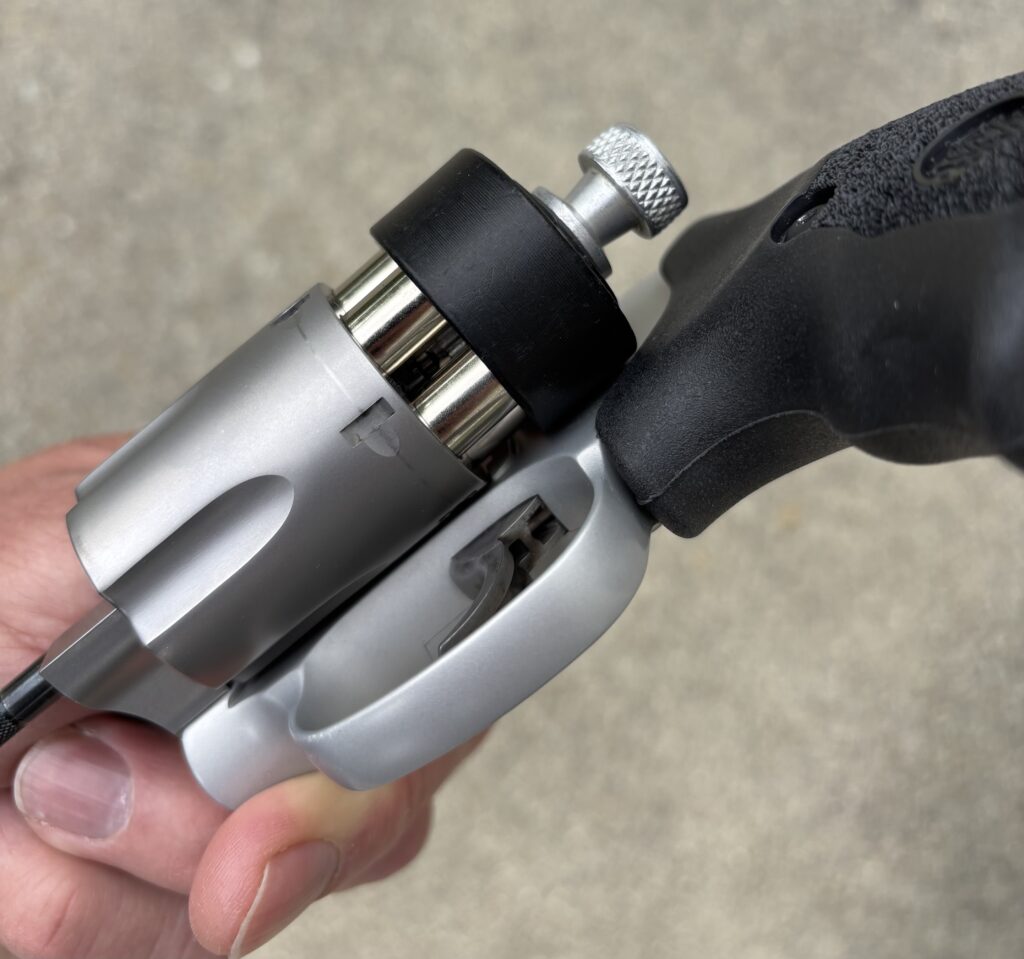
The problem I described can often be avoided with a little technique. One advantage that twist loaders like the HKS have over the push-release designs, is that you can release the payload early. If you just start the noses of the cartridges into the chambers, then twist the release knob, you can load the gun without fully seating the loader against the cylinder face. If you do this with the EBGs, you won’t have any problems with snags at all, because the rear of the loader body won’t protrude forward of the edge of the grip. Easy peezy.
However, this may be easier said than done when you’re working fast. In the rush to reload the gun, it can be difficult to be that precise, and we frequently wind up with the loader fully seated before the knob is turned (as it’s actually designed to be used). With the loader fully seated, you’re more prone to encounter the snag when you remove it after discharging the payload, especially if you have to pull it off the gun after one or two rounds stick. Once again, if the rounds all drop in perfectly, you can just let the loader drop free, but that’s not how it happens all the time, in my experience.
Another helpful technique is to focus on lifting the loader away from the gun’s port side, rather than pulling it straight back off the cylinder (in line with the chambers). This works better to avoid the snag, but sometimes the stuck cartridge(s) won’t allow you to pull the loader off this way, and you have to pull the loader off straight to the rear. When you do, you’ll be more likely to snag it on the leading edge of the grip.
Good, just not perfect
I don’t want to exaggerate the magnitude of this problem, though. The EBGs are actually better than most of the grips out there, and if I was grading them, I’d give them a B+. Most of the time, even with the HKS, things will work out OK.
Many RevolverGuys will probably be happy with the grips as-is (especially if they’re going to feed their gun using strip-style loaders), but the grips aren’t perfect for the HKS and similarly-sized loaders . . . and I’m that picky soul who thinks they should have been. It was a design requirement for the grips to work flawlessly with the HKS, so I’m a little disappointed they don’t, because they were really close to pulling it off. It’s possible my samples were just made a little on the proud side of the manufacturing tolerance, but I’ve tried several pairs and they’re all the same, so I think the specs are just a little on the tight side, and wish they’d left us a little more room back there.
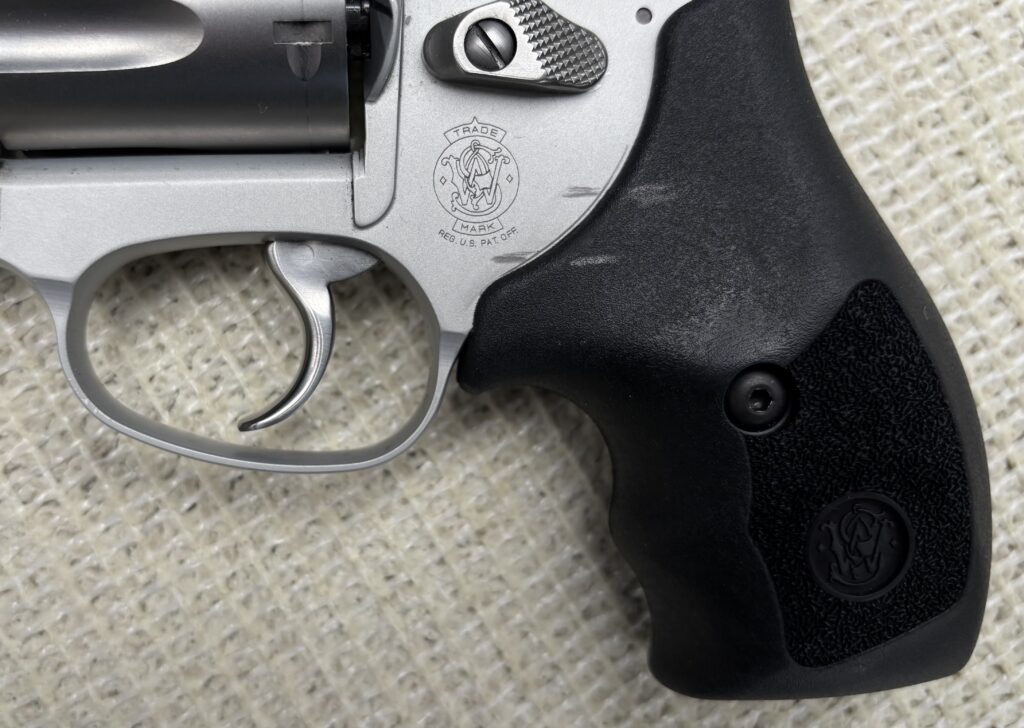
That’s not a showstopper. Since they’re made of rubber, I can fix the grips with a razor and sandpaper. There’s a hard plastic skeleton on the inside that terminates close to the edge of the exterior rubber cover, but I think there’s enough room to trim the rubber back without getting into the skeleton, and make it work. It wouldn’t require much to be removed, to get the necessary clearance to make them totally interference-free.
I’ll fix it later, but I’m disappointed that it’s necessary, because this was a point that I emphasized when I was contributing my ideas to the project.
ON BALANCE
Despite that, I think the new grip is a definite improvement on the earlier S&W boot grip design that we’ve been living with ever since the Uncle Mike’s Spegel copy went away, and even if it’s not 100% perfect, it’s a 95% solution, and that’s pretty darned good.
The Enhanced Boot Grip has a lot going for it. It feels great in the hand, improves the trigger reach on the small J-frame, helps tame the recoil, isn’t tacky, and is very affordable, at an MSRP of only $35.
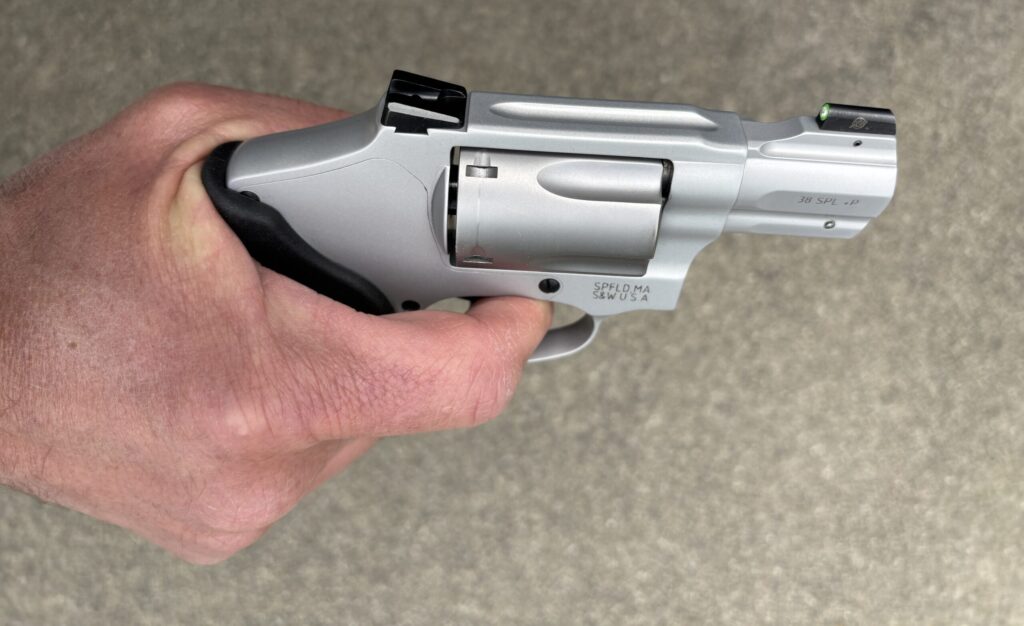
While I liked the custom VZ Grips High Horns that shipped on my 642UC, I’ve got to admit I like this new grip even better. The texture offers more traction, the rubber is softer on my bones, and I like the shape better, especially up near the recoil shoulder. While the difference doesn’t bother me at all, the G10 grips are also a little heavier than the new rubber grip, which will make the EBG more attractive to folks who are closely watching the weight.
I think Smith & Wesson has a real winner with this grip, and I won’t be surprised to see it replacing a lot of “old standby” grips on J-frames. In many ways, I liked it better than my long-favored Crimson Trace LG-405s, which is a true credit to the EBG. The Crimson Trace grips still hold the crown, in my book, but not by much. I have to admit that if I was starting over again, the EBG would definitely get the nod over that much more expensive option–$35 for the EBG versus $330 for the Crimson Trace? That’s a no-brainer, to me.
I’ll be buying more of these grips, and will use them as my default for J-frames, going forward. If you like a boot-style grip on your hammerless J-frame, you should give these a try. If you do, make sure to let us know what you think of them in the Comments.
*****
ENDNOTES
1.) Andrew started the ball rolling, but never got to finish the project during his tenure at S&W. He moved to Ruger in June 2025, where he took the position as Director of Product Management, and was no longer at S&W when the new grip design was finalized. We’ve all benefited from the seeds he planted while he was there, however, with the Enhanced Boot Grip being just one example. I’m grateful he initiated this program.
2.) It seems the various marketing teams haven’t really come to an agreement on what to call the grips, or the guns that wear them. The S&W Store calls the grip the “UC Enhanced Rubber Grip for Hammerless J-frame Revolvers,” but the product label on the box calls it the “Grip, J Hammerless Wrap Around Rubber Carry.”
Smith & Wesson also describes it as the “S&W Enhanced Boot Grip” in the product specifications for the gun, which they have designated the “Model XXX Ultimate Carry Revolver S&W Boot Grips.”
Lipsey’s, in contrast, calls the guns “Ultimate Carry/Rubber UC Grips” and describes the grips as “Black Rubber UC High Horns” in their product description.
For simplicity and consistency, RevolverGuy will just call them the Enhanced Boot Grip (EBG).
*****
Featured Image: That’s a Mitch Rosen Extraordinary Gunleather CCQ holster, Express Line BHL belt, and 2 Squared Plus 2 cartridge pouch, in Cuban Brown color. Standby for more on this rig in a future article.

These look good. I’ve railed here many times about the “boot grips that gunwriters drool over” having open backstraps that pound the palm of your hand every time you fire. These look like the bee’s knees wearing the cat’s pajamas for pocket carried J-frames, especially for those of us with tender paws. I’m kind of in the market to replace the 25-year-old Pachmayr Compacs on my EDC 642, and I was reluctant to get another pair of Compacs, since their quality has deteriorated quite a bit. These look like a good replacement.
On a different note, I commented on another gun blog (boo, hiss!) about the lack of a round-butted Python in the shorter barrel lengths, to reduce printing, and said, “Do I have to do all the thinking for the gun companies now?” Now I see that Davidson’s is modifying 2.5-inch Pythons (and Anacondas!) to have round butts. (The grips suck, but it’s a start.) Now that there are also high-quality boot grips with a covered backstrap, it looks like maybe I am in fact doing all the thinking for the gun manufacturers, and they’re getting my messages through telepathy!
I also like the “High Horn,” for the reasons you mentioned.
Thanks to Smith & Wesson for listening to its customers, and thank you for bringing it to our attention.
Haha! 1811, I think we’d be better off if the gun companies actually DID let you do all the thinking for them!
Now for Ruger to build us a good medium-frame double action . . .
Based on your article, I just ordered a pair. It’s my Father’s Day gift to myself.
I don’t remember ever ordering a product sight unseen based on an article, online or not, before, but I trust you.
If I don’t like them, you owe me thirty-five bucks (Sport that I am, I’ll eat the shipping and the tax.)
Trust, but verify, hmm?
You drive a hard bargain, but I’m betting ($35, it seems) that you’ll like them!
Well, I just got the grips delivered. I ordered them on Saturday, got an email saying they were shipped on Monday. They gave me a 23-digit tracking number but didn’t say who was shipping it. On the theory that only the government would use a tracking system that required a 23-digit number, I went on the Post Office’s website, and it said the item couldn’t be tracked. I’ve never been able to track anything on their website, so I didn’t get too excited, and yep, USPS delivered them on Saturday afternoon, almost exactly a week after I’d ordered them.
But enough of my tale of woe (or government hilarity, take your pick). Looks like your thirty-five bucks are safe; so far, I like them. Turns out I didn’t have an Allen key small enough to fit in the screw, so I had to tighten it with the tip of my knife. I haven’t fired my J-frame with them on yet, but dry firing feels pretty good. And they clear the HKS speedloaders that I’ve used on all my revolvers since, um, a long time ago. I’ll take it out to the range in a few days and try it out, after I buy an Allen key that I can use to make sure the grips are tightened up. But I don’t foresee any problems.
Thank you again for bringing these grips to the attention of us revolverguys.
Seems a good number of folks like Andrew Gore move from S&W to Ruger, but I don’t read about anyone going from Ruger to S&W. Curious! You noted that the barrel shroud on your UC model was overclocked. Obviously no one checked for sight alignment at the factory. For what those revolvers cost, they should come out of the factory perfect and ready to go.
Given that the .38 Special is a proportionally large cartridge relative to the overall size of the J-frame itself (compared to a K or L frame) I question whether it’s realistic to expect every variation of ‘speed loader’ to work 100% of the time on a revolver with such a comparatively small grip and frame area. I supposed it is something to strive for.
The new grips looked to be a great upgrade on my EDC J-Frames until I got to the fine print on the S&W site: “Will not fit revolvers with exposed hammer.” There went that bubble. However, for those with the concealed hammer models, the new S&W product is half the cost of the VZ grips so you can outfit two of your J-frames for the price of one. (yes, I’m a cheap *** ). One feature I do like about the Hogue version of the Spegel boot grip is that they are compact enough to give me a decent hold on the gun while enabling both my vest and pocket revolvers to slide discretely into and out of their respective hidey-holes despite having bobbed hammers.
Great review – mouchos nachos. I know you hated having to put those rounds downrange.
Dee Nader, amigo.
Yeah, the overclocked UC has to go back, and I’m not happy about it. It took me a few hundred rounds (and much frustration that I couldn’t “fix” my trigger pull) before I figured it out. I presumed that I was obviously the problem, but no . . . it was the gun. I’d assumed the new two-piece barrel system wouldn’t suffer this malady, but it appears the assemblers at S&W are a creative lot, and found a way.
I updated the text to make it more clear these are for Centennial-style frames. Since those are the only ones I’m interested in, I kinda neglected to address the incompatibility with the pocket-snaggers, Thanks for bringing it to my attention!
Thanks for highlighting these grips, Mike. I share your opinion that they deserve recognition. when S&W swapped the Uncle Mike’s Spegel spec boots for the rubber design years back, my heart was filled with rage. I had received a large shipment of 642’s at NMSP HQ in Santa Fe and promptly discovered they would not work with HKS #36 speedloaders, at all. This put a speed bump in our training as we issued each NMSP recruit (and field officers that wanted them) a 642, Galco Ankle Glove holster, Bianchi Speed Strip and HKS #36 speedloader. It baffled me at the time that S&W would make that change without confirming compatibility with the most commonly used loading device for the guns.
The team at Smith & Wesson righted that wrong with these new grips. As you point out, they are superior to the Spegel style boot grips for shooting comfort and trigger reach. I ordered a pair when you brought them to my attention and put them on an M&P 340. This gun with these grips works with all loaders I have: HKS, Safariland Comp I, SpeedBeez, and Jet Loaders. Thankfully, I have not experienced the issues that you have with the HKS loaders with them. Salute to Andrew Gore for the attention to detail he exhibited on the project. I’m glad he took input from guys like you!
Thanks Kevin! I’m glad you’ve had such great success with all the speedloaders you mentioned. Maybe mine just came out of the mold a little proud. Jason says that he’s had no issues with the HKS-36 on his.
I bet that was a huge disappointment when you got those NMSP guns! What a ridiculous thing, to build those new grips with no consideration for speedloaders.
I’m curious, are the 642 BUGs still in service, or did they get replaced alomg the way with a self-chucker?
I am pleased to report that NMSP still issues 642’s as back up guns. I had the opportunity to spend a day on the range with a recruit class recently as a retiree mentor. The gentleman that has my old job now was asked by one of the instructors when they were going to get rid of the revolvers and start issuing semiautomatics as backups. His reply of “Not while I’m in charge” gave me a warm fuzzy and hope for this generation. 🙂
That brings a huge smile to my face! Great news!
My snubby has (I think) the original black boot grips (with finger grooves, large checkered panels, and open back) which fit my hands quite well. However, those whose hands are much bigger certainly would benefit by the new enhanced boot grips.
The Uncle Mike’s Spegel copies were good grips. At the time, they were the best thing going, for concealable rubber grips. I took mine off and replaced them with Eagle Secret Service rosewoods, then the Crimson Trace LG-405s. I gave the Uncle Mike’s to my brother, who still rates them as his favorite J-grip.
Good article. I can’t see where you followed up on your comment that the UC’s rear sight was too tall for the XS Dot up front.
What was your solution, please?
That’s a topic I’ve reserved for a future article James. Stay tuned!
Great review Sir! I ordered a set of these grips when I first saw them advertized on the S&W website. I put them on my M&P 340 and I have been very pleased with them. I only have Comp I loaders which work perfectly so I had not tried any other loaders. I tried a variety of loads in the Scandium 357, including the short barrel 357mg Gold Dots. The new grips helped but 357 anything in that light of a gun is still unpleasant. I had to try it, but will stick to easier shooting loads for normal carry. Thank you again, and I’ll definately be ordering another set for my 642.
Thanks for the great report, Sir! Those featherweights can be a real handful with any kind of load–I’ve got a story coming soon about that.
Fantastic review as usual and I look forward to giving these a try. I also appreciate the discussion about speedloader clearance. I wish that speedloader use and compatibility was a bigger priority with revolver manufacturers today.
Now if we can just get Smith to enhance their QC and roll out a lightweight .38 six shooter…
Indeed, Sir. Wouldn’t that be a nice turn of events? Glad the review was helpful.
One of the reasons I stick to 5 Star speed loaders is because of how, in my experience, they tend to work regardless of grip. It’s rare for a 5 Star loader to catch on a grip; again, just my experience.
As for grips, I’m a fan of Hogue grips, and the grip I have on my S&W 632 (the Davidson’s model) is Hogue’s Bantam grip with closed backstrap. Like my other Hogue grips, it’s comfortable, and manages recoil well. However, I am glad S&W redesigned the factory boot grip on their J-Frames. Having a decent grip from the factory is important, in my opinion, because I feel you shouldn’t HAVE to go out a buy a new grip right away just for the firearm to be usable.
All that being said, I’m not a fan of these new Centennials; or at least my 632. I do NOT like the dot sights from XS that they use, and because of the way the rear sight is cut (the Davidson’s model does not have the dovetail rear, but rear sight groove is machined for the XS front sight) replacing the XS front sight is pointless as a regular front sight won’t work with the rear groove.
I find the sight picture XS dot sights provide to be intuitive (for ME), and not easily repeatable. On top of that, the POI I got with .32 Long and .32 H&R was noticeably different when I tried an XS sight on my LCR. I thought the S&W 632 would be better because it had a rear sight cut for the XS front, and I could line it up like normal rather than the “rising sun” picture I frequently see people recommend. The problem is lining the dot in the…half-moon groove(?) does not give me the POI I thought. It’s been recommended to me elsewhere (and I think an article here on the UC model mentioned the same) to “dunk” the front sight in the bottom of the rear sight “bowl”. Haven’t tried that yet, but if I ever shoot the 632 again, that’s what I’ll try. Hope it works.
Oh, and in case someone asks why I kept the Davidson’s S&W 632 I bought in spite of my gripes, the reason is pretty straightforward. It’s the first new manufacture S&W revolver I’ve bought that had zero QC issues; lockup, timing, everything on it checks out. Can’t bring myself to get rid of it. So, I just keep it as a backup in case something happens to my LCR and I need another .32 snub to take its place.
Alexander, I’m working on another article about the sight regulation issue with the XS Sights. Burying the ball in the notch goes a long way towards correcting things, but it’s an awkward sight picture and the tall ears of the rear sight can obscure the target. My subconscious doesn’t want to accept it, and wants to float that front sight to the top of the notch, which makes it shoot too high. The rounded top of the front doesn’t help either.
I think S&W goofed the math on rear sight height if they were gonna use the XS front. I also think a flat-topped front sight would have been easier to use (XS has since introduced a product like this).
More to follow.
With respect to the 5-Stars, they’re quality loaders and do fit most guns better, but they turn the “wrong” way for someone long habituated to the HKS, and they cost a lot more. If I was starting out new, I’d go with the 5-Star, but old dogs and new tricks . . .
Yes, I agree that the HKS loaders are cheaper than the 5 Stars (particularly the DC models). Plus, if you’re used to the way the HKS turns, you’ll find it hard to adjust to the 5 Stars; as you pointed out. I can use HKS or 5 Star myself, I just tend to stick to the latter for consistently and grip compatibility as I mentioned earlier. I do appreciate the aluminum construction and durability as well, but their tolerance for a variety of grips was what sold me.
Personally, the Safariland Comp II is one of my favorite speed loaders. Easy to load, relatively quick to actuate. The problem is there’s a lack of variety, and the round profile can hang up on certain grips. The nice thing about 5 Star is that they make loaders for basically everything; even up to .500 S&W and 410. One of the reasons I’ve recently started using 5 Star’s DC loaders is because they offer a “push” release (although not quite as intuitive) like the Safariland, but with the grip compatibility of the regular 5 Star loaders. They’re expensive though, and I don’t recommend them for everyone.
Also, with respect to my original comment, I meant to say, “I find the sight picture XS dot sights provide to ‘NOT’ be intuitive”. I apologize, I tend to type as I think, and don’t always remember to check for goofs.
I hear ya–That’s what I picked up from your comment, that the sight picture wasn’t working for you either.
Those Comp IIs are great, but like you said, very limited in their selection of fits. The 5-Stars are great, just not a great fit for me.
The trials of a RevolverGuy! Always “Close, but not perfect.”
I actually found on my 632UC that the sight picture of “rising sun” or “equal height equal light” works best with Fiocchi wadcutters and the Federal 85 gr, which to me is the not intuitive part. I would prefer to put the ball all the way in the cup, but I find that shoots unacceptably low. I would love a replacement rear sight that has a shallower cup to dunk the ball in, because I find “EHEL” to be a pain with the round top big dot…
Chris, your timing is impeccable. I took my first shots thru my 432 UC today, and found that putting the top of the round XS sight even with the top of the rear (“rising sun,” as you describe it) placed my Fiocchi .32 Long WCs right on top of the front sight. I was excited to report it, but you beat me to the punch. I’m with you about wanting a shallower trench in the rear sight, so the XS dot can properly nestle in it. It’s awkward, as it is.
At least the .32 is better than the .38 has been, so far. The UC sights on the .38s are a mess.
Hi, Mike –
How do these compare to the stock grips on your Ruger LCR? One of the (many) reasons I went LCR instead of J-frame was the grips were so much better for me.
Tyson, the OEM LCR Hogue Tamer grips are much softer and also bigger. They feel good when you shoot, but don’t work in a pocket or ankle holster very well, in my experience. Great shooting grips, but not good carry grips, I think.
I prefer the S&W design to the Ruger design for a variety of reasons, so I’m unwilling to make the switch. I know we all have our own preferences, and I understand why some may prefer the LCR, but it’s not a good fit for my needs and tastes. That’s why it’s good to have a market that offers many choices!
Interesting. I’m shorter than you but bulkier, and with Duluth jeans and a Mika’s holster, the LCR pocket carries fine (it’s actually the only way I’ve ever carried it – my belt holsters have only ever been used in classes). If I ever get in shape maybe pocket carry won’t work for me anymore – the horror!
Do you know how these grips compare to the LCR Bantams in terms of size and recoil? Something about the combination of LCR + Bantams seems to point naturally and magically soak recoil in a way that nothing else does. I’ve been real tempted to pick up one of the UCs in .38 but losing the Bantam has been holding me back.
“Other Mike” (haha!) you’re in luck, because Hogue just introduced a new, closed-back Bantam grip for the J-frame. This grip mimics the design they did for the LCR, so you can have a similar grip on your UC if you decide to buy one.
The Bantams are made of a softer rubber than the new S&W grip, and their profile is larger at the toe.
Ordered the new SW grip but my carry is a 638 so no bueno for the SA mode, maybe they need to do a modified verson for the 638, for now just ordered the new Hogue enclosed back Bantems you mentioned. The stock grips suck with +P’s, the new grip really helps but I gotta have the SA function usable.
Yes, unfortunately the new grip is only compatible with the Centennial frames, Gerald. I’ll be interested to hear what you think of the new Bantams.
Re: allen head grip screws –
A 40 year old lesson from Jeff Cooper reviewing a new .45 auto with allen head grip screws with Jeff stating a preference for screws he could tighten with the Swiss Army Knife in his pocket.
SAK screw driver blades are best slightly relieved for width which is an easy touch with a grinder, Dremel or file. Of course, now we have other multi-tools for pocket carry too.
From the pictures, it looks like the new S&W high shoulder grip could be easily shortened to clear the hammer of a non-Centennial revolver. Belt sander, Dremel tool or even SAK knife blade. In the past, I’ve modified Pachmayr and Uncle Mikes grips for fit and loader clearance.
Indeed! El Jefe had it right.
I appreciate the thought about modifying these for external hammer guns–I’m sure it could be done, if desired. Might be an interesting project to attempt, someday.
A helpful tip: I’ve found that throwing rubber grips in the freezer before I start sanding on them works nicely to avoid “melting” as I work on them.
I couldn’t wait to get the enhanced boot grips for my 640. Everything was great except the outer rubber covering began to flake off after a couple of weeks pocket carry. S & W replaced them, just to have the new set do the same thing. I hope they will get this corrected for future runs.
Hmm…that’s disappointing, Jim. I haven’t pocket carried mine yet, but will have to test and see if it happens again. Was it the same area that failed on the grip each time?
Yes, primarily the rear sides. Seems to have thin fragile layers of rubber coating that come lose and peel in small sections at a time.
Thanks Jim, I’ll look for that.
Mike,
Great review and timely as I have been contemplating picking up a pair for my 442 and 940.
I assume these will not work with the older “bodyguard” frame, such as the 638 or 649 series?
I have a stash of Uncle Mike’s and Spegel wooden grips but looking for an extended shooting session option.
Thanks for a great blog.
Tony, I don’t think they’ll be a good fit on the old Bodyguard frames. S&W markets them exclusively as “hammerless” (Centennial) grips, and says they “will not fit revolvers with an exposed hammer.”
I’m glad you’re enjoying the blog and appreciate you writing in!
You have great reviews. I had the SW Ultimate Carry as my top pick, then I read some user comments claiming the revolver had a lot of flaws. I didn’t believe it – then an article here that showed the fatal failure of the SW and didn’t recommend the gun for self-defense. The local store finally got this gun and I went to look at it – and I was very disappointed, the one I had in my hand was not right, the barrel clearance and timing.
from Europe, thanks to export permits, it is practically impossible to complain about the weapon at SW and for someone to “try to fix it” to dig into it for almost 1300 dollars, what does it cost here….? Ridiculous and very sad.
I went and bought a cheap Taurus 850 – it has almost the same dimensions, only heavier, it is stainless steel, mechanically reliable and in order, the surface is also well-finished. For half the price – yes, it does not have such nice sights, but the front sight can be replaced with tritium.
Reliability is the main thing for me – it would be nice to see a review of this model here – there are not many weapons with such a design, small dimensions, hidden hammer.
Of course, I also had older SW and Kimber K6XS and Ruger LCR in my hands, but they all had some problem – Kimber size, LCR false reset.
It seems that the outsider is becoming the favorite.
Thanks Michal. Your situation is difficult, because you’re much more limited in supply and access to the factory for repairs. You definitely have to be very careful to make sure the gun is in good shape before you purchase it.
I’m actually surprised that you can get the UC revolvers in Europe, as well as the other snubs (LCR, K6s, etc.)–I would have thought there might be a restriction on these guns, because they weren’t forh “sporting” use.
I like the Taurus 850 a lot. I’ve shot a few and I’m eager to test one, but they are still not legal to purchase in my state. It turns out that the gun laws in your country are better than the laws in my state! I think you made a good choice and hope you will enjoy shooting it.
Hi. The laws in my state are very good – I can carry a weapon concealed to protect my own health, life and property and that of others. We also have the right to defend ourselves with a firearm in the constitution. There is no limit to the number of rounds in a weapon – anyone who requests one gets an exemption for over-limit magazines – if you want 30 rounds in a pistol, feel free if you are willing to carry it, I can use bullets with controlled deformation. There is no limit only for sporting weapons – I am from the Czech Republic.
Many weapons are sold here – we are actually a little Texas in Europe 😀
Unfortunately, the problem is the export permits, so I always preferred to buy Czech or German weapons – easy service, spare parts – by the way, the Shadow 2 that I bought here costs much more than in the USA, even though it is made here – that is also sad.
For example, decent Alfaproj revolvers are made here – the stainless line is very nice – but the smallest 2-inch model weighs 850g and has an exposed hammer – you can’t carry it. Sport revolvers from Germany like Spohr or Korth are very beautiful, but expensive and there is nothing small to carry just for sport.
For a revolver to carry, I have to choose brands from America.
I’m discovering this website, it’s amazing how much information there is 🙂
PS sorry for the bad translation – my English is basic and so I prefer a translator.
Michal, I appreciate the education about gun laws in the Czech Republic! I’m happy to hear things are so good for you there. It’s a shame that more European countries are not like yours.
The translator is working very well. I have no problem understanding you.
I’m happy you found the website and hope you will continue to write us with your observations!
Just curious, Mike, but why the legal holdup to sell Taurus 850s in California? It doesn’t appear that a five-shot, internal hammer revolver should be that difficult for the state to review and approve. Maybe it’s political.
The Roster is definitely political, but it’s also an extortion scheme. The manufacturers are required to pay fees to have their products tested by state-approved laboratories (and also have to submit a handful of samples for testing), and also have to pay fees to the state to place and keep their approved guns on the Roster. Sometimes a manufacturer decides the potential sales are not worth the expense and hassle, and they don’t submit a gun for approval.
Remember, too, that any slight change (grips, sights, finish, barrel length, etc.) constitutes a “new” gun, that requires its own testing and fees, so the expenses quickly multiply for the manufacturer.
I suspect someone at Taurus decided not to submit the 850 because they have other guns they can sell in CA instead. Too bad, as I think it would do well here.
Mike,
I recall the article you did on fitting Taurus boot grips to S&W J frames.
Since then I’ve changed out a few and do like the fit and feel of them on the J frame…am wondering what their response would have been if you just handed them one of those and said…Here, make that a perfect fit for a J frame.
Steve
Ha! That would have been an interesting exercise, but I took a different route, and just explained the qualities of those grips (and others, like the Crimson Trace LG-405) that worked so well, and encouraged them to incorporate them in the new design. I think they did a good job of that, overall.
I’m glad the Taurus conversion worked so well for you! I liked that combo a lot, but think this new S&W grip is even better. It has a little more belly and fills my hand better than the thinner Taurus grip.
Mike:
Thanks for the review. These grips seem to be closer to the great Hamre Forge AFR grips with the covered backstrap except they offer more cushioning as opposed to the hard material Hamre Forge uses (on the rare occasions their grips are in stock). I am sorry to say that, if you want these grips from S&W and live in California, you are SOL. The S&W website notifies you that they don’t ship to your California zip code. I can only imagine this is the result of the useless law that went into effect this past January in California that requires gun parts to only be sent to people that have provided the seller with positive ID (such as a Real ID DL) and that the package can only be delivered to the address on the ID and that the person on the ID must be present to sign for the package when delivered. Many suppliers have just decided to just stop dealing with California at all because of these provisions. It might be possible to obtain these grips in California once they become available through third party dealers, such as Midway, who have the certification process in place, but be prepared to pay substantial extra costs for the extra processing and mailing charges. Don’t even get me started on buying a new barrel (not so much a problem with revolvers) since they must now go through an FFL holder that will (as of July 1st) now be required to conduct a background check before they can release the barrel to you.
I’m glad to hear that S&W has developed a better boot grip and many RevolverGuys seem to have embraced it, pardon the pun. However, the pictured grip still appears to leave the pinky dangling or trying to squeeze onto the bottom of the grip.
My department forbade aftermarket grips on service or off-duty/ backup revolvers with one exception: the aluminum Tyler T-Grip. I admit I tried it and it allowed a firmer grip, especially on the S&W Model 36. It still didn’t address the issue of getting all digits involved with grasping the firearm.
Personally I enjoy shooting, feel more confident and in control when I can have a decent grip by using my entire hand. I haven’t modified any of my revolvers at all, they’re all completely factory stock, (Mas Ayoob’s legal articles have definitely caught my attention!) other than installing Pachmayr Grippers on all three Smith & Wessons. My nearly new Taurus 627 came from the pawn shop last year wearing a new Hogue grip, so I left it alone. Works just dandy!
S&W did manufacture a slimmer 3 finger grip for their J- frames and I do use that on my 642 during the summer months since the Gripper is a bit bulky but does offer one heck of a terrific grip compared to the stock checkered wood grips. Actually, the right half has virtually no checkering visible since it has been worn smooth over the years.
I would’ve liked to have offered a more positive view of the new S&W grips. Perhaps if they release a grip fitting a full hand, I’d order a set or two.
Thanks for keeping us abreast of the features suitable for “an elegant weapon for a more civilized age.”
Have you looked at or tried Recoilrider grips yet? I’m considering them as an upgrade from the stock grips on my Taurus 856.
Interestingly, the stock grips on my 856 seem very similar to the S&W EBG you reviewed here. I have the exactly same issue with HKS speed loaders on my 856, too, although that may partly be a technique issue on my part.
Danny, I haven’t tried them yet. I’ve gotta tackle some other projects, first. Maybe a reader will chime in with their experience with them.
Another grip maker I wanted to bring to your attention is Recoil Rider.
I absolutely love the RevolGrips on my S&W 351C, but for my Taurus 942M-UL with my extra-large hands Recoil Rider has been just the thing, as they offer grips in Standard and Large sizes (and I already found their replacement cylinder release to be a knuckle-saver on the J-Frame).
I was skeptical about the claim that the grips were nearly as smooth as plastic or G10, but cushioned like rubber, but I’ve found that to be exactly the case. (not that I need it with .22 Mag, but if I ever get a 905 I’ll definitely put a set on that too)
I like Delta Ergo grips on my J – frames. They’re not as “cool” looking as most others, but they’re very light, and fit my medium-sized hand well, with all fingers on the grip. Point ability is excellent in my opinion, and they also pocket conceal very well. Surprised they haven’t been mentioned here.
I think I must be the only person with small enough hands to hate the finger grooves on J-Frames…the first thing I did to both my UCs was take a dremel and sandpaper to the finger groove on them, and it significantly improved the feel for me. But, at least this one doesn’t look too “sharp”, so it might work fairly well for me! Can’t wait to get my mitts on one of these…might have to grab one for my new Davidson’s 632 (the one with the brass bead front and trench rear, so I can use my favorite Safariland 25 pocket holster ;))!
Funny enough, I’d suggested they build a finger groove-less version to sell alongside it, but the testers all reported back that they liked the grooved version better, and it was decided to just go with that version, alone. Oh well.
Nice review. With my large hands, these are my favorite boot style grip for the S&W centennials. After carrying one on my 342 for a few months, I did get rubber separation from the hard plastic frame of the grip where it meets the trigger guard. I contacted S&W and they sent me a new grip. I was able to glue the other grip back together with Loctite 406 super glue but haven’t used it enough to know if it will separate again.
That’s good feedback, Dump. Many thanks. It seems like that’s a common trend with these, unfortunately. I hope the glue does the trick–I’ve been fighting the same battle on my CT LG405 grips for a decade.
Hi, so I gave S&W a chance – the pieces made in 2026 showed up, so I bought the S&W 442 Ultimate Carry – after 40 shots, this rubber grip broke on the back – great quality.
In a direct comparison with the Taurus 850, there is a difference in weight – aluminum vs. steel – and the sights are better on the S&W. The trigger, quality of workmanship, timing and cylinder locking are exactly the same.
The Taurus has been shot a lot and the grip did not break…..
I am disappointed, it would be a beautiful revolver, but it has childhood diseases, I don’t understand why they make it in South America for half the price without defects and in North America they can’t do the same at a premium price?
Well, I have to solve the grip – I can’t even buy a new one, I wonder how the seller will solve it, I’m going to claim the gun.
Correction – the grip is actually in two parts as shown here in the article – maybe it will be enough to just reassemble it – I hope it didn’t crack inside. It looked like it was a piece of rubber and slid onto the frame and secured with a screw – since I don’t have the necessary Allen key and this size will be hard to find in our country, I can’t look yet.
I was very nervous when I wrote this in the evening, I apologize again – maybe it won’t be that bad.