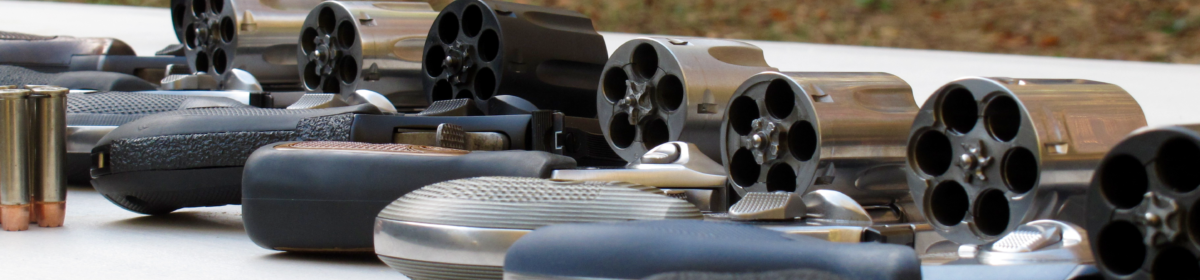

I had an interesting conversation with a fellow student at last year’s Colt Python Experience, held at Range Ready in October 2024. The student was a highly-accomplished IDPA and IPSC shooter, rated as a Grand Master in Open and Revolver Divisions, and he’d received a lot of criticism from some fellow shooters in his club for looking down at his revolver during his reloads.
My new friend’s tactipals chided him with the admonition that looking down and “taking his eyes off the threat” was a bad practice that would be dangerous “in the real world,” and they encouraged him to reload with the gun up in his line of sight, so he could “watch for threats” while reloading.
Hmmmmm . . . let’s talk about that.
LIGHTNING FAST
As background, my new friend showed me a video in which he emptied and reloaded his Smith & Wesson revolver (I think it was a Performance Center Model 986 but it might have been the Miculek 327) in mere seconds (Sub-Three? Sub-Two? I don’t recall exactly, but it was lightning fast) on the timer. He used a moon clip that seemed to leap from its carrier and fly into the gun all by itself, as if it was pulled into the gun by an invisible tractor beam. The well-coordinated maneuver began with the gun pointed on target, and terminated in the same spot—a dazzling feat of skill that’s well beyond my own abilities, and the type of thing we only see from the best athletes in the sport.

To accomplish the reload, he held the gun at waist level, close to where the moon clip rested on his belt. This positioning required him to look down for a moment to guide the clip into the open gun, before the cylinder was shut and the gun raised back into a firing position. It was this quick look that drew all the ire from his fellow competitors, and he asked me if I agreed with their critique. Was it a bad idea to look down at the gun, and take his eyes “off the threat,” he wondered?
REALLY???
His concern was genuine, but I couldn’t help but laugh about it all. I don’t think his eyes were down and off target for more than a few tenths of a second before they were back up, and the whole ruckus seemed silly and nonsensical to me—an exercise in “picking fly s#!t out of pepper,” at best.
They were bitching about a (sub?) three-second reload, with eyes off target for a few tenths?
Have these people ever seen me reload? Good Lord, they’d need a calendar and a sundial to time it. I’d be proud to own that “failure!”
Honestly, this was the kind of silliness that generates a lot of heat on Al Gore’s interwebs, but no real warmth.
APPLES AND ORANGES
The real problem wasn’t his reload, it was one of context.
This is bound to upset some folks, but I’ll say it anyhow. The thing about activities like IDPA and IPSC is people sometimes forget they’re games, not training. These games test and develop very important skills that are relevant to self-defense, and often use equipment that’s either suitable for defensive use, or close to it, so they’re useful pursuits for people who want to improve their martial skills. However, the sporting and competitive nature of the games creates an inescapable rift between them and the reality of armed self-defense.
The games are only loosely based on the gritty reality of violent conflict. Sometimes the participants lose sight of that, like my new friend’s critics did–and perhaps, even my new friend, himself. Heck, most self-defense training is far removed from real combat, but the games add even more artificiality on top of that.
RANGE KATA
To illustrate, consider the equipment he used. Nobody here will argue that you can’t defend yourself with a gun like his, but a five-inch, moon-clipped, N-frame with high profile target sights is not the most likely choice. The skeletonized speed holster and moon clip carriers he used were straight-up competition gimmickry. They’re optimized for the game, not for real life, and would be completely inappropriate for defensive carry.
Holsters and ammo carriers like the ones he used sacrifice security, protection, and concealment for speed, which is necessary when the goal is a sub-two-second draw to first shot, or a similarly speedy reload, on the playing field. But gear like that would result in a lost or damaged gun or moon clip “out in the streets.” The best way to turn your three-second reload into a three-minute reload is to crawl around on all fours, looking for your lost ammo in the gutter.
Hurry up. You’ve only got the rest of your life to find it.
Consider the disconnect in tactics between the games and reality, as well. In the video, my friend stood erect, with his feet planted, to perform that amazingly fast reload. In the real world, threat-filled, hypothetical scenario that his fellow shooters were clubbing him with, we wouldn’t want him to stand in place though, would we? When you’re facing armed opponents on the “two-way range,” it’s a really bad idea to stand in the open and reload your empty gun. That whole “stand and deliver” thing looks great in the movies, but it sucks in real life, and doesn’t do much for your longevity.
In such a bad spot, it’s much better to move somewhere that makes it harder for the bad guy(s) to see and hurt you, than to reload your empty gun out in the open. So maybe our friend’s critics shouldn’t be worried so much about a quick peek that “takes your eyes off the threat,” and should worry more about getting killed while standing on the X, doing your best imitation of a bullet magnet, eh?
If these gamesmen were really worried about tactical considerations, they’d be discussing things like drawing a backup gun, the best way to load when you’re trying to get small behind a Kia in a parking lot, or how to run across that parking lot like a scared rabbit looking for refuge.
How about reloading on the move? I know they do lots of that in the games, but I wouldn’t give it a blanket recommendation in an armed citizen gunfight. It seems to me that running and loading at the same time is usually not a good idea, particularly with a revolver, because you won’t do either very well. Run, or reload, but don’t try doing both simultaneously.
Priorities!
MORE SILLINESS
The critics urged my friend to reload with the gun up in his face, so he could “watch the bad guys.” Maybe that works for them with their autopistols, but it’s not a good idea with a revolver.
There’s a matter of mechanical efficiency to consider, here. Unlike a pistol magazine, which can be quickly and easily shoved and locked into place regardless of the gun’s orientation, we need to have gravity on our side when we’re reloading a revolver. Gravity helps the cartridges to go where they need to, and to stay there until we close up the cylinder. It’s much harder to hold the revolver oriented in the vertical plane, so you can have gravity working for you, when you’re holding it up at eye level.
Additionally, while holding a revolver up in your line of sight to reload it, and keep an eye on the Indians circling your wagon, sounds like a John Wayne level of cool, we don’t do our best work in that kind of pose, do we? When you try to thread a needle, untie a knot, or open a jar, do you do it with your arms stretched out and your hands in front of your face, or do you “bring it in” and work the problem close to the chest, below chin level?
Reloading a revolver requires dexterity, and we don’t do dexterity-intensive tasks up high, in our chin-up sight line. Instead, we do them down low, with our chin tucked and our eyes looking down. It’s how we’re wired . . . even before we turn 50, and can’t see anything clearly anymore.
If the task is to get your empty gun back into the fight, you need to do that just as quickly as possible. I think I’d rather work the problem where I’m most coordinated, and briefly look down to get the job done quickly, than double or triple the time it takes by working the problem in a more awkward, eyes up position. Which of these options gives your threat more free time to press his attack, after all? Take your peek, get the job done fast, and get back to work.
WELCOME TO REALITY
So, let’s leave all that gamesmanship behind for a second and talk about reloading in a gunfight for a moment.
It seems to me that if your gun runs dry in a fight, and there are still bad guys trying to kill you, your next course of action will primarily be dictated by matters of time and distance.
If you’re within contact distance of the threat, forget about reloading. Your job right now is to fight the threat and make him stop his attack. You might use your unloaded gun as a striking tool, you might use your empty hand skills, or you might disarm him and use his own weapon against him. If you can create the time, space and position of advantage necessary to access another weapon (a backup gun, a knife, OC, an improvised weapon, whatever) or make an escape, that’s a good thing, but reloads are not on the agenda.1
At a more intermediate distance, you might be able to access that secondary weapon right away, or make an escape. You probably still don’t have time to reload your gun, if your enemy is really intent on hurting you.
At an extended distance, you might finally have the option to take cover and reload your gun, then get back in the fight. Things like cover, concealment, intermediate obstacles, distance, injuries, lighting, allies, and other stuff will influence whether you’ve got the time and space to pull off the reload and get back in the fray before it’s too late.
If you do, you’ll have to get the job done as efficiently as you can. This is no time to dally. The longer your revolver cylinder is open, the longer your gun is out of the fight, so focus on the job and get it done as quickly as you can, to the exclusion of almost everything else.
Honestly, I don’t think this is a very likely scenario in the armed citizen context. Reloads under fire happen in some military and law enforcement engagements, but you’d be hard-pressed to think of many cases where armed citizens had to load, in extremis. I’m not saying it hasn’t, or can’t, happen, only that it’s highly unlikely. By the time guns run dry in armed citizen gunfights, people are usually running away, badly injured, or dead. The reload becomes more administrative at that point—something you do to avoid standing around with an empty gun while you cover a threat that might reanimate, or have his buddies come looking for him, while you wait for the cavalry to arrive.
THE RELOAD
It’s not likely that you’ll do it, but it will be important, if you have to, so let’s discuss the reload a bit.
Depending on your injuries, skill, composure, and reloading method, you might be able to get the gun loaded without looking at it much, or even at all. If you’ve practiced it, can keep your head, and aren’t injured, it’s possible to open the gun, eject the empty brass, orient the gun for loading, access your spare ammo, and move the ammo towards the gun without having to look at it. That preserves your ability to monitor your environment while you’re offline, as necessary.

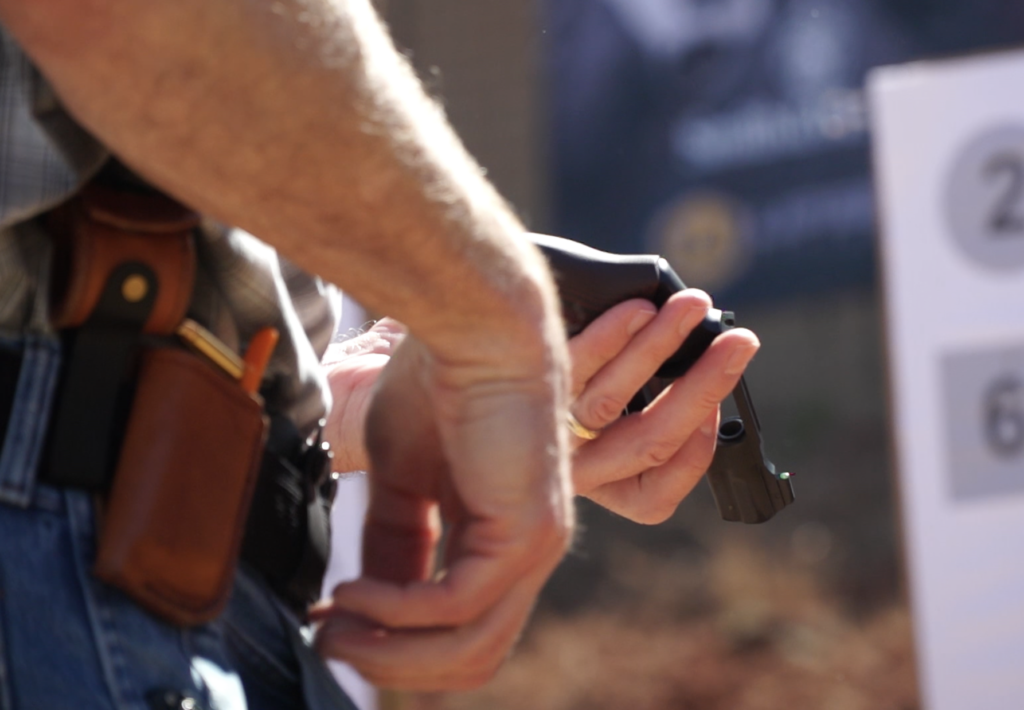
You should probably take a quick look at the gun to get the ammo started into the chambers of your cylinder. You’re going to be stressed out, and you might have lost some dexterity, so the extra peek will benefit you here. I’ve previously discussed some techniques that I teach in my classes which can help you index the cartridges to the chambers without necessarily looking at the gun, and I think they’re worthy of practice, but when the chips are down you want to use all your senses and get the job done fast.2
If you’re using a speedloader, it’s a simple task to close the cylinder after loading and get the gun back into a firing grasp without eyeballing it.
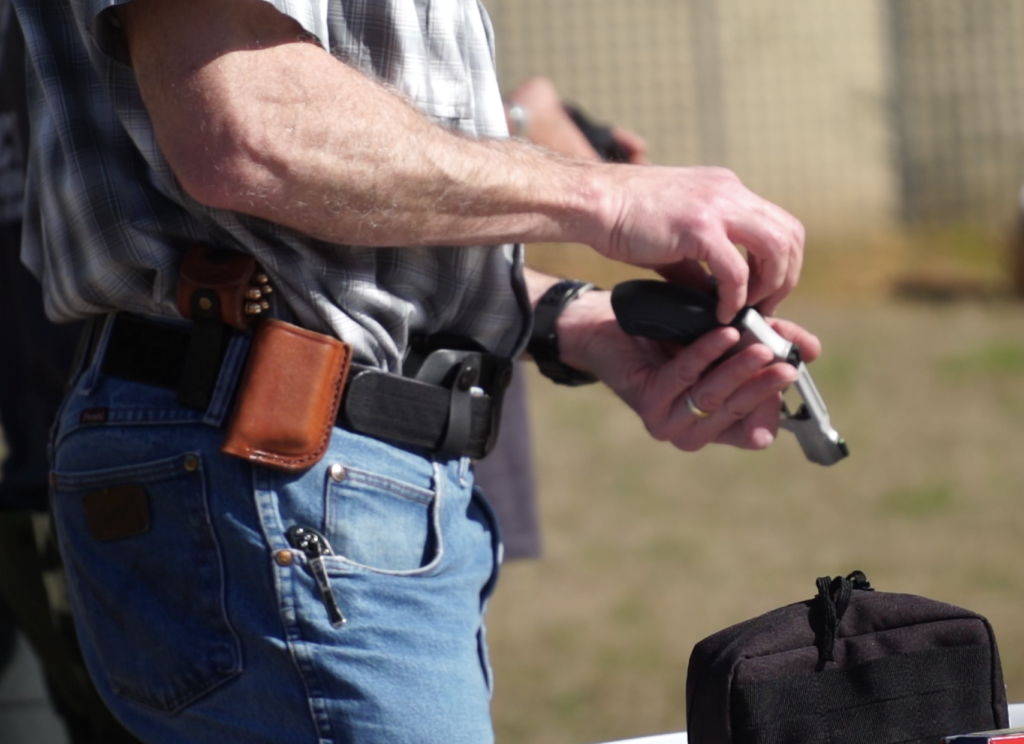
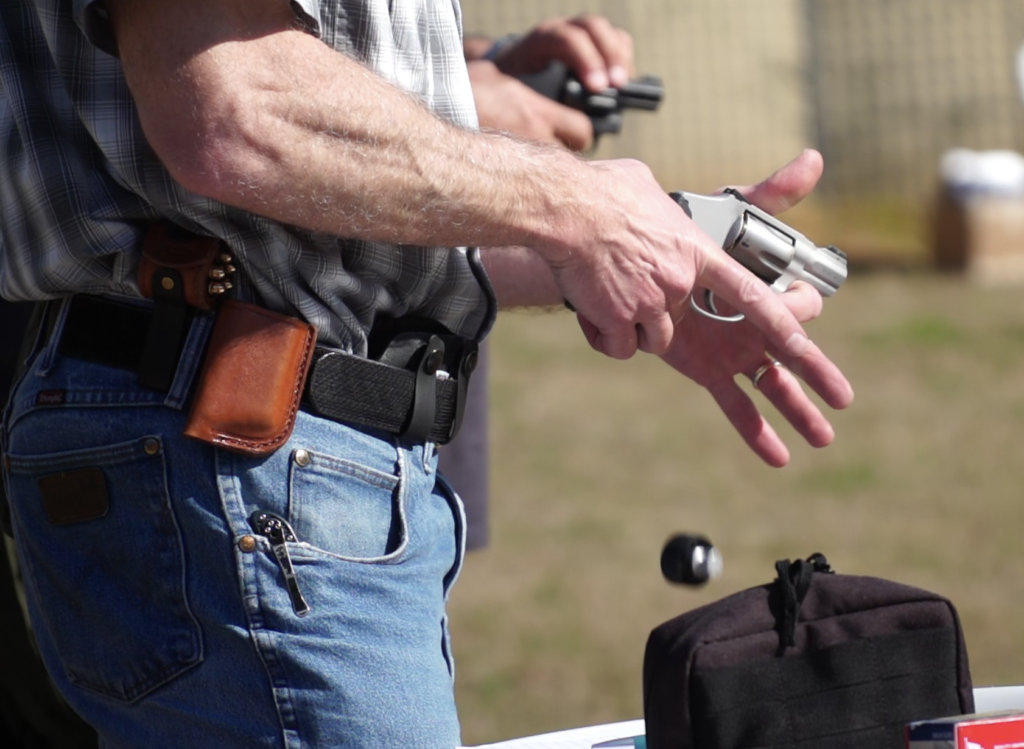
If you’re loading with loose rounds or a strip loader, it’s probably a good idea to look up after loading your first rounds, before loading the next ones. As you reach for the next pair of rounds from your pouch or pocket, or as you peel your strip loader away and move it back towards the cylinder to load the next set of chambers, take a quick look at what’s going on around you, and decide whether it’s time to close the gun up, or load a few more rounds. If you have time to continue loading then get right back to it, and repeat the process–“Look as you load,” as NYPD taught their officers in the wake of the tragic Scott Gadell gunfight.
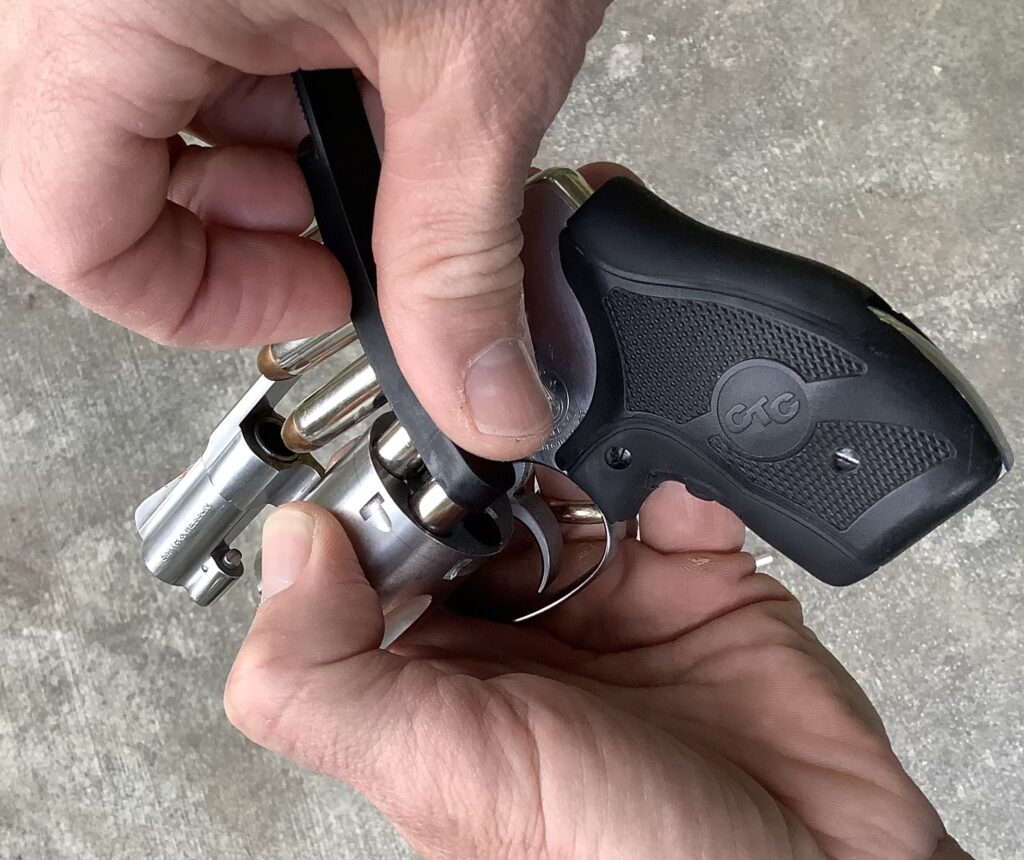
Of course, stress, injuries, and physiological effects like tunnel vision can change all of the above very quickly. Do your best. Adapt. Improvise. Overcome.
GOOD ENOUGH
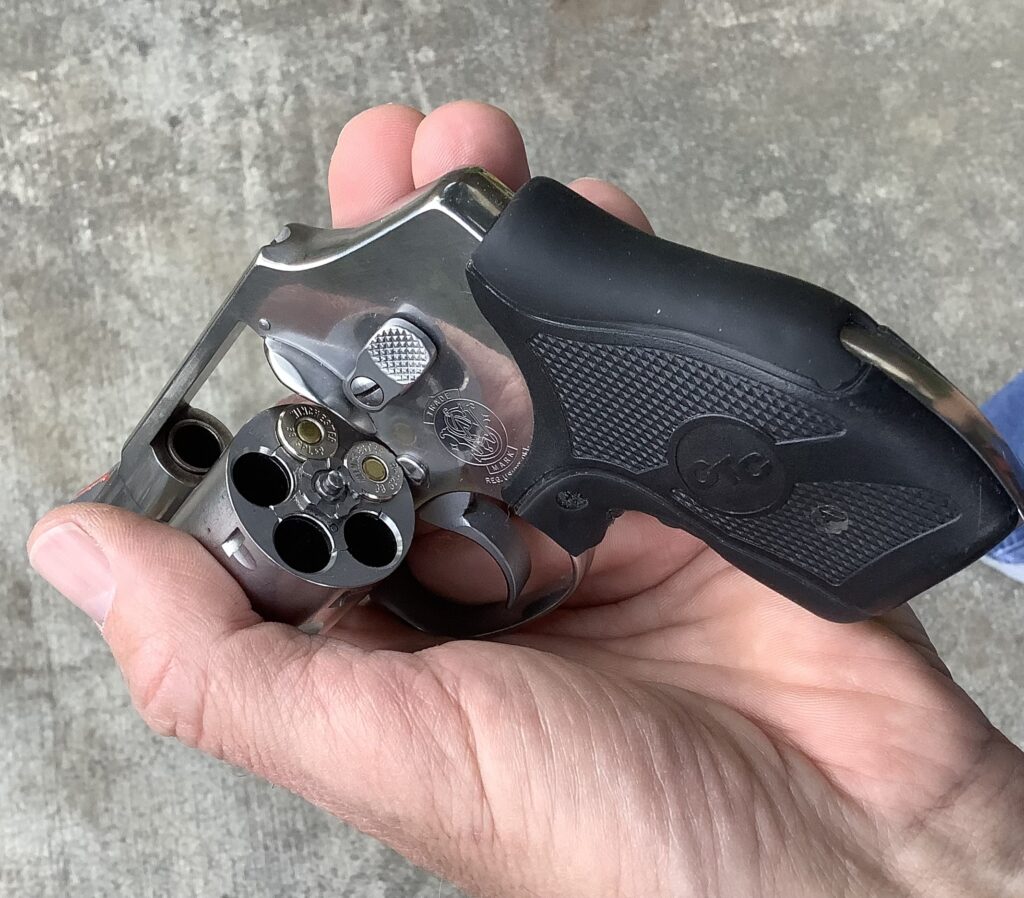
As we’ve previously discussed, your reloading method, and the time and space available, might encourage you to load just a few rounds into your gun, instead of filling it up completely.
A speedloader will allow you to fill all your chambers in a single effort, but if you’re loading loose rounds or loading off a strip loader, you might be better off getting just a few rounds into the gun, and getting back into the fight sooner with a partial load. Firing a few rounds at your enemy right now might be a better option than delaying your fire to fill the gun to full capacity—a lesson that CHP Officer James “Skip” Pence taught us in his own blood, over 50 years ago.
KEEP IT STRAIGHT
The conversation which started me on this train of thought was about a silly criticism of a fellow competitor, and while I found it amusing, I think the underlying issue is very serious indeed.
As shooting enthusiasts, we’re constantly confronted with ideas, products, and training that masquerade as being relevant to self-defense, when they’re actually just silliness, gimmicks, and entertainment. It’s important for you to know the difference, if you’re serious about your personal safety.
I love the shooting sports and encourage each of you to participate in them as much as you can, and enjoy yourself while you’re doing it. I respect and admire the tremendous athletes in these sports, who perform amazing feats with guns in their hands, and appreciate how the games can help a defense-minded shooter improve his gun handling and shooting.
I’ve got no beef with the games or the people who shoot in them, but I do think it’s important to keep the game stuff separated from the self-defense stuff. There’s a small bit of overlap between them, but not as much as most people think.
Don’t let game theory influence your self-defense preparations, and don’t let your self-defense preparations interfere with your enjoyment of the games. They’re separate animals, so respect and appreciate the differences between them.
Use your head. Be critical. Figure out what’s important, and what isn’t.
Most of all, be safe out there.
*****
Endnotes
1.) I’m not talented in this arena, and get out of my depth very quickly here. I would refer you to my friend Cecil Burch, of Immediate Action Combatives, if you want to learn more about these vital skills. Cecil has forgotten more about this stuff–in just the last few days, alone–than I’ve ever known. He understands the integration of the gun with empty hands combatives, and is an invaluable resource for understanding the entangled fight.
2.) The index techniques I discussed take advantage of your sense of feel, and will help you get the gun loaded faster. In some cases, they’ll allow you to accomplish the job strictly by feel, but if you can supplement them with your vision, that’s even better. We may not always see clearly though–if we’re injured, working in low-light, or have lost or damaged our glasses, our sense of sight may not be much help to us. In that case, it’s nice to have a method that primarily relies on a different sense to get the job done.

Very insightful Sir! I have often thought about this very topic. I remember in my police academy, as we were on the range with generation 2 Glock 17s, the instructor harped on us about reloading with eyes up and scanning for threats. That became pretty doable with an auto pistol like you discussed.
A couple of years later, I was allowed to carry a revolver as long as it met certain criteria and of course I had to qualify with it. At that time, we had one officer still carrying a Smith model 66. His advice to me was very valuable and something I still carry with me. He told me the tactics taught with an auto pistol are valid and have their place, but carrying a revolver requires a few different tactics. He said you wont be standing still on the X reloading 17rnds after emptying your firearm of 17rnds. You need to hopefully accomplish the task with 6 or less and then be prepared to either pull a back up or retreat to an advantageous position where a reload is possible.
As a civilian, I exclusively carry a revolver. Depending on what I am wearing, sometimes I dont carry a speedloader but instead rely on ny 2x2x2 pouch because it fits against me in a more slimmer profile. I never feel inadequately armed going about my routines. I think, like you said, the games and real self defense tactics can overlap but having the where-with-all to identify the differences is important. Thank you again for your thought provoking material!
Thanks for the kind words, Mark! Yes, each weapon system has its own peculiarities that effect how we run it and the tactics we must use. That veteran’s advice was solid, and you obviously took it to heart. If only it worked that way all the time, eh?
People who criticize someone for looking down at their revolver during a reload are the same types who give others grief for looking down while holstering the firearm and offer similar unsolicited pointers to gym rats under the guise of being helpful. Just look at how many people trash talk Olympic gold medal winners who target shoot with one hand while the other is tucked in a pocket. Keeping your eyes on a target at all times is best suited for someone who possesses laser eye beams for sure, but for the rest of us mere mortals I think we’re doing just fine and don’t need to hear any comments from the peanut gallery. Tell your friend not to let Fudds and know-it-all dudebros get him down as obviously they forgot that the primary goal of Range Ready is to enjoy yourself and have fun, not be judged and critiqued like a stallion at a pony show.
Could not agree more sir. Well said..
I like that stallion analogy, Jeb!
Contrary to square range experts, actual bad guys tend to throw lead your way. Your coordination can turn to jello real quick. Cardboard just stands there, bad guys don’t. Gamers tend to quickly loose sight of fantasy versus reality. The techniques they use in competition likely will not work well when they are under fire. I venture to say that your average Grand Master who is victorious on range day will likely have a significant change of attitude when bullets are coming his way.
The technique of the reload is going to vary between bottom feeders and wheelguns. The auto reload of ‘hand meets hand’ is more natural and helps speed a reload. As you well pointed out, one can do this speed reload standing, on your back, side, even upside down (?) and you don’t need to actually have eye contact with your gun or magazine.
Revolvers are a whole ‘nuther ballgame. During IPSC matches I participated in (shortly after the earth cooled), I invariably shot my revolvers, going up against everyone else with their scoped and comped .38 Super race guns. We were allowed to use duty rigs, which I did. My slightly faster-than-normal speed reload of a revolver evolved into a protocol that consisted of opening the cylinder, holding the gun slightly to my side with the muzzle up, and popping the ejector rod. This spit the brass to my side and away from my feet. If you’ve never had a few pieces of spent brass mess up solid footing on pavement, you’re in for a treat. Once the cylinder was cleared, I would then bring the gun to my belt, muzzle down, aim the speed loader for that point, give a quick glance to verify indexing, pop the rounds in and go . . oh, and ditch the speed loader.
With a revolver, gravity is both your friend and your enemy. How you handle your gun decides which role gravity is going to play. Watch Jerry Miculek (in slo mo if possible) do speed reloading of his revolvers and you’ll see what I mean. Reloading at eye level is just a non starter in about 95% of situations.
Use of the cylinder flutes is useful tactile aid. I am personally not a fan of unfluted cylinders on defensive guns. The flutes are indexing aids that, if you’re paying attention, it will tell you where your chamber is. I use my thumb on the cylinder to tell me where my ‘top chamber’ is. Try this in low light, or even candle light in a dark room. It works with speed loaders and speed strips, albeit with concentration and a good bit of practice.
The big message I’m hearing here is, “practice with what you carry!”
The flute index technique you described is extremely valuable, I think. Multiple senses at work, to get the job done. Good stuff!
I always appreciate you sharing your valuable experience, which was earned on the two-way-range.
Yep, there’s no way to reload a revolver at eye level, and for most revolvers, there’s no fast way to reload them at all. That’s why when I carry a revolver as a primary, I always carry a backup J-frame. I’m a big believer in the New York reload. (Of course, the J-frame is in my pocket whenever I’m awake, so maybe it’s not just a “revolver” thing.)
(Update: I just tried bringing my J-frame up to eye level, pointing the barrel up, opening the cylinder, dumping the empties, turning the barrel down, bringing a speedloader up to the gun, etc. It worked just fine sitting at my desk in front of the computer, but my arms and hands still kinda blocked my view of my theoretical threat. Maybe I’ll try it on my next range trip. If it works, maybe they’ll name it the “Old 1811 Technique.” Don’t tell anyone about it till I see about royalties.)
I’ll have an agent standing by, with your contract!
I agree with almost everything you wrote, except that it’s pronounced “on da streets”; you gotta say DA instead of THE, or else… Or else you’ll be dead on da streets LOL
Ya got me, pal. Kilt in da streetz! There, that’s better. 😆
This is right up there with the Garand ping as a non-issue. Gamers will game, and the response should have been the demand that his critics do something unmentionable to themselves, and do it somewhere else. They’re messing with his head, and “malicious envy,” to quote Jordan Peterson, is the likely reason.
As for the real world, some things remain important: don’t get shot, don’t get caught out in the open, and fight back in anyway you can.
Invoking the spirit of LT Frank McGee to come on back for a spell, bring the gospel to these benighted souls.
If we could bring back the style of policing that was done during Lt McGee’s watch, things would be much different ’round here!
Well done Mike. Clear, concise, complete.
Focus on the task at hand. Task priorities can change at speed.
I like the revolver games a lot. Great practice in safe gun handling and rapid precision shooting. Life is not a game.
Thank you Sir. That means a lot, coming from you.
Sometimes there’s so much static on the freqency, it’s hard to hear the signal. We do our best here to try and filter out the noise.
I wasn’t there but I would say it’s 99% a 929 if it was a ‘competition’ 9mm Revo. Those 7 shots aren’t very helpful in any game.
I’d also bet if he’s the real-deal and not a paper GM his reloads were sub 2. And first-shot-on-target draws sub 1.
To your point competitions don’t emulate real life. A 32-round field course would be hard to declare self defense. If we had a “realistic” sport… You’d fire a cylinder at a relatively close target. Then your gun would get taken away and you’d have to pay a lawyer hundreds of thousands dollars. So far no one has expressed wanting to play that shooting discipline.
However, the pressure of the clock does make you a better shooter. At the GM level your reloads, transitions, sight picture acquisition are all subliminal. I don’t see how mastery of gun fundamentals leads to ‘bad habits’.
Take your carry gear to a match. Lots of people do. If you or your gear crumble under the pressure of a match, they certainly won’t hold up to a defensive use.
C.S., it probably WAS under two seconds. He was lightning fast. I didn’t know where to find the video later on, to verify, but your par times are probably spot on, and our guess on the gun is probably correct as well.
Yes, there is MUCH to be learned from competition! No argument here. I think it’s great stuff, and quite valuable, if I didn’t make that clear. I also agree it wouldn’t be as entertaining if it was more realistic (and there’s the rub–a balance between entertaining and realistic is necessary, favoring entertaining).
The important thing is to stay focused on what is relevant, and what is not. Sometimes that gets forgotten, so I thought a gentle nudge was in order.
You make a lot of good points here, Mike. If you are that guy that Murphy decides to pick on by getting you in a gunfight with your carry revolver AND having hostilities extend past your initial cylinder load out, it’s an interesting day and you’re soon to be famous. Most of us carry minimal spare ammo daily, so not flubbing the reload in that situation would be fairly critical (I confess to a 2x2x2 pouch, and an 8 round strip loaded with 6 rounds, speedloaders typically in the vehicle in the summertime). Bringing the gun in tight and loading and looking ala NYPD training makes sense to me. You are going to convince me to start wearing a backup when I check the mail and mow the grass!
I tried it, but the neighbors kept looking at me funny. I guess an ankle rig and shorts was a bad call on my part.
I have practiced loading a revolver with speed loaders while not looking, and in my experience it is definitely doable. However, I find it works best when there is zero clearance issue with the loaders, and the loader itself drops freely after releasing its payload. My 5-Star loaders work the best in this regard, as they have the best grip clearance of all the loaders I own. My Safariland Comp IIs can be faster and easier, but their round profile can be a hindrance depending on the grip used. They also work best specifically with my S&W Model 10s and my Model 12, none of which I carry. A good example, the Comp II works fine with the factory grip on my Taurus 856 UL, but struggles with the older Taurus boot grip (the one with the medallions).
Also, IN MY OPINION, I think it’s better to take the extra second or two to look down at your revolver reloading. The way I see it, if I’m in a situation where I have to reload my revolver in a fight, chances are I might fumble a bit with the loader under stress. The least I can do is take the time to look down and ensure I’m getting the rounds in the chambers.
Now, if I’m shooting a semi-auto like my Beretta 92, this is all a non-issue. I can reload my Beretta without looking at it, no problem. We’re talking revolvers here though.
One last thing. If I have to reload, revolver or semi-auto, I’m personally going to move to cover before doing so.
I am a retired Border Patrol Agent. (1978-2000) We carried .357 magnum revolvers of S&W, Colt and Ruger makes. We loaded from loops. Speed loaders were verboten when I first came on board.
In 1986 I was detailed to the Academy as a Firearms Instructor. The lead instructor was Kent Williams.
He was a phenomenal shot.
Several of us went to a USPSA match near the Academy in Georgia. Kent carried a heavy barreled S&W Model 10 (former BP issue). The El Presidente Drill was one of the stages. Kent won that stage.
12 shots with a reload from the loops.
He had big hands and could load 3 at a time from the loops. (He practiced it almost daily.)
One bystander exclaimed ‘he didn’t reload’. I told her ‘ lady that is a 6 shot revolver and he just fired 12 rounds, pretty sure he reloaded.’
He was very accurate also.
We were taught to be accurate. Duty loads back in those days were 6 in the gun and 12 in loops.
We had to wait a few years for the Patrol to OK speed loaders.
And YES we looked at the gun when we reloaded.
As Col. Cooper opined “speed is fine but accuracy is final.”
peace, y’all.
Amen! Wynn, thanks for sharing that with us. Glad to have you here.
Hi, Mike – great article. Handgun self-defense isn’t the only martial art I’ve practiced. Every martial art has to deal with these two facts:
1. The sporting version of the art can be great training, but very different from the art practiced in earnest
2. Even the earnest version of the art can acquire ‘dojo accretions’ – things added to the art because they seemed like a good idea to someone, but aren’t actually relevant to actual combat
I was in a HEMA dagger seminar 10 or 15 years ago – the teacher would introduce some concept, then the students would break into pairs to practice it. One young lady, who appeared to be a skilled martial artist, was the worst possible practice partner because she kept trying to ‘win’ the drills, instead of helping her partner learn the technique. When I got stuck with her it was during a unarmed defense against a committed overhand attack, with the dagger in an icepick grip. She kept feinting with the dagger, which makes the defense we were working on completely fall apart. She defended this by saying, “Well, if it won’t work against a feint, it won’t work in real life.” But as the teacher pointed out, the medieval German and Renaissance Italian manuals we’re working from don’t include the armed attacker using feints against an unarmed opponent, and many hundreds of hours of surveillance video camera footage showing modern criminals using a knife to attack people with this exact technique also don’t show feints. She was trying to add something to the art because it seemed like a good idea in training, not because it was needed. (Since this was an Italian art, maybe we should call this a ‘sala accretion’ instead of ‘dojo accretion’.)
Finding my rambling way back to the topic at-hand, reloading a revolver for civilian self-defense seems like a dojo-accretion to me. If we are recreating the historical art of 20th century American police handgunning, then reloading a revolver is very much a necessary part of the art. But if we are working on 21st century self-defense with a revolver, then it is a minor part of the art, at best. I mean, I need to reload when I’m at the range, so I work on doing it crisply and try to get my reps in there, but I’ve pretty much dropped this from my dry-fire practice. If I was going to shoot competitively, I’d definitely work on it, and I’d work on making it as fast as possible. But for my purposes, more time on drawing, sight acquisition, and smoothing out my trigger press are far more valuable than reloads.
Thanks Tyson, I appreciate you adding to the conversation with this! I think you’re absolutely right about where reloads fall in the spectrum of skills we’re most likely to need.
I mainly agree, but I try to keep my eyes on the threat as much as possible and reload by feel if I can. My reason is this: Once upon a time I was on a surveillance and my job was to watch our UC agent walk down an alley and enter the bad guy’s apartment. When I saw our guy walking down the alley I glanced at my watch to note the time, and when I looked up, he was gone. I had some anxious moments till I heard his voice on the wire talking to the crook. (Six-ten p.m., by the way. It’s one of those things I remember after 40 years. Don’t ask me what I had for breakfast.)
As several people here have stated, self-defense incidents are fast and fluid. You might get away with taking your eyes off the ball, but you might not. That’s why I prefer the New York reload.
You won’t get an argument from me about that. The best “reload” is a second loaded gun!
And just for grins, I think RevolverGuy historian Tony Perrin makes a good case that we should be calling it the “Kansas Reload” or even the “Texas Reload,” after the mounted troops who went into battle with multiple guns mounted to their saddles at the dawn of the revolver era.
Excellent article Mike. Very insightful.
Keep up the good work.
Thank you, glad you enjoyed it!
My career overlaps Wynn’s BPA career by a couple years at both ends, but I had the advantage of being in a plainclothes, all-concealed-all-the-time agency. We were, if I recall correctly, limited to 6 in the K-frame and 12 in loops or drop pouches. I carried two Bianchi Speed Strips in drop pouches, and a couple of speedloaders that somehow accidentally fell into the pocket of my sport coat. (I hate it when that happens.)
Around 1980, speedloaders were authorized, and I could carry them openly after that. (I still carry Bianchi or Galco speed strips in 2x2x2 pouches occasionally.)
Scott Reitz, a retired LAPD officer whose career is contemporary with Wynn’s and mine, has a youtube channel called “Uncle Scotty’s Stories” where he states that one of the reasons speedloaders were banned in LAPD in the 70s was because roll-call sergeants wanted to look down a row of cops standing at attention, and bulging speedloader pouches ruined the symmetry. Don’t know if it’s true or just an LAPD rumor, but my experience with paramilitary bureaucracies makes me think there might be something to it.
Uncle Scotty told me that story in person once, and I had to smile because the same dynamic had been in play at the CHP. Folks who have never served in LE/MIL might be surprised to hear that appearances and uniformity sometimes take precedence over function and efficiency, but all the cops and soldiers know it’s true.
Just to throw another example out there of how silly things can get, there were several state police outfits that required members to carry handguns on their right hip, regardless of which hand they intended to shoot with . . . and this lasted into the autopistol era!
Uniformity, you know.
I was teaching a class for LE several years back and they were bemoaning the fact that their chief wouldn’t let them carry more than one spare magazine on their duty belt, for appearance’s sake. This kind of nonsense is not just a thing of the past.
Yep. I worked in Illinois, and for a while the ISP troopers carried their Model 39s in thumb-break holsters on their pants belt (not an overbelt) with no spare magazines (although some troopers stashed spare mags in their cars or jacket pockets). Their cuffs were stuck behind their belts, loose with no pouches. Later on, when they went to Model 459s, they started wearing overbelts, with decent holsters and cuff pouches, and two spare mags. I was glad to see it. (In 1967, when they were lauded as the first state police agency to issue autopistols, they carried them in crossdraw flap holsters. So I guess things improved for the troopers, but fairly slowly.)
I read a long time ago that the Iowa Highway Patrol mandated that their troopers’ K-frame (Model 10? revolvers be carried on the right hip, regardless of the individual trooper’s handedness, and that the gun had to carry the factory wood grips. I wasn’t sure I believed something so ridiculous, but apparently it was true. (The bureaucratic mind never ceases to amaze me. Around 1981 I was talking with one of our regional office pogues about wearing a Level II Kevlar vest (under the shirt). His first words were, “If you’re authorized to wear one . . . ” I quit listening to him after that.)
Well, it can be carried to extremes, but uniformity has its place. I remember once taking an evening constitutional in my neighborhood and seeing one of my suburban housewife neighbors standing on the sidewalk talking to a Cook County Sheriff’s Police officer who was holding a clipboard (so it was an official contact, not a visit to Mom or Aunt Whoever). The officer was wearing OD BDU pants, a pistol in a drop-leg holster, a white T-shirt, and a sheriff’s star clipped to his belt. His unmarked Chevy Caprice was parked in the street. I thought then and I think now that a little more uniformity (or at least a uniform shirt) would have been a tad bit more professional.
Most definitely, but that scenario is a whole new can of worms to discuss . . .
I think it was the late, great Paul Harrell who said (insert Shatner…esque pause) it can be advantageous to reload your firearm prior to it going empty, if the circumstances permit.
My own preference is to have a full-length ejector rod, to minimize the odds of having to manually pluck individual spent casings during an emergency! With that, I’m curious to know what is the most compact revolver that utilizes a full-length ejector?
Ricky, Justin did an article here many years ago where he discussed this topic:
https://revolverguy.com/ejector-rod-length/
Personally, I’ve found that it doesn’t make much difference as long as you’re using good technique. Pushing the tip of the extractor with your thumb (what we’ve come to coin the “FBI Technique”) seems to encourage extraction problems, but giving it a sharp slap (just one, don’t pump it) will clear everything nicely, even with a short throw rod.
In my experience, the most limiting factor isn’t the extractor rod throw. Instead, it’s grip interference. Many grips are built with too high of a profile, and they can prevent the inboard chamber from being properly cleared. This problem is especially acute on the small frame guns. Frankly, I’m not particularly concerned with extractor rod throw, but I spend a lot of time modifying grips to suit my needs.
Agreed. Half a lifetime ago Giles Stock took a special interest in teaching me to run the GP100 I brought to API350. In the decades since I can’t not punch the ejector rod during the recharge. While a full-length rod is nice to have, stocks which allow all the empties to leave the cylinder without impediment is essential.
They’d really get their panties in a twist when I New York reload… dropping guns left and right.
Besides, statistical chances of needing to reload in a civilian gunfight are nonexistent.
When looking at defensive gun use, I listen to people say who have actually seen the elephant, and eschew gaming theory.
I think we all know the low odds of needing a reload or a second gun (or even firing shots) in an armed citizen’s encounter with a bad person, but there are two things to consider. One is, if you have to shoot the aforementioned bad person, the “statistical average” has already been shattered; what makes you (the rhetorical you, I’m not getting personal here) think the rest of the “statistical average” will hold up? The other is, bad people tend to have running buddies (they always have money and drugs, and they’re usually gangbangers), and if one or more of them shows up to assist or avenge him, it might be a good thing to have a full gun in your hand. Jeff Cooper always carried a 1911 and a spare magazine on his belt every second he was awake, and when asked why he carried the spare mag, he always replied, “So I always have a full gun.”
I’m not one of those people who worship Col. Cooper (he was almost a Luddite in his refusal to admit that technological progress continued after 1911), but he was in fact a good guy to listen to.
Indeed. A gun should not be carried without a reload for it. Even the new wonderpistols that hold half a box of ammo. In the case of the autos, it’s as much about reliability as capacity.
Only been in one gunfight, and I’m not there to make one who ended up shooting the fool. But I hearing from those who have, it’s safe to say it’s probably (not always) over before you’re out. So the reload is most likely for the aftermath and is there to give you the reassurance of having a full gun in case BG wakes up again, or his friends take exception. Both these things do happen. I’m ok with reloading near the belt line and looking down for half a sec. I’m also going to be behind whatever cover I can find, if possible. You pays yer money and you takes yer chances.
Sounds like an excellent plan to me, buddy. Be safe.
Sorry for the start of that, I swear I didn’t type it that way!
Ha! I know you didn’t. Computers!
Mike, an excellent article about reloading during gunfights. I see the discussion bobbed and weaved through multiple related topics, however I’ll try to limit my comments to your original points.
I haven’t tried competitive shooting, either IDPA or IPSC or any other organized event so I can’t comment on their benefits to armed self defense. I vaguely recall an account in Jim Cirillo’s book where he contested some silly rule that would have cost him dearly in a real gunfight. I believe that was his final day in that competitive shooting league.
There were a few times in undercover roles that I carried my S&W Chief without a reload. However, whenever practical, I carried at least one reload per revolver.
By the way, I never heard the term “New York Reload” until years after I retired from NYPD. Many of my colleagues and I carried two revolvers which was encouraged by the instructors at the range since it was tactical and practical. That back up gun could possibly provide a quick reload for you or your partner. Your service revolver may be dropped, rendered inoperable or God forbid wrestled out of your grasp! Naturally that second revolver and its holster came out of your less than enormous paycheck. Just like your service revolver, since the cost of all equipment and uniforms were borne by the officer, not the department!
Oops, I digressed!
To this day I always carry a reload on my person for my S&W .38 Special. I also keep a second reload, in the form of a speed strip or speed loader, in my vehicle.
“Look and Load” was thundered into my thick Irish head until it became second nature. A few years ago a deputy sheriff in Florida was running the HR 218 course. He was pleasantly surprised to see me and another retiree from different agency actually load a few rounds, glance back at our targets, then load a few more. After the 40 round course of fire he uttered another familiar phrase, “glad to see that you guys didn’t bury your head in the gun.”
Although I’m told that the odds of civilian armed confrontation are remote, especially if one is cognizant of their surroundings (commonly referred to as situational awareness), being able to reload quickly, even if it’s just a few rounds, seems incredibly logical should a bad situation become worse.
My fellow RevolverGuys have an incredible depth and breadth of knowledge, experience and wisdom. I’m very grateful that you have this forum, thank you!
I’m grateful to have such a great audience, made up of experienced folks like you who are willing to share their hard-earned wisdom! I really do appreciate your valuable thoughts on this, and also appreciate the kind words.
If you’ll allow another digression, prompted by your comment . . . my experience lately indicates that less and less officers are carrying backup guns in the age of high capacity pistols. I presume these officers think there’s little need for “additional firepower” since they have so much on tap, already. Of course, additional capacity is only one of many reasons to carry a BUG, as you expertly pointed out. This is an area that appears to need more emphasis in modern LE training.
I just reread your statement here and it reminded me of something. When I was an instructor at FLETC, one of the things I lectured on was backup guns. (My agency authorized J-frames and the subcompact version of the issue compact .40 auto; we were a plainclothes, concealed carry agency.) I always asked the question, “How many of you flew here?” Almost all of the hands went up. Next question: “How many of you flew here in a plane with just one engine?” That’s how I hoped to instill the idea that a backup is a good thing. Since I never saw them after they left the academy, I don’t know if it worked, but I like to think it did.
Great article – thoughtful, and encourages me to think more about the real life problems. Thanks.
That was the goal! Thank you for the kind words!
“…a calendar and a sundial….”
Perfectly hilariously stated Mike!
So many great points in your article!
Thanks pal!
Thanks for a great article … and the Comments were as entertaining AND educational as the substantive article.
Comparing “fact” to “fantasy” made me wonder (in amazement) at the likely *thousands of years* of combined experience that is represented here by folks like you and the Commenters who have actually walked-the-walk and are also analytical enough to recognize what really went right (as opposed to just got lucky!) and who then take the time and effort to teach the rest of us who are glad (hopeful) we never have to walk those paths.
Thank you all!
Thank you. I’m proud of the community we’ve built here, and always learn from them!
A brand new Massad Ayoob upload discussing various revolver reload methods, including his “Stress-Fire” technique:
Search on YouTube:
Massad Ayoob — Facts and Firearms Channel
The Cleanest Revolver Reload You’ll Ever See
A few months ago I completed my second combat / concealed carry class with Georgia Law Enforcement Academy personnel. The lead instructor mentioned back up guns.
He pointed out that an ankle holstered weapon may not be the best primary carry option but it’s surprisingly easy to utilize if seated, as in a motor vehicle. As the sole retired guy in the group, it seemed that a back up gun was a novel idea to my much younger, active duty classmates.
In my second career, I was fortunate to have made several contacts in local law enforcement. Tale of two deputies, both experienced but with different outlooks:
One veteran Florida deputy equipped his vest and gun belt with four spare magazines for a total ammo load of 86 rounds, including his Glock 17, if my math is correct. He didn’t feel the need for a back up gun since he also carried an AR-15 and a Remington 870 in his patrol car.
A colleague of his had recently retired from a large East Coast police department and started a second law enforcement career in Southwest Florida. This deputy carried a sub-compact Glock in an ankle holster that could use the same magazines as the Glock 23 on his gunbelt. After years of working in a busy urban environment, the second gun was his constant companion.
Yes Sir, that’s it in a nutshell. Sadly, the culture of the backup gun seems to be waning in many corners.
As you understand so well, those long guns might just as well be locked up on Mars, if you need another gun Right Now.
For those who haven’t thought through it, lost guns, broken guns, inaccesible guns, guns hit by gunfire, guns that have been taken from you . . . they all demand an immediate solution, not one locked up in your car. Instead of carrying four Glock 17 mags on a Sam Browne, you’d be much better off trading two of them for a J-frame.
A few years ago, a police officer’s handgun was struck and disabled by the gunfire of an active shooter, while it was still in the officer’s holster. He was functionally disarmed in an instant, while under fire.
In May, the video from an OIS in Fountain Valley, CA was released to the public. In the BWC footage, you see a man take a female officer’s gun away, stripping it from her hands as she wrestled with him through the open door of her patrol car. She fled the scene, begging him not to shoot her, and hid behind a nearby vehicle, defenseless against the man armed with her gun. She had plenty of time and opportunities to engage the suspect from her new position, had she been armed with a backup, but all she could do was watch in panic, as another officer arrived on scene and handled business. She was lucky. Things could have gone very differently.
It’s not about capacity! It’s about redundancy!
Rant off.
Yep. In the famous 1986 Miami shootout, one of the slain FBI agents, Jerry Dove, had his 459 9mm disabled by a .223 round through the frame. I don’t know if he had a backup or not, since he was killed almost immediately after his gun was hit.
When a person is pointing a gun at you, your eyes go straight to the gun, and your bullets tend to follow your eyes. That’s why a lot of people are shot in the hands, the gun, or the arms. So it makes good sense to have a) a backup handgun, and b) the ability to shoot accurately with either hand.
Yes Sir. That’s a notable example. I’ve seen the actual gun and it was toast.
I wrote an article on this topic a while back. It’s still out there in cyberspace, and still relevant:
Hand and Arm Injuries in Gunfights
I just read it. Glad you recommended it.
Redundancy is right.
On the job, I carried a “vest gun” that could use the same magazines as my sidearm.
In addition, I carried a “travelling” gun that would migrate from my support side BDU pocket holster to my jacket pocket as needed. That one was usually a ’60s despurred Colt Cobra, occasionally a 642.
I also carried 3 spare hicap mags. Four 10 rounders if I was in a 1911 state of mind.
Maybe I was just paranoid, but you know that they say.
Woody,
Someone sent this article and said I should look it over cuz the author mentioned Range Ready. I was scared that maybe I did something wrong. I read the whole article. Who the hell ever said to that fine young man that he should load a revolver up high like a semi? I wanna know because we can’t be friends anymore. Gosh dang it was good to hear your voice here. Keep up the great work! Hope to see you one day soon. Cerino
Thanks pal, much appreciated!
In case I didn’t make it clear, and for the record, the sugestion did NOT come from the Range Ready staff or the staff and participants at the Python Experience, but from his fellow shooters at his home club. I know you guys wouldn’t have suggested something like that!
Looking forward to learning from you guys again. With enough work, you might turn me into a shooter someday.
Great article Mike! I’ve always incorporate the support side thumb knuckle/cylinder gap/strong side index finger nugget you enlightened me with a couple years ago at Holiday, during dry and live fire. It’s a great technique, but under stress, it’s a good idea to just “see” those bullet noses into the chambers during the reload and use gravity to your advantage…turns out, Newton was right! During the first GS Revolver 250, using speedloaders, Ed Head, instructed us to see the first two rounds into the chambers, if we got those, the rest would follow. If a 27+ year gunfighter was telling me to “see” the rounds into the chamber, I am going to take that as very sound advice and practice was being preached! Be well my friend and keep up the good work.
Thanks pal! You certainly had a trusted and experienced source in Ed. We all sure miss him.
Terrific article. The apples to oranges aspect of competition gear for competition vs carry gear cannot be over stated. I wish more people could distinguish between the two before they try speaking “authoritatively” on these topics.
We simply cannot keep the revolver “in our workspace” and hope to reload it efficiently, whether an empty gun reload or replacing a couple of fired cartridges with fresh from a strip or a pouch. Dividing our attention, briefly, to get ammo in the holes is, to me, a lot like looking up periodically while writing a citation to ensure the violator isn’t coming back to my car to kill me. Necessary and trainable.
That’s a good analogy, Frank! Divided attention is necessary to do both jobs well.
This got me thinking – I attended the Border Patrol Academy in 1990. We were still training on revolvers, S&W 686s during that particular period. I don’t recall anyone telling us to watch the “threat” as we reloaded. We were using loops to boot because the Patrol hadn’t officially adopted speed loaders for some silly reason. We could carry them in the field, but only after going to the range and qualifying. Anyway, I got pretty quick loading wadcutters, two at a time, from a 12-loop. I wish I hadn’t given that piece of leather away to another agent after I decided to join that temporary fad and transition to a semi auto. I found an old concealment covered six loop (Galco or similar) in my stash and used it for my recent LEOSA qualification with my 640, the old .38:Special version. My state’s course doesn’t have any dedicated reload stages, but it’s quicker in between strings to top off and stage for the next one.
Rob, you’re a man of great taste! I’ve got one of those in my pocket now, and it’s always been my favorite snub. Still haven’t found anything better. Carry it all the time.
I’m surprised USBP hadn’t gone to training with speedloaders in Glynco by then, but I probably shouldn’t be. A guy who’s well practiced with loops isn’t giving much up, as you’ve shown.
I see that Mitch Rosen is now making a 2x2x2 carrier, and I’m sure it will be too notch. I’ve got him making one for me and will report on it in these pages.
Once again, the Colonel has provided us revolver guys with another outstanding and high-quality article! I’m not able to add anything substantial to this conversation but would like to say thank you Mike and commenters on here for adding even more information to an already deep reservoir of wisdom found at RevolverGuys.com!!
Thank you Sir! Much appreciated, so glad you enjoyed it.
Thank you for an excellent article. It also inspired a very interesting thread. When I joined the US Secret Service there was no FLETC and I’d never seen a speed loader. We attended something called CLEFTC (Consolidated Law Enforcement Training Center) at 1310 L St. in D.C. Now the Presidential Garage, or a least it was last I knew. We were on our own for food and lodging, not like present day FLETC with uniforms and a cafeteria. So, we were in work attire everyday. We were issued a 6 round dump pouch. But we were taught to load two at a time from a 6 round loop. So we all had to dump the dump pouch and buy a 6 round loop. I know this would be scary for the bosses now but we also had our issued pistols with us and carried to and from school everyday. At school we locked them in a locker. But the scariest part was all of us practicing our two round reloads in our hotel rooms every evening with our new 6 round loops. I never heard of any incidents but that doesn’t mean there weren’t any. I don’t remember when we got to use speed loaders but it wasn’t until I was well out of training. What really seems to happen was we all got speed loaders for qualifications shoots, but in real life we carried the loops. By the time you got the pistol, the Motorola the size of a brick, and handcuffs under a suit coat having the bulk of speed loaders sticking out was a non starter. Back in those days the three piece suit was the most popular for agents on protection. That was because you could hide a set of bright colored ski suspenders under the vest and help hold all that gear up wearing suit pants. A side note on that, I was on the Ford Detail in Vail one summer and on a personal trip into Leadville, I was in a shop having a summer sale on ski equipment. There was a 99 cent special on some orange, red, and yellow 2″ wide suspenders! After my cohorts saw these in action it got to be a thing, at least in my circles. The day Sarah Jane Moore took her shot at President Ford, I had a long mid-day break. I walked several blocks from the St. Francis Hotel to the Eddie Bauer Store to buy a heavy duty ranger style belt that was narrow enough to fit the belt loops on suit pants. That was a great buy in that era, not a lot of selection for heavy duty belts to lug all that gear around under a suit coat. I was wearing that belt when the bullet flew by me. Bare in mind ballistic vests weren’t a thing yet. I’m giving that belt to a grandson this week, if only I could still wear it but as good as it was it shrank!
One more venture into the weeds, we were issued S&W M19-3’s 2 1/2″ bbls. If you took them into the armorer at Beltsville and asked nicely they would tune it up for you. They were super smooth. They got only +P+ 110 grn Treasury loads for range and street carry. I was digging thru my plunder a few weeks ago and found the box for that Model 19, that’s how I know it was a -3.
Once again thanks for the great article and the stroll down memory lane. I still have the dump pouch, in great shape, never used.
Sir, welcome aboard, and thank you for your kind comments, and for writing about your time in the Secret Service. I really enjoyed hearing about your career and hope to hear even more!
You might enjoy our story about the Treasury Load, since you shot so much of it during your career. You can find it by tapping on this link: The Treasury Load
Please look for an email from me in your Inbox. I’d like to follow up with you about your comments.
Thanks for reading!
I’m not sure why anyone would conflate a competition with reality however in the “real world” too many POs lose control of their emotions and let those scared emotions run away from their control, which, IMO, is why in the last decade or so we see so many perps “mag dumped” my one or many POs, this is also a sign of very poor training as well as even less qualified people being hired. I also believe there is some merit to looking down while reloading ,as was taught for many years in the academy the Scott Gadell tragedy, we were told he “looked down” to reload his revolver and that’s when he got “nailed” . However there were so many other factors that came to light in the aftermath that even 8 years later when I came OTJ, first with the NYC Housing PD and then the NYPD in 1995 after the “hostile takeover’, there was plenty speculation still being repeated however the warnings and lessons of that day, and many others, were drilled into our minds. However, again, the reality of a real world situation and a competition tends to bring out alot of armchair generals and here we have yet another example of some folks who have the luxury of living a very peaceful existence, able to criticize someone who possesses phenomenal skills, provided by the men and women ensuring their safety as best they can! In today’s society it seems as though this mindset exists in every segment of our society and emotions , unfortunately, are what most people operate on sadly. We need more critical thinkers, as exhibited in this very well written “article”, yes I’m old , and more people need to relax and “chill”, the kids assure me this is proper lingo today!, and just enjoy every moment in this precious life we are all blessed with!
Yes Sir! There are definitely some training and agency culture deficiencies that contribute to these wild mag dumps that we’re seeing too much of. The revolver’s day has passed as a police service gun, but we’d do well to start reemphasizing deliberation and ammo conservation in training again.