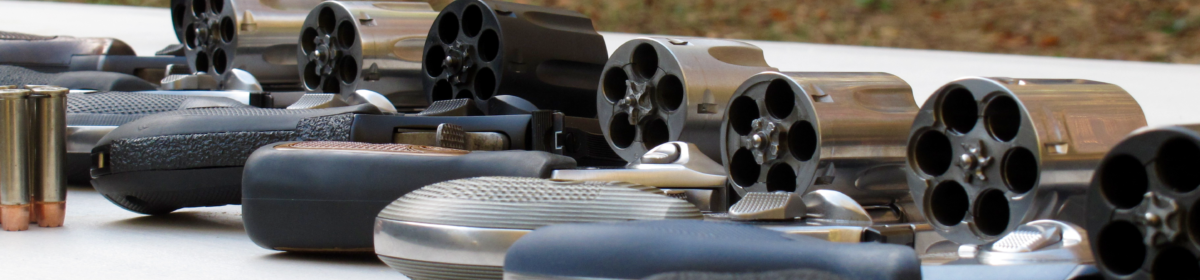

How many times have you said or heard, “If only this gun could talk about its past.” Where has it been, who owned it and what has it done?
I have a few, old long guns that fall into that category. One is a battered Browning A5 humpback 12 gauge with checkering that’s almost a memory. Another is a Remington 870 20 gauge with an action so smooth that if it’s held vertically and the action is released, the forearm will drop as effortlessly as if on ball bearings. My 1950’s-era Winchester 94 .30-30 has had its bluing silvered by use and time, especially at its perfect balance carrying point at the bottom of the receiver.
Of course, I’ve got revolvers that make me ask the same question. In fact, have four treasured, pre-War, N-frame Smith & Wesson revolvers that I find especially interesting, and one in particular–a Registered Magnum–has shared part of its past with me.
SEASONS
I guess that most of us have gone through phases in our interest in guns. Mine started with a couple single shots–an H&R 12 gauge Topper, and a Remington 580 .22. Growing up in the 60’s, I moved onto ratty old pumps, an ancient double that would sometimes fire when it wanted to, and other oddities.
My college days brought me into varmint hunting and a penchant for accurate rifles. 1911’s and old military guns found their way into my possession for a while. As I grew older, a sporting clays and wingshooting passion brought me into the world of higher end over/unders and a love of the 28 gauge as I followed Boomer, Valkyrie and Freyja, my Airedales, in pursuit of game birds (by the way, my beloved pointing dogs were Airedales, a truly versatile breed that typically flushes, not points). One special 28 gauge in my collection from this phase is a Zephyr Upland King, replete with incredible engraving, a checkered butt and elephant ivory mid and front beads. Made circa 1950 in Spain, this gun was Marcia’s gift to me on our first anniversary, nearly 30 years ago.


My tactical phase came next, with lots of black rifles and shotguns, and hundreds of hours of training, with tens of thousands of rounds fired. In 2004, Ohio passed concealed carry and I was certified to train many in the proper use of handguns for protection, with a couple former students actually putting that knowledge to use. After dealing with too many students who objected to being in a CCW class, I moved on, because they thought that they knew it all. Three years were spent with our local Sheriff’s Office Training Bureau running quals and helping the “no carries” get up to speed.
That brings me to where I am today, at age 75, which I thought would have taken a lot longer to reach. When I refer to myself as being older and wiser, my wife kind of smirks a bit and jokingly mentions, “Well, one is true.” While I still have a few 1911’s, some rifles that I’ve taken to Africa, some excellent bird guns, a fine selection of .22’s, and some black guns and striker-fired polymer wonders in the safes, I have come to truly appreciate blued steel and walnut appointed firearms, mostly lever action rifles and old revolvers.
CLASSIC SMITHS
My main interest is in old Smith & Wesson N-frame revolvers, primarily pre-War models. Their seemingly massive weight, huge cylinders, hand-checkered top straps (on the Registered Magnums), fitted rear sights, and meticulous assembly fascinate me.

The buttery actions on these fine guns are an even bigger fascination, and I marvel at the feel when I pull smoothly through, on double action. It reminds me of a huge, massive Swiss watch, almost silently clicking through the trigger stroke, while rotating the cylinder into its final, locked position, before dropping the hammer. I think back and try to imagine the true craftsmen, wearing leather or canvas shop aprons, intent on their work, bending over a fine revolver in production, while deftly using measured, practiced strokes of a file, or a light, almost feathery touch of a stone, to turn metal into a work of functional, mechanical art. These men, who took such pride in their craft, are now mostly long gone, but their work lives on in the firearms in our possession.
NEW FRIENDS
Three years ago, I was honored to join a very special group of men whose values and traditions revere the Second Amendment, family, God and country. Through their influence and my exposure to their firearms collections, I’ve learned volumes about old, collectible guns, but realize that my knowledge is minuscule compared to theirs. Gratefully, their influence has helped me to acquire some of the old Smith & Wessons that appeal to me so much.
My first was a Smith and Wesson .38/44 Heavy Duty, with a four-inch barrel. As many know, during the days of motorized bank robbers, the old, relatively anemic .38 Special round wouldn’t penetrate the heavy steel bodies of the bad guys’ vehicles.

Boosting the velocity of the round helped solved the problem, but necessitated using the heavier, N-frame upon which the .44 Special was built; hence, the .38/44 moniker. This was the precursor of the .357 Magnum. Mine is well-used, smooth, accurate, and has probably been reblued at some point, which belies its age.


Next came a six and a half inch, .38/44 Outdoorsman, which is essentially the same gun as the previous model, but with a longer barrel, and hand-fitted adjustable sights, making it more versatile as an outdoorsman’s field gun. It’s as smooth and accurate as the Heavy Duty, with a nice finish which is probably original.


The Outdoorsman was followed by what is now a favorite–a Smith and Wesson .44 Hand Ejector, Third Model. This gun is more commonly known as a Wolf & Klar .44, and was a favorite of Southwestern lawmen.

Wolf & Klar started as a pawn shop in Fort Worth, and grew into a respected hardware and gun store. The company often ordered specially-made runs of revolvers, and had the pull to do it, as one of Smith & Wesson’s best customers.

My particular revolver is a .44 Special, with a four-inch barrel and a very well-worn finish, which gives the word “patina” true meaning. It’s incredibly smooth, accurate, and a lot of fun to shoot. In fact, I often find myself carrying this .44 on our rural property, as I make my daily rounds.

SETTING THE HOOK
My first encounter with an S&W Registered Magnum, which is truly in a class by itself, was at Gunsite, when a small number of us took private 250 and 350 Revolver classes taught by my late, good friend, Ed Head—a respected Gunsite instructor, and a legendary, retired Border Patrol agent. My Texan buddy, Mark, shot both classes with a 3.5” barreled Registered Magnum, and acquitted himself quite well. I was able to shoot Mark’s revolver then, and others of his, in the years to come. After that, I definitely wanted to own a Registered Magnum, even with its pretty hefty price tag.
As explained by Roy Jinks, Smith and Wesson historian:
The .357 was introduced in 1935, and was a custom manufactured revolver. It was available with a minimum barrel length of 3 1/2 inches and a maximum of 8 3/4 inches. Each revolver was manufactured to the individual’s specifications. The revolver was stamped with a registration number and a card was enclosed with each revolver. When the gun was received and the registration card filled out and returned, the owner received a registration certificate, which included the owner’s name, registration number, barrel length and trigger pull, both double and single action. The certificate was signed by Douglas Wesson, vice president of our company. Unfortunately, this practice proved too costly for a revolver that sold for $60, and was discontinued after approximately 5,500 of the registered .357 magnums were manufactured.
A DREAM GUN WITH A STORY
A few years ago, my friend, Bobby Tyler, of Tyler Gun Works in Friona, Texas, had a 3.5 inch Registered Magnum in his possession and I was able to buy it. My dream had been realized, but the extra paperwork that came with the RM made it even better.
Included in the envelope was a letter from Smith and Wesson historian Roy Jinks, detailing the ownership journey of the revolver, as well as the registration certificate, and photos of the gun’s second owner, who was the son of the first owner.


The son was B.B. Smith, a Richmond, CA Police Inspector. The photos in the package show the Inspector, wearing a fedora and the Registered Magnum in a Bucheimer crossdraw holster.


They also show his badge and credentials, a target shot at the range, and, surprisingly, a License to Carry Concealed firearm, dated May 19, 1947. Listed on CCW form are the Registered Magnum, another Smith .357 (model unknown), and a Colt .25 ACP.


Curious about why a CCW was needed for a police officer, I reached out to an LEO friend who, ironically, works for the same department. He surmised the Bay-area agency didn’t have a policy that permitted official carry off duty, and issued the CCW permit in its absence.
TWISTS AND TURNS
Both the historian’s letter and Registered Magnum Certificate show that the gun was originally ordered with an 8 3/4 inch barrel, blue finish, D.W. King front sight ramp and Elmer Keith 1/8 inch gold bar, and a King square outline rear sight. It was sighted in at 75 yards with magnum ammunition, a center hold, and magnum stocks. Guns could be ordered with factory sights regulated out to 100 yards with either a center or six o’clock hold. The certificate further indicates that the single action trigger pull was set at 3.5 pounds and the double action at 10 pounds.


From there, things get a bit murky, because the revolver now has a 3.5” barrel and the front sight is not the one described in the letter or certificate. Yes, the serial and registration numbers match the paperwork. Interestingly, the gun came with the original barrel and the original, much-worn stocks that are now almost smooth. The stocks on the gun now are period correct.


The story that came along with the gun was that the original owner, B.K. Smith, had the 8 3/4” barrel bored out smooth. However, the barrel is still rifled, although the grooves appear to be very shallow. The owner’s son came into possession of it, and returned it to the factory to have a 3.5” barrel installed, which was much more appropriate for his work as a police inspector. Unfortunately, the original front sight is absent and was replaced by what appears to be a mirrored King ramp model.

SHOOTING THE REG MAG
Somehow, the Registered Magnum reflects the old saw about something being more than just the sum of its parts.
The reliability and longevity of these guns are outstanding, even legendary. My amigo Mark has put 20,000 rounds through his oldest 3.5” Registered Magnum, and it’s still going strong. The round count the gun had fired before Mark’s ownership is unknown, but one can only imagine it was substantial. During the two Gunsite classes shot with his R.M., a nightly cleaning is all it took to keep it going with nary a misfire.

Mine has never failed to fire and mechanically, it’s perfect. Many of my more modern revolvers, which have been tuned by the best smiths for reliability, have needed attention when problems arise. My Registered Magnum? Never. Not bad for a ninety-year-old revolver.

Interestingly, both Mark and I have discovered that these guns seem to like .38 Special +P or .357 Magnum loads over standard .38 Special. The rounds used for the accompanying photos were lead, 158 grain SWC at 1000 fps. Of course, the big N-frame dampens the recoil of even the heaviest loads.
LEATHER
Obviously, this revolver’s historical significance just begged for some period correct leather to go along with it. I turned to good friend, Mike “Doc” Barranti, of Barranti Leather in Dunn, Texas, to help me out.

We decided that law enforcement officers of the time could possibly have used a Myres Belt Scabbard, Model 988. Barranti purchased the rights to the old, much revered, SD Myres Saddle Company products, and actually used the decades-old, original Myres pattern to make my holster.

To accompany it, Doc also produced an impressive, lined Ranger Gunbelt, known to some as a River Belt. A twelve-round cartridge slide completes the rig. I can’t help but wonder if this special revolver had ridden in a similar rig ninety years ago.
REVOLVERGUY VOICES
As mentioned earlier in this piece, we’ve all wished that our guns could talk to us and tell us the stories of where they’ve been, who owned them and what they’ve done. This revolver can tell me a few years of its story and that’s something. But what tells me even more are two sets of well-worn stocks, and an action honed smooth by years, and probably tens of thousands of rounds.


So, I’ll continue to shoot this revolver once owned by Inspector B.B. Smith of the Richmond, California Police Department. I’d really like to get a period correct Bucheimer Crossdraw like the Inspector used, and maybe even a fedora.

These exquisitely made S&W revolvers can’t talk but their impressive workmanship and durability speak volumes about the talented folks who crafted them for discerning customers who wanted the very best.
Right you are! I also find it amazing that these guns are up to 25 years older than me!
Great story Sir! Thank you for sharing your N Frames with us! I personally have a love for K Frames. Specifically the Model 19. My first .357 was a 4in Model 28 Highway Patrolman edition that I unfortunately let get away from me. I was 17 when I handed the $250 bucks to my folks who then signed the paperwork and bought my M28 for me. I toted it all over the canyon lands and wooded river bottoms of Northern NM. It is definately one that got away but I try to make up for it by keeping several M19s around. Thank you again!
Thanks for your comment, Mark. I agree, the N frames do get heavy and I’ll go back to K’s from time to time. However, part of the heavy weight is history!
Alas, a wonderful walk back in time to when S&W revolvers were assembled with the care and elegance of a Rolls-Royce Phantom I (@ 1925-1931 ), and a lasting legacy of artistic craftsmanship. While steel qualities and heat treatments have evolved over time, the classic Rolls-Royce like quality has not been matched. For the Colt Python aficionados out there, sorry, the 5 and 4 screw N-frame revolvers had a better fit and finish than any Colt.
The big N frames are a delight to shoot and easy to control. As for carrying a 5″ version for 10 hours a day, well, that’s where the K-frame stole the limelight.
Nick, you have some treasures that many of us can only fantasize about. Thank you for sharing .Use them with love and care.
Thanks for reading and your comments.
I’m glad to be able to share these works of art with others who would appreciate them.
Better than the Python? Maybe slightly. But not better than the “Shooting Master”.
Thank you for an excellent article on your life’s journey with firearms. Very well written and great images. Vintage Smith revolvers are treasures of a different time, the pinnacle of manufacturing in this country.
Thanks for your comments, Tony. Holding, and especially shooting these fine revolvers connects me with the past and their former owners.
Wonderful revolvers and great story about them. I enjoyed reading about your “seasons” of gun collecting, especially your first firearms. I was born in 1972, and my first firearm were… a Remington 582 (the tube-magazine model of the 580 series) and a 20-ga. H&R Topper. An 1896 Swedish Mauser came next, and the first handgun I bought on my own was a 1955-vintage Combat Masterpiece (pre-Model 15). A minty 4″ M28 Highway Patrolman that my dad (who is your age) picked up during one of our many gunshop excursions came my way and has filled my “heavy-duty” N-frame .357 niche ever since. But I’d love to get my hands on one of the gorgeous pre-war models! Thanks for sharing your photos and experiences with us.
Etienne,
It looks like we came down the same path in our introduction to firearms. I owned a 582 for a while too, great rifles and very accurate. Good luck in your search for a pre-war model.
Thank you for sharing these guns with us, Mr. Rukavina. The history you have preserved and the stories that go with these guns are priceless. Those Smith fellows (B.K. and B.B.) knew their revolvers! How cool that Sr. opted for a King’s long range front sight with a Keith gold bar on that 8 3/8″ barrel, and that the younger Smith had the 3 1/2″ barrel with the King’s ramp/mirror front sight installed for police work? The fact that those sights were options from the factory back then reminds us of S&W’s glory days! Thanks again for the great article.
Mr. McPherson,
We definitely look at the creation of this fine revolver in the same way, especially how it was transformed for different purposes. It’s pleasure sharing with someone with a similar viewpoint.
Nick, I sure hope you find a Bucheimer Crossdraw for B.B. Smith’s gorgeous ole Reg Mag!
Great idea, my friend! The next time that you see me, I’ll have one with me!
Now share pictures of your Browning and Remington yeah?
What a beautiful collection! The history is especially interesting to me, as I currently call Ohio home but grew up on the San Francisco Bay… Oddly enough, my high school years and beyond in Richmond! I did have a friend on the Richmond PD, too, though I imagine he’s retired by now. Anyway I’m glad you actually shoot those beautiful machines, I’d hate to imagine how many gather dust and rust in an attic or sock drawer.
Excellent article. The pictures are each worth 1000 words themselves. The style and class and history behind those revolvers pops right out of the picture into the reader’s mind. And you are exactly correct… if only those old guns could tell their stories.
I have recently discovered old Smith revolvers and am quite impressed with their quality. I just picked up a 28-2 and am very impressed with this firearm. This no doubt will become my new addiction. Thank you for the article and inspiration therein.
Thank you for a great article. I believe the Registered Magnums are the finest example of S&W’s ever built. I’ve never had a chance at owning one of them. However, I was on the S&W Forum once and saw a discussion on old vintage S&W boxes and their worth. I had an old box laying around on a shelf below my loading bench. I kept odds and ends for scope rings, mounts and screws in it. I have no idea where it came from or how long I’d had it, but it looked really old. I took a pic of it and posted it on the forum. I got an immediate response from a member there who told me to be careful selling the box and not take the first offer. He told me it was valuable. Turns out it was a box for a Registered Magnum. I sold it for $950. It was just the cardboard box with the little metal tabs at the corners. The thread on the site about my box got off onto a discussion that a similar box had just sold for $5000. True thing. The thread perked along for a few days with lots of discussion and opinion about why someone would pay so much for a cardboard box. The thread kinda ended when the guy who actually paid the 5K for the box joined the thread. He told us that he actually owned the pistol the box came from the factory in. He had all of the original items that came in the box from the factory and the certificate. Getting the box completed the whole set up just like it came from the factory back in the 1930’s. He said the box raised the value of his RM more than the 5K he paid for the box.
One thing I learned about the RM’s especially those from the 30’s they were really expensive and if you had one you were likely “someone” special. The average cop or gun guy couldn’t afford a RM. They were owned by Presidents, General, Movie stars, CEO’s. I never learned who my box originally went too. I’d like to think General Eisenhower’s RM came in my box. Probably not but I know he had one.
I agree with your comments I am lucky to own 2 .38/44s one a pre war 5 inch barrel the other a 4 inch post war gun. I love their balance and with proper .38s would have felt well armed.
Speaking of guns with stories, a woman was consigning her late father’s collection to a local shop when she mentioned his Ruger Security Six had a police record! This remark grabbed the shop owner’s attention — an explanation was needed before continuing this transaction!
As the tale goes, her dad used the Ruger to dispatch an early morning home invader in Van Nuys during the mid-80s. When police arrived at the scene they recorded the shooting’s pertinent details, thus the gun’s police record. It was ruled a justifiable homicide, and her father was not charged.
The gal called it a “blood gun”, and not just for that event…it clocked her in the forehead and drew blood when she shot it as a young teenager!
This 4” stainless Security Six wearing Pachmayr presentation grips still looked almost brand new. $500? Okay, twist my arm why dontcha?
Mr. Rukavina, you certainly have a beautiful collection of great revolvers.
My uncle carried a 3.5-inch pre-Model 27 N-frame .357 as a duty gun; that was my intro to the big Smiths.
About 30 years ago I was at a gun show in suburban Chicago and a vendor had a table of about ten .38-44s that were allegedly carried by the security force of Boeing Aircraft Company during WWII; all of them had “B.A.C.” engraved on the frames. I wanted one, but I didn’t have the dough at the time (Damn kids, always wanting shoes and food and stuff!)
I’ve always been a K-frame guy, but recently I’ve become enamored of more vintage guns like .38-44s, 1917s, 1950s, and even (Somebody, please help me!) 1911s. I guess I’m becoming more of a traditionalist in my old age.
And as a retired LEO, I like that your Reg Mag spent time in a cop’s holster. That’s just icing on the cake.
I was always told “Buy the gun, not the story” but you lucked out and got both anyway!
If the holster is not documented as a Bucheimer, it is more likely by the Clark holster company that operated in Los Angeles from 1930 until formed into Bucheimer-Clark in 1959. Ed Clark originated the spring-post holster design shown in the picture. [The patent number on Berns-Martin holsters is for a Clark patent.]
Any holster marked Clark, LA or Clark, Los Angeles would be from before 1960.
A couple of other companies from the 1970’s used the Clark name but were only tangentially related. Markings seen are generally Clark or Thompson with a stagecoach stamp and cities other than L.A.
Just about every holster company except Bianchi made a spring-post holster. Safariland made a holster using a different Clark pattern most would recognize as being made by Lewis – but again, Clark designed it.
Mr. Smith,
Thank you so much for sharing your knowledge the holster in the photo and its probable history. I’ve learned something new and interesting from you.
Nick Rukavina
Nick – great write up and even greater revolvers. Fil here, 57. I just almost suddenly developed a passion (which I didn’t have before) for SW revolvers (though I had a few old ones) and went nuts with model 27s and model 29s. Bought three. But I discovered that my true passion lied with short barreled, around the 3 inches either 27s or 29s, so I bought what I could find – just can’t get enough. Thanks for this article! It quenched some of my thirst.
Excellent article. I understand. My father was Idaho State Police from 73-94. When ISP transitioned from the S&W Model 65 to the S&W 4586 in 1991, he purchased the Model 65 and when he retired in 1994 ISP gifted the 4586 to him. He passed away in 2016, and I inherited both those Smiths. Before the Model 65 became the primary sidearm in 1979 the Model 28 rode in the trooper’s holsters. Dad opted to not purchase the 28 at that time (79) – a decision he later regretted, but so it goes. Anyway, I cherish both of those Smiths along with their Safariland holsters and the worn equipment belt that carried both of those handguns and their respective holsters. My father was a uniformed officer throughout his career. He wrote many tickets, pulled more than a few folks out of smashed up vehicles (some alive and some not), changed flat tires for folks and drove through Idaho blizzards and blistering Idaho summers. He only fired those handguns on the range, but those two handguns will not be leaving my collection.
Amen, brother. If the fires, floods, or man-made disasters ever chased me out of my home, the first things I’d try to save would be dad’s duty guns and badge. Those are irreplaceable!
Reading this article just gave me goose bumps because I’m so into these Smith revolvers especially the old blue steel! I actually recently have come across a gentleman with a 1936 3.5” registered magnum model 27 that’s up for grabs. Although I haven’t seen or had it my hands yet I’m working on that! Just out of curiosity what kinda price tag did you have to pay for yours? I know these specific smith revolvers are the “grails” of the S&W world and can fetch a pretty price. If you would give me some kind feedback on that if you would. Enjoyed the read as well! Looking forward to hearing from you! Thanks..