
SCENARIO: Walking to your car, late one cold, rainy evening after a business meeting, you see them. Both of them are armed with knives. You bellow your challenge, “STOP, DROP YOUR WEAPON!” as you slide between two cars, building distance as you draw your J Frame. “I should have brought a bigger gun,” you think, as the knife wielding suspect follows you. The knife glints as he charges. You are authorized to employ deadly force, and as a consequence of the suspect’s failure in the victim selection process, you watch your sights rise and fall. There’s no sound as you back pedal. You have no idea where the number two man is, but you see the first suspect jitter and scamper away.

You lose sight of your assailants and as you get your back to a wall of the area, you scan. Wild thoughts race through your mind: Did I hit him? Oh God, what if I missed? Where did they go? Is this over? This is going to cost me a pile of money in lawyers’ fees and seriously complicate my life… You suddenly realize that you fired your revolver, and it might be a fabulous idea to get it reloaded because you have no idea where your assailants are or if they will press the attack.
OPTIONS
You decide you have two options in terms of reloading your revolver.
OPTION ONE: You hunker down behind cover, carefully open the cylinder of your Centennial and push the ejector rod up to raise the fired cases. You try plucking the partially ejected rounds out of the cylinder with your cold, rain-soaked hands which are now trembling due to the dump of adrenalin into your blood stream. After what seems like a long time you are able to remove three fired cases.

Now you are trying to access the spare ammunition you carry in a stylish Two-by-Two cartridge pouch. You look around trying to figure out where your assailants went. You fumble to get the first two rounds into the gun, but you finally succeed. You grit your teeth as you withdraw two additional cartridges and fumble to get them into the cylinder. The rain is coming in sideways, and the lights are out all over town. The traffic signals click on, but only on emergency power. With two spare rounds in hand, you try to shove them into the gun. It doesn’t take a genius to know you are trying to fill the one remaining charge hole with two shells. You successfully get the last round in the cylinder, dropping the fourth spare round, and close the gun up. You are not sure how long the whole process took but it seems you could have been timed with a sundial. Oh yeah, I better call the police, and you begin to fumble with your phone….
OPTION TWO: You hunker down behind cover, you carefully open the cylinder of the Smith and Wesson and eject all of the cartridges, both live and fired, into your palm and quickly dump them into your rear trouser pocket.


You then access the Safariland Comp I speed loader you habitually carry and insert the cartridges into the cylinder. You have done this a pile of times (you are a multiple attendee at the Pat Rogers Memorial Revolver Roundup at Gunsite). You close the cylinder and get back into the fight.

You are glad you are able to quickly reload your revolver and keep scanning for threats. It sure does feel good to have a fully loaded revolver in your hand. You now access your phone to call the police. What do you tell the dispatcher and the responding police? (Author’s Note: Come to one of our classes where we teach the dynamics of interacting with law enforcement.)
WHAT’S THE BEST PLAN?
The purpose of this article is to initiate discussion on how to tactically reload a revolver. A tactical reload is defined as replenishing fired cartridges while retaining unfired rounds, thus bringing your weapon back to a fully loaded condition. In essence, you do not want to conduct a typical speed reload (where the gun is presumed to be completely empty) because you may still need the unfired cartridges still contained in your cylinder.
You have a finite amount of ammunition to work with and retaining unfired ammunition helps you better defend against the possibility of additional threats. Dumping perfectly good and potentially lifesaving ammo on the deck is suboptimal.
LOOKING BACK
A brief discussion about the history of the revolver tactical reload is in order. Typically, prospective law enforcement officers have to attend formalized training with their agency’s academy (Examples are New York Police Department Academy, Federal Law Enforcement Training Center, Pennsylvania State Police Academy, etc.) Newly hired officers are taught the basics of using their issued sidearm and some sort of long gun. Most academies don’t teach the use of backup handguns.
Most recruits are issued a single handgun. The teaching methodology centered around using that one weapon. During the revolver era, some academies focused on what are called “empty gun” reloads. In an “empty gun” reload, the shooter has fired all available rounds and is taught how to fully reload his handgun, whether it be a revolver or semiauto. Training drills and courses of fire tended to emphasize this. Threats tend to persist, and additional shooting may be required to attend to lethal problems.
What happens when you have not fired the entire complement of ammunition in your sidearm? How do you get it fully loaded in that case? Some academies taught “partial gun” reloads, initiating the origin of the tactical reload.
ASSUMPTIONS
At this point in our discussion, readers need to know about underlying ideas that were associated with a recruit’s handgun training. These initial theories are based upon historical periods. I have a friend who served in the FBI and went through our academy in the late 1960s. He was equipped with a revolver, belt holster and that was about it. Most of his training centered around reloading his revolver from loose cartridges carried in his dominant hand trouser pocket. Speed loaders were not in common use at that point. I suspect some agents may have carried reserve ammunition in some sort of belt mounted slide where individual cartridges were housed in loops of leather but I have never seen photos of period training where our agents had issued ammunition carriers.

I have another friend who served in the FBI with whom I worked. He was a student in possibly the last revolver armed classes of trainees. He was equipped with a Smith & Wesson Model 13 fixed sight revolver with a 3 inch barrel (Author’s Note: S&W, now that you are making revolvers without the dreaded lock, please, please, please bring back the 3 inch version of the Model 10/13.), a thumb break, strong side, outside the waistband leather holster, a Safariland Comp II speed loader, a Safariland Split Six speed loader carrier, and a Desantis 2x2x2 cartridge pouch. For training events, my friend carried spare, loose cartridges in his right front trouser pocket.

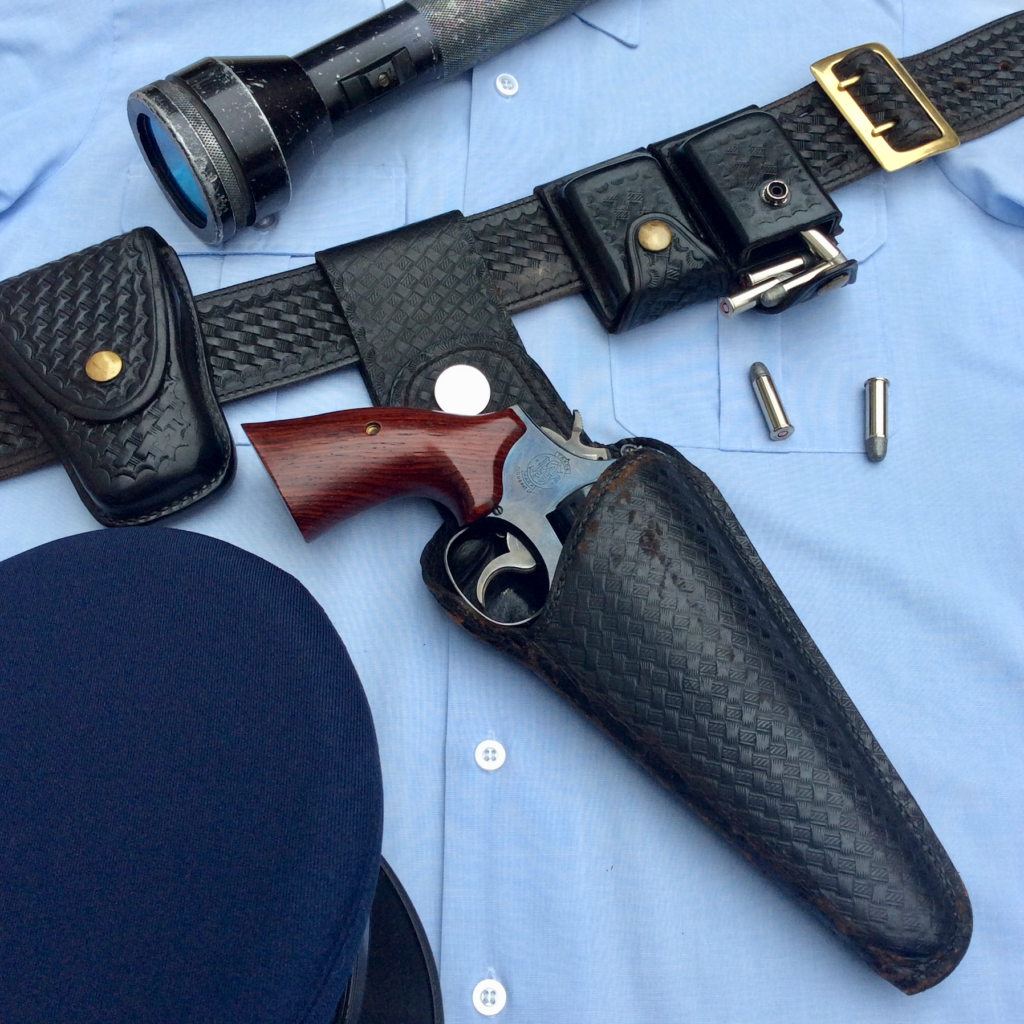
I am aware of noted Los Angeles Police Department Officer Scott Reitz who began his career carrying a revolver and was required by LAPD regulations to carry reserve ammunition in drop pouches. While speed loaders were in common use, they were not authorized for LAPD officers.
As a historical note, I have reviewed what I believe are all of the revolver centric qualification courses used by the FBI during the period when FBI personnel were primarily issued revolvers. In none of those courses were “partial gun” reloads required on timed courses of fire.
TECHNOLOGY, TRAINING, AND TACTICS
The 1960s-era FBI agent only had the option to reload his service revolver with loose cartridges. If he was in a fight and expended three rounds, it made sense to remove fired casings, leaving live ammunition in the cylinder while he accessed reserve cartridges. If he needed to address an immediate threat, all he had to do was close the cylinder and begin firing.


My 1980’s-era FBI Agent had access to the newfangled speed loaders so he had a way to more rapidly reload his revolver, yet he was taught the tactical reload described above. Officer Reitz only had access to either loose cartridges carried in the dump pouches on his duty belt or later an early form of “speed strip”. The point is that what each agent/officer was issued in terms of equipment impacts what techniques are taught. Likewise, there tends to be a sort of inertia in terms of training and techniques. Once a technique is adopted, most agencies are loathe to change it. My suspicion is that once early agents were taught how to top off a revolver who only had access to loose cartridges, that technique continued to be taught despite my 1980s agent friend having access to speed loaders.
ANALYZING THE TRADITIONAL TECHNIQUE
Let’s take a look at the Pros and Cons of the Traditional Technique, from a variety of angles:
SPEED: First, the traditional technique is slow. There is no denying that. The technology has progressed to the point where speed loaders are commonplace. Speed Strips are very common as well. Cartridge loops and pouches may still be found, but seem to be fading away a bit. If the point is to get your revolver from a partially loaded state to a fully loaded state, there are several technological means that expedite that process. If you have discharged a weapon at a potential threat and are unsure if that threat is still ongoing, getting your weapon fully reloaded is just plain good sense (it makes even better sense to carry a backup handgun but that is another topic). Anything that enhances that process should be considered.
DARKNESS: The late Pat Rogers once told me that a technique that doesn’t work in the dark is not something you should rely on. During one of the carbine courses I took with Pat, we did a night shoot. It was dark out. You could barely see the outline of your hand in the ambient light. Pat had us load and make ready to shoot a demanding carbine qualification course. The catch was all of our preparations had to be done in complete darkness except for the weapon mounted light check. This experience was an eye opener for me. It really caused me to re-think some of the things I had been taught. Applying the lesson, I learned from that experience to the traditional tactical reload of a revolver causes me some serious concern. The traditional tactical reload technique relies on being able to see the fired cartridge cases that are left partially ejected. I suppose you could feel them if you were in a low light situation but I believe the possibility of pushing those rounds back into the cylinder is a distinct possibility. Even assuming you can successfully remove fired cases from individual charge holes in your revolver’s cylinder, you are now faced with the task of feeding individual cartridges into those same charge holes. Doing that on a well-lighted, flat range under blue sunny skies with puffy white clouds on a range at Quantico is one thing. Trying to do that behind a parked car in the dark after you traded rounds with a goblin is another matter.
CLIMATE: Cold temperatures have a deleterious effect on human performance. I believe that once you get down to about 10F degrees will seriously inhibit their ability to perform a traditional tactical reload. It gets worse when you realize that in the scenario I posited at the beginning of the article, it was raining. Folks may not think that the rain would be a factor but it’s something to consider. If you want an example, go try to pick up empty cartridges cases on a snow covered range. At the opposite end of the spectrum, if it is 90 degrees Fahrenheit and humid, trying to grasp small, smooth round cartridges might be just as much of a challenge.
HUMAN PHYSIOLOGY: We know fine motor skills tend to be degraded by the fight or flight response when adrenaline gets pumped into their blood stream. Trying to pluck individual cartridge cases out of a revolver cylinder, as opposed to speed loading the empty cylinder of a revolver, seems to be fraught with unnecessary pitfalls.
THE REAL WORLD: I have thought about this topic a fair bit. During one of the many telephone conversations I had with the late Pat Rogers, I asked him about how a thinking shooter would conduct a tactical reload of a revolver. Pat’s response was immediate. Dump the contents of the cylinder into your palm, pocket live and fired rounds and speed load the cylinder. Pat explained that this was the quickest way of conducting a tactical reload. Readers who are not familiar with Pat need to know that he served as a New York Police Department (“NYPD”) Officer for 20+ years. Pat’s service occurred during the 70s, 80s and 90s. The 1970s were a noticeably violent time in law enforcement in general and in New York in particular. Pat described the 1970s NYPD police work as “the War Years.” Pat was involved in multiple gunfights, and he shot a fair number of criminals. Those shootings centered around using mandated revolvers per NYPD regulations.
EXPERT OPINIONS
In researching this article, I spoke with retired Texas lawman Wayne Dobbs. In our discussion, he concurred with Pat’s assessment but added that if you are crouching behind cover, you will have lots of difficulty pocketing rounds in your front trouser pocket. The better course of action is to deposit rounds in your rear trouser pocket or a suit coat pocket. Wayne could not recall any instance where someone conducted a tactical reload of a revolver as described in Option One above during a real fight. Wayne also mentioned that the best solution was to access a backup gun (I couldn’t agree more).

I queried the remainder of the instructors who teach at the annual Pat Rogers Memorial Revolver Round Up (PRMRR) regarding whether they were aware of anyone conducting a tactical reload of a revolver in a fight. There was only one incident where a lawman conducted a tactical reload by removing fired cases from the cylinder of his duty weapon. That officer, Master Sergeant Gary Eastridge, described his fight in Episode 4 of the Off Duty / On Duty Podcast, hosted by his son, Bryan. Rather than recite the details of Master Sergeant Eastridge’s shooting, I highly suggest you listen to his account in his own words (beginning around the 37 minute mark). Master Sergeant Eastridge conveys lots of lessons besides how to reload a revolver. I will touch on a couple of noteworthy details.

Master Sergeant Eastridge was a relatively new officer (five months of service) when he was involved in his shooting incident. He was required by department regulations to carry reserve ammunition in 12-round loop cartridge slides on his duty belt (Master Sergeant–then Officer–Eastridge’s incident occurred in 1979.). He carried a S&W Model 19 with Speer 357 Magnum hollow points. He, by his own description, liked to shoot, but was not as deeply into firearms as he is now. Gary had been taught to retrieve two rounds of ammunition from his cartridge loops and fill his cylinder for his reload. Gary’s son indicated that Gary still can easily beat him using loops when his son is using a strip loader. The elder Eastridge noted that he saw that he had one live round left, then placed his thumb over that round and ejected the remaining rounds. He then filled the cylinder from rounds carried in his loop loaders. His concern was getting the gun back into action as quickly as possible because there were seven additional potential criminal associates of the individual they were trying to arrest. Gary felt that given the conditions, he could have accomplished this reload in low light.
In further discussing this incident, Gary noted that a backup gun is a great option as are speed loaders. He was constrained by regulation to reload from loops and he learned to be very proficient at that task. That tracks with what I have observed. Older FBI Special Agents who were trained on revolvers during their initial training, were incredibly fast loading loose rounds from their pockets.
In further discussing the tactical reload of revolvers with the instructors who teach at the PRMRR, they all agreed that if there is an imminent threat, dumping the contents of the cylinder and speed loading it makes the most sense. If the threats have been stopped, then opening the cylinder and removing individual cases is fine.
CONCLUSION
In today’s world where speed loaders are commonplace, OPTION TWO, the tactical reload using a speed loader is probably the quickest, most positive way to reload a revolver if there is any possibility of the presence of an active threat.
What is even more important is having situational awareness so you can see threats before they see you AND having the necessary, ingrained, reflexive gun handling that allows you to rapidly conduct any operation. Master Sergeant Eastridge was constrained by department rules from using speed loaders. Despite that imposed limitation, he trained and figured out a way to win. We should all learn from his example.
*****
SPECIAL THANKS: I’d like to extend my appreciation to Master Sergeant Eastridge, his son Master Sergeant Bryan Eastridge, Detective Wayne Dobbs, and the Instructor cadre from the Pat Rogers Memorial Revolver Round Up, for the help with this article.
*****
Editor’s Note: Bruce will be one of the featured instructors at the upcoming Revolver Fest and Pat Rogers Memorial Revolver Round Up events, and if you liked what you saw here, make sure to register for one of his sessions! For those who will miss these events, you can find more information about Bruce’s public enrollment classes at his SAC Tactical website.

It’s articles like this one that force me to consider and evaluate a variety of unhappy scenarios, and hopefully better solutions, if ever under attack by “goblins” who might ambush me.
By far the most dangerous environment for me is where I live (Portland, Oregon) because of the out-of-control homeless/nutcase/zombie situation downtown. My decision is not to go there and avoid the all too real risk.
Spencer:
Thanks for the kind words. I am glad this article provoked thought on these issues. What works best for me may not work well for you; but the point it to think it through a head of time.
As to Portland, I understand your concern. I try mightily to avoid places like that.
It’s worth pointing out that my comments about Portland’s homeless problems are separate from the current news regarding the ICE protests in the city, which lately have been very small in size and limited to a tiny area. In fact, that ICE location is so hidden from the rest of the city that I doubt most residents know where it is. And they certainly aren’t affected by the (so far) small, peaceful demonstrations.
Back in 2020, when for months young unemployable couch surfers were raising Cain during the George Floyd protests (riots, really) in downtown Portland near the Federal buildings–well, that was a big mess that could have been shut down by the local police if we had had a mayor and city council with just a little common sense and leadership skills. Instead, the feckless politicians allowed the agitators, many of whom could not explain why they were there, loot, burn and trash much of the downtown. For at least a couple of years after, windows in the City Hall and many stores were boarded up, and more than a few companies went of business.
On the other hand, Portland’s “homeless” problems, especially downtown, are different, though chronic, and yet similar. They’re similar to the 2020 protests in that wimpy politicians won’t allow the police to roust the vagrants, winos, ex-cons and druggies and give them some stick time. Instead, normal people have to suffer with unbelievable piles of trash, gobs of excrement and vomit, and used needles deposited on city sidewalks and in parks. Adding to that filth is the spontaneous violence that sometimes erupts when slobbering bums, high on a cocktail of meth, fentanyl and fortified wine, hear demonic voices and attack bystanders with knives and bludgeons.
If the national guard were called in to remove that homeless riffraff from my city and stuff them in forced hard labor camps I’d be pleased. But if the ICE protests remain small and peaceful, then I see no need for the military to be deployed. The city’s police, if allowed to do their jobs, are well equipped to handle any local protests that get out of hand.
Let’s please keep it on track . . . thanks
Will do, Mike.
Seriously, I have enjoyed the latest articles from Bruce, Nick, Steven and Kevin.
All of our writers do a great job!
Welcome aboard, Mr. Cartwright. There should be a companion “A-A” group to the alcoholics called Attorneys Anonymous. I think we’d find some interesting company there.
I managed to survive the era of revolver cartridge drop boxes. Just the image of them in this article gave me hives ! They were an abysmal creation designed for parade grade asthetics over practical reality. They were worthless, but they sure looked good.
IMHO, God’s gift to wheelgunners was the HKS speed loader. I think it was first marketed as the “Second Six” or something like that around 1970. I was still a rookie when they first hit the market, and they were immediately appreciated. In my academy class, Newhall was a fairly fresh wound despite being on the opposite end of the country from where that went down. Despite official department policy, many of us, myself included, carried these newfangled speed loaders to supplement the dump pouches. It was easier to ask for forgiveness from I.A. than permission. When Safariland came out with the Comp2 loader, nirvana had arrived.
For revolver reloading – there is no substitute for practice, practice, practice. Pitch darkness, in the rain, at 28 degrees (F) is no time to be juggling rounds and wondering which charge holes have the live rounds. Since the early 1990s, I’ve come to swear by the Safariland Comp-II speedloader. It’s compact enough to fit into a pant or jacket pocket, and is probably the fastest way I’ve found to recharge a revolver.
Despite the popularity of autoloaders, I still carry J-frame S&W as my ole reliable.
S. Bond:
I am glad you survived the dump boxes. I messed with those when I was a beginning shooter and threw mine away as soon as I discovered speed loaders.
I started out with HKS speed loaders and find them to be sturdy and pretty dependable. That said, I have become a big fan of Safariland Comp III loaders. Lots of folks dislike them because of their size, but when worn in a Simply Rugged Sidewinder they pretty much disappear. I have found nothing faster than a Comp III. One of the other advantages of the Comp III is that the spring in the mechanism literally drives the rounds forward into a cylinder’s charge holes. Not only does that increase speed but it helps in seating rounds in dirty charge holes.
Of all the hard-core shooters that I have encountered in my travels, they almost universally have a couple of things in common. One of those things is that they routinely carry a S&W J frame revolver. These gents (and ladies) can argue about what handgun/ammo/brand of Scotch is best etc., but they almost universally like the J frame.
Regarding carry a J frame, one of my very early mentors said it best: “The wheel came first.”
Yes.
Dump ’em all, load ’em all.
And carry a six shooter.
Viejo Lobo:
The only thing better than a six shooter is a pair of six shooters…..
Old Wolf has a good suggestion: Carry a six-shooter (or even a 7-shooter),but I usually don’t. I’m a big fan of the New York reload, and when I go to the Unfree section of the country to visit family, I carry two five-shot revolvers, for several reasons. (I only carry revolvers there because the state bans autopistols “capable of accepting” mags of over 10 rounds, but doesn’t codify what “capable of accepting” means. Several years ago, the state AG (who’s now the governor) woke up one morning and decided certain guns were “assault weapons” and therefor banned, even though they didn’t fall under the state’s legislative ban. The state Supreme Court said, “Hey, sounds good to us.”) One reason is, I only have to carry one type of speedloader. (You may think that’s silly, but I remember an incident in Chicago where an officer emptied his K-frame, then emptied his backup J-frame, and was shot and seriously wounded while he was trying to load his 5-shot revolver with a 6-shot speedloader.) The second reason is, I prefer to carry DAO revolvers, to preclude a dishonest claim that I cocked a revolver and had what amounts to an ND. (You may remember the McCloskey incident in St. Louis, where the Circuit Attorney had the PD crime lab return the McCloskeys’ inoperable pistol to operable condition, since an inoperable pistol wouldn’t support a felony charge.) It’s hard to claim I cocked a Centennial.
I heed the words of two great American philosophers: “Paranoia is total awareness,” from Charles Manson, and “Nobody’s on the legit,” from Alphonse Capone. It’s not my ideal way to live, but there it is. I didn’t make our society, I just have to live in it.
Old 1811
This was a topic of discussion between myself and my two staff instructors. We came to the same conclusion. If you could be legally armed in “Unfree America”, carrying an “old” revolver has lots of pluses. A revolver rendered double action only makes even more sense. I try to avoid places like you describe but a pair of double action only revolvers is a great plan if your travels take you behind the line. Thanks for pointing that out.
For awhile, decades back, I carried pair of 2″ .38 Special Colt Ds –a Cobra and a DS. Both were, are, mid-60s production, fitted at the time with Baramis and bobbed hammers. A couple of Bianchi Speed Strips served as reloads. The Colts were ideal for beltless carry under, say, a tuxedo cummerbund.
With more suitable grips, the Cobra also made a great BUG, carried in my off-side BDU pocket, traveling to my jacket pocket for traffic stops. I bought another one in case that one ended up in Evidence, and set it up identically.
Like me, both are retired now. A pair of DAO 856 ULCHs “replaced” them, one on my LEOSA, usually carried with a “stylish 3 X 2 cartridge pouch,” maybe a couple of HKS 10s stowed away somewhere.
Viejo Lobo:
I wish colt would bring back an actual aluminum framed Agent/Cobra. I think they would sell a bunch of them. That said, I keep hearing good things about the six-shot aluminum framed Taurus. I am hoping to try one at Revolver Fest.
If I carry a revolver i carry both speed loaders and either a speed strip in a watch pocket or a 2x2x2.
Ive never used a revolver in a fight but I have utilized them to pot grouse on hikes. I like being able to load a single round without using one of my speed loaders
Ryan Knuth:
Having options always makes good sense when it comes to defensive guns. I am a big proponent of learning how to reload your revolver with loose rounds, speed strips and speed loaders.
Outstanding food for thought Sir Bruce. Believe I’ll work on that “Dump & Retain’em All” technique on the range tomorrow.
Sir:
Thank you for the kind comments. I am glad the article gave you some food for thought.
We developed a shooting/reloading drill that we will teach at the Revolver Fest and Pat Rogers Memorial Revolver Roundup that combines accurate shooting with three reloading techniques. It will also be the subject of my next Revolver Guy submission.
Hopefully, we will cross paths in Arizona in November.
What is the name of the shooting/reloading drill class you will be instructing at the Revolver Roundup? Sounds like a class I definitely want to sign up for. I have 3 types of reloaders -round stainless, round rubber, and rubber 8 round strip.
I want to be as proficient as possible. Trained with Greg E. at a Roundup a few years back. Learned so much and there is no such thing as too much training.
Wheel Gun Judy
Wheel Gun Judy:
I believe the folks at the Pat Rogers Memorial Revolver Round (“PRMRR”) call my course: “Marksmanship Stands” or possibly “FBI Diagnostic Shooting Drills”. Look for my name (Bruce Cartwright) when you sign up.
My suggestion is to bring a full-size gun, preferably with adjustable sights for this course. You can shoot it with a snub, but I find my students get more out of the course if they use a full-size gun. If you only have a fixed sight gun, that isn’t a problem, just be sure you know where it shoots.
As to Greg Ellefritz, he is an exceptional instructor, and I am blessed to be able to teach with him.
Please let me know if there is anything you need a hand with. Also, please introduce yourself to me when you arrive for class.
Very enlightening Sir! I carried a Smith M19 on duty, during an age when Glock 17s were being issued. I had the privelage of receiving instruction from a firearms instructor who was about to retire but still carried a revolver. I remember, it was his suggested tactic for a tactical reload to dump the whole cylinder, pocket the empties and live rounds, and reload with a speedloader.
I carry a 2x2x2 pouch at times in conjunction with a speedloader but I’ll admit I dont practice with it as much as I should. Especially while manipulating a flashlight or in wet conditions. Your writing definitely has me thinking about my training deficiencies and the “what ifs”. Thank you for a great article!
Mark:
I am glad I could provide some food for thought!
Thanks for the informative and instructive article. As a revolver junkie and one who regularly edc’s a revolver, the scenarios outlined drove home some good points. I am going to incorporate the scenario 2 into my practice routine. Appreciate the work in putting together the revolver-centric content. Please keep it up!
Mike Nix:
Thank you for the kind words and encouragement!
My first day on the job, a little kid ran up and pulled the flap on my dump pouch. There I was, on my knees, picking .38 cal rounds out of the grass.
A guy I knew, carried a Browning HP as backup.
Bob:
That’s a great story! Thanks for sharing it.
This exact revelation came to me during the night shoot portion of a Gunsite 250 class. I fired my rounds, switched my light off, moved to the side, opened my cylinder to pluck out the rounds, and suddenly realized that I could hardly see the cylinder at all, much less which cartridges had dented primers and which didn’t. After a moment’s panic and indecision I dumped everything on the ground and filled up with an HKS loader. All my tac loads became speedloads as soon as the lights went out.
Andrew:
Training at night can teach you some amazing lessons. I am a big fan of that practice.
Option three; you’re wearing a brace of revolvers on a double chest bandolier then simply draw a new one after depleting the current one. They all laughed at you when you ordered Uncle Mike’s 8 holster El Mariachi rig, but you got the last laugh in the end.
Bruce,
Thank you for another solid article!
You may be interested to know that over on Snub Noir last month Michael de Bethencourt discussed the same topic. His variation might amount to a “Third Way,” or maybe an “Option One and a Half.” As I interpret his post Michael recommends opening the cylinder, upending it to let any unfired cartridges fall into your hand, punching the ejector to discard the empties, then pocketing only the live rounds. It adds a step but only usable cartridges are going into ready reserve. Both methods are simpler and quicker than trying to pick which empties to pluck in the dark…
Look forward to receiving the session sign-ups for the Pat Rogers Memorial Revolver Roundup so I can see about attending another session with you and your crew this November. Cheers!
Michael, if you follow the “tactical reload” hyperlink after the subsection title, “what’s the best plan?” you’ll find an article I wrote years ago discussing that same method that DeBethencourt wrote about. We jokingly call it the “Reverse Tactical Reload.”
Look forward to seeing you in November!
Michael Brady:
That is a great option. As Pat Rogers used to say: “Learning has occurred.”. I will check that out and give it a run. I appreciate the comments from readers because it is a great way to tap into the collective wisdom of Revolver Guy readers.
One of my regrets was not training with Mr. de Bethancourt when I was stationed in New England. I used to shoot in New Hampshire with a very switched on group of shooters who had nothing but excellent things to say about Mr. de Bethancourt’s training, including his folding knife classes.
I and my crew are looking forward to training with you in November. Safe travels!
Looking at the leather rigs gave me a chuckle; back in the day normal carry was a mod 10 plus a small frame in an ankle holster. Can’t tell you how many of our compadres were carrying green grossed out ammo or the ones that sprayed them down with oil to make them look pretty. (Can you spell squib?) Wonderful article and overall blog. Methinks I speak for most here that the best firearms come with steel, wheels & wood! And BTW, I concur about the model 13. At my age I’ve stopped buying more “toys” but I would make the exception to reclaim my old 13.
Remember the WD40 controversy? Guys would hose down their sixguns with WD40 because rust (think Midwest, not just FLA). Being a penetrating oil, the lube made its way into loaded rounds with the very result you described. As I recall, the issue made its way into the American Rifleman magazine.
Viejo Lobo:
I remember that article. To this day, I won’t use WD40 for anything gun related.
FLAwtha:
I remember seeing that green gunk (I believe it is called “verdigris” but I may be mistaken). As to a Model 13, I plan to lobby the S&W folks whenever I see them for a reintroduction!
Hey Bruce, Thank you for the article. This technique makes sense, especially in the dark. It rightfully relegates the traditional method to admin use on the range in daylight. I typically carry my cell phone in my right rear pants pocket. Pondering your article has caused me to relocate the phone to ride with my wallet in my left rear pants pocket to make room for live rounds/spent brass possibly inbound. Thank you for the thoughtfully applied wisdom.
Yes, yes and yes; I will purchase a new, no lock, 3″ model 10 the minute I see it. Take my money, S&W.
Likewise I’d drop a Grover Cleveland on a new +P rated 3″ Model 12 the instant it was announced. Wouldn’t turn down a reintroduced no-lock 315 Night Guard neither. Pretty sure I’m not alone…
You’re in good company. Make mine a 2″ RB with a flat latch and a tritium front sight.
Great article Bruce. Glad I was able to do that podcast. It was a little early in the history of that podcast and wasn’t well listened.
It was definitely my favorite episode, FWIW.
Bryan:
Thanks for the kind words. I really enjoyed doing the article. I spent a big chunk of a morning talking to your Dad about that shooting. It was a great time and I learned bunches from him.
I am glad you did that episode. There were lots of lessons that your Dad learned and passed on to the rest of us. Things like that need to be recorded. I wish gents like Ken Hackathorn and Pat Rogers, among others would write books to preserve some of that hard won wisdom.
A tactical reloading technique that I used and taught back in the early 80’s was to open the cylinder and point the barrel upwards WITHOUT touching the ejector rod. More times than not (quite often 100% of the time) any remaining LOADED rounds will fall in your hand, while the spent cases will remain in the cylinder.
These recovered loaded rounds are placed in a pocket (the rear pocket on my strong hand side was my preference) as the ejector rod is depressed to clear the fired cases in the normal manner. The gun is then fully reloaded with whatever loading device or manual method you choose. This method only takes a couple of seconds longer than a full dump and reload.
I don’t recall anyone using this technique in a real circumstance, but a few loaded rounds in my pocket vs a few loaded rounds on the ground was a no-brainer IF it was appropriate to perform a tactical reload in the first place.
Thank you Sir! That’s the method we jokingly called the “Reverse Tactical Reload” in the article we wrote a few years back, which is hyperlinked in Bruce’s article, and available directly here:
More About Tactical and Partial Reloads
I appreciate you sharing your experiences with it. It’s good to know you found it a valuable technique in your prior use.
B.K.S.:
Thanks for sharing that. It’s funny how folks running essentially identical guns received different training on the same system from their respective agencies. Pat Rogers used to say the policing is regional. That comment extends to teaching fighting techniques with firearms as well.
Carried my beloved S&W 19, .357 on duty for the first chapter of my police career starting 1970. In the late 80’s went to semi auto pistol, S&W “wonder 9” 9mm. with variety of issued ammo. Early in the 90’s, post FBI Miami Shootout, I got onboard with S&W 4006 .40 cal. exercising my option of on-duty carry, chiefly for increased capacity and bullet performance.
Involved in a shooting, the .40 ammo worked as advertised, stopping the threat, double-tap, 10-X, Winchester issued silver tip, inside 21 feet.
In retirement (2001) I’ve carried a variety of handguns (LEOSA). My son presented me with a S&W 642 .38 spl, as a retirement gun, but I still like the semi-autos for capacity and concealability. I sometimes get the urge to take the snubby out for a dance along with a couple of speed loaders. Sometimes as a backup gun. In my retirement loadout, either 380+P, 38 +P, or 9mm+P, I like the Underwood Xtreme Defender for all calibers. Mostly semi-auto, but my wheel guns have places of honor in my vault.
Welcome Sir! We like a good self-chucker too, around here. I can’t fault your decision to favor the autos, but I’ve got a feeling your shooting would have turned out well for you, regardless of which handgun you were carrying, because you were the key element in your success. As my friend Evan Marshall is fond of saying, “it’s the Indian, not the arrow.”
Ron Willis:
I am glad you came out of your shooting in one piece. Thank you for being part of the thin blue line.
Great article Bruce! I took your “refresher” class at the Pat Rogers Memorial Roundup two years ago and that was a great class. I look forward to seeing you there next month.
I couldn’t agree more about wanting to see a new S&W 3″ model 13 (without the lock) and a new Colt Agent (with the factory hammer shroud). I have both guns and hesitate to shoot them given just how much they have both gone up in value.
Jeffrey Krenzel:
Thanks for the kind words. I am glad you found my course to be beneficial. I have lots of fun teaching them. Hopefully our paths cross in November at Gunsite.
Mike,
Thanks for posting the link to the “Reverse Tactical Reload” method article you wrote.
WGJ
Judy it’s great to hear from you in the comments again!
I love reading or listening to anything Bruce has to say. One of the best parts of being part of the Round Up Instructor Cadre was getting to meet and become friends with Bruce (and his son!). Every conversation with him is great.
I’ll second that, pal. I really enjoyed hanging out with him at Revolver Fest, and look forward to seeing the two of you at Roundup in a few weeks!
Mike and Cecil:
Likewise! I am looking forward to catching up with both of you. Thanks for the kind words. It means a lot. Safe travels!
I attended Bruce’s FBI instructor qualification course class at last year’s Revolver Roundup. Shooting at a B8 repair center double action only at 25 yards was a wakeup call for many of the participants. If you can keep your rounds in the black, think how much of a cakewalk ten yards could be. I missed my agency issuing revolvers by four years. I remember the old salts telling me you had to prove your skills with dump pouches before the firearms instructor would authorize you o carry/use speed loaders. Different times back then. Now that I am retired, I normally carry some sort of Centennial in my pockets.