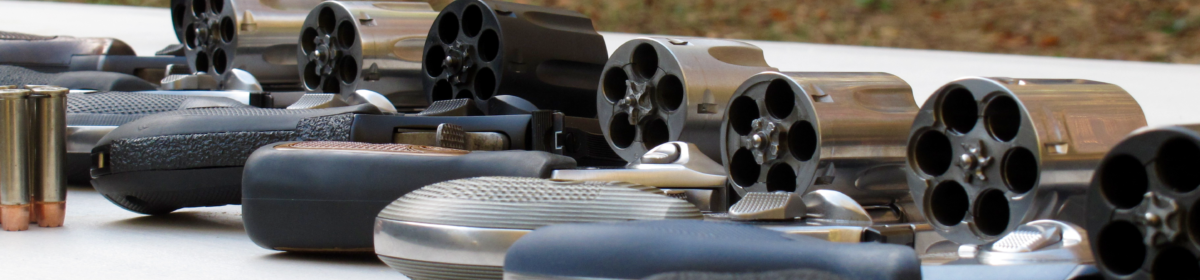

One of the many pleasant surprises of the 2024 Pat Rogers Memorial Revolver Roundup was my first brush with a unique piece of U.S. Air Force (USAF) history—a destroyed Smith & Wesson M13 Aircrewman revolver. This artifact was a generous gift from fellow Shootist Matt Olivier, who told me, “It makes sense for you to have this, as a former Air Force pilot.”
Wow! I was amazed and honored to receive such a thoughtful gift. Thank you, my friend!
A voice from the past
I’d known of the USAF M13 revolvers, but had never seen one in the flesh before this. That’s not surprising, as the few that escaped the Air Force’s destruction order are prized rarities, and not something the average RevolverGuy is likely to encounter.


While this scrapped sample was no longer intact, it was still an M13 and still an exciting link to a special chapter in the history of my chosen service. I think it’s a neat story, and if you’ll indulge me, I’d like to try my hand at telling it.1
THE OLD BREED
The roots of the United States Air Force (USAF) lie in the United States Army Air Force (USAAF), which played a critical role in defeating Imperial Japan and Nazi Germany in World War II.
Since the USAAF was a component of the US Army, World War II airmen were armed with the same sidearms that their soldier brethren used. The .45 ACP M1911A1 pistol was the principal sidearm for ground-pounders during the war, and many flyboys used them too, but the airmen also made great use of the .38 caliber revolvers that were purchased by the Ordnance Department as substitute standard weapons. Most of these .38 caliber revolvers were Smith & Wesson .38 Military & Police “Victory” Models, but there may have been an odd Colt Commando or other .38 Special gun in the mix, here and there.

It made sense to issue .38 caliber revolvers to the airmen for a variety of reasons. The most important of these was logistics—the rapidly-growing Army needed as many M1911A1s as they could get, and it didn’t make sense to divert large numbers of the guns to airmen who were less likely to need and employ them than the soldiers.

Then, there was the issue of size and weight. At 8.5” in length and 39 ounces (unloaded) in weight, the M1911A1 is a big and heavy gun. Although the 4” Victory Model is slightly longer, and only 5 ounces lighter, it carries and handles like a smaller, lighter gun, and its spare ammunition could also be carried without the additional bulk and weight associated with pistol magazines. This was important to aircrew members (pilots, navigators, bombardiers, engineers, gunners, radiomen, loadmasters, etc.) who worked in cramped environments, and couldn’t afford to add more weight and bulk to their gear.2
The manual of arms was a factor, too. It was Army protocol to carry the M1911A1 hammer down on an empty chamber in that era. This wasn’t ideal, but it also wasn’t too limiting for soldiers principally armed with rifles or carbines that were carried in a chamber-loaded condition, making them ready for immediate use. However, the sidearm was normally the airman’s only individual weapon, and carrying it in a condition where it couldn’t be fired without working the action first was problematic. An airman floating to the ground under canopy, or one who had just crashed into terra firma (either in his plane, or under silk), might need to get his sidearm into action without delay, and might be injured in a manner that prevented two-handed operation of the gun. The revolver would facilitate getting the gun into the fight in ways that the auto could not, given the Army’s affinity for Condition Three Carry.3
NEW SERVICE, NEW NEEDS
The United States Air Force (USAF) was born on 18 September 1947, not long after the guns went silent in Europe and the Pacific. The new service inherited everything it had from the USAAF, including its people, its airplanes, and its sidearms.
The USAF initially continued with the mix of M1911A1 autos and .38 caliber revolvers it had on hand, but within a few years, the Air Force’s leaders were eager to standardize on the revolver for general issue, particularly because there was a reduced emphasis on small arms training in the newest service.

Our nation’s airmen were heavily preoccupied with the training required to attain and maintain proficiency in their aircraft and flying mission, and there was little time to train with their sidearms (which most military thinkers of the era believed were unlikely to be used anyhow, as the new age of nuclear combat dawned). The revolver’s simplicity made it easy to learn with minimal training, and its long, double-action trigger added an element of safety for personnel with limited training and experience, so it was a natural choice to serve as the Air Force’s new standard.

Then, there was the issue of accuracy. The M1911A1 pistols of the WWII era were built “loose” to enhance reliability in austere conditions, and featured sights that honestly weren’t very good (small, and hard to see). When these factors were combined with vigorous .45 ACP recoil, and poorly-trained soldiers/airmen who had only received rudimentary (at best) pistol marksmanship instruction, it’s easy to understand why the M1911A1 developed a reputation for being an “inaccurate” arm.
By contrast, the Victory Model and Commando revolvers in inventory had more visible sights than the M1911A1, significantly less recoil, and the potential for greater mechanical accuracy. Poorly-trained personnel found it easier to hit their targets with the revolvers, particularly when they were fired in single-action mode. These factors convinced the Air Force’s leadership—and particularly it’s influential “gun guys,” like General Curtis LeMay–that the revolvers were more accurate than the autoloaders they were competing with.
THE NEED FOR SPEED
While airmen had always been sensitive to the size and weight of their sidearms for reasons we previously discussed, the transition to the Jet Age made weight an even more important consideration. Some writers have theorized that reducing the weight of aircrew survival equipment (which the sidearm was considered to be part of) was an important goal to enhance aircraft performance, but the real preoccupation over weight was tied to the introduction of the ejection seat, which the Air Force’s new jet-powered aircraft were increasingly equipped with.

As aircraft speeds and altitudes increased in the jet age, it was no longer a viable solution for pilots to crawl and jump out of their aircraft in an emergency. The earliest post-war ejection seats, powered by a solid propellant charge, were designed to get pilots out of their aircraft at speeds which would prevent jumping clear of them. They worked, but as the fleet grew even faster, with the introduction of planes such as the Century-Series fighters, and the mighty B-52 Stratofortress, the ejection seat needed even more thrust to get pilots safely clear of the aircraft. This led to the development of rocket-powered ejection seats that were a real kick in the pants.

The ballistic and rocket-powered ejection seats of the Jet Age subjected the pilot and everything he wore to tremendous acceleration forces. A heavy piece of equipment, like a pistol worn on a survival vest, had a lot of resting inertia, and could be torn away or become unsnapped by the force of the ejection, becoming a secondary missile that could injure the pilot, in addition to leaving him disarmed.4


An additional ejection seat-related concern was the elevated risk of flailing injuries to the arms and hands. Ejecting at high speeds often led to broken limbs as loose, unsupported arms were subjected to high-velocity winds that would catch, twist and bend them. The early seats were relatively unsophisticated and offered little protection against this danger, so it was important that an aircrew member’s sidearm could be easily operated not only with a single hand, but by either hand. Since the M1911A1’s controls were not Southpaw friendly, and its chamber-empty carry mode required the shooter to cycle the slide against a heavy recoil spring to load it (typically a two-handed operation), it was not an ideal gun for the job.5
ENTER THE LIGHTWEIGHTS
The combination of these factors pointed the fledgling USAF towards a lightweight revolver as the ideal sidearm for its new age, jet pilots. Fortunately, the industry had already been working on several designs that were suitable for their consideration, as a result of prior Air Force and Army interest in lightweight pistols.6
By 1947, the Army issued requirements for a lightweight service pistol in 9mm, and multiple designs were submitted and tested over the next eight years. Two notable designs were born as a result of this competition—Colt’s aluminum-framed Commander, and Smith & Wesson’s aluminum-framed Double-Action Automatic (Model 39). However, by the summer of 1955, the Deputy Chief of Staff of the Army for Logistics decided the current M1911A1 inventory was sufficient for the Army’s needs, and the trials were suspended.7 With the prospect of a lucrative government contract vanishing, Smith & Wesson offered the Model 39 to the civilian market in 1955, as Colt’s had previously done with its Commander, in 1950.

The pistol trial itself may have been a bust, but it had spurred industry to work with aluminum frames, and it didn’t take long before the technology made its appearance in revolver designs.
After introducing the Commander (regarded as the first pistol design with an aluminum frame), Colt’s introduced the first aluminum-framed revolver, the Cobra, in 1950.8 The Cobra was essentially an aluminum-framed version of the popular Detective Special, which shaved about seven ounces from the steel gun’s weight. The 15-ounce Cobra (with 2” barrel) was chambered in .22, .32 and .38 caliber cartridges, with the 2” and 3” guns having round butt frames, and the 4” guns having square butt frames.

Colt’s was happy to provide samples of the gun to the Air Force for evaluation, but the Air Force also wanted Smith & Wesson to submit some guns as well. After a delay, Springfield responded with versions of their five-shot Chiefs Special, and six-shot Military & Police revolvers.9
PRELIMINARY TESTING
The details about the preliminary testing of these guns are still a little murky at this point, but an August 1951 article in The American Rifleman, by Major General (USA, Ret) Julian S. Hatcher, provides the best insight to the earliest evaluations of the Colt and Smith & Wesson submissions.10 Based on the known delivery dates of some of the samples, and the standards for publishing lead times in the era, this testing likely occurred in the spring of 1951.11
The Air Force’s point man on this project was (then) Lieutenant Colonel Frank S. Allen, who received the guns from Colt and Smith & Wesson, and led the efforts to test and evaluate them for the service. At some point, Lt Col Allen enlisted the help of Maj Gen Hatcher and author, firearms expert, and American Rifleman Field Editor, Alvin “Al” Barr, to shoot and evaluate an interesting cross-section of (nominal) two-inch-barreled guns that included the following:
-
-
- A “Lightweight Detective Special” (later branded as the Cobra, by Colt’s), numbered “4” in their testing, with an aluminum alloy frame, steel cylinder, and the standard, D-frame wood grips of the era, with a round top that ended well below the frame’s recoil shoulder—what we might call “service-style” grips, today. The empty weight of this gun was 15.3 ounces. It would have been identical to commercial Cobra production, which began in 1950;
-
-
-
- A “Lightweight Detective Special” (later, Cobra), numbered “5” in their testing, with an aluminum alloy frame and cylinder, and custom grips of Lt Col Allen’s design, which differed from the standard Colt grips by reaching up to the recoil shoulder and terminating in a flared top—similar to Smith & Wesson “Magna-style” grips. The empty weight of this gun was 11.75 ounces. This would have been an experimental modification of the standard Cobra, with its aluminum cylinder;
-

-
-
- A ”regular frame” Military & Police, numbered “6” in their testing, with an aluminum alloy frame and cylinder, and steel barrel with round front sight. The gun wore square butt target grips that were modified by Lt Col Allen, who clipped and rounded the heel and toe to create a semi-round butt profile. Of note, Hatcher describes this gun as having a normal frame width, identical to the steel-framed .38 Military & Police it was derived from. The empty weight of this gun was 16 ounces. Although not labeled as such by Hatcher, this would have been an experimental gun, due to the standard K-frame width aluminum frame, that predated the introduction of the Airweight Military & Police in 1952;
-
-
-
- A second “regular frame” Military & Police, numbered “7” in their testing, that was also made with an aluminum alloy frame and cylinder, and steel barrel with round front sight. This gun had a normal round butt profile with Magna-style grips, and had an empty weight of 15.5 ounces. Again, this gun would have been an experimental gun, due to the standard K-frame width aluminum frame;
-
-
-
- An “experimental Military & Police,” numbered “8” in their testing, with an all-steel construction—frame, cylinder, and barrel with round front sight. Per Hatcher, this round butt gun had a narrower frame than the standard K-frame Military & Police, in response to Lt Col Allen’s observation that the standard K-frame was “bulkier” than the Colt D-frame guns he was evaluating. Smith & Wesson responded to Allen’s input by building three different K-frame guns with a thinner frame, and this was the “heavyweight” version of the three, with an empty weight of 25 ounces. The gun wore “service-style” grips that stopped well short of the recoil shoulder;
-
-
-
- The second “experimental Military & Police,” numbered “9” in their testing, with a narrow, round butt steel frame like Number 8, but with an aluminum cylinder. This “mediumweight” version of the narrow K-frame wore “high” (Magna-style) grips, and had a ramp front sight, instead of the half-round sight found on Number 8. It had an empty weight of 22 ounces;
-

-
-
- The third “experimental Military & Police,” numbered “12” in their testing, with a narrow, round butt aluminum frame and an aluminum cylinder. This “lightweight” version of the narrow K-frame wore Magna-style grips, and had a ramp front sight like Number 9. It had an empty weight of 14.25 ounces;12
-
-
-
- A Chiefs Special, numbered “10” in their testing, with all-steel construction—round butt steel frame, cylinder, and barrel with round front sight. This “heavyweight” five-shot wore Magna-style grips, had an empty weight of 19 ounces, and would have been identical to commercial .38 Chiefs Special production;
-

-
-
- Another Chiefs Special, numbered “11” in their testing, with round butt steel frame, aluminum cylinder, steel barrel with round front sight, and Magna-style grips. This “mediumweight” five-shot had an empty weight of 16 ounces and would have been an experimental model of the .38 Chiefs Special due to the aluminum cylinder;
-
-
-
- Lastly, a third Chiefs Special, numbered “13” in their testing, with round butt aluminum frame, aluminum cylinder, steel barrel with ramp front sight, and Magna-style grips. This “lightweight” five-shot had an empty weight of 10.5 ounces and would have been an experimental model of the .38 Chiefs Special due to the aluminum frame and cylinder.13
-
It’s notable that the testing conducted by Allen, Barr and Hatcher left the three experts with the definite opinion that the weight of the gun was less important than the design of the grips, with respect to the shooting comfort and accuracy potential of the guns. The heaviest gun in the test–the narrow-frame, “heavyweight” M&P of all-steel construction (Number 8)–was the least comfortable gun to shoot with the “full factory” 158 grain jacketed loads (at a nominal 870 fps), by virtue of its poor grip design, which left the upper part of the frame, near the recoil shoulder, exposed. In contrast, Hatcher felt the lightest gun in the test–the “lightweight,” all-aluminum Chiefs Special (Number 13)–was more comfortable to shoot, because of its Magna-style grips, even though it weighed nearly 15 ounces less, by comparison.14
recommendation
As a result of the tests conducted, Lt Col Allen was encouraged to recommend the lightweights to the Air Force, provided they were outfitted with suitable grips. It was his determination that the Air Force should purchase a limited quantity of the Colt Cobra, Smith & Wesson Chiefs Special, and Smith & Wesson Military & Police revolvers with aluminum frames and cylinders for further test and evaluation in the field–a story we’ll dive into, in Part II.
(Continued in Part II)
*****
ACKNOWLEDGEMENTS
This two-part article would not have been possible without the generous help provided by the following individuals:
Matt Olivier, my friend and the owner of M and H Classics, whose generous gift of a demilled M13 Aircrewman inspired this journey;
Craig Smith, my long-distance friend and the research arm of RevolverGuy, who provided me with an indispensable wealth of articles, images, and other references, and encouraged me to run with the project. I wouldn’t have made it to Rotation Speed without his help;
Gaston Comeau, an esteemed S&W collector who generously shared images, military manuals and other reference materials. His daily airdrop of vital documentation sustained the project and turned him into the RevolverGuy equivalent of the 82nd Abn Div, parachuting in to provide needed assistance. Airborne, Sir!
Mr. Richard Nahas, co-author of the Standard Catalog of Smith & Wesson, esteemed member of the Smith & Wesson Collectors Association, and the owner of the finest collection of Aircrewman revolvers in the world. His generous assistance was vital to my understanding of the chronology of these guns, and the accuracy of the final product.
Mark Fricke, my friend and all-around expert on law enforcement training, equipment, history, and ammunition. Mark was the guy I turned to for help to decode the M41 mystery, and he made the fog lift for this grounded airman.
Ed Harris, industry veteran and ballistics expert, who has contributed to many RevolverGuy projects, and helped me to get a better understanding of WWII-era .38 Special loads and performance.
Thank you, gentlemen, for all of your contributions!
*****
ENDNOTES
1.) I start with a caveat. While I have a historical interest in these guns, I am not a collector and don’t have the education or experience of a dedicated collector. The real experts in the field, such as Richard Nahas of the Smith & Wesson Collector’s Association and the Standard Catalog of Smith & Wesson, or Kevin Williams of the Smith & Wesson Collector’s Association, are doubtlessly more knowledgeable about these guns than I am, but I’d like to try my hand at telling the story from the RevolverGuy’s perspective.
2.) Every airman had his own version of the common problem. The fighter pilots worked in tight cockpits and heavy, bulky gear was not only uncomfortable, it could restrict important movement (like “checking six” for enemy aircraft) and get hung up on oxygen mask hoses. It could also prevent them from getting out of the aircraft, if they had to bail out of a damaged bird.
The same went for the bomber crews, who also had the obstacles of crawling through tight doors and access tunnels inside the aircraft, and getting in and out of places like ball turrets, nose and tail gun positions, bomb bays, and the like. These tasks were made even more difficult (particularly in the winter months) by the requirement to wear thick layers of clothing (including insulated coveralls and thick, wool-lined, leather jackets) to keep from freezing at high altitude.
Even the trash haulers needed to avoid gear that would get hung up on comm cords, cargo, and the tight confines of the aircraft. Anyone who has ever flown an aircraft, regardless of its size, will tell you that airplanes have “fingers” that always want to grab you, as you move around inside them. Planes like the C-47 may have looked “big” to some eyes, but they’re an awfully tight office to work in.
3.) Even in the M9 era that started in the mid-1980s, the Army required its troops to carry their pistols chamber-empty in the field, whereas the Air Force required airmen to carry their guns chamber-loaded, with the safety/decocker lever in the Off position. Since I’m now long-retired from the Air Force, I’m not sure what the current protocols are for the M18/17 pistols used by the two services, but I suspect not much has changed. Tradition, you know.
4.) Here, it’s worth mentioning that some of the aircraft introduced in the early 1950s were equipped with downward-ejecting seats. The B-52 Stratofortress (first flight in 1952), for example, had downward-ejecting seats for the Navigator and Radar Navigator crew positions located on the lower deck. The F-104 Starfighter (first flight in 1954), also had a downward-ejecting seat, which was necessary to clear the aircraft’s tall tail at high speeds. In these systems, it was especially important for aircrew to avoid carrying heavy equipment that could become unsecured during the ejection, and strike them in the neck or head on the way out.
5.) One could debate the merits of the chamber-empty policy for ground troops armed with M1911A1s, but it definitely made good sense for aircrew members who were strapped into ejection seats. The gun’s floating firing pin, restrained only by a coil spring, could potentially strike the primer with enough force to detonate it during the force of an ejection, making chamber-loaded carry of the M1911A1 unsafe. Interestingly, the M1911A1’s successor, the M9, had a firing pin block that eliminated this concern for a later generation of airmen, who were directed to carry the gun chamber-loaded while strapped into the seat. Given the unintended discharge issues surrounding the current M18/17 pistols, I’d personally be hesitant to mount up with a round in the chamber of one of those, regardless of policy.
6.) Major (USA, Ret.) George C. Nonte, Jr., who spent a 20-year career in the U.S. Army Ordnance Corps, reports, “The Army Ground Forces staff looked into the desirability of a new handgun during the years 1946 -1955,” and, “official specifications [were] established by the Ordnance Technical Committee in 1947.” These specifications called for a lightweight (25 ounces, maximum), 9mm pistol with a double action trigger system, and an overall length of no more than 7 inches. One source indicates the newly-formed Air Force may have pushed for a new semiauto pistol of those specs early on, but by the early 1950s, it seems their focus had switched to revolvers, leaving the Army to take the lead on the lightweight auto front. In a March, 1952 article in The American Rifleman, (then) Colonel F.S. Allen noted that the US Army Ordnance Corps “ran an exhaustive test of a number of foreign automatic pistols and the U.S. M1911 .45 caliber pistol” in 1948, confirming the Army’s postwar interest in pistol technology. Refs: Allen, Colonel F.S. “How Good Are the Small Automatics?” The American Rifleman, March, 1952, and; Nonte, George C., and Ezell, Edward C. (Editor). George Nonte’s Combat Handguns. Stackpole Books. 1980.
7.) Nonte. We’d see this process repeat several times in the following decades, with other U.S. government pistol trials that were terminated early when desires ran afoul of the budget.
8.) These alloy frame guns were manufactured beginning in 1950, starting with serial number 1 LW (with the “LW” presumably meaning “Light Weight”), but Colt historians RQ Sutherland and RL Wilson note, “the earlier production was not known as Cobra, and the barrels were roll-marked as on the Police Positive Special. The first barrels marked Cobra appeared in June, 1951. A few of the early barrels were marked as on the Detective Special.” So, even if the “Cobra” marketing name wasn’t applied until later, the gun that we know today as the Cobra debuted in 1950. Note: this earlier, aluminum-framed Cobra is not to be confused with the cosmetically similar steel gun, with a different action, that was introduced in 2017, with a recycled Cobra moniker. Ref: Sutherland, RQ, and Wilson, RL. The Book of Colt Firearms. Published by Robert Q. Sutherland. 1971.
9.) Colt’s Manufacturing was well ahead of Smith & Wesson in the aluminum frame semiauto race, starting work on the Commander in 1947, and introducing it into the commercial catalog by early 1950. In comparison, the experimental form of the pistol that would eventually become the S&W Model 39 (the X-46) didn’t arrive until October 1948, and the Model 39 didn’t go into production until November 1954. The same pattern transferred to the revolvers, and it took Smith & Wesson until March 1951 to deliver an experimental aluminum-framed gun to compete with Colt’s D-Frame Cobra, which appeared more than a year earlier. Ref: Nonte, and; Supica, Jim, and Nahas, Richard. Standard Catalog of Smith & Wesson, 5th Gun Digest Books. 2024.
10.) Major General Hatcher had previously served as Chief of the Small Arms Division in the United States Army Ordnance Department, during World War II. He was a well-known author prior to the war, and continued to write several books, post-war, including what is perhaps his best-known work, Hatcher’s Notebook. After his retirement in 1946, he took the position as Technical Editor at the NRA’s American Rifleman magazine, where he was a regular contributor. There were few reporters on small arms development who were as influential as Maj Gen Hatcher, in this era. Ref: Hatcher, J.S., Maj Gen (USA, Ret), “What About the Featherweights?”, American Rifleman magazine, August 1951.
11.) Sample Number 13 in the Hatcher article is the gun identified as “X65” in the essay Aircrewman Revolvers: .38 Military & Police M13, in the Standard Catalog of Smith & Wesson, 5th Edition. According to the essay, this J-frame revolver was shipped to Lt Col Allen on 9 Mar 51. Hatcher’s article would likely have been submitted at least two or three months prior to its August 1951 publication date, to allow for editing, formatting and printing prior to the magazine’s distribution in July. These facts and circumstances combine to place testing in the March to May, possibly June, timeframe.
12.) This is the gun that would eventually serve as the model for the Air Force M13 and the .38 Military & Police Airweight—the “Pre-Model 12.” The narrow aluminum frame, inspired by Lt Col Allen’s observation of the trim Colt D-frame, would be labeled the KA-frame (K aluminum frame) in S&W parlance.
13.) This is the gun that would eventually serve as the model for the “Baby Aircrewman” that the Air Force would procure for field testing, and the .38 Chiefs Special Airweight (the “Pre-Model 37”) that would go into commercial production. The grip frame and trigger guard on this experimental gun were shorter than those found on the later guns it inspired. Ref: Interview with Richard Nahas, and; Supica and Nahas, Standard Catalog of Smith & Wesson.
14.) Gunfighting and close quarters combat authority Colonel Rex Applegate would emphasize the same point, in a September 1953 article in The American Rifleman, about the new lightweight revolvers entering the market. Applegate emphasized that frame design and grip shape were critically, “ . . . important in relation to the recoil effect on the shooter’s hand and his fire control.” He would go on to describe his preference for the Magna-style grips that went all the way up to the frame’s recoil shoulder, because they lessened, “the shock against the web of the hand . . . fill[ed] the web of the hand so that no looseness is present, . . . [and prevented] any side movement which may result from recoil of successive shots.” Ref: Applegate, Rex, Lt Col (USA Ret), “Lightweight Revolvers,” American Riflemanmagazine, September 1953.
ADDITIONAL RESOURCES
Organizations:
Smith & Wesson Collectors Association: https://theswca.org
Books:
Standard Catalog of Smith & Wesson, 5th Edition: https://www.gundigeststore.com/product/standard-catalog-of-smith-wesson-5th-edition/
Forum Posts:

Until reading this article I had no idea about the complex history of the M13 Aircrewman revolver. Well done, and I look forward to Part II.
Moreover, the article suggests a pervasive theme with the government’s careless destruction of serviceable small arms (among many things) that could have been used by other branches of the military and law enforcement agencies. Such a moronic, wasteful policy.
The military and Federal LE are terrible about that. The M9s were being destroyed, last I checked, and I think they should have been rebuilt and placed in reserve. Federal LE agencies collect and destroy perfectly good duty weapons when they’re replaced, and won’t even allow the agents and officers who carried them to purchase the old guns. It’s stupid.
You’ll see more of that in Part Two. Glad you enjoyed the first!
Our tax dollars at work
Sadly, when my local agency “de militarized” in 2020, we turned in our M16A1s to be returned to the feds for destruction. Quite a shame. Now rifle operators have personally owned ARs, which I guess is good (customized to the individual) but I liked the long lightweight barrel and balance of the A1. I would gladly have bought the weapon I carried for a decade.
All that great history, smashed to pieces. I guess it’s better than giving them to the Taliban, though.
Ooh, a two-parter!!!
Your examination- in classic Mike Wood Deep Dive style – of lightweight Air Force service revolvers is all the more tantalizing as rumors of “something light” in the S&W mid-frame space continue to swirl around Q1 ‘26.
A lightweight K (or even a compact L) is long overdue. Here’s hoping this isn’t just wishful thinking, or 40 years of regret for letting a 12-3 go down the road before I was mature enough to appreciate for the concept.
Standing by for Part Two!
Thanks Michael. I’ve been holding this one for about a year, waiting for the right time to run it. Other priorities kept bumping it back. I’m very happy to finally share it!
I know there are some products coming that may scratch your itch. I just hope they’re built well. My expectations are low.
In the meantime, there’s a nice M&P Airweight for sale over at R&G Firearms
Colonel, this is a precious gem of revolver history and development, and I can’t wait for subsequent increments.
It is probably safe to say that we would not have the plethora of alloy frame revolvers and pistols, we have today had it not been for the rapid development under the expansion of the military and the jet age. It is also a sad reminder that the government is quick to destroy items that would have not just utility and usefulness, but such historical significance. I would speculate that the use of high strength aluminum alloys used in aircraft significantly facilitated the development of alloy frame pistols in the late 1940s, and enabled Eugene Stoner to give us the AR15 platform. Ounces equals pounds is true for infantry and even for air crews.
This stroll through history also brought back a LOT of childhood memories of growing up on (and around) AF/SAC bases . . . No memory of Westover AFB, vague memory of Homestead AFB, finally to Pinecastle AFB. Watching the B47s, later B52s, KC-97s and KC-135s going in and out was overwhelming for an elementary school brat. The Wing designations changed, and I was too young to notice (or care?), but the last one I remember was the 306th Bomb Wing that had been at MacDill AFB until @’62.
It also brought back the memory of Col. Michael McCoy, the commander of the 321st Bomb Wing at Pinecastle AFB. In 1957, I was in 2d grade, in the schoolyard on recess and seeing Col. McCoy’s B-47 break apart mid-air while on approach to Pinecastle AFB (MCO), and the debris falling less than a mile from my elementary school.
I never recall seeing any of the air crews carrying sidearms, but I’m sure it was my being oblivious to it, the 1683s, and 1505s. The AP folks, however, were a different ball game entirely – they could scare the ugly off an ape.
I’ll be damned. You saw the McCoy crash? Must have been frightening for a Second Grade student. Here’s a salute to Colonel McCoy and his fellow crewmembers. May God bless them all.
Yes, lots going on with firearms design and materials during this exciting time. You’re absolutely right that these guns paved the way for later developments like the Stoner guns.
Those Air Policemen of the era–STRAC! It makes me proud, just to see the old photos of them. All part of an Air Force that I missed, sadly. I’m poorer for it.
Didn’t see the impact, that was well away from the school. It was seeing that plane come apart that scared the you know what out of me. My old man flew those the last year we lived at Homestead AFB, before the move to Pinecastle, and I’d been up close to them on base. He transitioned to the 52s at Pinecastle.
I was told later that there was a wing failure on Col. McCoy’s aircraft from a modification that was done to the plane to carry a new type of missile. After all these decades, and countless commercial (and military) flights, I’m still fascinated with aviation, but I never got comfortable being a passenger.
Thanks for this priceless article, especially the pix.
Wish the Aircrewman Colt magna-style grips had replaced the standard grip scales across the line.
Note there are still aluminum cylinder M12s showing up on that auction website every so often.
Wonder how many hardy souls actually fired the .38-44 load out of a Cobra?
Thanks Lobo, it took many months to put this one together, but it was a wonderful project and I enjoyed it very much. I appreciate all the assistance I received from the folks I credited. I’m looking forward to running the next part.
I hope most were smart enough to avoid running .38-44s in those Colts!
It’s interesting that the narrow, steel K-frame prototype was so poorly received. You can understand how a narrower frame and service-style grips would make for a painful experience, even though the gun weighed twice as much as the all-aluminum J-frame. The Magnas were a much better grip, and could have solved that problem.
Fascinating how grip design is the most important feature of recoil control in these weapons, when you might assume weight would be a lot more important.
No thanks! That sounds like no fun at all.
I was in the Air Force 1966 1970 my last station was Plattsburgh AFB in New York. I was an engine mechanic working on B 52 and KC 135 one time we went to a classroom where they handed out. I believe they were a model 10 Smith & Wesson’s And they showed us how they operated. We never got to fire them after the class they collected them all and said if we were ever deployed, we would be issued the pistols before boarding the aircraft. Thank you for a great article. Looking forward to part two
Perfect explanation of why issuing revolvers to airmen made sense! If you’re not going to provide extensive training, they’re a safe bet. Glad you enjoyed it Dave, thanks for writing from the Hush House. 😁
Planes, guns, and history all intertwined in one, wait two, fantastic articles! Can’t wait to read part II. The letters from our audience, especially the eyewitness account from s. bond is unbelievable. Keep up the great work Mike.
Thank you Sir! Happy New Year!
Great article, looking forward to Part II. The SAC Elite Guard Model 15s would make a great subject for another article in the future.
Yes it would!
Great read, thank you Mike! I’d agree the grip style makes all the difference, and while I’m no Colt expert, were I in charge of selection I’d have leaned toward the Cobra with a 3” barrel. Of course if the USAF had gone with a semi auto the Colt Commander would have served well, as would the Smith 39. I have an old 439 and even qualified and carried it off duty for a year. The main difference I could tell was better sights than the 39. It was a bit large for CCW (3913 was ideal) but otherwise a great gun for me. Looking forward to part II.
Thanks pal! I’m looking forward to sharing the next one. I’ve honestly never been a big fan of the S&W autos (slide mounted decockers aren’t my favorite–same reason I liked Sigs over Beretta), but I’ve always been attracted to the Model 39-2 and thought the 3913 was underappreciated. Imagine a modernized 3913 with a P365-style magazine–that would sell well, I think.
I think we’d call that a 6906–2.0!
Point well taken about the Smith safety–the SIG 229 is my EDC–but if you run a Smith TDA, use that safety only for decocking and administrative purposes.
P.S.: I won’t carry one unless it’s a 3 or 4 digit. I have dropped a gun on occasion, and not on command.
I suppose it would be a 6906V2.0, P!
Actually that would be the poster formerly known as “P.”
Much prefer revolvers to computers.
Absolutely great excellent article
Thank you!
Fascinating. The different models that were tested are all new to me, and I found it interesting that so many of them used aluminum cylinders. If I recall, the aluminum cylinders turned out to be the downfall of the original Model 12s and they had to return to the old standby, steel, for the cylinders later on. I also wondered why they used aluminum cylinders and steel frames to save weight, when just the opposite (steel cylinders and aluminum frames) would have probably been lighter and caused fewer problems. Was it a product of 1940s/50s metallurgy regarding aluminum, or typical big dumb bureaucracy in action?
Regarding the DoD’s desire to replace the 1911 after WWII, I read several years (decades?) ago, probably in The American Rifleman, that the weight of the 1911 itself was only part of the problem. The 1911 and GI shoulder holster together weighed 80 ounces (5 pounds), and pilots and tankers who wore them for long periods were experiencing nerve damage that interfered with arm motion and manual dexterity. Not something you want when you’re trying to control an airplane or a tank. But a little problem in Korea kinda soaked up the budget, the project was abandoned, and the only real result of the project was the Model 39. (I’m not counting the Commander, since the original request for testing specified double-action capability.)
I’m looking forward to Part II. I love to learn new things.
1811, I’ll answer lots of your questions in Part II!
As you saw in Part I, S&W responded with a smorgasbord of choices, not knowing what Uncle Sam would like best. It didn’t take long for Col. Allen’s team to narrow the field, though.
Interesting about the weight of the 1911 package causing problems. If you look at those “tanker” chest holsters, the straps are pretty narrow. A modern version would use a wider strap to better distribute the load. One wonders whether a wider strip of leather could have solved the problem?
Forgot to mention. Somewhere I have a photo of my late father standing in front of his office (the Sperry ball turret of an Avenger torpedo bomber), with his Victory Model S&W in a shoulder holster and six spare rounds in loops attached to the leather harness above the holster. The rounds had pointed, conical bullets that I’ve never seen before or since. I used to have six of them, but I don’t know what happened to them.
Thanks for the fascinating and enjoyable read-looking forward to part 2! If I could go back and whisper in Lt. Col. Allen’s ear with the benefit of 20/20 hindsight, I would steer him towards an aluminum framed gun with a steel cylinder and four-inch barrel. A six-shot revolver, either a Colt Cobra or a S&W M&P. Use a square front sight regulated for a modified M41 load; like a 125-130 FMJ bullet with a wide flat nose profile. A bullet like that could’ve delivered 850 fps from a 4″ tube and maintained standard .38 Special pressure, I think. Add some lightweight, synthetic grips that were ergonomic and covered the backstrap and charge on. Thanks again for the cool story, Mike.
Thanks pal! I think your recommendation would have been spot on, and a gun like that would have remained in service for a very long time–kind of an aluminum framed Victory Model, eh?
Yup, an aluminum framed Victory Model is exactly what I was thinking. Only upgrading the front sight to a more visible shape than the half-moon. The revolver wouldn’t need round nose bullets for reliable function, so subbing a projectile with a flat nose would enhance its capability while still meeting the “rules of warfare” it was held to, (as long as it was an FMJ) I believe. Firing similar loads through a 4″ Model 12 are controllable and not unpleasant, especially when stocks are selected carefully. They could have done a lot worse!
We need to get you a commission and a job at the Pentagon, buddy. Maybe you can straighten out this M17/18 mess for us!
A 4″ 12-2 with synthetic grips and a flat latch would have done nicely.
Even now.
Forgotten Weapons did a video on the Colt version of the Aircrewman Revolver. Aluminum cylinders weren’t a great in .38 Special, but I wonder if it could’ve worked in .32 Long. Moot point now though.
Hey Mike, referring to #2 in your endnotes and the issue of “checking six” for all the reasons you mentioned, the IAF came up with a simple, typically Israeli solution….they attached rear view mirrors to the exterior of the cockpit.
I thoroughly enjoyed our short time together at the show. Stay safe brother, and hopefully see you up in my neck of the woods someday.
It was great seeing you, my friend, and a pleasure to spend the extra time with you.
Did those mirrors have the warning label on them? “Objects in mirror are closer than they appear” 🤣
😂
Hmm, I can’t remember……of course it might’ve just been a Mirage. 😉
Ha! I see what you did there!!
Another great article. I cant tell you how much I appreciate your efforts in the footnotes. I feel like I learn as much from them as I do the articles.
Thanks Whiskey! I appreciate the kind words and I’m glad you found it interesting and educational–makes it worth all the effort, to hear from happy readers like you.