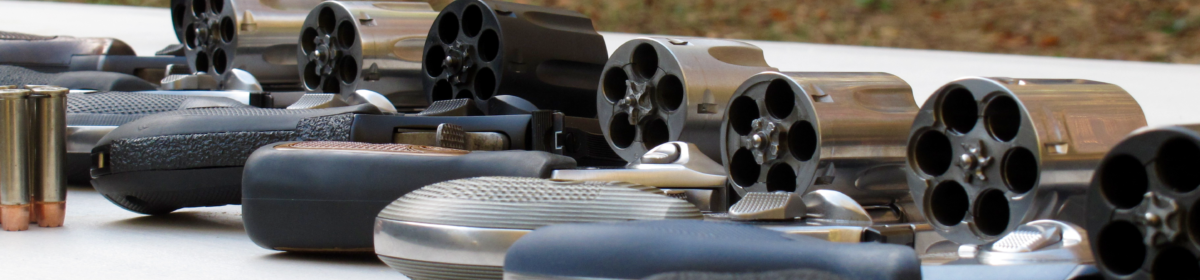

In Part I of this series, we discussed the U.S. Air Force’s early interest in aluminum-framed revolvers, and their experience with prototype/development test samples from Colt and Smith & Wesson. We pick up the story in this second part, with the delivery of Aircrewman operational test samples from the two companies, which would eventually lead to the procurement of the M13 Aircrewman revolver.
THE COLT AIRCREWMAN
In late 1951, Colt’s Manufacturing began delivery of 1,189 revolvers of the type specified by Lt Col Allen to the United States Air Force, who designated them as the “Revolver, Lightweight, Caliber .38 Special, M13.”1 These 12.5 ounce “Aircrewman” revolvers were 2” guns with the long, round butt grip frame of the early Cobras, and were built with aluminum frames and cylinders, with the remaining parts being made of steel. The cylinders and frames were anodized with the frame flats polished semi-bright, and the edges left matte, and all steel parts were blued.2

The Colt Aircrewman revolvers wore Magna-style, checkered walnut grips of Lt Col Allen’s design, with Air Force medallions inlaid at the top, and a grip screw that entered from the right side (the left panel had a blind escutcheon).
The serial numbers came from the sequence of commercial Colt Cobra and Colt Courier revolvers, 1902-LW through 90470-LW, with most numbers between 2901-LW and 7775-LW. The Air Force added their own numbers on the butt of the revolvers, starting at “A.F. No. 1” and proceeding to “A.F. NO. 1189.”3

The backstrap was marked “PROPERTY OF U.S. AIR FORCE,” and the left side of the barrel was marked “AIRCREWMAN” on one line, with “.38 SPECIAL CTG..” beneath it. The right side of the barrel was marked “COLT’S PT. F.A. MFG. CO.” with “HARTFORD, CT. U.S.A.” beneath.4

THE SMITH & WESSON AIRCREWMAN
A year later, in late 1952, Smith & Wesson delivered 605 six-shot, round butt, KA-frame (narrow, aluminum K-frame) revolvers to the United States Air Force, equipped with aluminum cylinders. These early S&W Aircrewman revolvers were delivered with diamond-center, checkered, Magna-style stocks with Air Force medallions and a screw that entered from the left grip panel. An additional four guns were delivered to the Springfield Armory.5


The guns, which shipped on 7 Nov 52 to thirteen different locations (including some overseas), were marked in sequence with the Colt Aircrewman revolvers, starting at “A.F. No. 1190” and ending with “A.F. No. 1794,” marked toe-heel. The four-digit number was also marked in other locations, including the bottom of the barrel, the rear face of the cylinder, the front face of the extractor star, and the rear face of the yoke.6


The guns weighed around 14.5 ounces, were built on 5-screw frames, and had steel bolster bushings in the center of the recoil shield, to provide a hardened surface for the bolt and center pin to pass through, as there were concerns the aluminum might wear prematurely. The front sight was a ramp-style sight, like the Number 12 sample previously tested by Lt Col Allen.7

Another 605 guns were shipped on 7 Nov 52, as part of the Air Force contract (AF Contract No: DA-19-059-ORD-721). These guns were five-shot, round butt, J-frame revolvers, equipped with aluminum frames and cylinders. Like their bigger brothers, the “Baby Aircrewman” revolvers (as collectors came to call them) were delivered with diamond-center, checkered, Magna-style grips with Air Force medallions and a screw that entered from the left grip panel. Also, as with the bigger guns, an additional four samples were delivered to the Springfield Armory.8
The smaller Aircrewman revolvers were marked in sequence with the larger Aircrewman revolvers, starting at “A.F. No. 1795” and ending with “A.F. No. 2399,” in an identical fashion to the larger guns. The Air Force number was also repeated in the same locations found on the larger guns.9


The “Baby Aircrewman” revolvers weighed around 10.5 ounces, were built on 4-screw frames, and had steel bolster bushings in the center of the recoil shield, similar to the bigger guns. The front sight was a ramp-style sight, like the Number 13 sample previously tested by Lt Col Allen.10
The markings on the five and six-shot Smith & Wesson revolvers were similar. Right side barrel markings included “AIRCREWMAN” on top, with “.38 SPECIAL CTG” on a second line, beneath. “SMITH & WESSON” was stamped on the left side of the barrels, and “PROPERTY OF U.S. AIR FORCE” was marked on the backstraps of the frames. A small “P” proof mark was found on the left side of the frames, above the trigger guard, and the butts were marked with the Air Force numbers, as previously indicated.11
FIELD TESTING
With the 1,189 Colt revolvers and 1,210 Smith & Wesson revolvers in the hands and holsters of airmen flying all over the world, the Air Force began to evaluate the suitability of the three designs, based on operational experience.
While the five-shot S&W Aircrewman was an exceptionally compact package, which was favorable for certain non-flying assignments (like plainclothes Office of Special Investigations or Intelligence operations), the Air Force quickly grew to favor the six-shot Aircrewman revolvers for arming the aircrews that were busy fighting a hot war in Korea, and a global Cold War with the Soviets. The increased capacity of the larger guns was undoubtedly seen as an advantage, and a good trade for a slightly larger profile.12

The larger of the two six-shot guns, the Smith & Wesson, had an advantage over the smaller Colt design when it came to shooting. As Maj Gen Hatcher, Lt Col Allen, and Mr. Barr had discovered in their own preliminary testing in early 1951, the larger KA-frame gun was generally easier for most airmen to shoot. In the 1951 testing, the three experts shot 27-yard groups that were 25% smaller with the larger Smith & Wesson, giving it an accuracy advantage over the trimmer D-frame Colt.13

However, the Smith & Wesson wasn’t without complaint. In February of 1953, the Air Force notified the Army Ordnance Department (which was the agency responsible for the procurement of these guns—an arrangement that would last until Springfield Armory closed in 1967, and the services became responsible for their own small arms procurement) that the Colt version of the Aircrewman met their requirements in its current configuration, but the Smith & Wesson needed improvements to correct deficiencies identified during field testing, to include the ejector rod and sideplate screws working loose after repeated firing.14 If these deficiencies could be corrected by S&W, the Air Force thought the gun would be ready to compete against the Colt submission for the final award. It was the Air Force’s preference that the contract would be awarded to a single company, unless “unqualified parts interchangeability [could] be guaranteed.”15
COMMERCIAL AIRWEIGHTS
Meanwhile, sensing they had something good on their hands, and needing a product to compete with the Colt Cobra (which had already been on the commercial market since 1950), Smith & Wesson introduced Airweight models of the Military & Police and Chiefs Special in (roughly) late 1952, as the Air Force evaluated it’s three Aircrewman models, and the Ordnance Department prepared to manage the competitive bid process .16

The timing of the introduction of the Military & Police Airweight and Chiefs Special Airweight revolvers would confuse the relationship between them and the Aircrewman revolvers, for many decades to come. It’s common to see references from various writers and sources that the Aircrewman revolvers were “based on” the commercial Airweight models, or identical to the commercial Airweight models that were “already” in production, save for the unique military markings.

These reports confuse the chronology. There is little doubt that the commercial guns were an outgrowth of the military program, not vice-versa. The experimental J- and K-frame guns delivered to the Air Force and Lt Col Allen in early 1951 were clearly the archetypes that the commercial Airweights derived from.


Consider, for example, that the first aluminum K-frame prototypes delivered to the Air Force were built on frames that had identical dimensions to the steel-frame Ks, and it was only at Lt Col Allen’s request that S&W developed new samples with narrower frames. These narrow frames would become the standard for the Aircrewman revolvers that followed, and all the commercial M&P Airweights manufactured prior to 1984, when the frame thickness was increased to standard K dimension.17 The M&P Airweight definitely took its cues from the Air Force program, not the other way around.
SELECTION
The commercial Airweights did precede the Air Force’s selection of the gun that would enter service as the M13, however.
The Ordnance Department had directed improvements to the S&W designs on 10 Mar 53 (likely in response to the Air Force’s 12 Feb 53 complaints about the ejector rods and sideplate screws coming loose), and by April, Smith & Wesson had won a competitive contract to deliver 40,000 KA-frame Aircrewman revolvers, which would be designated as the “Revolver, Lightweight, M13” in military parlance.18
The commercial M&P Airweight was already being produced by the time the M13 contract (AF Contract No: DA-19-059-ORD-1493) was assigned.19 The M13 serial numbers apparently followed a sequence of Military & Police Airweights that were shipped to dealers throughout the country, providing fodder for the later confusion over which gun came first.20

The M13 Aircrewman generally followed the pattern of the earlier Air Force gun, with small changes. It remained a round butt, 2” barrel, ramp-sighted gun with an aluminum frame and cylinder. The diamond center, checkered, Magna-style stocks were still there, but the medallions were standard S&W now.21


The M13 revolvers shared the “PROPERTY OF U.S. AIR FORCE” markings on the backstrap of the earlier guns, and the “P” proof mark near the trigger guard, but were uniquely marked on the topstrap with “REVOLVER, LIGHT WEIGHT, M 13.”22 Instead of being stamped with a unique Air Force number, the guns were marked on the butt with standard, C-prefix, six-digit serial numbers, which were repeated on various parts of the gun, like the earlier guns with Air Force numbers.23
PRODUCTION CHANGES
The earliest M13 production was on the 5-screw frame, but a sixth locking screw (later nicknamed the “Bug Screw,” by collectors) was added shortly after manufacturing began, to hold the upper sideplate screw in position, likely in response to the Ordnance Department’s 10 Mar 53 letter.24 This change occurred somewhere within the first 2,541 C-prefix guns delivered to the Air Force, under Contract No: DA-19-059-ORD-1493, which was complete by 22 Sep 53.25

The guns manufactured under the subsequent contract (Contract No: DA-19-059-ORD-1546) incorporated additional changes requested by the Army, that were outlined in a letter dated 22 Sep 53. These included a new sideplate design that eliminated the upper sideplate screw and its locking screw (thus creating a “4-screw” Aircrewman variant), and the elimination of the steel bolster bushing. The former simplified the design and eliminated the troublesome, walking sideplate screw, while the latter simplified manufacturing and rid the gun of what was now viewed as an unnecessary feature.26
Additional changes to the M13’s markings would occur at various points in the production timeline, providing fertile ground for future collectors. Perhaps the most notable of these occurred near the end of production, when the “PROPERTY OF U.S. AIR FORCE” marking on the back strap changed to a simple “U.S.” at the request of the Ordnance Department in May 1956.27
M13 production ran from 1953 to 1957, and a total of approximately 40,000 guns were delivered to the Air Force during this time.28
TROUBLES
There were storm clouds forming on the horizon for the Air Force’s new guns, however.
The aluminum cylinders which made the M13 Aircrewman revolvers and the previous Aircrewman revolvers so lightweight would eventually become the Achilles’ Heel of the guns, as they began to fail with sustained use of certain types of .38 Special ammunition.
Reports of cracked aluminum cylinders must have surfaced early in the guns’ service life, because the factory replaced the aluminum cylinders on the commercial M&P Airweight and Chiefs Special Airweight revolvers with steel cylinders in 1954.29 The Air Force, however, did not make the same upgrade, and kept the aluminum-cylindered guns in service. In fine government fashion, deliveries of the aluminum cylinder guns to the Air Force continued for three years after the commercial guns had changed to steel. Presumably, the Air Force just replaced their broken guns with the new arrivals, as the contract was being finished.
By 1959, however, the problem had reached a point where the Air Force made the decision to withdraw the guns from service. In a letter dated 21 Sep 59 (and revised on 23 Oct 59), the Air Force directed all users to consider the Colt and S&W aluminum revolvers unsafe, and directed them to destroy “all M13 revolvers excess to Air Force requirements . . . to prevent further use as a weapon.”30 One source indicates both Colt and S&W revolvers were returned to the Colt factory, in Hartford, for destruction, but the most common reports indicate the Colts were returned to the factory, while most of the S&W revolvers were destroyed locally, at the Air Force bases where they were issued.31 These latter guns were destroyed by a variety of means, including crushing, cutting, and torching them, and most were sold as scrap.32
ABOUT THOSE CRACKS
The story of the M13 cylinder cracks is shrouded in confusion, and there are many contradictory reports about what caused them, so I’ll do my best to separate the wheat from the chaff before we close this examination of the Aircrewman revolvers.
To understand, we have to start with the .38 Special ammunition that was issued by the U.S. military in World War II. When the war started, the military issued ammunition loaded with 158 grain lead bullets, but since these soft lead bullets were prone to deform on impact, some foreign nations declared that they were violations of the Hague Convention of 1899, which declared a prohibition on “bullets which expand or flatten easily.”33
To avoid looking like they were in violation of the Hague prohibition, the military contracted with Remington to provide a jacketed, 158 grain bullet load, which was supplied in early 1943. The jacket on the new Remington bullet was made of steel and simply clad with copper, since the wartime demand for copper was so high.34 The load purportedly ran around 850 fps, but this was probably from a test barrel, as tests conducted with representative ammo and guns from the period tend to produce velocities just under 800 fps.35

The Remington 158 grain jacketed load got us through the war, but post-war analyses of combat equipment revealed complaints about the recoil and flash it produced, especially in guns with shorter barrels. Remington had already been working on a solution for those issues, and by 1948 they’d developed a .38 Special load topped with a 130 grain, copper alloy-jacketed bullet that they were hoping to sell to military, law enforcement, and export customers. The new 130 grain load was designed to produce 950 fps from a 4” barrel, measured at a distance of 15 feet from the muzzle.36
Remington’s timing was fortunate, since the beginning of the Korean War in June 1950 created a demand for more ammunition to feed the varied assortment of .38 Special revolvers in military inventory.37 The Ordnance Department contracted with Remington and Winchester to make 130 grain loads for the war, and reports from the field were positive, with troops favoring the 130 grain load over the old 158 grain load.38
In August 1953, the Ordnance Department declared the 158 grain jacketed load obsolete, and approved a new standard for an M41 Ball load (“Ball, Caliber .38 Special, M41”) that ran at 16,000 psi, and produced 950 fps (measured 15 feet from the barrel) with a 130 grain, copper alloy-jacketed, lead core bullet.39
M41 AND THE AIRCREWMAN
The Air Force contracted for the M13 revolver in April 1953, shortly before the August 1953 M41 Ball standard was created.40 Yet, while the M41 standard lagged the start of the M13 contract, it’s clear the Air Force intended the two to be a matched pair, from the start.41 The 130 grain loads from Remington and Winchester had performed well in the Colt and S&W Aircrewmen revolvers that had been acquired starting in mid-to-late 1951, and both the Air Force and Smith & Wesson expected the new M13 revolvers to run on an exclusive diet of the relatively low-pressure M41 load.

If the guns had been restricted to the soft-shooting, 16,000 psi M41 Ball load, they probably would have fared much better, but despite the demands of the war in Korea, there were still supplies of the circa-18,000 psi, 158 grain, steel-jacketed load from WWII left in inventory.42 Indeed, it’s reported that after the Army declared the 158 grain WWII load obsolete in 1953, and replaced it with M41 Ball, the Air Force continued to procure the 158 grain load for its own use, alongside M41 Ball.43

As a result, the new M13 revolvers were shot with a lot of the hotter 158 grain loads, procured through both military and commercial channels, that subjected the new guns to more stress than they were intended to handle.44 They were also fired with the hot signal rounds that were part of the aircrew survival equipment.45 The cumulative effect of all this training and operational firing with loads that generated higher pressures and velocities in the guns were cracked cylinders and frames.46

As Roy Jinks stated in a 1975 article, “individuals did not restrict themselves to low velocity cartridges and began to use high velocity cartridges which caused pressures which were sufficient to cause the cylinder to rupture.”47 I suspect the aluminum cylinders on the M13s would have had an abbreviated service life in any case, and may even have struggled on a strict diet of M41 Ball, but the smorgasbord of ammunition they were fed doomed them to an early retirement.
NOT DONE YET
Despite the Air Force’s disappointment with the Revolver, Lightweight, M13, they weren’t done with the .38 Special revolver yet.
The destroyed M13s were replaced by a variety of .38 Special revolvers before the service settled on a new standard, in the early 1960s, which also bore the Smith & Wesson marque. The new guns would have a successful run in the holsters of our airmen, and carry them into the semiautomatic pistol era that started in the mid-to-late 1980s.

That’s a story for another time, though.
*****
ACKNOWLEDGEMENTS
This two-part article would not have been possible without the generous help provided by the following individuals:
Matt Olivier, my friend and the owner of M and H Classics, whose generous gift of a demilled M13 Aircrewman inspired this journey;
Craig Smith, my long-distance friend and the research arm of RevolverGuy, who provided me with an indispensable wealth of articles, images, and other references, and encouraged me to run with the project. I wouldn’t have made it to Rotation Speed without his help;
Gaston Comeau, an esteemed S&W collector who generously shared images, military manuals and other reference materials. His daily airdrop of vital documentation sustained the project and turned him into the RevolverGuy equivalent of the 82nd Abn Div, parachuting in to provide needed assistance. Airborne, Sir!
Mr. Richard Nahas, co-author of the Standard Catalog of Smith & Wesson, esteemed member of the Smith & Wesson Collectors Association, and the owner of the finest collection of Aircrewman revolvers in the world. His generous assistance was vital to my understanding of the chronology of these guns, and the accuracy of the final product.
Mark Fricke, my friend and all-around expert on law enforcement training, equipment, history, and ammunition. Mark was the guy I turned to for help to decode the M41 mystery, and he made the fog lift for this grounded airman.
Ed Harris, industry veteran and ballistics expert, who has contributed to many RevolverGuy projects, and helped me to get a better understanding of WWII-era .38 Special loads and performance.
Thank you, gentlemen, for all of your contributions!
*****
ENDNOTES
1.) Bruce N. Canfield indicates the guns were shipped in mid-to-late 1951, in the article, “America’s Military Revolvers,” published in American Rifleman magazine, May 1997. Similarly, Mr. Richard Nahas has a factory letter from Colt’s in his possession, which indicates 150 A.F. No. guns were shipped from the Colt’s factory to the Port of Embarkation San Francisco, on 14 Nov 51.
2.) Gun details from Walter L. Rickell’s article, “Rarest of the Colts? The 12 ½ Ounce Aircrewman,” published in Guns Magazine, Oct 1975. Some sources claim the Colt Aircrewman weighed as much as 15-16 ounces, but these are probably estimates based on the weight of the commercial Cobra with steel cylinder—note that the experimental test gun evaluated by Allen, Barr and Hatcher weighed a reported 11.75 ounces.
3.) Of interest to more serious collectors, I should note that Mr. Kevin Williams, of the Smith & Wesson Collector’s Association, has assembled an exceptionally detailed “Aircrewman Revolver Cheat Sheet” that provides additional detail about the Air Force numbers applied to the Colt Aircrewman revolvers. Mr. Williams advises the abbreviation for “number” changed during the course of the sequence, starting with “No.” for 3-digit numbers and changing to “NO.” for 4-digit numbers. The direction the numbers were applied also changed at the 4-digit mark, reversing to a heel-toe orientation. Ref: Rickell, and; Supica and Nahas, and; Sutherland and Wilson, and; Williams, Kevin, at Smith & Wesson Forum https://smith-wessonforum.com/s-w-hand-ejectors-1896-1961/313933-aircrewman-revolvers.html?highlight=aircrew
4.) Rickell, and; Supica and Nahas, and; Sutherland and Wilson, and; Williams.
5.) Supica and Nahas.
6.) Williams, and; Supica and Nahas. Smith & Wesson Historian Roy Jinks, in a May 1975 article about the S&W Model 13 revolver published in the Arms Gazette, says the first production of S&W Aircrewman revolvers dates to 23 Sep 52, and the Air Force “became interested” in the guns and signed a contract for them in “late 1952.” The September 1952 production date is surely a reference to the 605 original KA-frame Aircrewman revolvers that were later delivered to the Air Force on November 7th of that year, per the Standard Catalog. Ref: Jinks, Roy G., “Post-War Models of Smith & Wesson: Model 13,” Arms Gazette, May 1975, and; Supica and Nahas.
7.) Hatcher, and; Williams, and; Supica and Nahas.
8.) Williams, and; Supica and Nahas.
9.) Williams, and; Supica and Nahas.
10.) Hatcher, and; Williams, and; Supica and Nahas.
11.) Williams, and; Supica and Nahas.
12.) This is something that today’s RevolverGuys still understand and appreciate. As we’ve previously discussed in these pages, the compact, five-shot J-frames excel when it comes to concealment and balancing size, weight, and capacity, but many RevolverGuys are still left with an unshakeable feeling of diminished capability with five rounds on tap, that completely disappears when capacity is increased to six rounds. The additional round does reflect a 20% increase in capacity, but it seems the effect it generates is out of proportion to the math. For some reason, having six rounds in the gun often seems “whole” and comforting, while having five rounds seems like a slightly uncomfortable compromise. This psychology helps to explain the recent introduction of a host of new six-shot, .38/.357 caliber, small frame guns from makers like Colt, Kimber and Taurus, and the renewed interest in chambering J-frames for six .32 caliber cartridges.
13.) Hatcher.
14.) Letter from Department of the Air Force, Headquarters United States Air Force, AFDRQ, Dated: 17 Feb 53, To: Chief of Ordnance, Department of the Army, Subject: “Revolver, Lightweight, Cal. 38, Special, M-12”. Note, the “M-12” designation shows up in this and other correspondence, but no Aircrewman revolver was ever marked M-12, and the family of guns was referred to by its later designation, M13, in future military technical orders and communications.
15.) The contract would eventually be awarded to a single source.
16.) Reporting varies on the dates of introduction, with differences between sources and even contradictions within the same source, at times (i.e., 1951 and 1952 are both reported for the M&P Airweight and Chiefs Special Airweight). What seems most likely is the commercial introductions of the M&P Airweight and Chiefs Special Airweight followed the initial deliveries of 1,210 guns to the Air Force, even if the frames of the first commercial guns were manufactured as part of the same run. The Standard Catalog, for example, marks the start of M&P Airweight production at September 1952—two months before S&W shipped the Air Force’s first guns, on 7 Nov 52—but it’s likely S&W filled the military contract first, before shipping the commercial guns. The first commercially-marked frames may indeed have been manufactured in September, but I’ll bet lunch that the military guns were the first to leave the factory, in any quantity. I’ll also bet that the 1951 references to the start of Airweight model production actually correspond to the first experimental guns that were delivered to the Air Force and Lt Col Allen in early 1951, not the start of commercial production. Ref: Supica and Nahas.
17.) The narrow KA-frame guns had frames that were approximately .080” thinner than the standard K-frames, and were equipped with special .240” hammers and triggers, because the standard .258” hammer and trigger parts would not fit. The KA-frame guns also had narrow rebound slides and grip panels. Starting in 1984, with engineering change 12-4, the Model 12s were produced with aluminum frames of standard, K-frame width, which allowed parts commonality with the rest of the K-frames. This simplified logistics and manufacture for Smith & Wesson, and was particularly helpful to consumers who wished to replace the grips on their Model 12, because it opened up the entire universe of K-frame grips to them. It did the same for holster selection. Ref: Jinks, and; Supica and Nahas.
18.) A copy of the 10 Mar 53 letter is not available, but is referenced in a different letter from the Ordnance Corps dated 22 Sep 53. It’s my speculation that the improvements discussed in the 10 Mar 53 letter were in response to the Air Force’s 12 Feb 53 complaints. The timeline makes sense, because the M13 contract was awarded circa-April 1953, and production began thereafter. Ref: Letter from Ordnance Corps, Springfield Armory, 22 Sep 53, “Revolver, Lightweight, Cal .38, Spl., M12 (S & W)”.
19.) Letter from Ordnance Corps, Springfield Armory, 22 Sep 53, and; Williams.
20.) Supica and Nahas.
21.) Williams, and; Supica and Nahas.
22.) Williams notes variations, including the backstrap marking changing to “U.S.” around C402350 and the spaces being omitted between “LIGHT WEIGHT” and “M 13” on the topstrap, around C277238.
23.) Williams says the six-digit numbers were repeated on, “the flat on the bottom of the barrel, on the rear face of the cylinder, on the front of the extractor star, and on the rear face of the yoke.” The Standard Catalog places the serial numbers in a range from C247000 to C405363 (serial numbers were drawn from guns manufactured concurrently with Model 10, 11, 12 and 45 production).
24.) Supica reports the term “Bug Screw” was originally used to describe the upper sideplate screw, because, “it was a real bugger to install.” Mr. Nahas explains that the steel sideplate screws could not be torqued down, because they would strip/damage the aluminum frame threads. Additionally, he explains the hole for the upper sideplate screw was shallow, because the frame design didn’t allow more depth in this area, and the screw only engaged the frame with two or three threads. This resulted in a weak hold and the propensity for the upper sideplate screw to back out easily, under recoil. The locking screw (“6th screw,” later referred to as the “bug screw” by collectors who apparently transferred the title from the upper sideplate screw) was added to help prevent the upper sideplate screw from backing out, and it’s my speculation that this change was encouraged by the 10 Mar 53 Ordnance Corps letter, drafted in response to complaints received from the Air Force on 12 Feb 53.
25.) Letter from Ordnance Corps, Springfield Armory, 22 Sep 53.
26.) Letter from Ordnance Corps, Springfield Armory, 22 Sep 53.
27.) Letter from Department of the Army, Office of the Chief of Ordnance, ORDIR-S, Dated: 2x May 56, Subject: “Marking of Revolver, Lightweight, Cal. .38, Special, M13”, To: Air Materiel Command, MIPR Liaison Office, and; Williams. Note, the Colt and S&W revolvers are both referred to as M13 in this letter, in contrast to the earlier M-12 designation seen in some 1953 correspondence.
28.) The Standard Catalog dates start of production at 1951, but we’ve already discussed how this is probably inclusive of the experimental guns. Williams and the Standard Catalog report approximately 40,000 were made, but S&W Historian Roy Jinks narrows the count to 39,545 guns. Ref: Jinks, Roy G., “Post-War Models of Smith & Wesson: Model 13,” Arms Gazette, May 1975, and; Supica and Nahas, and; Williams.
29.) Supica and Nahas.
30.) The “excess to Air Force requirements” clause gave units the room to keep some guns in service until suitable replacements could be obtained, and it’s likely that some of the M13 revolvers remained in service for up to a year, possibly more, after the destruction notice was issued. Indeed, a Strategic Air Command publication dated June 1960 included the M13 revolver in the list of small arms that personnel would train with. These “non-excess” guns probably account for many of the survivors that eventually escaped destruction, with theft accounting for most of the rest. Ref: Letter No. 59-65 from Headquarters, Air Materiel Command, Redistribution and Marketing Division, Dated: 23 Oct 59, Subject: “Disposition of Dept of Air Force Excess Cal .38 Special Lightweight Revolver M13 – Colt and Smith & Wesson”, and; Strategic Air Command Manual 50-2, Small Arms Training Program, dated June 1960.
31.) Rickell, and; Supica and Nahas, and; Sutherland and Wilson, and; Williams.
32.) Jinks, and; Supica and Nahas.
33.) In September 1946, (then) Major John D. Cooper wrote, “A plain lead, unjacketed bullet was at one time considered legal in war, but during World War II several powers arbitrarily classified them as unlawful and this ruling seems to have become accepted.” The gun world would later know him as Lt Col Jeff Cooper, when he rose to prominence as a leading thinker, trainer and writer in the gun community. Ref: Cooper, John D., Maj, “What Good is a Pistol?”, Marine Corps Gazette, Sep 1946, 30, 9, pg 29.
34.) Hackley, Frank W., Woodin, William H., and Scranton, Eugene L. History of Modern U.S. Military Small Arms Ammunition, Volume III, 1946-1977, MRC Publishing, 2016, and; Cartridge Collector: .38 Special, at https://cartridgecollector.net/cartridge/38-special/
35.) Firearms and ammunition expert C.E. “Ed” Harris reports a sample of the WWII load produced 798 fps from the 4” barrel of his Colt Official Police.
36.) Hackley, Woodin and Scranton.
37.) Aside from plentiful stocks of WWII-era S&W Victory Models and Colt Commandos, the military had purchased commercial variants of guns like the Military & Police and Combat Masterpiece, among others, to equip the troops.
38.) Hackley, Woodin and Scranton.
39.) Hackley, Woodin and Scranton.
40.) The proximity of these dates set the stage for future confusion, as some sources have claimed that M41 was specifically developed for the M13 revolver. As we’ve shown, however, work on the cartridge predated work on the gun—they just happened to show up on scene around the same time.
41.) “The M13 revolver was designed primarily as an aircrewman emergency or survival weapon, using M41 cartridge Cal .38 130 grain metal jacketed lead bullet, specification SP1961.” Ref: Letter No. 59-65 from Headquarters, Air Materiel Command, Redistribution and Marketing Division, Dated: 23 Oct 59.
42.) Current SAAMI MAP for the .38 Special is 17,000 psi, but it’s believed the WWII-era ammunition may have been loaded around 18,000 psi.
43.) Anyone who finds this surprising has never served a day in uniform. Contracting and supply channels are routinely disconnected from operational channels, and frequently purchase equipment that the operators don’t want and can’t use. Additionally, we need to consider that the Air Force was still in its infancy, after separating from the Army just a handful of years before, in September 1947, so it wouldn’t be surprising if there were lingering disconnects between the Air Force (as the consumer) and Army Ordnance (as the supplier). It’s even possible that Army Ordnance prioritized issuing the new M41 to Army units, and delivered the obsolete 158 grain load to the Air Force until M41 production could meet the demand from both services. Regardless of the reason–whether it was inefficiency, growing pains, or the Army taking care of the home team, first–it probably took some time before the 158 grain loads were completely replaced by M41 ball in Air Force inventory. Ref: Hackley, Woodin, and Scranton.
44.) Many Air Force units and installations procured small arms ammunition individually through commercial channels, to support training and operational requirements. At times, this was the result of supply chain shortages and inefficiencies, while at others, it was merely a matter of convenience or an attempt to get something “better” than what could be obtained through official channels. As a result, a wide variety of ammunition was fired through Air Force weapons, including many commercial loads, and even some locally-produced reloads (a common practice in the era, which was even addressed in Air Force publications like SAC Manual 50-2, Small Arms Training Program), that operated at higher pressures than the 16,000 psi standard for M41 ball. Just about any .38 Special load of the era, short of low and mid-range target wadcutters, was hotter than M41.
45.) In early 1943, the Navy asked Army Ordnance to develop a .38 Special tracer round that downed aviators could use for signaling and rescue. The resulting round was loaded by Remington, and had a 120 grain bullet with a red tip and a trace length of about 350 yards. Later, a 158 grain tracer bullet load was developed and issued. The Air Force issued these tracer loads as part of aircrew survival equipment, and many were fired through M13 revolvers in training. Ref: Cartridge Collector: .38 Special, at https://cartridgecollector.net/cartridge/38-special/, and; U.S. Militaria Forum, at https://www.usmilitariaforum.com/forums/index.php?/topic/333327-photos-descriptions-of-wwii-era-38-sw-and-38-special-ammo/ and; Field Manual 23-35 / Air Force Manual 50-17, Pistols and Revolvers, July 1960.
46.) Part of the confusing narrative that has grown around M41 ammo and the M13 revolver are reports that the M41 ball standard was changed along the way, either to “downgrade” it for compatibility with the M13, or increase its potential after the M13s were retired. My research has not shown this to be true. As friend and ballistics expert Mark Fricke says, “M41 has always been M41.” The initial M41 pressure standard was set at 16,000 psi in 1953, and a study of available military technical orders and field manuals indicates the standard has not changed since, despite claims to the contrary. I’ve read some reports in various corners that the M41 pressure standard was decreased to as low as 13,000 psi to create a service round that would extend M13 life, but Fricke and I think it’s most likely this is a confusion rooted in technical and field manuals that address an approved “.38 Short Colt” round loaded to 13,000 psi, which was probably a substitute standard for training purposes, or CONUS-based security guards (i.e., industrial security, during WWII, armed with a hodgepodge of .38 caliber weapons). Some reports have dated the M41 “changeover” to circa-1956, but I’ve found no evidence to support the theory that M41 pressure standards were increased in that year. I think the truth about the M13 failures is simply that the troops beat the guns to death with hotter loads than they were built for, including military and commercial 158 grain loadings. Indeed, this was the Air Force’s conclusion, as well. In the Air Materiel Command letter that ordered the destruction of the guns, the Air Force explained their reasoning for the order, stating, “These revolvers are considered unsafe for sustained firing as in target practice or when used with standard commercial Cal .38 cartridges with lead bullets.”Ref: Letter No. 59-65 from Headquarters, Air Materiel Command, Redistribution and Marketing Division, Dated: 23 Oct 59.
47.) Jinks.
ADDITIONAL RESOURCES
Organizations:
Smith & Wesson Collectors Association: https://theswca.org
Books:
Standard Catalog of Smith & Wesson, 5th Edition: https://www.gundigeststore.com/product/standard-catalog-of-smith-wesson-5th-edition/
Forum Posts:

Know Your M13 Aircrewman.
This should be a book. Plenty of material for appendices too.
Did the Navy ever try anything besides sticking with the Victory Model?
I’m no expert, but I believe some Combat Masterpieces were purchased by the Navy, primarily for Marine Corps use. I think the State Department also bought a few Pythons that were used by some Marines on embassy duty. Other than that, I think the Navy primarily used Victory Models and 1911s through the 80s.
Yes. The S&W Model 15s were issued to the pilots and Helicopter Aircrews in the Marine Air Wings. The issue ammo was the higher pressure M41, 130gr FMJ
The Marines in the 1980’s on MSG duty were issued S&W 4″ Combat Magnums, the model 19-5 specifically. Their ammo was the same as the DSS staff, a 125gr SJHP .38 Spl +P
The Navy’s old MAAs (Masters At Arms) on the Naval Bases of the 1970’s-1990’s that did not have Marine Corps Security Force Companies on board, long before the establishment of today’s Naval Security Forces, were issued 4″ Ruger Service Sixes. Again, issue ammo was the higher pressure M41 FMJ
I do not know what the Naval Aviators were issued.
Thanks Todd, I appreciate the extra details. What’s the scoop on the “higher pressure” M41? Everything I’ve found indicates the M41 standard has been unchanged. Do you have source info on the specs for the higher pressure load?
The higher pressure M41 was for the most part issued to the Airforce SP units for use in their Combat Masterpieces. Some will say it was only issued to the Air Force but that isn’t the case.
The load was, IIRC, .38 Special, Ball, PGU-12/B High Velocity cartridge and it was loaded to reach 950-1,000 fps out of a 4″ Model 15 or 4″ Service-Six. The standard M41 was rated at 750-800 fps out of a 4″ barrel
Thanks Todd, I’m very familiar with the PGU-12/B, but that’s not “M41” and we shouldn’t be calling it that.
What continues to confuse me, are the references I see on the interwebs to a “higher pressure” M41 load. As I explained in the article, all my research indicates that the M41 standard remained unchanged over the years–there is no “low pressure” M41, nor any “high pressure” M41, only M41. Same as it ever was.
The PGU-12/B used an M41-type FMJ bullet, but it’s not M41! Different animals.
I’m open to being corrected, but haven’t had anyone show me source documentation to support the theory that M41 pressure standards changed over the years, despite claims to the contrary. If any reader has source documentation to validate the claim, I welcome it. Until then, I’ll maintain that “M41 is M41,” as my friend Mark Fricke says.
In 1970, I arrived at my last US Army duty station – U.S. Army Transportation
Aeronautical Depot Maintenance Center (ARADMAC), at NAS Corpus Christi. One of the details that I drew there was weapons cleaning at the base armory. I don’t recall whether I cleaned any M14 Rifles that day but I distinctly recall cleaning a bunch of S&W Model 15’s. I was not a revolverguy at that time but had heard that S&W revolvers were know for their smooth DA trigger strokes. The ones that I cleaned impressed me as having pretty gritty trigger strokes.
(When I was there, NAS Corpus Christi was home to three USN training squadrons – two for multi-engine pilot training on the P-3 Orion and one for training navigators. As well as hosting ARADMAC at the former Navy Complete Engine Repair Facility [CERFAC], the base also hosted a Coast Guard air squadron.)
Brilliant! Thanks for all the in-depth research that makes this story all the more fascinating.
One big question that remains is why the Air Force opted to destroy the guns rather than having Smith & Wesson fit new steel cylinders to them. Did the guns exhibit other signs of premature wear, such as stretching in the frame, that would make modifying them a moot point, or would the costs of refitting have been prohibitive versus tossing them and ordering something new?
I have a 1955 Combat Masterpiece (pre-Model 15) that has the same swoopy hammer profile as these M13s (but wider), and I love it. It’s interesting that S&W only stuck with that design for a relatively short time.
Good question. My Answer? It’s the government way. It’s easier to completely replace the guns with a new contract, than to have them modified, and who cares about cost when it’s not your money?
Another fine article. Thank you for sharing your wealth of knowledge with us.
Thank you Sir! I learned a bunch while researching this one, and would like to thank all the folks who assisted me, once again!
This is a vastly more complex history than I was aware of in regard to these lightweight revolvers.
The last photo (undated) seen above shows what appears to be a Strategic Air Command policeman and his holstered full-size revolver sporting stag grips. Did the Air Force allow that option way back when?
Yessir, that’s the other story I alluded to. I might tackle that someday, if I get the time to do it.
Spencer, Col. Mike can go into much greater detail on SAC Elite Guard, but the short of it is that when Gen Curtis LeMay was SAC CIC, he established an elite Security Police group for SAC HQ, at Offutt AFB in Omaha, Nebraska. They were the select of the select, had a special uniform, were issued S&W Model 15 revolvers with ‘stag’ grips, in crossdraw holsters. It tended to project the image that LeMay wanted of “FAFO”. Out in the SAC wings, SPs usually wore 1505 (khaki) uniforms and the ones I remember as a kid at the time wore .45 ACP and toted M1 carbines in the M38 Jeeps. Even in khakis, you didn’t want to mess with them.
Thanks, S. Bond, for the additional details.
Mr. Bond:
The holstered revolver shown in the photo above is a S&W Victory Model, not a Model 15. The latter did not come into the Air Force inventory until some time after this photo was taken. The picture was taken of Elite Guard Sgt. Billy Davis while on duty at Offutt AFB. Somewhere I have a list of the Elite Guard special equipment. The revolvers were Victories which had been refinished to nickel to give a snappy appearance. The lanyard ring seen on the butt of the revolver was standard on the Victory but not on the USAF Model 15. The grips were plastic fake stags made by Franzite in the style of Magnas.
Interesting. I’d wonder how many people found the round too weak, and went to the gun store off base…
A fair number of units were actually buying ammo for training through commercial channels, apparently.
Outstanding.
As a RevolverGuy you know you’re in for interesting reading when the endnotes are roughly 2/3 as long as the main text–and that’s counting the photos! And those illustrations are, again, priceless.
Great question as to why the AF didn’t replace the aluminum cylinders with steel. More interesting to me is why Smith, with future contracts at stake, didn’t insist upon it, take the loss and send replacement cylinders gratis. Even a fumble fingered guy like me can install a cylinder (and hand) and fit them if necessary.
Thanks again.
I’m gonna guess it had something to do with the vagaries of gubmint contracting. The contract didn’t call for steel cylinders, and if S&W had supplied them, they’d be in violation of it. This would also have opened the door for Colt to challenge it (and rightfully so, because they weren’t given a chance to compete with a steel-cylindered revolver of their own). The path of least resistance was to execute the contract as written, rather than suspend it, do a re-compete, then make a new award for a gun with a steel cylinder.
The gubmint could have issued a new contract to refurbish the guns after they were delivered, but I suspect they could have purchased new guns for less money than it would have taken to collect, repair, test, and reissue the aluminum guns, and by this point it seems the Air Force had lost confidence in the new material, because the next contract was for an all-steel gun (the Model 15).
An amazing pair of articles! Thank you for running down some persistent myths and dropping some eye opening conclusions about the development timelines of the revolvers and the M41 round.
Thank you Sir. I hope it will be a good reference for posterity.
Richly detailed, carefully referenced, and very well written.
Simply wonderful.
Thank you, as always!
Thanks for the kind words, Michael. These deep dives are a lot of work, but reader appreciation fuels them.
Chapeau for agreat insight into the Aircrewman with many new facets. It was complete folly to have the revolvers destroyed! Instead they should have been returned, repaired/upgraded and used as USAF general officers’ sidearms.
Looking forward to an article on the further use of .38 special revolvers in the USAF.
Greeting from the Rhineland,
Heinz Schulte
Danke Herr Schulte!
Mike, I have one gem in my snubby collection: A 1964 Korth (Police series 20) revolver 5 rounds .38 special. I call it a “bastard” because it has 5 rounds (S&W Chief) & the exposed ejector rod (Colt) as well as the wheel turning like a Colt.
It was the first serious revolver Korth produced for the Hamburg Harbour police (2″/4″). By the time they were ready the Hamburg Harbour Police switched to a .32 pistol. So some 600+ were sold commercially.
The quality of this Korth revolver is examplary!
Heinz
These were great articles, Mike. Great job!
So, you said that revolvers in the hands of the Air Force was “another story for another time.” I’m really hoping that is retired Air Force guy speak for “working on it as we speak [please].”
Keep up the good work!!!
Haha! Maybe down the road, BC. I’ve got a book to finish and these distractions are keeping me from it!
Colonel, this was a superb follow on with detail that has not been hidden, but that has been sadly overlooked by Gen. Shooting Q. Public. Thank you for keeping the history alive, and showing how even some good ideas can not just outpace technology, but also get tripped up by lousy logistics.
Today we take alloy frame revolvers for granted – nearly everyone makes them: S&W, Charter Arms, Taurus, etc. But it was the trial and error, even at the expense of the taxpayer, that figured out the devil that was in the details of strength and durability limits of those early guns.
I think S&W would be smart in bringing back the full size Model 12, and mark the Classic ones with US Air Force markings, built for a steady diet of +P rounds, and a special serial number to thwart the counterfeiters. I’d be all over one.
An aluminum K-Frame makes so much sense that it should have happened a decade ago.
Well done Mike. I really enjoyed these two articles on the airweight. I am a fan of the commercial model 12.
-john
That Model 12 deserves a reboot. Glad you enjoyed the stories, John. Thanks for the kind words.
Thank you so much for this deep dive into the history of the Aircrewman! It’s a shame that they couldn’t be fitted with steel cylinders, but simply purchasing new all steel K frames may have been the easier route at the time.
I foolishly thought that this would be the year we would finally see the return of the Model 12. In our current carry driven market, a lightweight, compact, six shot .38 makes so much darn sense. They could also be sold at a much lower price than an exotic scandium frame revolver.
I hope that revolver companies decide to listen to y’all one day.
William, don’t give up hope. I have reason to believe that message has been received loud and clear.
Hope so! Not sure we really needed, say, a “retro” M36 with that newer frame profile and a half moon sight, or an overpriced M10 repro, or a 6″ slicktop N frame .357 with, again, a half moon, but I’m willing to learn how these would have better market share and penetration than a righteous M12 +P.
Meanwhile I’ll make sure my battered survivors get some sunlight and exercise.
We’re working on it, pal. It’s safe to say all of us in this audience would have had different priorities if our hands had been on the wheel, but we’re working on fixing things.
Revolver developments at S&W are all over the bell curve, especially when left to rely on their own imaginations. The retro-styled J, K, & N models seem to betray an assumption that revolver buyers are either collectors or newbies who either don’t care or don’t know about the limits of a half-moon front sight on a working gun. Elsewhere on the curve, the Ultimate Carry, Carry Comp, L-Comp, and the new Night Guards are modern fighting revolvers that leave almost* nothing to wish for.
* My wish, like that of many here, has long been, and remains, a +P M412/612 with a smooth action, great sights, and a full-length ejector. Perhaps someday, but not today…
Col Mike , Thanks for yet another comprehensive Revolver guy History lesson . I discovered the blog in the summer of 2022, Researching information regarding a newly acquired used model S&W 640. I had already owned a nickel plated 70s vintage Colt Cobra and S&W blued 29-9 that I had bought from a retired Smith & Wesson salesman that had trigger work done ( maybe at the factory ) and it was nearly as smooth as my Colt Python. One of the next articles I had read about in you’re blog was the article on S&W model 12 K Frame , You gave a small history about the model 13 with the aluminum cylinder models & the problems . I was hooked & kept reading Suffice it to say things becamebecame expensive . Sometime later, I acquired a fairly pristine, S&W Model 12 . I can definitively say that the model 12 is much easier to shoot accurately with standard 158 grain 38 special rounds. I acquired a blued Colt Cobra ( Also 70s vintage ) and I cannot be nearly as accurate with it., That may be due to the fact that I put a two finger wooden likely custom grip that I bought in the late 80s at a gun show, the guy that sold it to me said it’s what the detective used to use years ago for deep concealment. At this point, I won’t go into some of the other acquisitions, Other than to say, I appreciate the craftsmanship of the older wheel Guns And I really enjoy the bright nickel which is no longer available. . The first firearm I bought when I came to Florida was a bright, nickel plated S&W true Bodyguard ( model 38 I believe you alluded to in the first article not the current bodyguard).Sadly it was stolen from my car before I had a concealed weapon license. I did not see another one in bright, nickel for nearly 30 years, I finally came across one that looked nearly brand new. Not too long ago. Like I said among quite a few others .Keep up your efforts ! if you can provide me with the Patroon information , I would like to lend some support to your efforts
Dr Steve .
stolen from my car nearly 30 years ago.
Dr. Steve, it sounds like you’ve got a great (and growing) collection of revolvers, there! I’m glad you discovered us and have learned so much from our articles.
There’s a hyperlink to our Patreon page on the Homepage of our site–look for it in the right margin. You can also find it here, at this link:
RevolverGuy Patreon
Thank you for your support!
All I wanted from SHOT Show 2026 was a refreshed M12. The new L-frame Night Guards are pretty cool, but Scandium is only required to make the new seven-shooter a 357 – a feature I predict won’t see a lot of use – and it costs more. At least they didn’t make the cylinder from titanium…
Mike, What do you know about revolvers for USAF personnel inside the nuclear silos / launching crews?
Thanks,
Heinz
I know the crews were armed with M15s, then M9s, in my era. I presume they used standard ball ammo. The Security Police topside were the real security for the silos and crews. Last time I spoke to one of them, many years ago, they were using FMJ in their M-16A1s, nothing fancy.
I gave up waiting and scratched my aluminum K-frame itch by ordering a vintage 12-2. I don’t need magnums, and I can live without +P, so I’m going Old School, for now…