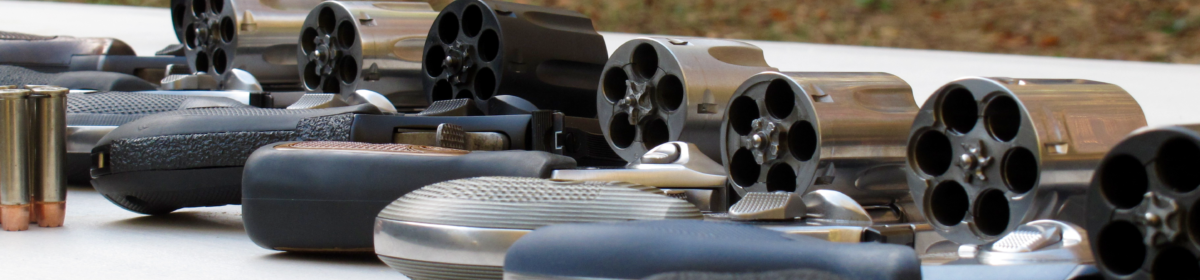

The four-inch Smith & Wesson Model 686 (aka the Distinguished Combat Magnum) is one of my perennially favorite revolvers and my friend, the .357 Magnum is one of my perennially favorite cartridges. Which, now that I think about it, is probably why Mike tapped me to write this one. Anyhow, today we’re going to discuss the latest iteration of S&W’s flagship L-frame revolver: the Lipsey’s Exclusive S&W 686 Plus Mountain Gun. Incidentally, I’m also going to give you guys a backstage glimpse into my writing process.
Disclaimers: The gun for this review was loaned to me by Lipseys’s. Double Tap Ammo and Lost River Ammo both provided ammo for this review. We received no financial compensation and this review was not coordinated with any of the aforementioned companies or entities, nor with Smith & Wesson. This article contains affiliate links.
Because I know someone will ask, the knife shown in the featured image is the ESEE-4, maybe one of the best general-purpose outdoor/bushcraft knives in existence. Now on to the article!
How I Write
I usually begin one of these articles by hanging out with the gun a bit. I’ll handle it, dry fire it, and for a few days just leave it sitting on my desk. After a range session or two, I form some general impressions. Some metaphors, comparisons, phrases will come to mind as I shoot the gun – figuratively and metaphorically – taking it to the range and photographing it. By the time I’m halfway done with the range work, I’ve formed some strong impressions, and have a rough idea of what I’m going to say.

Typically, a review will go more or less as planned. Nothing throws a wrench into the works harder or faster than a late reliability issue, though. I had a wholly different article planned for the 432 Ultimate Carry Ti than the one I ended up writing because of exactly that. I also had a different article planned for this one than what you’re about to read. Keep this thought in mind as we examine at the gun.
The 686 Plus Mountain Gun
The “Mountain Gun” concept has been around for several decades, but production ceased way back in the mid-2000s. The return of the Mountain Gun imprint on a S&W revolver is certainly an interesting development. Another collaboration between S&W and Lipsey’s, this one brings some popular features to the table. It is a (nominally) 4-inch, L-frame, double-action revolver chambered in .357 Magnum. Other Mountain Gun Versions are available in .22 LR, .44 Magnum, and 10mm Auto.

It is also the first L-Frame revolver in many years to be manufactured without the Internal Locking System. We’re tickled to see this development, as no one ever warmed to the lock…or wanted it in the first place. Additionally, it is a 7-shot gun instead of a six-shooter. Let’s dig into what you’ve all been waiting for, the nitty-gritty details.
Barrel
The 686 Plus Mountain Gun’s one-piece barrel is ostensibly a four-inch gun, but it’s actually a hair longer. Smith & Wesson’s product page calls it 4.13 inches, Lipsey’s product page lists it as 4″, and I’ve seen it described as 4.25 in some internet articles. Suffice to say, it’s a tad longer than my old-school, 4-inch 686’s barrel. Departing from the traditional 686 barrel profile further, it is also a tapered barrel. It is quite a bit thinner than the bull barrel of my vintage Distinguished Combat Magnum.

Also noticeably absent is the heavy, full underlug which, along with some other slight differences, accounts for almost half a pound of weight savings. The barrel and underlug sometimes cause me to be reminded of a bulked up Model 66.

Instead, the barrel has a half underlug with protects the ejector rod. The top of the barrel is serrated, presumably to cut down on glare The barrel rib comes to a pedestal at the muzzle, atop which sits a pinned, partridge-style sight. We’ll return to sights in more detail a bit further on.

The right side of the barrel is monogrammed “Mountain Gun,” with “S&W .357 MAGNUM” in tasteful text on the left. The new barrel profile didn’t do much for me initially, but it grew on me.

Sights
The sights on this gun are decent, but only just. They aren’t terrible, but they aren’t my cup of tea, either. The front sight is a very tall, eye-grabbing affair with an inset brass bead. The blade is pinned in, allowing it to be replaced to suit the owner.

The backside of the blade is serrated, presumably to reduce glare though the benefit is hard to discern due to the glare off the brass bead itself. More on how this affects accuracy will be discussed in the Accuracy Section further down the page.

The rear sight is S&W’s standard round-tang, adjustable rear sight. Some say a hard-use gun should have fixed sights because they are less likely to be broken. I’ve seen some fixed sights fail, but I’ve yet to see a S&W adjustable rear sight break; I think you’re pretty safe with these.

For some reason, some years ago, Smith replaced the rear sight blade with a shallower (.126″ vs. the older .146″) version. It still gets the job done for the most part, but the rear sight on my 686-3 allows for significantly more precision and greater visibility. This part is replaceable through sites like Midway at only little expense and moderate headache.

Of note, the top strap is drilled and tapped to allow the addition of other sighting options. The adjustable Bowen Rough Country sights are one of our favorites. To be honest, I’m a bit disappointed that something like this isn’t included on a gun intended for hard use in the mountains.
Strong fixed rear-sight options that would be excellent candidates for a mountain gun (big “M” and “G” or not) include the D&L Sports Fixed Sight and the Cylinder and Slide Extreme Duty rear sight, though these would necessitate cutting a front sight to a specific load and keeping it that way.
Frame
The Mountain Gun’s frame is S&W’s classic L-Frame that we all know and love. This large-medium frame splits the difference between the “lawman’s dream” K-frame and the much bigger, bulkier N-Frame that is best known for housing chamberings beginning with the number “4”…though not always.

A critical difference between my old 686 and the 686 Plus Mountain gun is the round butt on the new model. Some prefer square butt guns, but I think this is a positive development. The round butt is more versatile. If you want an easy packin’, comfortable, rounded gun, you can throw some round butt grips on and round out the grip profile. If you want a larger grip to control heavier recoil, you can throw a square butt conversion grip on the gun. Notably, the backstrap on the new gun is smooth rather than serrated like my old 686.

With the Internal Locking System deleted from this model, we expected to see a return to the older frame profile. If you look closely at the photo above comparing my pre-lock 686-3 (bottom) to the newer 686 Plus Mountain Gun, you’ll notice a deeper scoop for the hammer in the older gun. The reason for this difference and S&W sticking with the newer profile, is the addition of the new drop safety mechanism that replaced the ILS.

I don’t necessarily mind the drop safety – I don’t make a habit of dropping my guns, but I do get up to some real adventures. If I drop my gun, I don’t want it going off. What I’m not thrilled about is the idea that S&W sneaked this in there on us without saying anything. It’s not the end of the world. However, putting it in and not telling us just doesn’t seem like something my dad would have been proud of me for doing, so it kind of rubs me the wrong way. You can read more about this safety and how it works in Kevin’s excellent piece on the 629 Mountain Gun.
Cylinder
One of the big differences between this revolver and older Smiths is the addition of the seventh round. That’s a big increase – 16.667 percent to be precise – and it is noticeable on the range, especially for a guy used to shooting five or six at a time out of his wheelguns

Initially I was a bit torn about this. A revolver of the L-frame persuasion is “supposed to be” a six-shot, after all. Maybe more importantly, my precious S.L. Variant Speedloaders wouldn’t work with this gun. There’s also a tactile difference in lockup; the seven-shot gun shortens the cycle by – presumably – the same 16.667 percent, making it feel…different. Different isn’t always a bad thing, and I got used to the feel, and really came to appreciate having another round on tap. In lieu of my SLVs I ordered up a couple HKSs and made do. (No, HKSs are not “almost as good.” They aren’t even in the same ballpark, but they beat reloading loose rounds. And yes, I’m a bit salty that the technology to drastically and immediately improve revolver reloading exists but no one will manufacture it.).

The cylinder lockup on this new gun is different, as well. Rather than lockup at the tip of the ejector rod, fore lockup is accomplished by a frame-mounted ball detent that inferfaces with a recess in the yoke. Of course this isn’t brand-new; the Model 66-8, released in 2018, had this same locking setup. This system creates a strong lockup, and prevents the occasional backed-out ejector rod malfunction from binding up a gun.

Finally, the ejector rod is plenty long enough to throw empties clear of the gun. It’s a bit skinnier than the old-school ejector rod. Despite its skinny look, I’m sure its plenty strong.

Grips
This gun ships with Tyler Gun Works’ Bear Hug Grips. These grips are lovely in appearance. I don’t think they are a good match for this revolver, however, and they are my first complaint about the gun. Though this is to a large extent personal preference, I don’t like them.

The shape isn’t my favorite; the narrow neck funnels my hand too high up on the grip frame. This creates a diagonal angle from forefinger to trigger, which makes a straight-back press hard to achieve. It also places the knuckle of my middle finger right behind the trigger guard. This is exacerbated by how slick these stocks are; looks aside, I do not like smooth revolver grips.

My second complaint is that these grips were asymmetrical and just don’t fit very well. There is a noticeable seam at the bottom of the back strap. The fitment against the frame is also poor, leaving a large, unsightly gap. I’ve heard this complaint from several other Mountain Gun owners, as well.

I admire what Lipsey’s is trying to do, but something is lost when a custom product is mass produced. And frankly, I’d prefer the upcharge for these grips be spent on quality control and making a better base gun instead. I quickly replaced these grips with a rubber Hogue Monogrip that was, if not the most aesthetically pleasing, at least comfortable to shoot. Even Kevin, who loved these grips on his 629 Mountain Gun, quickly replaced them with Hogues for shooting.
The Action
The trigger shoe on the 686 Plus Mountain Gun is smooth and nicely rounded, as a double-action trigger should be. The double-action pull breaks right around 11 pounds, consistently, which is just about a half-pound heavier than my old 686-3. Though it doesn’t stack and is commendably smooth, getting the trigger moving seems to take just a bit of extra effort.

The single-action trigger is fantastic. It is crisp, clean, and four pounds on the nose. The hammer is of the current design: crisply checkered and with conspicious MIM mold marks. Though I don’t love it, I’m not a huge anti-MIM guy; they make guns accessible to guys on a working man’s income. If you want a gun with zero MIM parts you can have one from the likes of Spohr or Korth…but that dedication to craft comes at a price.

Of note, the trigger and hammer are flash-chromed to match the rest of the gun. I’m happy to see this feature, one that is notably absent on more pedestrian models of 686 in current production.
R.E.A.P. Methodology
That just about covers all the constituent parts of the gun. Let’s take a look at the whole thing, together and see how it performs in the areas of Reliability, Ergonomics, Accuracy, and Portability. To assess these criteria I took the gun to the range three times, and fired 417 rounds, in a variety of different loadings. The loadings fired were:
-
-
- PPU .38 Special 130-grain FMJ (75)
- Double Tap .38 Special SnakeShot 130-grain shot (12)
- Speer .38 Special +P 135-grain Gold Dot Short Barrel (5)
- Lost River .38 Special +P 158-grain LSWC (50)
- Remington .357 Magnum 110-grain Semi Jacketed HP (100)
- Speer .357 Magnum 125-grain Gold Dot Hollow Point (12)
- Hornady LeverEvolution 140-grain Flex Tip (12)
- Double Tap .357 Magnum 140-grain Lead Free SC-HP (20)
- Fiocchi .357 Magnum 142-grain FMJ (50)
- Perfecta .357 Magnum 158-grain FMJ (40)
- Lost River .357 Magnum 170-grain Wide Nose Keith SWC (8)
- Double Tap .357 Magnum 180-grain Hard Cast Solid (33)
-

Though not a prefect representation, these loads just about cover the .38 Special/.357 Magnum power spectrum, and the wide variety of ammuntion that can be used in these guns, from cheaply-manufactured FMJ to shot to state-of-the-art JHPs, to hard, wide lead.
Saying the .357 is insignificant as a hunting round is like saying that sourmash bourbon constitutes an unimportant factor in the diet of man. Maybe, but ain’t there lots of it being put to use?
~ Skeeter Skelton
Before we move on in the review, I’d like to thank Double Tap Ammunition and Lost River Ammunition Company for providing ammo for this review. Both companies offered up different loadings for us. This helps with out expenses greatly, and I had outstanding results with both companies’ offerings. Thank you!
Reliability
I almost hate to beat a dead horse, but nothing trumps reliability. A gun must work. A Mountain Gun that won’t go fire when the trigger is pulled can spook game (especially at handgun ranges), causing the trophy of a lifetime to be lost. A “click” can also cost invaluable moments when saving one’s own life against a charging mountain lion or a two-legged predator.

The 686 Plus Mountain Gun is reputedly reliable – as reliable as any handgun on the market if hype is to be believed. The truth is, I’ve had plenty of malfunctions with my old 686-3. I’ve had light-strikes, a backed-out ejector rod, crud under the star, and squib loads†. I don’t exactly hold revolvers to the same reliability standard as modern autoloaders, like the 1911 I carry every day, or the Glock 45 I carry on duty…or hell, even my .380 ankle gun that has clocked over 1,000 malfunction-free rounds. Ain’t it crazy how things change?

Still, in this writer’s humble opinion, a factory-new revolver should be able to make it through 500 rounds without a stumble. Toward the very end of my testing I had a light strike. There are two common culprits with light-strikes using a S&W revolver: the strain screw and the ammunition. I took the grip off when I got home and checked the strain screw. I found it tightened, ruling it out as the possible cause.
Could it have been the ammunition? I bought my first 10mm back in 2005, shortly after returning from Iraq. Back in those days, the dozens of us hanging on to the struggling 10mm Auto knew Mike McNett, the owner of Double Tap by name. We also knew that DTA was the sole-source provider of full-house ammo for the Ten – the genesis of the company. In the intervening two decades, I’ve shot an awful lot of Double Tap Ammo, and I’ve never had the first problem with.

Back to the original question: could it have been the ammo? The answer is “maybe.” There are some rumblings about hard primers becoming common in the industry. But with S&W’s recent track record, I’m unconvinced. Also, this is is an L-Frame, not some an ultralight J-Frame! This thing should make the cheapest gun show reloads go bang every. Single. Time. A hard primer shouldn’t even make 686 break stride.
Though I might be willing to give some other guns a second chance, my recent experience with the 432 UC Ti colors my opinion of S&W. Once bitten, twice shy. This may change in time, but this “click” immediately shattered my fragile confidence in newly-manufactured S&W revolvers. I shelved the gun, saved what .38/.357 ammunition I had left, and began writing this article.
†I think I took the internet’s favorite squib load photo – I have seen it accompany a lot of squib load articles, though rarely with attribution.
Ergonomics
Frankly, there’s not a whole lot to say in this section: this gun feels and operates like a 686. The grip is extremely adjustable, and as I mentioned earlier, I feel the round butt is a positive development in the life-cycle of the L-Frame. The trigger is quite good, the fit and finish looks solid, and the action is smooth. But there is one other thing.

Though I tried to avoid it, it is impossible for me not to compare this to my well-worn and well-loved 686-3. And as much as it pains me to say it…I think I like the feel of this one a bit better for one reason. The heavy lug of the older 686 design makes the gun a bit nose-heavy.

Comparing apples-to-apples with the 686 Plus Mountain Gun, the newer gun feels more balanced. The added weight of the old, heavy underlug does absorb some recoil, but the .357 – even with stout loads – isn’t known as a bruiser, and I don’t feel that the difference is enough to justify the added weight of the gun.
Accuracy
The accuracy of this gun wasn’t bad at all. I broke accuracy down several different ways, so hopefully everyone can get something out of this section. Before we move one, I will say that the sighting system could be better.
Permit me a slight digression (I swear this is going somewhere), but I think “dots” on a handgun’s sight are often misapplied. I don’t use the dot as part of the aiming process, but rather as a way to find the sight in the first place. For example, with the old “three dot” system, I never aligned the dots left to right. Instead, they are just there to let me see the sights, then I’d align the three tombstones, equal height, equal light. Perhaps I’m peculiar in that regard because a lot of people talk about aligning the three dots.

The brass bead on a revolver’s sight is, in my opinion, similar. It is for finding the front sight. Once found, it the entire front side blade is centered in the rear sight notch, the square to of the sight equal with the top of the rear sight blade. This is what is represented by the top set of sights in my drawing above.
Unfortunately, the brass bead on the front sight sits above the squared top. At best this makes the front sight rounded in appearance, which makes precision accuracy more challenging. At worst – when coupled with some glare as I tried to illustrate in the bottom sight picture – the front sight becomes very indistinct, making precision downright difficult.

I’m all for a brass bead – I love the one on my Colt King Cobra. The difference is that it is properly applied; the bead is below the squared top of the front sight.
Defensive Accuracy
Straight out of the box I shot two iterations of the BATFE handgun qualification. This is a pretty good, well-rounded qualification, with a little bit of everything. I kept went over a couple of the prescribed times, but for our purposes, we’ll just look at shot placement.

I shot the first iteration with PPU .38 Special ammo. I want to chalk up the lousy accuracy to the PPU ammo, and honestly it probably should bear some blame (see next section). Equally at fault though, is my recent inexperience shooting revolvers.

My second relay with .357 ammo was a little better. I thought there would be a serious difference in time and score when moving from .38 to heavier-recoiling magnums, but there wasn’t. I suspect that if I shot this now, being practiced up with wheelguns, I’d do much better with both .38s and Magnums, and as a result, would be able to discern some meaningful difference between the two.
Close Range, Double Action
After getting a rough zero I fired five-round groups with three .38 Special loadings, and three with a Magnum headstamp. While nothing to write home about, these groups were shot at 20 yards, offhand, in double action, the way this gun is intended to be used. You will notice from my groups that my sights favored just a bit low and to the right with most loadings fired for groups.

The 686 Plus Mountain Gun really did not like the PPU full metal jacket loading. The Lost River +P LSWC did impressively well, excluding my flier. This is an exceptionally powerful .38 load; so much so that I checked on their website, where it warns against firing this in aluminum-framed guns. The Speer Short-Barrel Gold Dot load also did very well.

All of the Magnum loads printed exceptionally well. Again, it is evident the sights were slightly low and favoring to the right. This could be adjusted for, but as Kevin pointed out in his review, the tall front sight means the rear sight would be precariously high, so I worked with it as-is. Again, if this revolver were mine, a replacement rear of some sort would be in order.
Long(er) Range, Single Action
Wanting to stretch the legs of the Mountain Gun a bit, I refined the sights a bit at 20 yards, then backed up to 65 yards. There is no magical, practical reason for this distance other than that’s where the picnic table on my range is. I chose one of the best performing loads, the Double Tap Hard Cast Solid, “benched” the gun on a rolled up jacket, and fired five, single-action shots.

The results will not impress serious shooters, but were not disappointing to me. Excluding the low filer, four shots are within the 8-inch center of the B6 target. With a crisper front sight, I feel I could do a bit better than this.
SnakeShot Accuracy
Double Tap Ammo also sent us a couple boxes of their DT SnakeShot™ ammunition, so I thought I’d give it a go and see how it performed. This was a completely novel experience for me. Other than a coup de grace to a run-over rattlesnake I have very rarely (if ever) killed a snake. I’m more of a “you go your way, and I’ll go mine” kind of guy.
I set up six pasters on the target. I would find out they weren’t quite far enough apart to fully assess pattern, but they did let me see what I could hit at a given distance. Each round contains a 130-grain payload consisting of 160 pieces of #9 shot, and a 50-grain, Hard Cast wadcutter. I started at 1 yard (3 feet) and moved back one yard at a time. Here are the results.

1 Yard: At 3 feet, the shot would be pretty devastating to any small animal in front of it, reptilian or otherwise. This might be a good load for rats at short range, too.

2 Yards: The shot still held a softball-sized pattern, with at least five pellets on the paster, and likely more. The hole at 3 o’clock is difficult for me to interpret but it looks like it contains at least two pellet strikes.

3 Yards: At 9 feet the group didn’t open up that much, but the pellets in the center became more sparse. Only one pellet hit the paster (the other three or four were from the 2-yard shot). Also note that the full-caliber hole on most shots is the wadcutter.

4 Yards: At 12 feet I was only able to score one additional pellet on the fourth paster. I think we’ve exceeded the maximum effective on this one. One also has to wonder how much punch these tiny pellets have beyond about 10 feet, though throughout this little “test” the wadcutter stayed within about half an inch of the paster.

5 and 6 Yards: I should have just stopped, but at both the 15- and 18-foot lines, all pellets missed their respective pasters. You’ll notice a doubled-up paster on number 6; it was to cover pellets from the fifth shot..
This was a fun project. These might fit your use-case, or might work better in your revolver, but this is how they worked in the 686 Plus Mountain Gun. Personally, I think I’ll stick with a plain, old wadcutter for small game and pest animals.
Closing Thoughts on Accuracy
Despite my quibbles with the sighting arrangement, this gun did pretty well in the accuracy department. I think it could be better, but most of that is probably opinion. For most shooters, this gun will do fine in the accuracy department. For the serious handgunners out there, there’s some room for improvement.
Portability
The final section, portability, covers how the revolver carries. This includes factors like its weight, as well as holster availability. Let’s address holster fits first. This gun is a 4-inch S&W L-Frame. Just about every holster made for a revolver comes in a version for this gun. It’s not a Glock 19, but you shouldn’t have a problem finding a holster for the 686 Plus Mountain Gun. I carried it comfortably in my Desantis Speed Scabbard.

The weight – if not the looks of the barrel profile – of this gun is certainly an improvement over my old 686. Unloaded, with the Tyler grips back on, the 686 Plus Mountain Gun weighs in at 34.5 ounces. By comparison, the old 686-3 (with VZ Tactical Diamonds) weighs a whopping 42 ounces. That’s 7.5 ounces – almost half a pound – of difference!

This difference is immediately apparent when carrying the gun. It also makes a slight difference when shooting, especially with the hotter magnum stuff. But the difference is not directly proportional, and given my ‘druthers, I’d take the weight savings any day.
The Article I Intended to Write
I began the review process really liking this revolver. It handles like a 686, but it is much lighter. Neither its slim barrel, safety-friendly frame profile, or frame-mounted firing pin were my cup of tea initially, but they grew on me…or at least became tolerable. And once I started shooting I felt like the gun ran pretty well. I also came to appreciate the lighter weight and felt like this would be a more-than-capable trail companion.
My intent was to write a “gun to walk the mountains with” review, with echoes of my embarrassingly unsophisticated, 2017 “gun to ride the river with,” a review of my 686-3. Even my featured image in this article was an homage to the opening photo of that long-ago piece.

Overall this gun is okay. Ah, but reliability… I only had one malfunction with the 686. It was a light-strike. I might be prepared to forgive this and continue on with the review of at least 500 rounds were it not for S&W’s ongoing quality control woes. My review of the 432 UC Ti went pretty well…until my very last range session when the wheels completely fell off that gun. It is pretty likely that a longer firing pin would ensure this malfunction didn’t happen again, but it would take a lot of rounds before I felt I could truly depend on this particular sample.
My confidence is in S&W revolvers is pretty thin. They have a lot of work to do to gain that confidence – and my unqualified support – back.
The Bottom Line
So what does that mean to you, dear reader, who is considering the purchase of a Lipsey’s/S&W 686 Plus Mountain Gun? “How,” you may rightly wonder, “do I put these mixed messages into context?” Here’s my final take on the 686 Plus Mountain Gun.
I can neither recommend nor non-recommend this revolver. I only shot and handled a sample size of one. The deeper I get into both writing and reading gun reviews, the more I realize this is almost always the case with gun reviews. Reviewers get such a soda-straw view of the product line, and from that is is impossible to opine with any certainty about the gun that winds up in a consumer’s hand.

So, I offer you the above, completely honest, unvarnished report of the facts I encountered and the following summary: the Lipsey’s Exclusive S&W 686 Plus Mountain Gun was mostly okay. Accuracy was unremarkable; about what I would expect to come standard with any modern, factory-new gun. There are some real improvements to this model: I really like the reduced weight, both for balance and portability. The lack of an ILS (are we calling this a “new” feature?) is nice, too. Ergos were good, and the trigger was notably good. I don’t like the grips or sights, but these are easily, if not inexpensively, replaceable. I had one malfunction which precludes me from trusting this gun for anything more serious than range use, at least without some modification and a lot more shooting. However, the gun could likely be modified to prevent this in the future. That’s about as fair and even-handed as I can write it, folks. Good luck.


I’ve had more than enough QC issues with brand new S&W revolvers that I no longer purchase S&W. I don’t trust them.
I’ve become a Colt fan. My Cobra is excellent, and so is the Python I purchased. I’d feel confident buying Ruger too. I love my LCR, and my first revolver was a GP100.
Thanks Justin for another unbiased and honest review! Lipsey’s is doing a good job of CPR on S&W and their revolver offerings as of late. Good job Lipsey’s and Jason!
I have been considering adding the new Mountain Gun to my 686-collection ever sense they were re-introduced last year. I’m up to five of the 686 guns right now, three pre-lock and two with the lock. Only one of them is a seven shot, which I am fond of. A MG would be great, old version or new.
However, with S&W still struggling with QC and the cost of new guns, I’m on the fence with the new 686-7 version. There are plenty of 686 pre-lock dash whatever’s out there for purchase for less than a new 686. When they pop-up on Gunbroker the common models go from about $650 to $800 and are in good condition. Of course, the old MG versions fetch a premium and I’m not going to shell out that much on one gun.
Your review has me continuing to keep looking at the pre-locks and maybe, just maybe, keep an eye out for that better than average deal on a new MG, I’m kind of thinking middle of the road, much like your review and conclusion.
Thanks again for a great review.
Another painful S&W review, but an honest and detailed one. Why customers keep buying Smith’s new revolvers after repeatedly getting burned makes no sense to me.
Thanks for another candid review of a handgun of interest.
Is anyone from Smith and Wesson actually taking these guns out in daylight and running them hard?
Your remarks about the effect of an improperly mounted front bead that attracts glare are spot on. And I agree with Nelson Ford that the hammer mounted spring loaded firing pin is superior.
Think I’ll stick with my decades-old L, see if I can score a 7 shot cylinder and make it function correctly.
Thanks buddy, I appreciate the thorough review!
Regarding reliability, before anyone gets too worked up, let’s all remember that Justin didn’t blame the gun for the failure to fire, because he didn’t have enough info to know what the culprit was. He’d fired 417 trouble-free rounds of a dozen different SKUs from eleven different makers before that FTF, and he was fair in his evaluation that he didn’t know why it didn’t light off. He didn’t troubleshoot (i.e., try it a second time to see if it would pop), he just packed it up, called it a day, and reported it exactly as it happened.
I can understand that, after the frustrating experience he’d had with the trigger sticking on the 432 UC Ti. Once you’re snakebit, it makes you cautious. I can understand not wanting to invest more time and energy to troubleshoot a gun from a brand that just disappointed me.
For perspective though, that FTF could very easily have been the fault of the ammo. Just as our gun makers are having QC problems (I’ve personally experienced issues with S&W, Ruger, Colt, Taurus, Kimber and Diamondback products in the last few years, and have heard of many more–Sig Sauer, anybody??), so are our ammo manufacturers. A history of reliability guarantees little right now, because reliable ammo manufacturers are getting bad components from vendors that are causing unseen problems.
The primers are a big concern right now, especially as domestic manufacturers increasingly turn towards foreign manufacturers to make up for shortfalls in the domestic supply. It’s true that many of the foreign primers are simply harder to pop, and they’re showing up in “American” brands–Hornady, Federal, Speer, Remington, Winchester, and all the other majors are having to source primers overseas, and all the smaller makers are as well.
The QC on these primers has been dropping for several years, as a result of trying to keep up with the incredible demand generated by two wars in the MidEast and Europe.
The brass cases are having their own issues. Friends in the ammo business tell me of the flaws they’re seeing in cases, and how it’s affecting the reliability of their products. They’re rejecting the ones they can detect, but others remain hidden.
One notable instance, from my personal experience, involves a maker all of you love and respect as a “reliable” ammo company. I began to experience a number of failures to fire in a 500 round case of .38. Specials (around an 8% failure rate–a second strike would reliably light them off, BTW), and contacted the manufacturer. Apparently, they’d received a lot of .38 Special cases from a vendor whose primer pockets were drilled a little too deep, so the first strike from the hammer merely pushed the primer deeper into the pocket, without setting it off. Once the primers were seated by the first strike, a second attempt would pop them.
This wasn’t the maker’s fault, it was the fault of the vendor who provided the bad cases, but guess who gets blamed for the bad ammo?
So, it’s not just guns causing these issues. Sometimes it is, but sometimes it’s the ammo, and we have to be fair and honest about that, just like Justin was in his reporting.
Now, before anyone thinks I’m being an apologist for S&W, let me say that if you heard any of my discussions at SHOT Show this week, you wouldn’t be thinking that.
I’ve been a vocal critic of the company over their ongoing struggle with QC, and last year I told the CEO of S&W that they were becoming a disfavored brand because they can’t be trusted to deliver a reliable product, and were risking becoming irrelevant in the market, as a result. I challenged him to attack this decline in QC before it was too late to save the company from ruin.
Think that made me any friends at S&W?
So, I’m not just bitching on internet forums, I’m going directly to the people that matter, and telling them uncomfortable truths they need to hear. I’m not making excuses for anyone in this industry, and understand your frustrations.
But we need to be fair and measured in our criticism, just like Justin was in this article. Sadly, there have been too many cases of S&W building an unreliable product that needed fixing in recent years, and some of those have even been Mountain Guns, but it’s premature to include the sample Justin shot for our review in that bunch. We need more information before we can do that.
So, let’s follow Justin’s lead here. He reported the failure, but he didn’t assess blame for it. We don’t know enough to know why the failure happened, so let’s not jump to any conclusions, OK? Thanks for your understanding
Mike, you are calling it correctly and thanks for talking directly with S&W, good stuff.
I have all so noticed problems with primers during the last couple of years, post covid. It used to be when I had a failure to fire it was mostly because I failed to seat the primer fully, only one or maybe two in a thousand, or even zero. However, as of late I have been getting several FTF, say 5-6 or more, per thousand and not because I didn’t seat the primer enough. It looks like a light primer strike and almost always go bang on a second hit. This is accruing with several different guns, both hammer mounted and frame mounted firing pins! I typically buy large quantities of primers at a time to save money and I’m hoping the next batch I get will be much more reliable. It’s frustrating, but tolerable seeing how my hand loads are for practice. I just hope my factory produced defensive loads are not affected by the mystery “light primer strike”.
Note, I referring to CCI small pistol primers. I bought a large amount as soon as they became available at the bigger established reloading suppliers.
…”last year I told the CEO of S&W that they were becoming a disfavored brand because they can’t be trusted to deliver a reliable product, and were risking becoming irrelevant in the market, as a result. I challenged him to attack this decline in QC before it was too late to save the company from ruin.”
I wish I had been there to behold that first hand.
Mike, I’m glad you can talk to the powers that be at Smith and Wesson like that. Because of their long mostly great history S&W has a lot of the benefit of the doubt. They would be wise to consider that even the youngest of us who trusted them “well because it IS A SMITH” will be collecting social security soon and that benefit of the doubt may just become part of their storied history.
I hope they get their stuff in line. Some of my most shining moments were with a Smith in my hand or on my belt. I’d miss them.
Great comments, Mike, as always.
Personally, I wouldn’t have stopped after a single light strike. I would have kept shooting until I either ran out of ammo or the gun quit altogether. Given the recent ammo shortages, I’m sure manufacturers were sourcing components from wherever they could find them, and the result has been some unreliable ammunition. Unless we see another major shortage soon, I expect that situation will straighten itself out over time. As Master Po said: “Patience, young grasshopper.”
I may be old but I am not a fan of brass/gold beads. Tradition is great but I much prefer tritium or fiber optic sights. I’m not concerned if the top of the front sight is square or round. I’m not a bullseye competitor—I carry handguns for defensive purposes, so I drive the dot onto the target.
The same goes for grips. Nearly all of my double-action revolvers wear Hogue grips. Deep blue finishes and wood stocks are beautiful, but handguns are tools to me. That’s why I prefer stainless over blue for durability, and Hogues over wood for their gripping power.
I haven’t given up on Smith & Wesson. I’ve been eyeing a UC, a couple of Mountain Guns, and the new Night Guards. I haven’t pulled the trigger on any of them yet for two reasons. First, I never buy newly introduced models—no matter the manufacturer. There are almost always bugs to work out. Second, I’ve had other purchases higher on the wish list, and money is a finite thing.
I’ll also admit that the online chatter about QC issues among revolver makers gives me pause, though it hasn’t completely deterred me. Last year I purchased two new revolvers and one used (unfired) revolver—two Rugers and one Colt. I changed the grips on all three and swapped the Colt’s rear sight, but all of them have functioned flawlessly. That’s really all I ask for.
I’ve been shooting handguns regularly since the 1980s. My first pistols were 1911s, and they ran perfectly—as long as you fed them hardball. Load hollow points, and you’d be lucky to get through a magazine without a stoppage. I learned early on that when I bought a new 1911, it went straight to a gunsmith for reliability work. Even then, it didn’t get carried for defense until it ran at least 200 (at the bare minimum) rounds of hollow points without a hiccup.
When I became a police officer, I was issued a new S&W Model 66. It functioned well, but I clearly remember my training officer carrying a small screwdriver to periodically check that the screws hadn’t loosened. Later, we were issued S&W 1006 pistols. Roughly 25–30% of them malfunctioned regularly. Mine failed to extract from the chamber every three or four rounds per magazine. I had to carry that jam-o-matic on duty for almost 2 years before the issue was finally corrected—not exactly confidence-inspiring. I carried a S&W 3913 as a backup religiously. It never failed.
My point, long-winded as it may be, is that handguns haven’t always been as reliable as people like to remember. I have found that people tend to look to the past through rose colored glasses. The last 30 years of “plastic fantastics” that just keep running as long as they’re fed have spoiled us. Another factor is that the machinists who learned their craft when revolvers were king are largely gone. Manufacturers have focused on striker-fired pistols for decades because that’s what the market demanded. Now revolvers are back in demand, and I think manufacturers are struggling to produce them in quantity without flaws. Hopefully, they’ll get it figured out in the near future. Until they do, I’ll be prepared to use the warranty and if I carry them for defense, I’ll shoot 200-300 or more rounds through them until I’m satisfied they are reliable.
Everyone have a good day and keep your powder dry.
There’s little more refreshing than an honest, albeit brutal gun review – Thank you for telling it like you saw it. I get sick to death of glossed over ‘reviews’ that only touch on the positive sides, but never dwell on the negatives.
I have been exceedingly disappointed with S&W over the last 25 years. It started with the Hillary Hole, and then descended into QC issues that apparently are not being taken seriously. Their venture into the two piece sleeved barrel system is nothing new, Dan Wesson introduced that long ago. The use of MIM parts, likewise, is nothing new, well, except for S&W. Colt started that in 1969 with their Mk III Trooper, and earlier with the M16A1 production, and it has been used in military small arms ( yes, guys, your ARs and M16s are loaded with MIM parts ), the aviation industry, particularly jet engine components, automobile industry, and a host of other products we all use and never pay attention to. The yoke mounted detent merely recognizes, finally, that Dan Wesson’s original crane lockup, and Ruger’s double action revolver three point lockup taking stress and complexity off the ejector rod is superior.
What S&W apparently has not been able to do over the past quarter century is put all of these advancements together in a package with absolute consistency and reliability. None of my S&W revolvers have the Hillary Hole, and only two have MIM internals, one being on my daily BUG. I look at the newer ones, and think, “Nice, but no thanks.”
On the plus side, I do like the Mountain Gun barrel configuration. It is lean, with no excess fat, and apparently designed for rugged use. Hopefully, someday, S&W will get it all together.
Hey Justin, thank you very much for the 686+ Mountain Gun review. Your points about the brass bead front sight are spot on (I thought your hand drawn diagram was worthy, Sir!). The bead being too high completely eliminates the advantage of a brass bead (finding the sight swiftly) by diffusing the shape of the top and making precision shooting really tough. The .44 version that I tested had a thin but definite sliver of blued steel above the bead that made precision possible. If they are going to go with a brass or gold bead, they have to get that part right! Same drill on the rear sight- the notch depth on the .44 was better than many contemporary S&W adjustable sights I’ve seen, but why did they ever go with a shallow window??? The fit of the TGW stocks on mine were better than what you got, but I had to swap them for Hogues with ammo that produced even moderate recoil. The thin barreled, 7 shot, L frame platform is really handy, as you pointed out. We just need S&W to tighten QC and speedloader makers to step up! It’s always good to read your stuff, hope your day job is going well.
Enjoyed the honest review, Justin. I’ve been tempted by these (more so the .44 version) but I share some of your trepidation about new S&Ws, unless I can inspect it personally before buying.
Out of curiosity, did you try a second strike on that one malfunctioning round?
A great review . . . however what’s a “partridge” sight?
Is that for bird hunting, or did you mean to say Patridge? Look up (I hesitate to say “google up”) Eugene E. Patridge for further elucidation.
Thanks Carl, I’m sure he knows the difference. It was just a typo, probably generated by some computer that thought it knew better than him, when he spelled it properly.
How did you like what he said with the other 5,097 words?
I loved it! Perhaps you missed my first three words . . .
No, I didn’t miss it. I just noticed that you thought it was more important to focus on a spelling error, than to engage in productive conversation about the topic. Thanks for reading.
I enjoyed your review also Justin. I will say I purchased and new 686-6 + 3″ last year and have run about 500 rounds of Winchester W Box 130 Gr RN practice ammo through it and have not experienced any problems yet. The one I have had the dreaded hole in it, but I like the revolver so much I went on and purchased it anyways. It is a safe queen, and I love firing it on my back yard range. Mine has three finger grooved rubber grip on it that came with the revolver and is a round butt. Again, thanks for the truthful review. Like this site Mike.
Thank you so much for another fantastic, and honest, review. The shallow rear sight blade, and front patridge sight, are very puzzling choices. The state of the speedloader market is also incredibly frustrating. More high quality, push style loaders are desperately needed. Light primer strikes are a common complaint on new revolvers, and I was unaware of the full reality about the current ammunition situation. Fantastic Info. here.
I also want to thank Mr. Wood for voicing our concerns directly to revolver manufacturers. It’s impossible to articulate in a short post how much this means.
Thank you Sir, we’re all in this together, and all want the same thing–good, reliable products to purchase!
The truth is I’m predisposed to have negative opinions about S&W today because of their more than two decades of missteps and apparent lack of interest in what their customers want.
Admittedly, Justin’s article above doesn’t totally trash the new 686 Plus Mountain Gun- in fact he lists some good aspects–though he thoughtfully pointed out some noticeable flaws (i.e., not-so-good sights, poor-fitting grips, a potential reliability problem) that, in my view, should not have existed. Especially since the provider knew ahead of time that Justin would rigorously test its expensive product and not sugarcoat his review.
It would be fantastic if S&W returned to their better–but by no means not perfect–manufacturing and quality control standards of several decades ago, and I hope they do soon.
100% agreed about the QC and our appreciation for Justin being so comprehensive and honest in his review. I’m proud of all our writers in that regard. We’ve got the best in the biz under this roof.
Thank you for the honest review Sir! When the new Mountain Guns were announced, my first thought was I had to have one. Instead of rushing out to get one, I took a step back and considered the QC issues I have personally experinced with new Smiths. I am still a true S&W fanboy and I regularly carry one or two of their products and trust my life with them. That being said, I never blindly bought one and carried it. I make sure it will prove reliable with samples of different ammo, swap grips to find the right fit for my hand and reliability with speedloaders.
The 66-8 I currently rely on had some blemishes out of the box but they did not interfere with reliability and I was able to overlook them. I think what I am trying to say is, my personal experience with S&W has been more good then bad and I have a renewed hope for the Nightguard models coming out. I know we all have our favorites and gun guys are like car guys… Ford or Chevy, Smiths or Colts.. If my Smith stops working all together or my Ford decides to not drive anymore, I may have to make some hard choices but overall, they do what I need them for. 🙂 Thank you again for your time and effort to bring us the facts and reviews I always look forward to reading.
The only S&W revolvers I have an interest in these days are old 38 spl K-frames manufactured in the 1960-1980 time range. I especially appreciate the beautiful blued models. I do not believe S&W quality today justifies their inflated prices. My used 1962 S&W Model 10-5 is an excellent revolver that cost less than half the price of a new and less desirable one.
All the “new” centerfire revolvers that I have ever purchased have been Taurus, excepting one Rossi 357 snub. I have had very few problems with my Taurus revolvers over the last 40 years. My favorite 38 spl is my stainless 3-in Model 856 Defender and my only carry revolver is a stainless 2-in 856. I also recently bought a new Model 82 (carbon-steel, medium-frame, 38 spl) with Taurus’s ugly matte black finish that I like so much that I had it Cerakoted in gloss black, which cost more than the revolver.
Any time I find an old Smith in the used section I’m drawn to it like iron to the magnet! I stand with Kaiser Wilhelm on the benefits of experience I guess. Gotta admit I wish you had finished shooting 500.. I do understand the frustration with the light strike after everything but if anything, it would drive me to shoot MORE rounds than planned! Was it a one off? This lot or even brand of ammo? Will it choke on other ammunition? I get pretty dogged running down a problem sometimes. It was a good review though, I’m really glad you pointed out the ill matched frame to grip fit. I have that issue with a couple of pieces and while they function ok it is annoying. And what from up were they thinking with that front sight bead??!?
Cheers!
Thanks for the review and good insights.
Despite S&W’s mounting QC issues as of late, I don’t think I would’ve discontinued the live fire testing after encountering one misfire. Ammunition, even within the same lot, can be incredibly variable lately. Out of curiosity, did you opt to try striking that round again (single or double action) to see if it would go off?
That aside, I’ve been pretty pleased with my 686+ Mountain Gun, though I mirror some of your sentiments. I’m very happy they opted for a flash chromed hammer and trigger – on stainless guns they just look better than the traditional color case hardened ones in my opinion. The partial underlug and barrel profile are also big winners here, especially given how much of a rarity it is to find a partial underlug L-frame. The Tyler Gun Works grips, while not perfect, are significant improvements over the usual Altamont-supplied stocks that tend to be far too thin and sharp in the corners in my experience. I would still prefer if the Tylers were a bit thicker, similar to the original S&W factory target stocks from years ago, but they’re a step in the right direction after no progression on that front for awhile, at least. I’ve swapped mine out with a set of vintage Pachmayrs (it’s also a shame that new production Lyman Pachmayrs never seem to line up or close properly in the front) and opted instead to put the Tyler grips onto a Model 10. They seem a little more comfortable for exclusive 38 Special shooting. I definitely wish that the gold bead was mounted a little lower in the front sight blade to expose more of the rectangular top of the sight though.
Here’s hoping that S&W can take some of this feedback to heart and incorporate it into future designs. For the first time in a long time I’m excited to see what S&W, Lipsey’s, and the folks at AFR cook up next now that the dreaded internal lock is on the way out. Provided that quality control matches how great the ideas are, of course. After running into QC issues with new guns from almost all major revolver manufacturers (a GP100 of mine had to go back to Ruger twice – once for a totally lopsided and misshapen barrel crown, and again for an improperly cut rear fixed sight where one side was completely slanted. My new King Cobra that had trigger hitching issues and heavy, unfinished machining marks on the grip frame, etc.), I’ve been cautious about purchasing anything without a thorough pre-purchase inspection.
The first L frame Mountain Guns had a 7 round cylinder and this barrel contour (The main idea Tom Campbell and Ross Seyfried and Skeeter before them, wanted the light gun for the outdoors.) The 686 is about 3 ounces lighter than the M66 on my postal scale. The Japanese iteration of SL Variant offers a good 7 round L frame loader. I have several and they work well.
I understand grips are a very personal thing, but those Rubber Hogues are about the worst thing Smith ever did to the Mountain Gun. The first iteration had Pachmeyr Presentations and the Compacs are still widely used by many MG fans, like Phil Shoemaker, that carry them everyday. My personal experience is the now discontinued Herrett Jordan Troopers; nice smooth wood stocks designed by Bill Jordan and Steve Herrett to allow for quick acquisition (Jordan wrote about this in No Second Place Winner) and tame even the heaviest recoil.
I too have struggled with S&W and Ruger’s terrible QC/QA issues in the last few years. I’ve seen it in the earlier re released Pythons as well. My new “Cobra” had noticeable voids on the surface of the frame… Corporate heads have rolled … I hope to see some better guns in the near future.
It certainly disappoints me that the only choices these days for rubber grips are Hogues (which I find to be good fitting, but hideous) and Pachmayrs (which look great, but fit terribly in their modern, current production incarnation. Vintage ones are great, especially the two-piece ones). I wish that Uncle Mike’s was still licensing the Spegel design, because those were great.
I agree to everything that you said! A Voice of experience!
While I think it’s good that Mr. Wood addressed S&W directly, and was blunt about it; I’m afraid I’m still cynical.
S&W sells how many polymer M&P pistols and ARs? Probably far more than they sell revolvers. I’m concerned that S&W will make the same mistake Colt did in the past and focus too much on LEO/Government contracts and downgrade civilian shooters.
That said, in this respect, I am glad we’ve seen new entries into the revolver market from Kimber and Diamondback. The more options people have, the more leverage we get on other companies to try to get them to step up. People would’ve laughed at me for saying this in the past, but I’ve bought new Taurus wheelguns with better QC than S&W. What does it tell you when the budget brand is now taken seriously?
This sucks! I have my beloved Python and a bunch of Ruger revolvers but I really want to add a Smith. I really want the 32 mag UC but am stearing clear due to all the QC issues. Thanks for the honest review.
I have one new S&W Model 10. I have not had the chance to fire it this winter. We’ll see.
I have a personal dislike for the 7 shot revolver. But that is just me.
I do like the aesthetics of the Mountain Gun.
My experience with newly purchased S&W handguns for 20 years has been very disappointing with exception of my 629 MG of 19 years. Unfortunately, it has the external lock but it has been exceeding accurate and reliable. My only wish (now) is that it was chambered in 45 Colt. The front sight was replaced with a fiber optic sight and a lock delete was installed. It experienced a couple of light strikes last year but the culprit was a loosened strain screw. I really want a 45 Colt MG but your review has finally convinced me to accept and cherish what I have. I am so tired of dealing with QC problems with new firearms and the subsequent warranty issues over time as they are used as intended.
One small suggestion. The newer Hogue fingerless rubber grips look and feel much better than the ones on your gun. They fit my hand better and are more comfortable. And, most importantly, the K-frame version and the N-frame version make it feel like one is shooting the same gun even though the frames sizes are significantly different!
I bought my first S&W revolvers in 1976 and I’ve had quite a few pass through my hands since. Back in 2000 when S&W was pilloried by a lot of people (including the NRA) for caving in to the Clinton administration’s demands and installing the lock, I pointed out that they were the subject of 29 wrongful death lawsuits, that even if they won them all, the legal fees would bankrupt them, that their British owners had told them if they didn’t submit they (the Brits) would shut them down, and who exactly do you turn to when you’re being blackmailed by the government? (And the PLCAA was a direct result of the Clintons’ efforts to blackmail S&W.)
But my loyalty to S&W is being shattered by the fact that nowadays they apparently can’t be bothered to spend time or money on the pesky QC, and blithely send unreliable garbage out the door. It reminds me of the old Bangor Punta days, only worse.
I hope they get their act together. I’d like to buy and recommend their products again before I die.
Justin,
I’ve recounted my troubles with my first S&W 43C here and elsewhere. Manufacturing flaws were compounded by the repair department’s inability to diagnose or correct its problems on three different trips back to the factory. On its fourth trip home for rework, after the involvement of a product engineer, it was replaced. The new one is maintenance dependent and ammo sensitive, but an 11-ounce J occupies an interesting niche. So, I understood everyone’s QC concerns, even before I read your chilling account of the spectacular failure of your 432 UC Ti.
In that spirit, I offer some observations.
Sights
The brass bead front sight on you 686 looks over-large and misplaced. The bead on my new 617 Mountain Gun is sized appropriately and does just what you and I want a dab of front sight color to do for us. Did you check with Jason Cloessner to see if it’s “within spec”?
I share your frustration with the shallow rear notch. My 617 presents a sight picture that requires me to occlude the bead from 4:00 to 8:00 o’clock to align the top of the post with the rear sight leaf. Rather than installing a taller (more fragile?) rear leaf, deepening the notch with a jeweler’s file is on the To-Do list, but I shouldn’t have to.
Stocks
Bear Hug stocks as currently made by Tyler Gun Works are very popular upgrade on the Lipsey’s guns. I’m experiencing them for the first time, not having acquired Deacon Deason originals when I could. Mine work fine for me on my 22, are well-fitted, made of real walnut, and oil-finished – in a word “Classy.” Haven’t tried them on a 357 running full-house loads though, so your assessment is valuable to me. But when a factory stock doesn’t suit us we replace it and add to that box labeled, “Leftover Grips” (the one next to the “Other Holsters” carton). That’s a feature, not a bug. But even if we decide the shape is not for us, they should fit properly at the joints, out of the box.
One Light Strike?
You didn’t blame S&W when the 686 didn’t like PPU ammunition, but seem to cast serious shade on the maker when you encountered a single light strike. You don’t mention giving the cartridge another whack to see if it was a Light Strike or Failure To Fire. If the revolver perks with everything else, it suggests the problem was with the brand and variety of the failed cartridge, if only a rare glitch.
I had some Light Strikes with my 432UC early on. Most went with the second hit, but some were genuine FTFs. Most were with Magtech S&W Long ammo. I quit using it. Then I read here at RevolverGuy that S&W firing pins were at some point shortened to meet California drop test standards. I replaced mine with an extended (old regular length) firing pin. Problem solved. The UC rides in my pocket routinely. Still haven’t gone back to Magtech.
Half a century ago Light Strikes and FTFs with centerfire ammunition used to be rare, usually happening with handloads, old GI surplus, or foreign military imports. These days they occur with name brand domestic fodder so often it’s hard not to credit the primers.
Sad But True
Quality Control has reached an unfortunate point where when we order a new revolver – from S&W, Ruger, or Colt – we must “count the horse’s teeth” and not be surprised to find some missing. I only accept this challenge to acquire a special feature set. Otherwise, I find myself shopping for vintage wheel guns I can inspect personally before parting with my cash.
Justin, I enjoy your work and value your unvarnished observations. Keep at it!
Michael
Interesting you’ve had issues with Magtech .32 Long. I’ve bought Magtech in multiple calibers, especially .32 Long (since they’re one of the few who produces it), and have never had issues with it in my Lipsey’s LCR. Makes me wonder if you got a bad batch.
I have a 432UC .32 H&R mag and it has proven quite reliable. So far mine has been a very fine piece of machinery with any ammo I run through it. Quite happy with mine and it is now my favorite and preferred pocket carry gun. Smith did get some of them right, I guess, which shows the potential is there.
Earlier I said of my 617 Mountain Gun:
“Rather than installing a taller (more fragile?) rear leaf, deepening the notch with a jeweler’s file is on the To-Do list, but I shouldn’t have to.”
Looking at the rear sight, square jeweler’s file in hand, I noted that the bottom of the notch is level with the rest of the sight assembly. There’s no way to deepen it to improve the sight picture. Harumph! There are taller rear sights available but I’m concerned I’d need to install a taller front blade as well. Grrr!
This fumble on the ten yard line is all the more frustrating because this 617 satisfies in every other way…
I too was beyond excited when I got my new Smith 686 MG. I loved everything about it. The build and balance, the fit and finish, the trigger was great in DA and SA. I loved the sights and the grips. My gun shot very accurate! Well, right up until it starting having problems, and sadly that did not take long. In my second box of ammo it began having FTFs due to light primer strikes to the tune of at least one per cylinder. Usually a go-around and it would fire but that click was a horrible sound. I checked the strain screw… right where it should be. This did nothing for my happy meter. Then, within 150 rounds the trigger would bind up and not pull at all. Just randomly. But it did this as frequently as once per every two cylinders. I’d open the cylinder, close it up and it would then function properly. All this was experienced with all factory ammo, several brands, and in .38 and .357. I had two range sessions with this gun both yeilding the same results. I sent it back to Smith and upon getting it back in a fairly timely manner I went back to the range hoping for much better results. Was I ever disappointed. Same problems. Nothing repaired. Nothing even incrementally better. I could never repeat the trigger failure dry firing it, only while shooting. The FTF problem after Smith “repair” was just as bad. I had high hopes but the QC just ain’t there. I traded it off for what? A Colt Python. I’m not even going to bother sending that MG back to Smith. My old Smiths are great. All of them. What happened to you, Smith and Wesson?
Quick profits might mean more to S&W than decent product quality and customer satisfaction is my assumption, Donald. There could be other reasons, though.
Yet Smith is not the only gun company suffering with poor quality control; I’ve had several Ruger single-action revolvers lock up and had to be returned to the company. The big difference between Smith and Ruger concerning warranty repairs, at least in my direct experience, is that Ruger is able to quickly fix the problem the first time. But judging by the numerous customer complaints I’ve read, Smith and Wesson does not. This is not the business model for long-term success.
It seems most executives at most publicly traded corporations have trouble seeing past delivering quarterly results. Of course that’s because institutional investors* are interested first (and frequently only) with share price. Customer satisfaction and long-term success are not essential to their calculus. Blow the numbers and they’re looking for a new gig.
*Those of us with 401k accounts or other pension funds share some responsibility; the institutional investors are striving to meet our expectations for annual rate of return on the funds we entrust to them (or they get fired too).
Just finished reading the review. While the 686 Mountain Gun seems to be a great idea,Smith and Wesson has done it before. What I mean by my statement is a very similar model was made for a short time in 2005. The model I am speaking of was the model 620. To put them to a side by side comparison, which I did. I own a model 620, my son just bought the 686. Yes the 686 is lighter by 3 ounces, different sights and the ball detent lockup , but it’s just basically a remake of the earlier model 620.
Keep up the good reviews coming.
Mark O
Thanks for all the good info on this S&W.
Also, thanks for the info on the book…I just ordered one:)
Jim
Good honest assessment Justin. Employment status right now prohibit me from making more gun purchases. But I would love to have the 10mm MG. But, as the overall theme of these comments are saying, the overall QC at but blue is highly questionable. Only way I buy a revolver these days is to handle it in a store first.. period.
Steve
Many years ago I witnessed an Arctic Survival instructor hammer his ESEE 4 into a small fallen tree and twist the knife to split the tree for firewood. Temps were way below freezing. The knife didn’t flinch.
I bought one when I got home. I’ve beat the snot out of it ever since, it’s been an absolute champ. If you could only own one fixed blade for every outdoor task for the rest of your life, make it an ESEE 4.
Anner, I now have 4 different ESSE knives, all for a different job. They’re very good at their intended purpose and especially at their price point. ESSE makes a solid product.