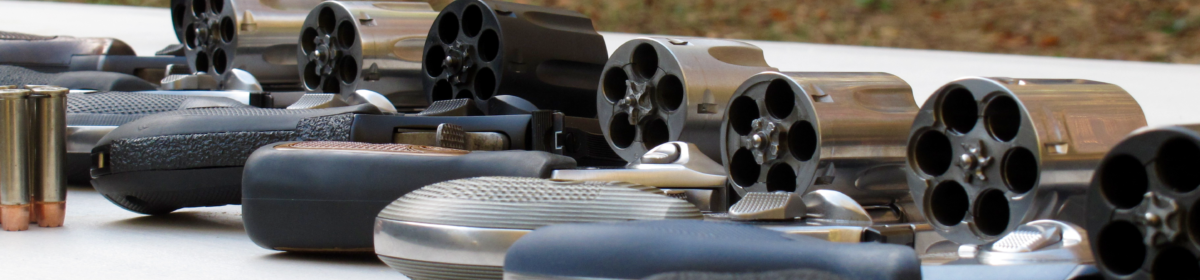

In 2024 Smith & Wesson and Lipseys introduced the Ultimate Carry lineup of revolvers. This series included four guns, two stainless and two black, one each in .38 Special and .32 H&R Magnum. This represented a major resurgence of interest in the .32 H&R, and an upgrade to J-Frames generally. The series has evolved, and in early 2025 several new versions were released, including lightweight variants with a titanium cylinder. Today RevolverGuy brings you a S&W 432 Ultimate Carry Ti Review.
Disclaimer: This revolver – as well as the second one they sent out – was provided by Lipsey’s. I purchased approximately 200 rounds of ammunition out of pocket for this review; the rest was provided by a number of manufacturers. . Despite being loaned this gun, my opinion remains unbiased, as I hope will become clear in the article.
Our Obligation
I don’t like going negative in reviews. I don’t like creating drama within the industry, nor am I looking for clicks with a bad review. Ultimately I just want products to meet the needs of customers (one of whom is me!). Unfortunately, from time to time a product just doesn’t meet any reasonable expectation. This review will be somewhat out of character, so much so that I felt this explanation was in order.
Our obligation is – first and foremost – to, you, the readers and not Colt, Kimber, Lipsey’s, Ruger, Smith & Wesson, Taurus, or any other manufacturer. The manufacturers will sell guns no matter what we do here at this little blog. Unfortunately, a lot of readers will buy guns based on what we do here, too. There is a big mismatch between S&W losing a couple sales, and a guy or gal who is struggling to make ends meet dropping 2/3 of a paycheck on a revolver that doesn’t perform, or is outright unsafe.
The seriousness of reviewing guns was driven home to me several years ago at Greg’s snubnose class. I happened to be seated by a guy who showed me his 640 Pro Series, complete with the same VZ grips I used. “I bought this on your recommendation,” he said.
My heart sank and my stomach flipped. Though this is a very sincere form of flattery, my immediate thought was, “oh crap! I sure hope you like it!” or maybe more accurately, “I sure hope you don’t hate it!” Neil did like it and we have been close friends since that class. But that moment reinforced the seriousness of giving gun recommendations: people will spend their money based on what reviewers say, and they will trust their lives to these guns based on what we say.
Because of this – and because I am also very price sensitive – I will never be anything short of totally honest when it comes to reviewing a gun. I hate to break ranks with most other reviewers of these J-frames, and I hate to come down on a project that has so much potential. However, you will spend your money, and maybe base your carry choices off advice given here, so I owe you my complete, transparent honesty.
BLUF: I Do NOT Recommend This Gun
I wrote most of this review before things…took a turn. This revolver was performing pretty well, and then suddenly, it wasn’t. The gun failed in a rather spectacular fashion. At Mike’s suggestion I asked for and received a second 432 UC Ti. Assuming I wouldn’t get a second lemon I took it to the range with no expectations. And then it, too, failed in a most unusual way.
As I said, most of this article was written before I experienced the big malfunctions. As such, the tenor of the general description of the 432 UC Ti may be at odds with my overarching opinion, which is: I do NOT recommend this revolver for life-and-death purposes. The first one failed within 600-ish rounds. S&W was offered the opportunity to redeem itself, and the second gun failed within 200 rounds.
To top it off, on the day I was wrapping up testing with the second gun, Mike’s non-Ti 432 UC showed up at his FFL. It had a horribly scratched cylinder face from grinding against the barrel extension. The gun was so out of spec Mike rejected it and had it returned to S&W.

Lipsey’s and the braintrust behind this revolver have a phenomenal idea. Unfortunately, S&W’s execution leaves a lot to be desired. At some point in the future, Smith & Wesson’s quality control may improve enough to make this gun viable. For now, though, these guns seems to suffer extremely poor quality control. Reliability and durability suffer, and one of my two samples created an extremely dangerous condition that I’ll discuss below.
If you still choose to purchase one of these revolvers, I would recommend a strict regimen of at least 1,000 malfunction-free rounds before depending on it for life-and-death purposes. With the sporadic light-strikes I had, I would also ensure that at minimum, 250 of these rounds are your chosen carry ammo. I realize that with ammo coming in around $1/round this is a costly proposition, but my experiences drive the advice I give.
It’s also worth mentioning that plenty of other folks have had problems with these guns, so this is not an isolated event. This Youtuber had a similar problem with a Performance Center 640. Though not exactly the same, it seems so similar enough it’s worth mentioning. There are also plenty of guys on forums out there with QC problems with these guns.
I believe that there are trustworthy samples of the 432 Ultimate Carry Ti out there, but I know for a fact there are untrustworthy guns. Caveat emptor. That said, let’s get into my review. To be honest, I feel that little of it matters aside from the section covering reliability, but I left everything else in the review intact.
A Note to Current UC Owners
Ok…one more qualifier! I do want to add a quick note for those of you who own working samples of these guns. One inherent problem with gun reviews is that we only get one gun (or occasionally two) to work with. We might get a bad one, or a good one. Even if most revolvers in a line are bad, there are bound to be some good ones out there!
If you have a 432 (or 442, 632, or 642) Ultimate Carry that works well, I’m not knocking it! Again, I think the concept behind these guns is outstanding, and a good one would have been a joy to shoot. If you have one that you can depend on, then by all means, use it. This assumes you have proven it reliable, and I would ask no more of this gun than any of the guns I carry: it must be 100% reliable for 1,000 rounds, at least a couple hundred of which of which are your given carry ammo.
Again, I hate to be negative, but I know you guys spend your hard-earned money based on reviews you read and watch online. As a small-town deputy in lowest-paid region of the country for public safety, I understand that as well as anyone. My moral compass won’t let me be anything other than brutally honest when it comes to a gun review.
The S&W 432 Ultimate Carry Ti Review
I hate to rehash all the details, but – guaranteed – this is someone’s introduction to the Ultimate Carry line, so we’ll cover the features. The Ultimate Carry revolvers made such a splash because they have a raft of upgraded attributes over more “conventional” J-Frames. Designed with input from a number of industry experts, these guns seem to be the revolvers that “thought of everything.”

For more information on the Ultimate Carry line, see Mike’s three-part deep-dive into these guns (Part I, Part II, Part III), and Kevin’s review of the steel-cylinder 432 UC.
We’ll begin this review by taking a look at the Ultimate Carry-specific upgrades bestowed upon this revolving pistol. After that, we’ll get into the reliability, ergonomics, accuracy, and portability, followed by my conclusions on the S&W 432 Ultimate Carry Ti.
Frame & Barrel
The UC guns are all built on Smith & Wesson’s infinitely popular J-Frame. Rather than steel, like my 640 Pro Series, the Ultimate Carry Revolvers are all built on an aluminum frame, offering a significant weight-savings. As with some other premium J-Frame options, the entire Ultimate Carry line comes sans internal lock. The lack of the internal locking system on this revolver is certainly welcome, for aesthetic as well as practical reasons. The UC revolvers are “hammerless” (or more correctly have a shrouded hammer) for a sealed, snag-free gun and double-action-only use.
The barrel is a classic 1 and 7/8″ snout, but with a bit of panache. The two-piece design features a steel liner that lends a two-tone look to the muzzle that I find visually appealing. The aluminum barrel shroud is contoured with lots of material removed, while maintaining a “heavy” look, and protecting the ejector rod.

Cylinder
The cylinder on this particular revolver is a differentiator from the rest of the UC family. It is titanium, for a weight savings of three additional ounces (16 for the steel cylinder, 13 for this model, according to manufacturer specifications). Being chambered in .32 H&R Magnum, this revolver holds six rounds, and the six charge holes are chamfered. The leading edge of the cylinder is also slightly beveled to allow for easier holstering.

Lockup is front and rear at the traditional points: at the cylinder pin and at the tip of the ejector rod. The ejector rod is necessarily short, being able to push .32 Magnum brass out only about half its length. I didn’t find this to be a huge detriment with the firm, open-handed smack of a Universal Revolver Reload, and the tip of the ejector rod is nicely rounded for comfort with vigorous reloading techniques.

The cylinder release is new-classic S&W: relieved on the upper half and checkered. The cylinder latch worked fine…mostly, until the latter part of my time with the first gun, but more on that later. A white S&W logo adorns the side of the gun, just below the cylinder release. Forgive me if I also reiterate here how nice it is to see a revolver without the offending lock above the latch.

Sights
One of the big things with this revolver versus others in its size class is the sighting system. I have long complained about the puny, integral front sights on most J-Frames, married to the miserable top-strap trench. This revolver suffers no such fate. The front sight is a pinned sight from XS Sights. It is large and highly visible, featuring a luminescent ring around a tritium insert. The luminescent ring glows after being exposed to light, and if it’s not glowing, the tritium tube in the center is.

The rear sight is a wide U-notch. The back of the rear sight is serrated, presumably to cut down on glare. It is also dovetailed in, which means like the front sight, it is theoretically replaceable. It is also drift-adjustable for windage, though be sure to loosen the securing screw before attempting to drift it.

I had no issue at all with the rear sight. The front sight is well on its way to falling off as the roll pin holding it in steadily drifts out, however. On a fairly light-recoiling revolver, with such a minimal round count, this is aggravating. Unfortunately, it is only one of two parts trying to separate themselves from this revolver. The effectiveness of this sighting system will be discussed in the Accuracy section below.
Trigger/Action
Appropriate to their stated purpose, all revolvers in the Ultimate Carry family are double-action only, and the Ti guns are no exception. The trigger on this gun is very good, and was, out of the box. It is incredibly smooth and breaks cleanly. With just a few hundred rounds on it, it is almost as smooth as my 640 Pro with Apex kit installed. This trigger breaks consistently at 10 lbs, 4 ounces.

The action has some other enhancements, as well. The most conspicuous are the four titanium pins visible on the left side of the revolver (one below the latch, two below the cylinder, one concealed by the grip). These make up the “endurance package,” replacing aluminum studs in the gun that could wear and even break on high round-count revolvers.
The action of this revolver created a malfunction that was heretofore unknown to and unimagined by me. This malfunction resulted in an incredibly dangerous situation that I will discuss further down in the Reliability section. The second revolver also had a malfunction that I had never experienced or imagined. If nothing else, these revolvers did inform me as to the “art of the possible” in regards to revolver malfunctions. Again, see more in the Reliability section.
The .32 H&R Magnum Chambering
The Smith & Wesson J-Frame is predominantly chambered in .38 Special +P and .357 Magnum, along with a handful of .22s and .22 Magnums. The .32 H&R Magnum was a standard J-frame chambering, but was dropped from the catalog years ago. In fact, the only .32-caliber revolver I had ever fired before the 432 UC, was a 3-inch Smith & Wesson I-Frame belonging to my great uncle. I was enamored with that gun for many years, and wish I knew what became of it.

Closer to present-day, the .32 H&R Magnum wasn’t dead in early 2024, but it wasn’t buying any green bananas, either. And then came SHOT Show and the release of the 432 and 632 Ultimate carry revolvers. Instantly new life was breathed into the slender magnum cartridge. Guys like me, who had never really considered the .32 H&R a viable defensive cartridge due to ammo cost and availability were suddenly looking at it. New loadings appeared, and manufacturers who had never thought about loading .32 Mag suddenly were.

There’s a lot to recommend in the .32 H&R Magnum. Most importantly, you get a sixth round in a J-Frame cylinder, something you don’t get with a .38 Special without necessarily increasing the diameter of the cylinder. Next, you get less recoil than the .38 Special, while still getting comparable ballistic performance. With the excellent sectional density and decent velocity of the .32 H&R, it penetrates well.

Another benefit is that revolvers chambered in .32 H&R Magnum can also safely chamber and fire two other cartridges: the .32 S&W Long and the .32 Short. The .32 Long is commonly available, and while not exactly inexpensive, also won’t break the bank, either. The decision to resurrect the .32 H&R J-Frame was timely and savvy, and the .32 Ultimate Carry revolvers seem just as popular as the .38 Specials, if not more so.

To be clear, I’m not quite sold on .32 H&R revolvers. That is not to say that I don’t love the concept. The cost of ammunition is prohibitive, with most Magnum ammo running a dollar or more per round. There is also the ammunition availability factor; though it is seen a resurgence in popularity, .32 ammo is far less common than .38. I would fear that the next run on ammo would make .32 H&R Magnum completely unobtainable. But I digress…let’s focus on the gun.
Let’s get into the review of this particular revolver, as judged on four criteria: reliability, ergonomics, accuracy, and portability.
Reliability
A defensive handgun must, above all else, be reliable. When you make the decision to press the trigger, the loudest sound on Earth is a “click” when you expect a “bang.” Revolvers are reputed to be reliable, but as those of you who shoot your revolvers enough know, they should be considered unreliable until proven otherwise, like any other manmade implement.

I fired a total of 617 rounds of ammunition through the first specimen of the the 432 UC Ti. Four hundred sixty-eight of these were of the .32 H&R Magnum persuasion, 134 were .32 S&W Long, and 15 were .32 ACP.
Ignition (UN)Reliability with .32 H&R Magnum
The .32 H&R Magnum ammunition used in this test was hefty mix, including:
-
-
- Black Hills 85-grain JHP
- Buffalo Bore 130-grain +P Outdoorsman Hard Cast Keith
- Double Tap 60-grain SCHP
- Double Tap 120-grain Hardcast Solid
- Federal American Eagle 85-grain JSP
- Federal Champion 95-grain LSWC
- Federal Hydra-Shok Deep 85-grain JHP
- Federal Personal Defense 85-grain JHP
- High Desert Cartridge Company (HDCC) 100-grain JHP
- HDCC 98-grain WC
- HDCC 100-grain RNFP
- Hornady Critical Defense 80-grain FTX
- Lost River Ammunition Company 100-grain poly-coat WC
- Lost River Ammunition Company 130-grain poly-coat SWC
- Remington HTP 85-grain JHP
-

Reliability with .32 H&R magnum ammunition was 100%… right up until my last range session. One .32 H&R Magnum cartridge had a lightly-dented primer and dig not ignite. In fairness and full disclosure, this round was not otherwise perfect. Upon removing it from the cylinder it exhibited some bullet-pull. It is possible the cartridge was out of specification, but I think it more likely that this light-strike owes itself to another set of issues. The round fired on a second strike.

Upon receiving my second 432 Ti, I promptly took it to the range. The first session – of only 60 rounds – was fine. My second session, at RevolverFest was…mostly fine. Upon loading the gun up with HDCC ammo, the cylinder would not turn, no matter how hard I pulled on the trigger. This was most likely ammunition-related (a high primer). Due to the fast-paced nature of the class I was unable to verify this, unfortunately. [Editor’s Note: I saw this happen, and it looked like a high primer to me, when Justin showed me the gun. -Mike] This SNAFU was still a portent of things to come. On my third and final outing with this gun I experienced another light-strike with .32 H&R Magnum ammo.

A sincere “thank you” to Double Tap Ammo, Federal, High Desert Cartridge Company, and Lost River Ammo Company for sending ammunition for this review. All sent ammunition without strings attached for use to use in this review. You will see more of them in the upcoming .32 H&R Magnum ammo roundup.
Ignition (UN)Reliability with .32 S&W Long
Thirty-Two Smith & Wesson Long was far less reliable than .32 H&R Magnum ammunition. Like .38 Special in a .357 Magnum, a revolver chambered in .32 H&R Mag should be capable of firing the shorter cartridge. This aids in ammunition availability and gives recoil-shy shooters a lightly recoiling option. Regrettably I did not find this to be the case, at least not reliably enough to depend on said ammunition. In fact, it wasn’t quite reliable enough to even really be enjoyable in practice.

I fired two full boxes of S&B ammo in .32 S&W Long, as well as 34 rounds of High Desert Cartridge Co.’s .32 Long wadcutter. All of the HDCC .32 S&W Long ammunition fired on the first strike, though admittedly, this is a very small sample size. Out of each box of S&B ammo, with its harder primers, two or three rounds required multiple strikes to ignite.

I don’t like this. Ammunition for the .32 H&R Magnum isn’t the easiest ammo to come by. Lately it seems that .32 S&W Long is more readily available, and far less expensive. The longer H&R cartridge seems to be coming around, but the ability to utilize less-costly practice ammunition would be very much appreciated.
Possible Ignition Reliability Causes
I am equipped with a theory regarding ignition reliability. First, the trigger on this revolver is very light. I tend to believe this gun is operating at the lower end of the reliability envelope, for the sake of a better trigger. While it will ignite American-made ammunition, the harder primers in South American (Magtech) and European (S&B) ammo challenge the light springs. Personally, I’d rather contend with an extra pound of trigger pull in exchange for reliable ignition. [Editor’s Note: Noted Gunsmith Nelson Ford has described how the UC springs have a reduced diameter to reduce their energy]

Second, the shortened firing pins on S&W revolvers probably have something to do with it, as well. These are informally known as “California firing pins,” and have been put in S&W guns for decades to improve drop-safety. Now, so-called, “extended” firing pins from the likes of Apex and Cylinder & Slide are actually the original length. Replacing the OEM firing pin in the UC (or really any J-, K-, or L-Frame) revolver may result in an improvement in ignition reliability.

Finally, Smith & Wesson appears to have some headspacing issues with some revolvers. When coupled with the short firing pins, a multiplicative effect occurs that negatively impacts reliability.
I recommend extensively testing with ANY ammunition before depending on it. It would take far more ammunition than would be cost- or time-effective to restore my confidence in either of these specimen, or frankly, in this model generally.
Common Issues
Aside from ignition reliability with non-Magnum ammunition, I have no concern with the reliability of this revolver. I wrote that line before my last range session with the first S&W 432 UC, and it almost made it in. I went to the range intending only to group and chronograph some .32 H&R loads and had a very eventful range session.
On earlier sessions I did have some very minor issues that are common to all revolvers. I did not clean it for the duration of the test. The small issues I experienced can be corrected by simply maintaining your life-support equipment. These are not strikes against the gun mind you, just a fact of life with revolvers.

The first of these was a junk under-the-star malfunction. This occurred during the first fifty rounds when unburned powder congealed with a drop of oil under the star. I wiped it out, and and had no further problems. This is a fact of life with revolvers, not the fault of this one. I point it out only because I can’t in good conscience say it had “no malfunctions.” If you carry a reload for revolver (any revolver!) keep the area under the extractor star clean and dry.

The other routine, expected malfunctions had to do with the cylinder: loading and unloading, when the occasional failure of brass to fully eject. And occasionally I had a round fail to fall fully into the chamber, slowing reloads. To be clear, neither is an uncommon problem with revolvers, and was certainly exacerbated by my failure to clean this gun. Slicking up the inside of the chambers certainly wouldn’t hurt a thing, and I personally feel that regardless of what you carry – be it a 1911, a soulless plastic pistol, or a revolver – you should maintain it as if your life depends on it…because it very well may.
Durability Issues
This gun is reputed to be extra durable, and even has an Endurance Kit to ensure longevity under high round counts. While the Endurance Kit fixes some problems, more pedestrian issues seem unaddressed. To wit: this revolver seems to be shaking itself apart. The first issue is the pin on the front sight walking out. After just over 600 rounds, about a quarter of its length is sticking out of the sight pedestal. It seems to have stayed here for a couple hundred rounds, but it’s not confidence-inspiring. This is an easy fix, but why wasn’t it caught before this gun left the factory?

I have noticed the sight pin issue as it has progressed, and I’ve kept an eye on it. What I just noticed after my last range session was the cylinder latch screw working its way off. When taking some photos for this article, I noticed the cylinder latch sitting at an odd angle. Manipulating it with my finger I noticed that it was very loose.

Tipping the gun on its side and allowing gravity to work on the cylinder latch, it separated from the frame…by a lot. In fact, the cylinder latch almost fell off, and was held on by only a couple threads. The screw (technically a nut) had backed off by almost two full turns, and wasn’t hanging on a by a lot. Removing the cylinder latch, it doesn’t appear that any thread-locker was applied. This is an easy fix…but it leaves me with lingering questions to wit: what else in this revolver needs an “easy” fix? I’ll own it: I have trust issues, but this shouldn’t happen.

A Very Dangerous Malfunction
I thought I knew all the jams, stoppages, “hiccups,” and malfunctions a revolver could have. Turned out, I had something to learn from each S&W 432 Ultimate Carry Ti I tested!
With the first specimen, I was firing groups for my .32 H&R ammunition roundup article. In an attempt to be as precise as possible, I was moving the trigger very slowly to the rear, and taking breaks between shots. If a shot didn’t feel right, I released the trigger, lowered the gun, and took a deep breath. Pretty standard stuff – I’ve done this with a hundred other guns, a thousand other times.

But on one evolution I stopped rearward progress of the trigger to clear my vision and something strange happened. The trigger didn’t follow my finger forward. The trigger was held to the rear, as if the hammer was cocked…only, this gun doesn’t have an exposed hammer or any other provision for single-action fire. VERY CAREFULLY I made my way to the barrel where my stuff was resting and picked up my phone to photograph the gun†. I didn’t have the presence of mind to record a video, being concerned about an uncommanded discharge at any moment. I captured two photographs, then set my phone down, aimed, and pressed the trigger. It fired under maybe a pound or two of additional pressure, like a really excellent single-action trigger. I was able to replicate this malfunction and record it several times – with an empty cylinder and with a loaded cylinder.

I doubt I have to explain the danger of this condition, but I will. Let’s put this in a defensive context: assume I am forced to draw my gun in a public place. I always reserve the right to choose not to move my finger to the trigger, or to cease my trigger press at any time as the situation changes. Assume the bad guy puts up his hands, or flat-out turns and runs away. I release the trigger to find it in this condition. Now what? I’m standing here with a loaded revolver, the hammer precariously cocked, over a live cartridge, that – Sig P320-like (sorry, I know it’s not the time for jokes) -could spontaneously fire at any second.

What, pray tell, do I do with this revolver, in this condition, in a public place, other than choose the least-worst thing to put a bullet into and hope for the best? What happens when this malfunction occurs on the range with an inexperienced shooter who doesn’t recognize the condition or understand the danger it presents and sets it on the bench, or turns to a friend? This particular malfunction was the deal-breaker for me. I’m told this may have been caused by rough finish on mating surfaces. Regardless of the cause, I’m no longer comfortable using this gun off the range. [Editor’s Note: Noted Gunsmith Nelson Ford has described how a relatively thick hand on the UC can bind on the ratchet and cause this problem, because the lightened rebound slide spring doesn’t have enough energy to pull the trapped hand off the ratchet]
†I was alone at the range and endangering neither myself nor anyone else. My range 180-degrees of safe shooting, and I kept the gun pointed in a safe direction at all times. Also note that this malfunction occurred approximately 16 minutes BEFORE the next malfunction (per my camera roll), meaning one did not cause the other.
The Buffalo Bore Lockup
Finally, there was another malfunction, again during the last range session when everything seemed to go wrong with the gun. In testing a bunch of ammunition, I loaded up five rounds of Buffalo Bore’s “+P Outdoorsman” 130-grain hard cast Keith load.

I fired one round and after some vigorous recoil found the gun locked up. I couldn’t pull the trigger to the rear or open the cylinder. It took three, hard slaps with the heel of my hand to pop the cylinder open. Once open, I couldn’t depress the ejector rod. I ended up pounding on the ejector rod with my stapler and getting the offending case out.

Thinking that perhaps this was a fluke, I reloaded the Buffalo Bore ammo again and…same result. After that I decided to move on and put the heavy stuff away. Since I did not have this issue with any other loading, I can’t put this malfunction at the feet of the gun. I think this is the fault of the ammunition rather than the revolver, but I felt it was worth mentioning.
But Wait…There’s More
On my third and final range trip with the second revolver, I experienced another, brand-new malfunction that I had never experienced before. I fired a cylinder full of fairly warm ammo. Some of the brass was a bit “sticky,” not wanting to fall free of the cylinder. I gave the ejector rod a firm open-handed strike as I always have with the Universal Revolver Reload technique. The brass did not fall free, and when I examined the gun I found out why.

The extractor star remained firmly in place. Instead, the entire cylinder had been pushed over the cylinder stop. Not only did this fail to eject the spent brass, it also forced me to manually return the cylinder to its default position. Examining the gun further revealed that the cylinder stop – the slightly raised portion below the recoil shield – was insufficient to arrest the cylinder’s rearward motion.

There are several possible reasons for this including poor machining of the frame, or a bent yoke/crane. I’m less concerned about the “why” at this point, though, and more concerned with the fact that this happened at all. Keep in mind that this is a revolver with fewer than 200 rounds through it; I have wheelguns with thousands of rounds fired and have never seen this or anything like it.
Between two S&W 432 UCs Ti’s I couldn’t make it through 900 rounds without a several major malfunctions. Again, buyer beware.
Reliability Wrap-Up
Before that last range session with the first gun, the biggest reliability problem I had was some light-strikes on .32 Long ammo, and the front sight pin walking out. A lot of things went wrong in that range session, however. I experienced a light-strike on magnum ammo. Next, I had the trigger-pinned-to-the-rear malfunction. The malfunction with Buffalo Bore ammo was interesting, but I disregarded it as it was ammo-related. And then I got home and noticed that the cylinder latch was close to falling off.
When I received the second revolver, I had another light-strike with .32 H&R Magnum ammo. Even worse, I had the cylinder-overcoming-the-cylinder-stop malfunction. The odds that I would get two guns with major quality issues is pretty low…unless there are underlying issues with the manufacture of this gun, and sadly I see no reason to believe otherwise.
All this combined to sour my experience with this apparently well thought-out revolver. At this point, I don’t think betting my life on this one is prudent or advisable. I had a few more tests I had planned to put this gun through, and use it for, but decided I to go ahead and shelve this project for the foreseeable future.
Ergonomics
All its problems aside, the ergonomics of this revolver are excellent. Pulling this gun out of the box got me excited about J-Frames again, at least initially. The visual appeal is obvious, and fitment seemed to be excellent (loosening parts aside). The controls are classic J-Frame, but the one thing that rightly gets all the credit for ergos is the Hamre Forge grip – it is excellent!

The S&W 432 Ultimate Carry Ti ships with a standard, rubber boot grip installed. I didn’t have much complaint with this grip before getting my hands on the AFR grip. The OEM grip is soft rubber, it terminates at the bottom of the grip frame, and it leaves the back strap exposed. Nothing to see here, folks.

But the nylon Hamre Forge AFR (American Fighting Revolver) UnderCover Grip is also in the box. It does two things differently than any other boot grip I’ve ever used. First, it covers the back strap. I’ve always been resistant to this as it makes the gun a little bigger, but in using it I’ve become convinced it is only a modest increase in size. In exchange it gives you a larger grip surface, and places your trigger finger more correctly in relation to the trigger.

The other thing the Hamre Forge grip does is cover the entire back strap, permitting a higher grip on the gun. This “high horn” design is almost identical to VZ’s G-10 grips found on the rest of the Ultimate Carry lineup. I found the Hamre Forge grip to aid not only in recoil management, but also in lowering the bore axis and making the gun point more naturally.

The texture on the Hamre Forge grip is called “roughout.” It provides plenty grip, but is not excessively sharp or tacky. It won’t rub you raw, and should be pretty easy on clothing (said as a guy who has holes in the waistline of all of his shirts). The left panel is also generously relieved for the use of speedloaders, and by the way, the HKS 32-J model works perfectly with the S&W 432 Ti.

The Hamre Forge AFR grips are the true star of this review. Despite the disaster this revolver was, the AFR grips included with both samples were outstanding.
Accuracy
One eternal frustration with gun ‘riters is the consistent eschewing of accuracy in small guns. “It’s a belly gun!” they’ll say, or “it only has to be minute-of-man accurate!” I don’t concur. I have said it before, but the fact that I am carrying a small gun does not represent a reduction in the threats I may encounter. It is only a representation of my inability – due to social constraints, weather/activities and related clothing, etc. – to carry a larger, more capable firearm.
Even if the situation precludes me from carrying a larger firearm, I may still have to stop a threat at more than a handful of paces. Putting distance aside for a moment – because it is not the only reason I demand accuracy – there may still be the need to deliver a precision shot at close range. When being shot at, people don’t tend to present like a B-27 silhouette: immobile and offering a full-frontal. Instead, they often move, get behind things, and try to make themselves small. I don’t like the idea of holding myself to a “-1 zone standard” when I may be presented with a much smaller viable target area, even if only at the small, single-digit yards distant.

Additionally – and this is a fact, not just Justin’s opinion – in order to carry a backup gun (BUG) at the agency where I am sworn, qualifying with it is not optional. Of the 30 rounds in said agency’s BUG qualification, eight are fired the 25 yard line. There’s no getting around it: this gun has to make hits at 25 yards to be useful to me.
For these reasons and others, I demand accuracy. I will be fairly critical of the S&W 432 UC Ti’s accuracy. It wasn’t great. The sights are large and certainly fast-acquiring. The “ball” of the front sight just seem to effortlessly fall into the “cup” of the rear sight every time I pick this scant revolver up. The front sight is large and highly visible. These are all good things for close-in speed work. Since I can’t guarantee that close-in work is all I will “need” on any given day, I don’t like sacrificing everything else.
Sight Regulation
The sights on this gun make precision shots unnecessarily difficult. I found the front sight to be of the appropriate width relative to the wide rear notch. The rounded nature of the front sight made elevation tricky. Unfortunately it also required modifying my deeply-ingrained sight picture. I began by shooting with the top of the front sight at equal height to the rear sight. I found that this sent rounds high, especially with full-power, .32 H&R Magnum loads.

With a center-mass hold, rounds impacted high at all distances. At three to five yards, rounds were in the upper half of the 8-inch circle on an IDPA or IALEFI Q. At seven to ten they were in the upper third. Beyond ten yards – 15 to 25 – rounds were straying out of the circle and into the high upper chest and neck. Not terrible hits, but certainly not where I wanted them. My Dot Torture score also reflected this with an miserable low of 40 of 50 points. Making this especially vexing was Lipsey’s claim that “32 H&R Magnums sights are regulated at 15-yards w/ Federal 85 gr. JHP…”

I spoke to Mike to report this finding. He recommended burying the ball in the cup by aligning the curvature of the lower edge of the luminescent circle with the curvature of the bottom of the notch. I was immediately put off by this for two reasons. First, putting the circle of the front sight at the bottom of the rear notch left the tops of the rear notch conspicuously “up in the air.” This makes aiming even less precise. Maybe more importantly, this is goes against the “equal height, equal light” I’ve trained for two and a half decades. It can be done, but it requires conscious effort.

Results Don’t Lie
Despite my misgivings about this technique, I gave it a chance. It worked. I immediately noticed results, and my scores instantly improved. Shots immediately migrated to the center of whatever I was aiming at. Of course this required thinking about it and remembering to do it.

This is problematic. It requires you remember which way you need to adjust. Before writing this section it had been about a month since I’d last shot the 432. To write this section I had to consult videos of my range sessions to ascertain the relationship between points of aim and impact. This is not the kind of technique you want to rely on in a fight. The alternative would be to deeply ingrain this style of aiming, but to the detriment of other firearms.

My Preference
I think the mark has been missed with these sights (as is also the case with S&W’s Bodyguard 2.0 pistol, but fortunately more reasonable sights are available for the BG 2.0). I understand that some people want sights that are fast-acquiring. However, it is possible for two things to be true at the same time: it is possible to make sights that are both fast and easy to acquire, AND that are suitable for precision accuracy. You may think that my indictment of this wheelgun’s accuracy is a denial of the need to be able to go fast, but don’t mistake me: speed is also important. Your hits must arrive in time to make a difference!
The sights on most modern semi-autos (let’s just pick any old M&P or Glock out of the hat) are an excellent example of sights that do both. They can be acquired quickly, yet are be well-suited to fairly precise accuracy at distance. I don’t understand the shift to purely speed-oriented sights any more than I would comprehend Bomar adjustable target sights on a J-Frame.

I wish the S&W and Lipsey’s team would stick with a decently large, square-profile front and square-notch rear. Still plenty fast, but also capable of putting hits exactly where you want them without some one-off sight picture you have to remember and think about. Squared-off front sights also mitigate any confusion about what one’s sight picture should look like.
I know I probably sound like a old man, shaking his fist and yelling, “if it ain’t broke, don’t fix it!” but I do feel these sights are a step in the wrong direction. They are oversized and rounded, rather than squared, inhibiting accuracy potential. Why limit the Ultimate Carry J-Frame to a being close-range-only revolver when you could have your cake, and eat it, too?
Portability
The S&W 432 Ultimate Carry Ti is about as portable as a J-frame revolver gets, and there isn’t a whole lot to say here. Holsters in any imaginable configuration – strong side, appendix, ankle, pocket, and more – are widely available. And the gun only weights 15.2 ounces, fully loaded with six 85-grain jacketed hollowpoints, a full ten ounces lighter than my all-steel 640 Pro. This also compares very favorably with the steel-cylinder UC models, which weight in at 16 ounces, empty.
Early in my testing I carried this revolver some. It was incredibly handy to throw in the pocket of my gym shorts when I had to run into a store on my way to the gym or track. Being single and dating, this is also a very “forgettable” gun to throw in the waistband on a first date. All of my carry and range work was done from a Harry’s Holster’s Icon that I reviewed years ago. The minimalist design added very little bulk and only about two ounces of weight to the overall package.

I had high hopes for the S&W 432 Ultimate Carry as an ankle gun. It has a lot going for it – the lightweight increases comfort, and reduces the likelihood of it flying out why while running, and the sealed backside keeps the interior clean. Were it reliable, I believe it would serve admirably in that role.
Closing Thoughts
I feel a bit out of place writing this conclusion; like a naysayer in the land of adoring fans. Most reviews of the Ultimate Carry guns are superlative. This revolver does have a lot going for it. The feature set truly has a “thought of everything” vibe, including some things I never thought of, like the Hamre Forge grips which are amazing.

I was also personally primed to love this model, being in the market for a backup gun for duty use when it came around. This seems not only to be the Ultimate Carry revolver, but also the Ultimate Backup Revolver: it holds six instead of five, is light recoiling, lightweight, has an excellent trigger and visible sights… In fact, until the the S&W 432 Ultimate Carry started coming apart on me, I planned to purchase it for backup use. The idea behind the Ultimate Carry is admirable, and I’m certainly not knocking the brains behind this good-looking, feature-laden revolver. It’s also a really good-looking revolver, as evidenced by the fact that I could not stop taking pictures of it. This thing is sexy!
However, I think the execution leaves a lot to be desired, and the problems seemed to stack up and dampen my initial enthusiasm. With enough hunting I could probably find a square set of sights to replace that big ol’ front sight that I never warmed to, though adding at least $100 to the cost of the gun. I could drop in an Apex Duty/Carry Spring Kit and likely solve some of the ignition reliability problems (but how many rounds would I have to fire to satisfy myself – to life-and-death satisfaction – that the problem is solved ?). And I could apply some Loctite to the cylinder latch screw and nut.

However, I’m not sure a whole lot could restore my confidence in this revolver after the trigger pinned to the rear (and was still live!), and the cylinder getting knocked back past the cylinder stop. These problems are dangerous and inexcusable.
Really though, I’m not interested in putting more money and time into improving this S&W 432 Ultimate Carry Ti, and proving it reliable. I think the features of this revolver are really something. I really wanted to like it and regret that it didn’t work out. The execution has been a huge disappointment, and I’m finding myself glad I didn’t drop my own money on this revolver.
If you don’t already own a UC revolver and are thinking about it, here’s my advice: I’m sorry to say it, but I’d wait a while on this one.
Hopefully I’m back with better news next time! Out here!

Thanks for telling it like it is, Justin. Not to come across as smug here, but I’ll stick with my vintage, reliable S&W J-frames that were manufactured with some standards.
I wish I could argue with you, but you are not wrong.
As someone who knew the original UCs were coming out months and months before they were released, I had been looking forward to them with intense excitement. I was fortunate to be in the first batch because of my Round Up ties, and mine immediately was broken at the LGS. Cylinder would not release. That’s kind of a big deal for a defensive gun.
Mine went back and three weeks later I got to try again. Since then it’s been flawless but I’ve seen so many others of them have even worse issues as you found. S&W have MAJOR QC issues right now. I look with great care at anything they are putting out. They have a lot of trust broken factors in the gun community, and that is a tough hole to dig themselves out of.
I feel really bad for Lipsey’s. They knocked it out of the ballpark with the entire design, but S&W completely dropped the ball.
Though QC on revolvers has been problematic for a while, it seems to have gotten really bad lately. Hopefully S&W gets their act together before too much damage is done. I really want them to, because there isn’t really much else to turn to for a good fighting wheelgun.
Hopefully I’ll be able to train with you next time you’re out at Apache!
It has, at least in my experience. I’ve got a 686-6 and 617-6 that are gorgeous. I’ve got a 340PD that’s a bear and a half to shoot but absolutely flawless. I decided to try my hand at the 329PD cause fool money and it was quite an ordeal. I had one example arrive and sent it back immediately for a number of cosmetic issues unbecoming a revolver so expensive. The second example the gun store looked it over and backed out of sending it saying it wasn’t much better than the first. Finally I got a third and while not perfection it was, “good enuf” that said I feel the fit of the forcing cone to the cylinder is exceedingly tight and maybe even not totally square. It doesn’t drag in its travel but you can certainly push the cylinder forward and make it touch IIRC. It’s just not a great situation IMHO. I feel like CZ has done a really nice job with Colt, I have the newer Python and it’s excellent and the Anaconda is mind blowing, better than the original by a country mile in no small part because it’s now basically a scaled up Python whereas the OG ones were not really that at all.
This is good to hear – I have a 617 4″ showing up at my FFL today. I’m going to be pretty critical inspecting it because of the recent QC issues.
It’ll end up a competition gun for me, but I’ll get 500 rounds through it before I start swapping out parts, etc. just to make sure the bones are good.
This is really a shame to read. But like you point out Justin, it’s hardly a one-off case in terms of QC issues with the UC series specifically, and recent S&W revolver production in general. My 642 UC has been reliable so far, but when I received it, nothing had LocTite on it, and my cylinder release and front sight both came loose in short order. This is so basic that it’s shocking to me there are guns leaving the factory this way.
Certainly, S&W isn’t alone when it comes to QC issues with current revolver production, but I’m seeing, and hearing, about issues with S&W more than anything else these days and at this point I wouldn’t buy another new one unless I personally inspected it first.
Sadly this issue isn’t confined to S&W…it’s hard to know who to buy a revolver from these days. Good to see you’re still hanging around here, Hammer!
Both my Dad and I got the 32 H and R guns and both had to be sent back for light strike issues and my Dads had dead tritium in the front sight. Since I got it back I’ve only had light strikes with the high desert ammo; not sure if this is a gun or ammo issue. My dad had the case rupture on a Buffalo bore 32 H and R round – I think those rounds are waaay over pressure for what the brass can endure.
In the past couple of years I’ve purchased this gun, two colts and two Tauruses(Taurii?). This gun and both colts had to go back (twice for the Python). Both Tauruses that a lot of people seem to deride have worked great, any both of those guns together cost less than 1 s and w or colt. It’s a shame that despite so many interesting revolver designs being out there, the QA is terrible and you have to take a 50/50 shot of sending your gun away for 3 months to hopefully get it to work.
“make ends meat” sorry to be that guy but just wanted to point this typo out, I know how frustrating this experience must have been and i’m sure it was all typed out in single session. S&W has been putting out products that are completely embarrassing when it comes to quality control these past few years. They really don’t make them like they used to anymore.
Thanks. With an article as big as this one (8,800 words, almost 50 photos, and 47 revisions) we’re (I’m) bound to have a typo or two.
actually … there were about a dozen or more … typos, wrong words, transposed words, and verb syntax error.
I see this in lots of copy these days and wonder if it isn’t some artifact of the wordprocessing (interestingly, “wordprocessing” got flagged) software, or a voice-to-transcript function. I was a magazine editor 40 years ago and I understand how easy it is to overlook things after seeing it “too many times”.
But I did find the article illuminating. I was considering recommending this gun to a friend … but no way now!
i’m sure?
Justin, your frustration in the face of anticipation is very familiar, and very understandable. It is very disappointing to go into an evaluation of what promises to be a tier one carry revolver only to find out you can’t trust it to do anything right. Disappointment is an understatement. Your honesty in this writeup is a necessary component to evaluate a gun as a potential life insurance policy.
To spend what appproaches a “G” note on a gun that you can not trust is more than just money wasted. A self defense firearm must be 100% reliable. It has to function first time, every time, regardless of the circumstances and ambient conditions. Once you lose faith in your sidearm, you are seriously compromised.
S&W has been having QC issues for some time, and there is no excuse for defective products being let out of the factory. As Brendan opined with Colt and Taurus, the red-headed step child that is Taurus actually functions. At the 2025 NRA Meeting, I got to handle the S&W UC guns in question, the new Colt D-frames, Charter Arms and Taurus. The 5 and 6 shot Taurus .38 and .357 snub revolvers felt like the S&W of days gone by – rock solid in feel and lockup. Even the Charter Arms Undercover has come a long way since the 1970s.
Maybe I’ll live long enough to see S&W return to its glory days of reliability and quality.
SLB,
Good to hear from you! I have had no reliability issues with Taurus revolvers (and with the 15+ pound triggers on them I’d hope not!) and have had overall good experiences with some.
The question I began this blog with, “is the revolver viable for defense” may become moot as the more salient question becomes “is the revolver financially viable for manufacturers?” With problems at Smith, Colt, and Ruger, it’s looking less and less like it.
While I didn’t have the major mechanical issues with my steel cylinder 432UC, I also noticed similar issues to Justin’s guns. It became a federal primer only gun at about 500 rounds for me, and I have difficulty shooting at distance with the round sight profile.
I have a 32 H&R LCR (Ruger #5469) for comparison and the execution is simply superior to the Smith. The LCR sights are basic but squared off so I can still shoot more accurately at distance and the trigger is a half pound lighter but it cracks every primer I’ve thrown at it, even Magtech. Loaded with 85g JHPs it’s still only 15.8oz on my scale, within spitting distance of the Ti UC.
I really appreciate the new direction that S&W is taking, including the UC line, but there’s still a long way to go on the execution front.
Justin
Thanks for a detailed and honest review. Pervasive QC problems are inexcusable on defensive tools. Loctite is cheap and so is staking pons where needed. They cylinder block on the frame is a new one on me. I’ve been carrying aluminum framed smiths for decades and never seen anything like what your photos show.
Titanium cylinders are a bad idea. The material is difficult to machine a smooth chamber surface, unlike stainless or carbon steels. The Smith 929, common in ICORE matches, illustrates this problem; some brands of brass are known to stick to the cylinder and not eject. I saw that occur on a stage at this year’s IRC.
I now consider all S&W revolvers of recent vintage as incomplete kits. They all require minor tweaks to fix problems that shouldn’t get outside the factory. My 929s were a major projects to get running. So much so that they will get new barrels this winter. I would replace the cylinders with stainless if I could buy unfinished but rough chambered blanks from S&W.
Thanks for telling it like it is with your sample J frames.
“I now consider all S&W revolvers of recent vintage as incomplete kits.”
Shades of the Colt 1911.
Thing about Smith–if the chassis is in good shape, and you’re not building a safe queen or a high-pressure hot rod, you can build a reliable, accurate and user-friendly revolver without too much heartache or expense.
I’m an old 442 guy, but with all the talk about the new UC’s, I had to get one. Got a new 632UCTI in May of this year from Maryville, Tenn. Mine came with no serrations on the rear site, and the charge holes weren’t chamfered. But other than that, mine has been near perfect after about 400 rounds through it.
No failures to fire, or other hangups, and although it came with the standard rubber grips, I do love the Hamre Forge replacements. Fits perfectly in my Mika Pocket Holster, and at my age, it’s a tough choice giving up my 442 for this new toy, but it shoots to point-of-aim for me even with the new (big) sights.
All things considered, I think I’ll keep it. Not too sure about the Titanium cylinder, though.
I’m glad you’re happy with it. I would urge some caution and a test of at least 1,000 rounds before betting your life on it; as the article said, aside from some minor quibbles my first one seemed fine for 500+ rounds. But if it works, it works – nothing wrong with that at all!
My family has three of the original steel cylinder 432UCs. All had suffered from light strikes. I sent the first one back for that plus a dead front sight. It still had light strikes upon return. I replaced the sight in another my self. I have replaced all the firing pins with extended ones. They are working all right now.
I’m tempted to install a plain blank front sight and trim it down to sight it in.
I had to return two 22 LCRs. I have a couple 856 Taurus that were fine out of the box. It’s a gamble what you will get now from anybody.
I’m intrigued by the Bodyguard 2.0.
I love the caliber and believe it the best defensive caliber- if I could only find the ammunition! That said, I handled the .38 special version in a local gun store about a year ago, and just wasn’t all that excited by it. Couldn’t really say why, but it leaves me unsurprised at your findings. The cylinder over stop issue is one I have with a Smith revolver of my own, but it’s an I frame in .32 made in 1917! I think I can forgive that one. My EDC continues to be a 3 inch LCR.
I am a huge S&W fan, however, sadly, I can relate.
Five of my seven post 1990 Smiths have either had to go back to the mothership or required replacement parts from the factory.
The two that have been fine are my 642 UC (Yet I have to bury the ball in the notch to match POA with POI) and my 686+ 6 inch.
My M&P 340 had to go back twice. Blast shield missing from new, then extractor star lost an arm. I have to bury the ball in the notch with this one, too.
My 686+ PC 2 1/2 inch had to go back twice. Rear sight failure (windage nut not staked), then broken hammer stud. Also loose ejector rod, fixed myself.
629 PC loose ejector rod, fixed myself. Loose front sight, fixed myself (staked).
617 Firing pin bushing fragmented.
PC 642 Yoke alignment.
I love my Smiths, but come on now! If I am going to work in quality control then I deserve a paycheck!
Jim
You, sir, must have the patience of Job to keep coming back after all those problems. I’m not sure I’m that patient, but maybe I should work on it!
I am afraid that I am not all that patient, yet my brain and my fingers are stuck on S&W. I’m a shooter, not a collector. I enjoy my Colts, Kimbers and Rugers, but I just want to shoot my Smiths!
Having a wider rear notch, in my opinion, goes a long way to improved fixed sights on revolvers. My Ruger LCR has a wider rear notch than any of my other revolvers, and I find it improves my sight picture.
I do gunsmithing work as a side business. Worked on a 432 UC with light strikes. Had to take a main spring out of a Model 60 to get it to reliably fire all ammo. Trigger absolutely was heavier by doing this. But this is a defensive gun, not a bullseye pistol.
So even though this is a sampling of one gun, I support your assesment that these guns are sprung way to close to being just barely being functional.
Steve
“Between the idea and the reality…falls the Shadow.”
Have to say, the first thing I noticed in the photos was the travelin’ sight pin. For what it’s worth, observations from someone who doesn’t own a 432 and has never fired one:
1. “I wish the S&W and Lipsey’s team would stick with a decently large, square-profile front and square-notch rear. Still plenty fast, but also capable of putting hits exactly where you want them without some one-off sight picture you have to remember and think about.”
Absolutely. I’ve used Big Dot sights on auto pistols and on a Taurus 856. I removed them from the autos and will do so on the 856. For me, repeatability and consistency under stress require “square” sights.
2. “California” firing pins–I’m probably the last to know that Smith is installing short firing pins to comply with CA’s drop tests. D*** CA, and thank you for that priceless piece of info.
3. Screws on modern revolvers do back out–Taurus SFRs are notorious for loose “yoke” screws–and require threadlocker. Remember when they didn’t?
4. When the UCs first came out, I had to have one. But the local dealer severed ties with Lipsey’s. And the prices were high and stayed there. Having been a beta tester for guns like the Colt Magnum Carry, I was unwilling to pay a premium for the UC and so waited for an increase in availability and a decrease in price. As reports of QC problems began to pile up, my money went elsewhere–856s, M12 Airweights, “S” series M&Ps.
As one of the vocal minority calling for a new M12 .38 +P, maybe it’s just as well Smith is ignoring us. Careful what you ask for.
5. The Hamre AFR grips are great. Trouble is, supplying them to Smith for this project has apparently tied up their production and all of their DA revolver grips are out of stock. Good for Hamre. Bad for us.
6. How was recoil in the hotter .32 Mag loads? Is the extra cost of the T justified?
7. Did you pop off the sideplate to investigate the trigger return issue on specimen #1? Not saying you should have in light of the warranty, just curious.
8. “Personally, I’d rather contend with an extra pound of trigger pull in exchange for reliable ignition.”
There it is.
And thanks for affirming that S&B primers are HARD. 9mm and .38 Spl are not exempted.
Finally:
Thanks, Justin, for taking one for the team.
I really appreciate the time and attention you put into this review Sir. I bought one of the first 442UC revolvers when they were released just as soon as I could get one. I was annoyed that after only a few weeks and less than 250rnds through it, the tritium died. My local gunshop’s distributor sent them a new front sight and it was installed for free. Thankfully, that has been the only issue I have had and as I approach 1000 rnds on it, I realize I have only used Win, Fed, Rem, and Speer ammo in it. I am not sure how it would do with other brands.
I also appreciate that you pointed out the malfunctions. These are great reminders of what to watch for even with revolvers I have used a long time and have grown to trust. Thank you again!
Thank you for this very disappointing review. I bought my first S&W revolver in 1976 and carried it on duty for the next 15 years or so with zero problems. Some of the Smiths I bought around 1980, during the Bangor Punta years, had severe QC problems, but Smith subsequently got its act back together. The last Smith revolver I bought was a 642 I bought around 2001, that I carry every day. I was planning to buy a 642 UC to kinda complete my collection, but now I think not. If I buy one and it works, fine, but if I buy one and it has problems like yours did, well, I have the time, but not the patience, to deal with it, plus I’ll never trust it. I’ve sadly concluded that I’ll stick with what I’ve got until I see improvement in Smith’s work ethic. If they sent you two such lemons in a row, knowing they were T&E guns, it doesn’t speak well of their concern for their products or their customers, does it?
Mixing apples with oranges… I own three steel-cylinder 432-UC’s. The first, in serial range EEB____, had issues with the trigger sticking and not returning when fired left-handed. It took several tries to find the combination of shims on the hammer and the trigger to eliminate that issue. (I don’t recall which was which but the hammer required 0.002″ shimming on one side and 0.001″ shimming on the trigger was just the reverse.) That gun sits in the safe as my backup copy.
I’m nowhere near 1,000 rounds on any of the trio but I’ve not experienced any malfunctions with the two in the EEJ____ serial range. The first one was fired mostly with the Federal 85 gr. JHP and the second two have been fired with my 90 gr. RNL handload, which feels slightly hotter than the Federal load.
QC seems to be a forgotten concept, from guns to airplanes and beyond on both ends. I think that we can thank the bean counters and the work ethic of younger generations for that.
Justin,
Thank you for your detailed review and analysis. I hope your speaking truthfully in this case doesn’t diminish the willingness of other manufacturers and distributors to send you test samples in the future.
Having read about the special care needed to maintain titanium I’ver been never much interested in any gun made of the stuff. If I really need a three ounce lighter revolver I can always pocket my 43C. Otherwise a six-shot, 16-ounce 32 is a rather convenient gat for EDC. Mine is one the early 432UCs and it’s been good to me…with a couple caveats.
1) As with other examples mentioned here, XS seems to have scored a bad batch of tritium vials early in the run. Mine failed after a month or two. Lipsey’s promptly sent me a replacement at no charge. Later that year I spoke with an XS rep at the Revolver Roundup who explained the sight going brown (?!!) was the result of tritium leaking from the vial and contaminating the phosphor. Interesting, if you’re into physics, I guess. Not sure I can blame Lipsey’s, S&W, or even XS for that.
2) I also had some light strikes with MagTech before learning their 32 Longs were being made with needlessly stiff primers. I quit buying the brand and installed a standard length firing pin anyway. No problems since with any other brand.
Keep up the great work and don’t hesitate to “nip the hand that feeds you” if they’re taking their products, and their customers, for granted.
Michael,
I’m afraid none of the gun makers feed us. I know your comment was in jest, but I want to me absolutely clear that RevolverGuy has never taken a cent from a gun manufacturer. And getting loaned guns is certainly fun, but testing one costs us a pretty penny in the form of ammo, driving back and forth to the range, and hours spent writing, taking photos, and editing these articles. If anything you guys “feed” us through patreon, and we owe you much more than we owe any gunmaker. RevolverGuy is and always has been a labor of love.
In any case, thanks for reading!
Justin
Thanks Justin. Didn’t mean to suggest anything untoward, only that your journalism calls for industry access. Sometimes speaking truth to power results in not getting invited to future conversations. So be it. Everything all of you do at RevolverGuy is much appreciated!
Thanks Michael, your support has never been in doubt! We really appreciate you and all the great readers we’ve got here at RG–it feels like a big family, to me. It’s a lot of work to do all of this, and we do it on our own time and dime, but the readers make it worth the effort. If you guys keep reading and commenting, we’ll keep writing!
You’re right about the industry–it can be hard for companies to get feedback they don’t want, but we’re in the unique position where we don’t rely on their financial support, and it gives us more freedom to tell it like it is. The reader definitely benefits from that!
Justin mentioned our Patreon . . . that’s something we really don’t promote at all, but we do sincerely appreciate the support we get there. Our Patreon receipts are very small, but they pay for our hosting and email services, which keep us running. We certainly appreciate all those who are helping to cover those costs!
I forgot to mention… That great rear sight?I had to cut away virtually all of the curve at the top-front of the No. 10 Tuff Products Roo Jr. pocket holster – removing the edging band – to keep that rear sight from snagging on the edging band.
Your review is the most informative and insightful revolver review I have ever read. THANKS!
Thank you for the honest review. It’s too bad these are distributor guns that have to be special ordered (at least that’s what the gun stores around here tell me–none are available OTC). It means I won’t be buying one because these days QC issues are so bad (and not just with S&W) that I refuse to put down any money for a gun unless I can first inspect it closely.
Paul, you can order from our friends at R & G Firearms. Drop them a line and tell them we sent you. They will ship to your FFL for the transfer.
As a bonus, they inspect all guns before shipping, and won’t send you a lemon. For a small fee, they will even test fire it before they ship it, so you can be assured it will work.
It’s as good as it gets for an online firearm purchase. They’ll take care of you.
And no, we do NOT get any kickbacks for the referral. They’re just friends and good people, and we know they’ll do right by you. It’s good for them, and good for our readers.
Thank you for that information, sir. That is great to know. I will look into them.
Best,
Paul
Mike,
Thanks for the information on R&G Firearms. I will keep them in mind when I want to make a purchase that isn’t over the counter from my local gun store.
Justin, thanks for this commendably candid report detailing so many problems!
Like others, I read about these new revolvers with interest, but already owning a Ruger LCR .327 Fed Mag meant a UC purchase was never seriously considered.
On the S&W QC front, two different brand new 686+ 5”ers at local shops have debilitating mechanical issues, from the factory: one would not allow the cylinder to be opened, the other has a gritty, sticky hammer pull in single action. Certainly guns like this shouldn’t be shipping, but dealers should not be offering them for sale either — send them back to S&W!
Your fourth right articles & reviews are most appreciated & the very reason why I can trust what I DO purchase.
With the “quality” issues of these computer built products it makes me appreciate that much more the old school machinists & factories.
That trigger “cocking” problem is a big one. At the risk of getting flamed by the tactical set this is why I prefer exposed hammers. I find the model 60 more comforting than a set up like this, and if I wanted a concealed hammer, a 638 or 649 would be my choice. I’ve never had an issue with a hammer spur snagging but I can see how it could. Also Justin you’re 100% right on sights, square ones are far more precise.
Thanks for the heads-up on California firing pins. I checked my three Smiths and ordered new pins.
Thanks for the honest review. I’ve wanted one of the UC revolvers since they came out — primarily because the sights are easier for my older eyes to pick up quickly. My old 642-1 is becoming harder to get a clear sight picture on. I haven’t bought one yet because I avoid early production runs of new designs regardless of maker; there always seem to be bugs. I waited to shoot them at RevolverFest and was impressed, but I still haven’t pulled the trigger. Your review, together with the growing number of QC complaints I’m seeing online, gives me pause. I’m a long-time S&W guy, but I’m even considering a Taurus 856 UL now — and that’s a big shift for me. I own two older Tauruses (one of which is currently nonfunctional) and have sold others; I’ve never been impressed before. After good reviews, trying several at RevolverFest, and talking with Caleb, my view of Taurus is changing.
And THIS is why I will never get rid of my Dad’s service Model 10. Hammer mounted firing pin, no lock, pinned barrel, with a 9 1/2 pound DA pull I have, in 10 years of shooting it, NEVER had a single light primer strike or misfire of any kind (with the very rare occasion of having a dud round….) I’m big enough (and seemingly getting bigger every year…) that I can carry it semi concealed.
With all the MIM this and MIM that, coupled with CNC machining, how is any of this possible? And people turn up their noses at and laugh at Charter Arms products….oh well, to each his own I guess….
A great and very informative article Justin, thank you!
I must be the odd man out because my 432 UC has been flawless so far and that includes with several hundred rounds of Magtech ammo. I’m very happy with mine. I hope the rest of you are able to achieve that type of nirvana… probably speaking too soon as my next range session will have Murphy pay me a visit now that I have stated my contentedness with my 432. Lol. Sadly however, my 686 MG has had problems and will be going back to the factory again. Fortunately, I have handled a lot more good examples of revolvers lately in different shops. But I have seen a couple of really, really turdish pieces on dealer shelves too. Thank you for the detailed and excellent article.
Donald, I’m super happy that yours is so solid. I hope there are MANY more of them out there, like yours, and I hope yours stays that way.
I’m sorry to hear about the 686 MG, and hope S&W will get it corrected for you shortly.
Thank you for the honest reviews, especially when it comes to life-saving tools like those UC J Frames.
I saw a 632 UC at my local gun store, inspected it and bought it to supplement my older 642. The sights, while not perfect, are a nice upgrade.
After 75 rounds only, I noticed a few things:
– 3 light strikes w High Desert ammo. A TK Custom firing pin has been ordered and should fix it
– that trigger is heavy. I will dry fire a few hundred times and might put in a spring kit to match the pull on my 642
– I hate that G10 grip and I am installing a spare set of Hamre AFR grips (better texture, better geometry)
I truly, truly hope that nothing else will go wrong, but it will take another 800 rounds or so before I carry the damn thing. At $1 per round, this will be costly, and to be honest I wish I would have bought a Kimber K6XS or a UC chambered in 38 special, for the cost of ammo. Sure, I love the extra round and somewhat lower recoil, but man… Smith and Wesson should be ashamed of themselves. At what point do we, as a revolver community, say F U until they start respecting us?
I won’t even talk about the other issues I had in previous S&W revolvers. Let’s hope I got lucky with this 632UC
Yes, I’ve stopped buying new Smiths in favor of old used ones. Something with honest wear and character, kinda like my friends. Not saying I WON’T make friends with someone young and shiny, mind.
My edc is an LCR .327 with .32 Mag wadcutters. It is a solid reliable piece. I have had no issues with it.
You know, I’m very glad to apparently have gotten a good example of one of the standard 632UCs. I haven’t put nearly that many rounds through it yet (around 200 so far, my count log is at home!), but I have had nothing but reliable ignition, even with overseas .32 Long! However, mine has the opposite sight picture to yours; it demands equal height, equal light, which I find quite difficult with a round front sight. I am sorry to hear about your experience though, because I know how excited we all were for these guns!
Thank you for the thorough, excellent, and honest review. I too like the concept of many of the new S&W revolvers, especially the Lipsey’s UC versions, and the models with no “Hilary Hole.” However, I’ve heard of so many negative quality control experiences from squared away guys (not yahoos), I just won’t consider, and can’t recommend any S&W new revolvers these days. Until S&W QC improves, if someone wants a revolver, I just point them to Ruger. Any mfg can have a lemon now and then. Ruger currently seems to have fewer, and their customer service usually seems to get it right if there’s an issue that needs correcting. Thanks again.
Ariel, Ruger has had plenty of struggles themselves, lately. The whole industry has been suffering from this problem, to one degree or another. Honestly, we’re at the point right now where blanket statements about brand quality just don’t hold up, and the consumer has to take things on a case by case basis. This individual gun from Company X is good, while that one is not. That gun from Company Y is bad, but this one is OK. I’m particularly hesitant to generalize these days, because there’s plenty of evidence to prove me wrong, one way or another. Caveat Emptor!
It’s a shame but the current situation with QC is almost abysmal. I like the .32 cartridge in general, I’ve owned several over the years in .32 S&W Long. I have a 1950 S&W .32 S&W Long Regulation Police shooter grade, the fit is so far above current standards it’s understandable why older S&W’s are coveted. The I frames are tiny in comparison to a current J frame, cute even comes to mind. With cast wadcutters it’s a nice carry for anyone with hand strength issues or a low tolerance for recoil
Justin,
Thanks for the honest review. My non-Ti 432UC went bad in less than 25 rounds as the cylinder almost immediately started rubbing the barrel extension. It went back to S&W and was repaired ableit the note they sent back with gun left a lot to be desired from a customer service perspective. This gun will be sold off as I have zero trust in its functionality.
Chris
Justin,
Disappointing to read of your experience, as I have been seriously looking at one of the 432/632 UC variants. I hate the lock, but perhaps one of the older 432PD would be a safer bet right now.
Regarding Harry’s Holsters, I have the same model that you do and it is the holster I use most frequently. I did order the updated version when it was released, and sadly, it is not as good as the original, in my opinion. Despite valiant attempts, it got relegated to the box of holsters that we all have.
Thank you for the honest and detailed review!
As a lifelong “S&W guy” this is an unfortunate review to read, but necessary. The factory has QC issues off and on for much of this century and spinning up to meet the immediate initial demand on the UC line has really surfaced that.
For every UC I’ve seen that worked flawlessly out of the box I’ve seen others thst didn’t. Those observations have kept me away from the UC line until it gets sorted out. The cylinder stop issue is one I’ve seen a couple of times over the years, although not on a UC, but that is a major miss. That said the UC Ti in .32 H&R is a brilliant concept and I want it to succeed. Keeping my fingers crossed.
Frank, we are too. We want these guns, and this company, to succeed. It’s important to have a S&W that builds guns to the highest standards, and we’re rooting for them. I think it all starts with the truth, though. We have to define the problem before we can fix it, and the problem right now is erratic QC that jeopardizes the reputation of the brand. They can fix this, with the right effort. They’ve done it before, and we’ll be here to celebrate it when they do.
Yikes! So far, my 432 has been fine through about 500 rounds of my handloads. Now I’ll wonder.
Who’d a thought: a cheap-ish Glock, etc. made of plastic would be bomb-proof, while expensive metal revolvers let you down.
I’m old.
Wow! Interesting and informative. I have had “new gun failures” in my 40+ years of shooting. I’m not interested in telling a long story except to say that my solution is to not buy “new”, meaning recently designed, guns just cause they have a feature(s) that are new to the gun or to the industry. I have plenty of great guns and I’ll continue to use those until the “new” models become old models and have proven themselves trustworthy.
Indeed. The “Two Year Rule” is a great place to start, and possibly needs to be extended!
I bought a brand new 642 about 7 years ago, and it had a burr on the ejector star that scratched the heck out of the recoil face the first time I opened the gun. Since I’m a smith, I fixed it and the scratch doesn’t bother me, but Smith & Wesson has a lot of work ahead of them to make up the reputation based on my experiences and those of people I’ve spoken with. My next revolver will probably be a Ruger, or possibly a Taurus. No more Smiths for me, since at 81 I’ll probably be dead before they get things fixed.
Justin
Thanks for the unbiased review. I was looking to add a 432 UCTi to my daily carry as an upgrade to my 332 AirLite Ti. Based on your review, the comments shared and a few discussions at RevolverFest that this article brought to mind, I will be waiting to purchase this gun. S&W absolutely must get their QC fixed. I am a life long S&W enthusiast. However, I just shipped back my 351c for timing issues after only about 200 rounds. I fell in love with the 617 Mountain Gun at RevolverFest, but I will be waiting to pick up one of these as well. Thanks for the article and the clear review.
Informative review.
I hate to say it but my biggest takeaway was the holes in the shirt comment haha.
I thought I was the only one with this issue and had attributed this to the metal clip of my holster or a rogue band of moths eating up all of my shirts exactly where I happen to carry my firearm.
Thank you brother and Semper Fi.
This is a rather sobering review. So many times over the last few years a new “hot” firearm is released, and the gun media sings nothing but high praises after 20 supervised rounds. The UC series has a lot going for it, to me, the sights would be the biggest selling point. Fair to say a J frame is what I reach for on most low threat days in rural America followed by an LCR. With all that said I applaud your honesty throughout the review and not just writing on after “what could have been based on everything else that has been published”. Certainly lemons happen from any manufacturer, but Smith has a less than great track record for recent production of their revolvers. Seems more important to start offering products in the latest hot color rather than focus on their history of high quality firearms.
I have fired Buffalo Bore heavy loads through an older titanium cylinder S&W, and had to take the cylinder out and drive the cases out with a punch. I don’t think there is anything wrong with the ammo, or, for that matter, the cylinder. It’s just that hefty loads in the .32 S&W titanium cylinders don’t go together. Brian Pearce wrote an excellent article on the .32 Magnum, which discussed the matter.
Justin,
Kudos to you and your candid review – keeping RevolverGuy honest and trustworthy. I also love that you and Mike consult regularly (or so it seems). A team effort.
It’s a good thing I love my Ruger LCR .357 as my carry and I am not looking to change that. I now consider myself very lucky that I selected the Ruger without bias input and it was luck of the draw, so to speak.
I appreciate the time, money, and experience that goes into the articles you and Mike post. I could not do what you guys do.
This wheel gun gal is grateful.
WGJ
Justin,
Sorry to hear that you received a few poorly assembled S&W revolvers. My service revolver, a Model 10 4″ heavy barrel, is still working well after 44 years. A few years ago I attended a concealed carry course for law enforcement. As I mentioned in a prior post, I was the only retired LEO at this event and the only guy armed with a revolver.
My 5 shot Model 642 with a 2.5″ barrel is my usual companion, so that’s what I used.
The instructor mentioned (more than once)
that capacity is an important factor.
A few weeks later I waltzed down to my local gun dealer and decided to look at the new UC .32 calibre S&W six shot revolvers. When I explained why I wanted greater capacity, the owner directed me to a 7 shot S&W revolver rated for .38 SPL +P. The 15%
discount on the 25 year old 242 Ti and avoiding “ammo creep” sealed the deal.
Hopefully S&W will compensate you with a dependable and reliable firearm.
I thought the 1,000 round reliability recommendation seems a bit on the high side. If memory serves me correctly I believe my academy qualified us with service and off duty revolvers using approximately 800 rounds over a 7 day course. A decade later I was selected for the Glock 19 transition course and we also fired about 800 rounds over three days.
Please stay safe out there!
My first handgun was a privately-purchased Model 10 HB. I paid $109.99 for it, new.
And don’t I wish I had it back.
I’ve had to send my 632uc to s&w 3 times to fix the trigger stuck to rear issue. I just got it back and will test it to see if it works now. Fingers crossed.
My issue was a bit different than yours though. The trigger was completely stuck at the rear in the fired position. This means opening the cylinder was impossible without taking the whole gun apart, making it completely inoperable.
I suspect this issue was due to parts breakage. The second time it happened a small rectangular piece of metal fell out of the gun in the gap behind the trigger. It looks like the bar linking the trigger to the rebound slide. If that link breaks, the rebound slide would jam into the back of the trigger once fired, causing the trigger to seize up.
S&W really needs to improve their QC. At this rate they’ll end up like Taurus was 10+ years ago.
Three times! You’ve got the patience of Job. They must do better than that, if they don’t want to lose all their customers’ confidence.
I’m hoping third time’s the charm. Breaking thrice in a relatively short period of time really makes you question its reliability. Other than that I really love the gun and I hope it works now. The guns are designed very well and on paper it should be the best. I feel sorry for AFR/Lipsey’s/UC owners because S&W is failing them. Shows you that even the best plans can be harmed by poor execution.
It makes me thoroughly cranky to hear that S&W sent you a non-functioning revolver and then sent you an equally unsat “repaired” revolver when you returned it. Mike’s similar experience picking up his 432UC adds to my crankiness. I guess I should be thankful that the 432UC I got only suffered from a missing set screw on the rear sight and a suboptimal trigger- at least it’s functional! It baffles me that S&W would make basic functionality a crap shoot for its loyal customers. This needs to change. Soon.
Unfortunately, when customers keep buying grossly inferior products from a company there’s no incentive for that enterprise to improve or even care about their loyal patrons. People would be doing S&W a favor by not buying their firearms until the company demonstrates serious quality control changes for the better. If that doesn’t matter to Smith then it should go down the tubes.
S&W quality control ain’t what it used to be. I bought a 642 Pro that locked up right out of the box. Hosed it out inside and stuff that looked like sand came out of it. Works fine now after a good cleaning. I was going to buy a 432 UC, but not anymore. Right now Taurus has S&W beat on QC.
Thanks for a very informative article.
I loved my 442 UC when I got it. Unfortunately I had a light strike issues and it is currently at S&W.
I have purchased three revolvers recently, the 442 UC, a S&W 629 44 4 inch and a Ruger Wiley Clapp gp100. The 629 had the front sight pin fall out (or broke on the range) and had to be repaired by my gunsmith. The Ruger had the front site fall off and I sent it to Ruger and they replaced the barrel and the pawl as well.
Very difficult to be a revolver fan right now as my Glocks run flawlessly as does my old S&W 5946. Hoping the qc issues start to get ironed out.
Is it possible that the frame lug was damaged when trying to pound out the stuck Buffalo Bore case? I assume the lug is also made of aluminum? There was a time the frame lug could be replaced. Is that still possible with these revolvers?
I reload the .32 H&R Magnum for a Ruger Single Six. High performance loads are very easy and cheap to assemble. One of these J Frames is tempting but I too am tired of the drama. The last new revolver I bought was a 43C when they first came out. I had a chance to examine it first and it has been flawless for me. I was nervous about the big round front sight and rounded notch in the rear but surprisingly it shoots perfectly, putting the bullets right behind that big front dot. I just shot a Steel Challenge match with it and had no trouble at all hitting the small round targets out to 25 yards. Does S&W actually attempt to regulate the sights or does it all work out by accident?
Wow. Very disappointing. I own 4 J-frames: 2″ Model 30 (mfd. 1970), Model 49 (mfd. 1973), Model 60 (mfd. 1978) and a 638 (mfd. 2003) and they are all excellent little revolvers. I think I’ll stick with those and forgo buying one of the newer ones. I’m sorry to hear that S&W is having issues with QC right now. Hopefully they’ll get it corrected. Excellent review though.
I’m selling my example. That high profile rear sight was snagging on both my Remora and Desantis pocket holsters, as well as my pocket. Never made it to the range. Hopefully, the K6XS I replaced it with will run…
Really enjoyed this review. I must be one of the lucky few who purchased an early steel cylinder Model 432 and had very few problems. I sent mine back to Smith and had them replace the steel cylinder with a Titanium one and then sent it to Nelson Ford to smooth the action and trigger . Maybe I should send it back to him to replace the firing pin with an original length one… I’ll run a few more rounds and see how it does.
BTW.. mine is very accurate with Federal HydraShok Deep and despite shooting high ( today I used the modified sight alignment and it shot to POA.) I’m happy with mine. It is tragic that S&W is suffering with such QC issues. Hopefully they will gain control of and rectify the issues. Apparently good gunsmiths are in short supply.
Very informative article. I had many of the same problems with my 432Ti and was extremely disappointed since I’m not sure I had ever been more eager to get my hands on a newly released firearm. I own nine snubby revolvers: six J-frames (M&P 340, a couple 442s, 638, 642, 317) a Ruger SP101, and two Kimbers, K6s and K6Xs in addition to the 432Ti. It really pains me that I’ve essentially consigned my 432Ti to the back of the safe after two returns to the S&W factory where my complaints were left unaddressed. I had three failures to reset on the first 50 round box of .32 long fired from the gun, but unlike yours, the failure occurred after igniting the round. I was able to manipulate the trigger and get it to reset. The condition that your gun had was in has to be one of the most dangerous failures I’ve ever heard of! I also had the front sight work loose and had terribly poor accuracy from the jump. The POI consistently strikes high and left of POA regardless of ammunition, shooter etc. In the two trips back to Smith, the ‘performed services’ on the repair orders included “Repair Extractor Rod, Repair Yoke, Adjust Barrel Alignment, Replace Barrel, Repair Sear and passed Range Testing.” Since the gun performed identically after the repairs as it had before I returned it, I gave up trying to get them to fix it. Easily the worst gun purchase I’ve ever made and a very costly lesson. I’ve made the decision to quit while I’m ahead with regard to any new Smith and Wesson revolvers. Just wish that your article had come out before I bought it. Keep up the good work!
I bought both the 32 and 38 version when these came out. The 38 has been fine so far. The 32 was unreliable and the action locked up on my second trip to the range. The elector rod came loose and locked the pistol up. It had several light primer strikes on alot of different ammo.
So sorry to hear about these problems with the UDs. I was so ready to buy one but for some reason I have been “dragging my feet” and never did so. Glad I stumbled on your review. I think I’ll go another direction. Maybe Smith & Wesson will get the message if more people think twice.
I was sure looking to get one of these, too, but won’t chance it. I’ve been a revolver guy since ’62, and I’m going to try an old-guy solution. I just got a 95% 3″ Model 30-1 in .32 S&W Long, and am going to work up loads with the ACME coated version of the .313 115-grain .32-20 bullet. I’ll take my Hamre-Forge grips off my 640 Pro and see how naturally it points. It should be a fun adventure. Gray Fox
Please come back with a report and let us know how it went!