Over the years, I’ve discovered that even if you meet people in vastly different circumstances, or at different times in their lives, a few essential things come out that everyone knows about that person. Anyone who knows me, whether they met me as a high school kid, a 20-year-old infantry Marine, a 26-year-old college student, or a 30-year-old gypsy, can tell you a few consistent things: Darren likes Yuengling. Darren likes peanut butter sandwiches. And the most consistent one- Darren LOVES to read.
I Love Books!
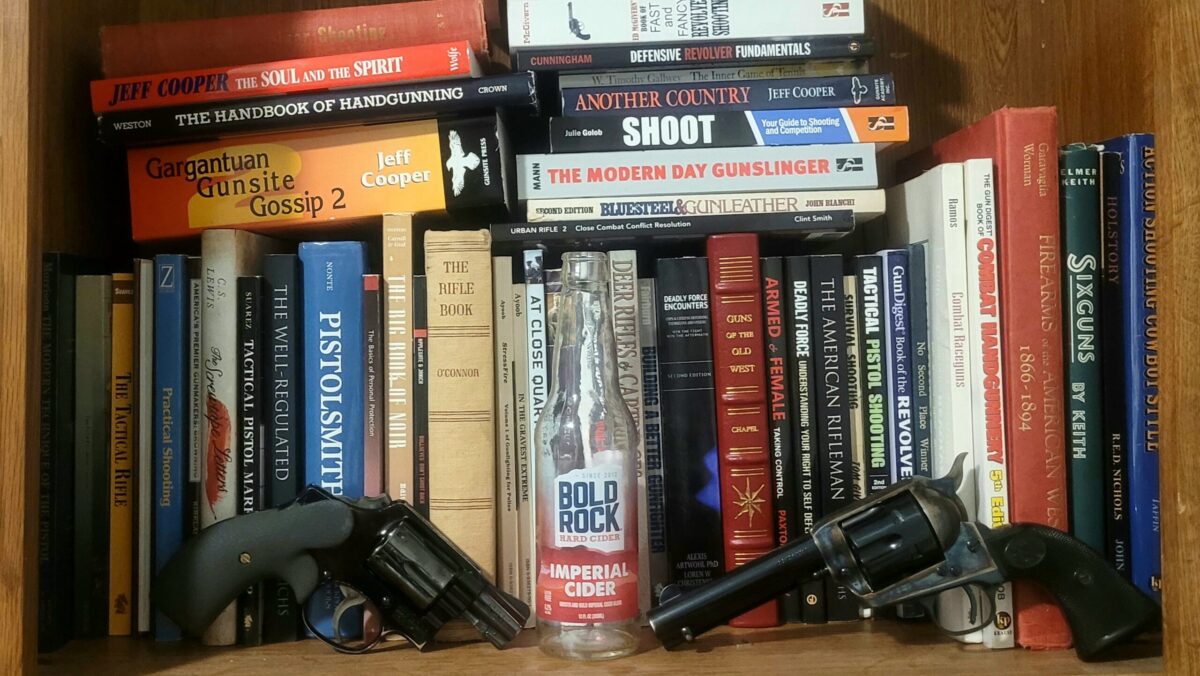
I was the kid in school reading books under the table during other classes. Used book store owners know me by name. Once, when moving, my mother suggested I throw out or sell some of my books to make the move easier–I had to step outside for a minute and take some breaths to calm down. So, between my bibliophilia and RevolverGuy ways, I’ve accumulated a lot of revolver-focused books.
A common complaint I hear from other RevolverGuys, especially young ones, is finding good information on wheel guns. Let’s face it, revolvers are not trendy right now, and there’s not much good information out there–hell, a lot of it is downright bad. And the generation that knew this stuff is not making YouTube videos about it (although this is changing a bit–see my comments at the end about that).
But the old timers wrote their wisdom down, so I’ve made this list in order to give readers some ideas. With one exception, I own or have owned all these books. While not organized into sections, I tried to keep similar books together. I wanted to do my best to cover a broad swath of books, so there should be something for everyone on here, but some topics, like collecting, I’ll freely admit are not my specialty.*
So, in no particular order, here we go!
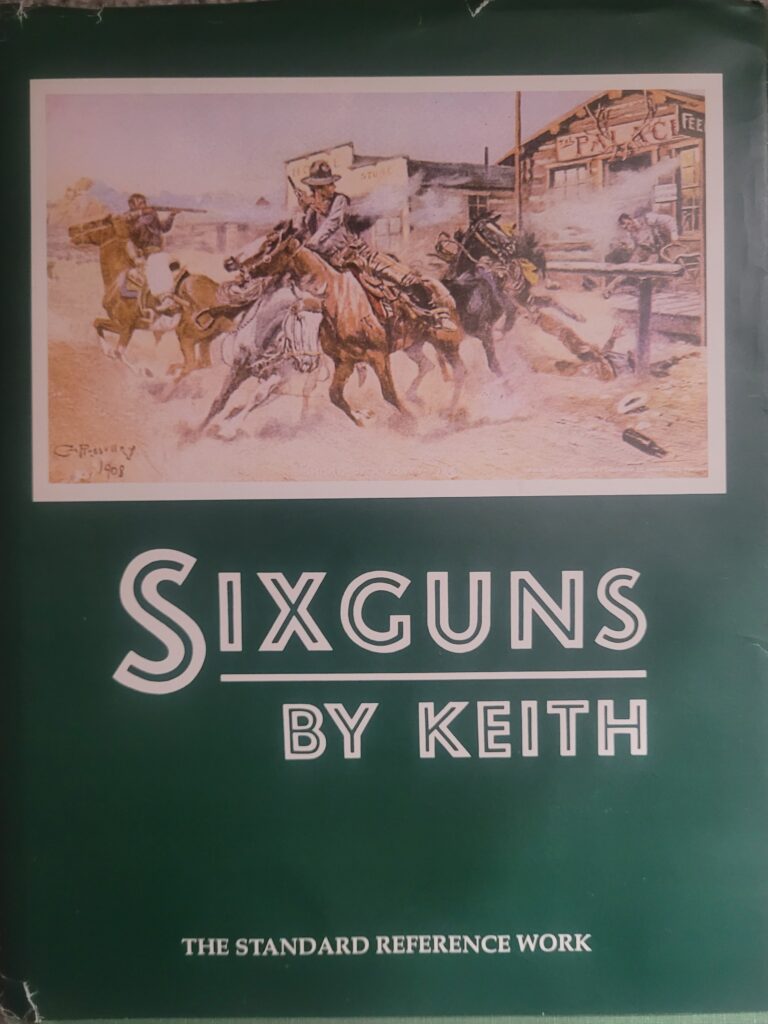
Sixguns, by Elmer Keith, 1955/1961
Like the first book was going to be anything else? The great Elmer Keith’s magnum opus, this was the last word on sixgunning for decades, and it remains an all-time classic. It covers everything from holsters to handloads and is backed by Keith’s wonderful stories and pictures.
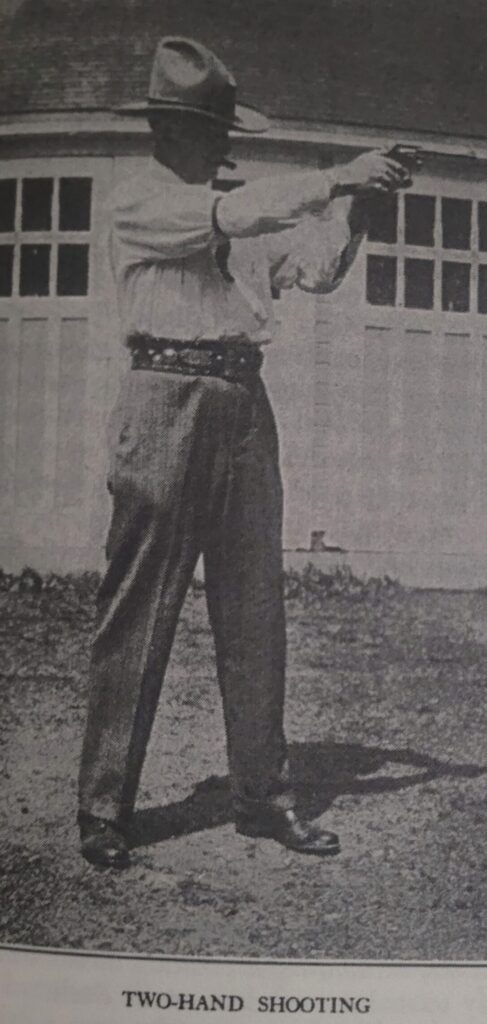
He wrote two editions, but for information you should get the later edition–it’s the same as the elder, but contains additional chapters to cover the then-new .44 Magnum and other products. I don’t have much else to say–if you don’t already have a copy of Sixguns, you should fix that immediately.
The various works of John Taffin
These would include The Book of the .44, The Book of the .45, Single Action Sixguns, Big Bore Sixguns, and more.
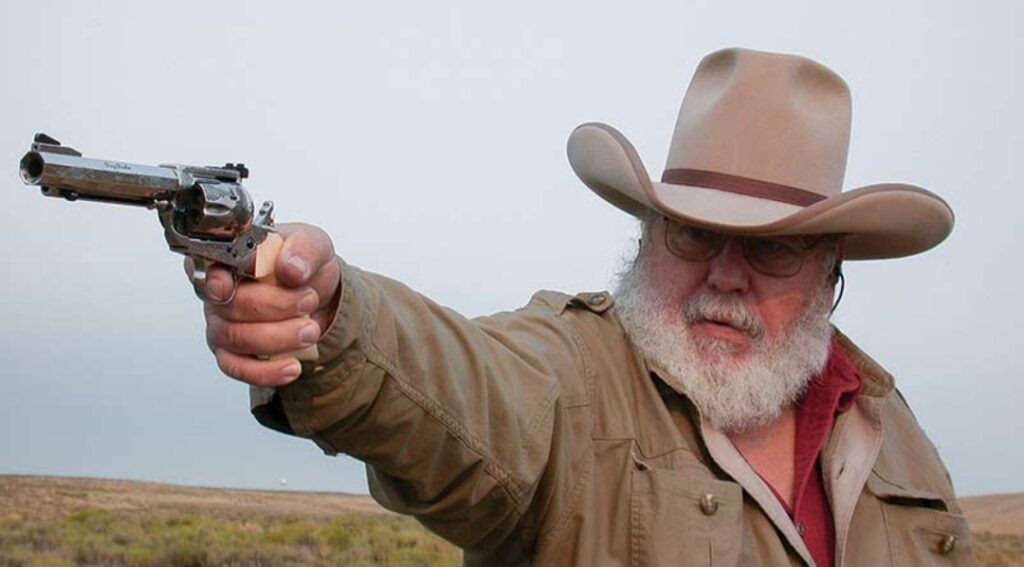
This is a personal one for me- the very first gun book I ever read seriously was John Taffins’s Single Action Sixguns, and it influenced me to get a Ruger Single Ten as my own first handgun. Mr. Taffin wrote a variety of books over the years, covering everything from calibers to Cowboy Action Shooting, so pick the one that aligns with your RevolverGuy interests and get it.
You don’t necessarily need to get all of them, as some of the chapters repeat themselves. The chapter on the Great Western Single Actions, .44-40, or the Triple Lock is the same whether it’s in The Book of the .44 or Single Action Sixguns. But no sixgunner’s library is complete without something with Mr. Taffin’s name on the spine.
Double Action Sixguns, by John Taffin
Single Action Sixguns, by John Taffin
The books of Grant Cunningham
These would include Defensive Revolver Fundamentals, 2nd Edition, and The Gun Digest Book of the Revolver by Grant Cunningham.
These are some of the more modern books on the list, and they’re the ones I’ve recommended to people trying to get into the current revolver shooting space. It’s actually harder than you’d think to find a book on revolver usage that covers modern equipment–the majority of books on this list, for example, were written before speed loaders were in common usage. Mike gave them a thumbs up in these pages, and Justin did as well.
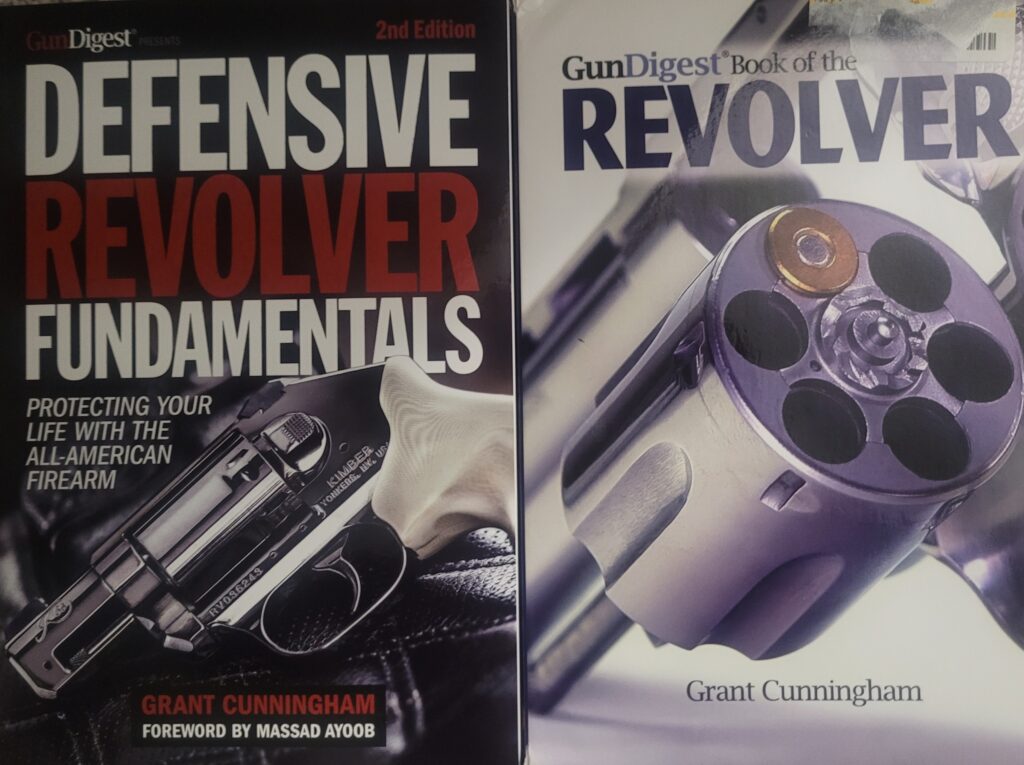
Cunnigham’s books cover almost everything relevant about modern revolvers and shooting. You might disagree with some of the defensive shooting advice, but this is one of the few comprehensive revolver texts from the 21st century.
Check out Grant’s books at the Gun Digest Store (Hey, while you’re there, you might as well treat yourself to Mike’s book on the Newhall Shooting as well–it’s on sale, just saying!)
Defensive Revolver Fundamentals, 2nd Edition, by Grant Cunningham
Gun Digest Book of the Revolver, by Grant Cunningham
No Second Place Winner, by Bill Jordan, 1965
Another title that should be no surprise to the readers. This was one of the very first books ever written that covered everything about shooting a revolver as a deadly matter. Jordan doesn’t talk about hunting, handloading, or history almost at all in his seminal publication–everything here revolves around serious social work, written by one of the fastest guns ever. Jordan carried a 1917 through the caves of Okinawa, was the public shooting face of the Border Patrol for decades, and performed tricks with a gun that you have to see to believe.
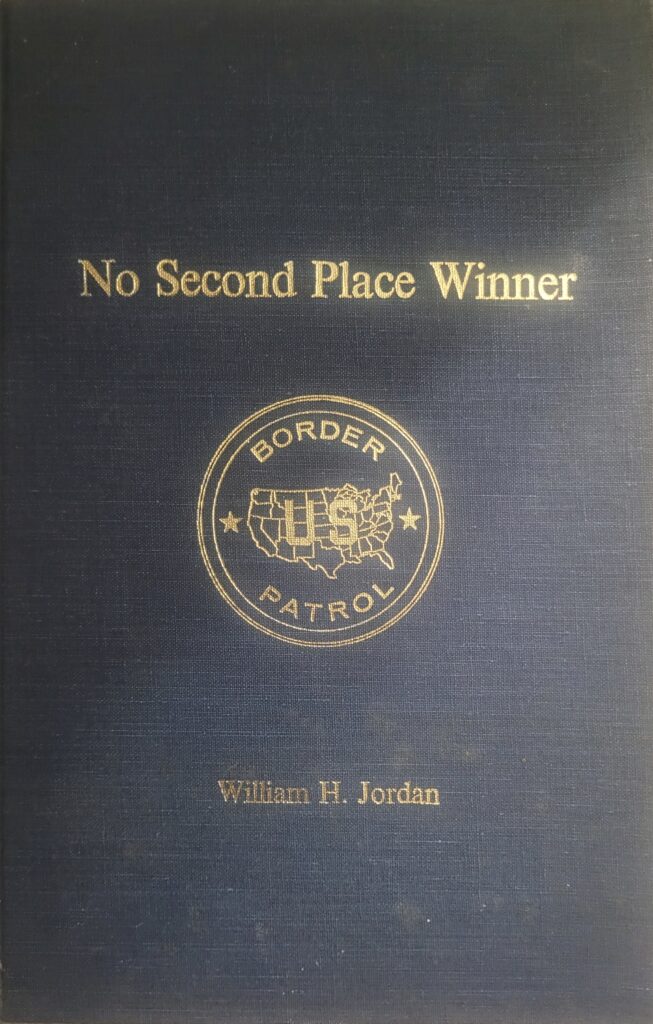
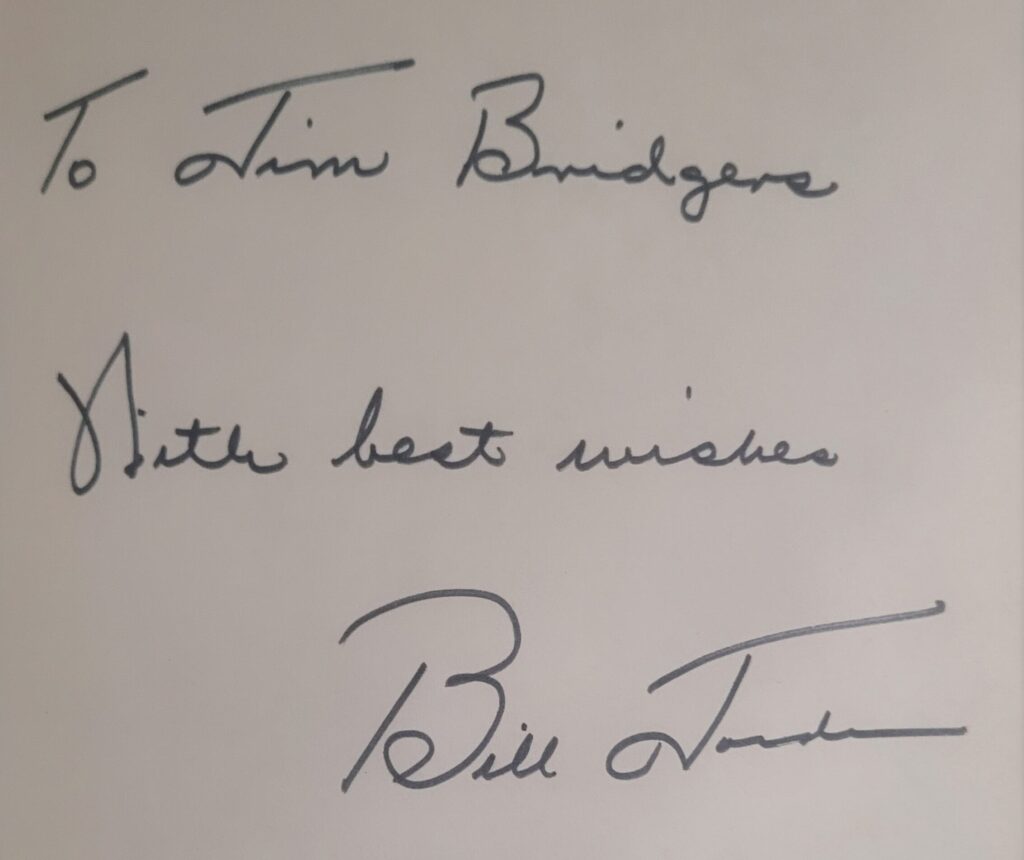
No Second Place Winner covered the gamut of gunfighting advice, from grips, shooting, holsters, even safely conducting training and dry practice. The advice, especially the shooting tips, may seem dated now, but they provide a valuable insight into what was considered cutting edge at the time. One aside–did you know that Bill Jordan’s uncle, Henderson Jordan, was in the Bonnie and Clyde posse? Now you know, and knowing is half that battle! (The other half is extreme violence.)
No Second Place Winner, by Bill Jordan
Fast and Fancy Revolver Shooting, by Ed Mcgivern, 1938
Another classic, this one’s a bit of a beast. McGivern was the best revolver shooter who ever lived until that Cajun Jerry fella came along, and the things Mr. Ed could do with a gun don’t seem real. He could put 5 shots of .38 into a playing card in 2/5ths of a second, break clays shooting two guns simultaneously, and shoot with a gun under his elbow using a mirror. And it was all recorded and verified with equipment, unlike a lot of the fanciful tales told about shooting at that time.
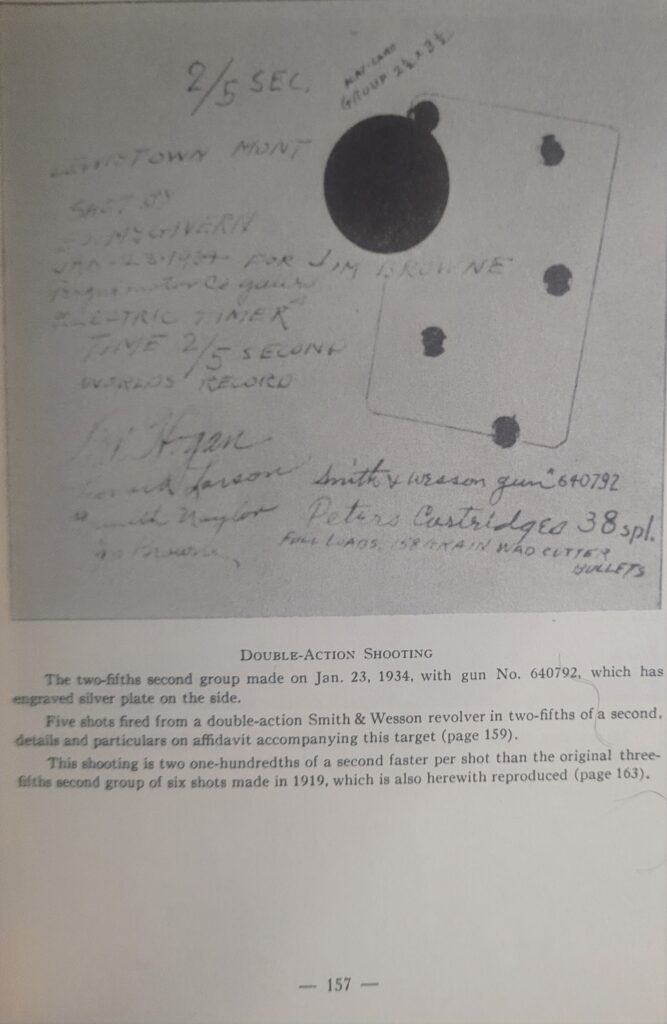
Even more amazing, he did most of it with completely stock Smith and Wesson revolvers. His book gives you all the details about how he did his shooting, even covering topics that made the bullseye shooters of the time cringe. Shooting while moving, shifting guns in hand, the man did it all. The prose is extremely wordy and dense, so it’s not an easy read, but you’ll be surprised at how well some of Mr. McGivern’s advice holds up.
Fast and Fancy Revolver Shooting, by Ed McGivern
Shooting, by JH Fitzgerald, 1930
With the resurgence of interest in Fitz Revolvers, more people should own this book. While Fitz covers a fair amount of shooting and revolver talk, the truly juicy parts of this book are the looks at subjects that were in their infancy at the time. Fitz covered expert witness work, combatives, concealed carry, and forensics at a time when some movies didn’t have sound.
The book is obviously slanted towards Colt products, as Mr. Fitzgerald worked for them as a representative. You’ll find a few gems in here ahead of their time. There’s a picture of the man in a stance that looks remarkably similar like a Weaver stance, retention positions that wouldn’t look out of place in a Shivworks class, and calls for a medium power cartridge that sounds a lot like the .40 S&W.
Shooting, by J Henry FitzGerald
The Snubby Revolver, by Ed Lovette, 2002
This short little book was out of print and expensive for years, but a few recent runs have alleviated that a lot. This is the sum text of the late Ed Lovette, who worked somewhere in the government, doing some stuff in some places, and we’ll leave it at that.
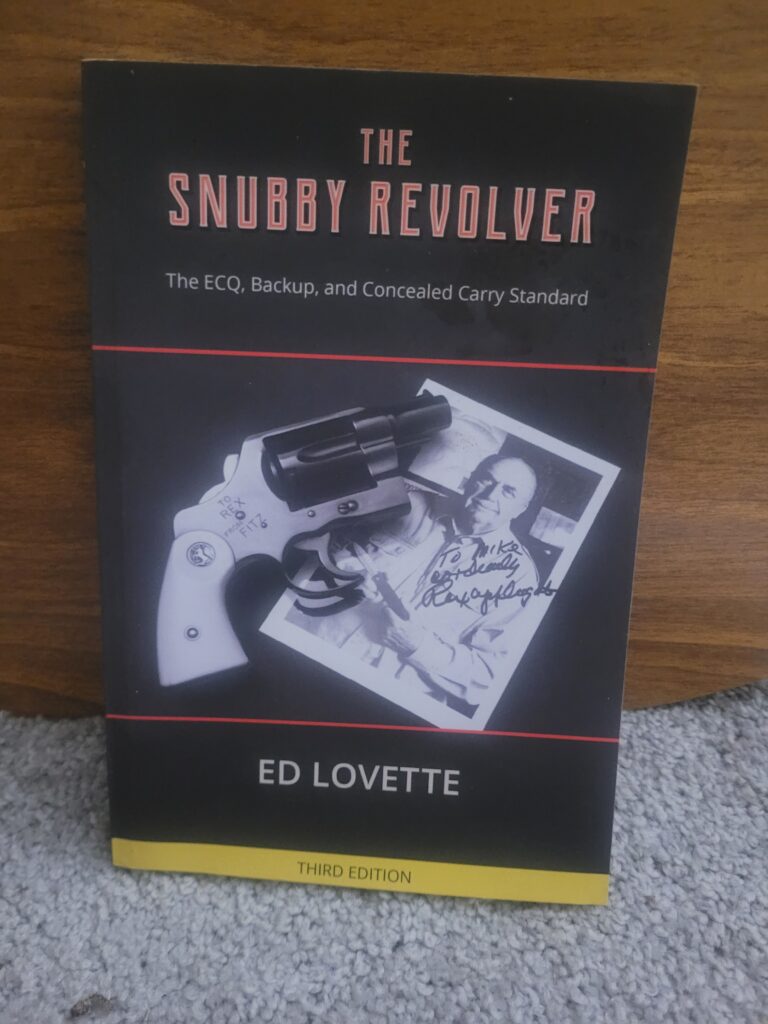
A brutal look at what actually hiding a gun is like in places where getting made gets you killed, Mr. Lovette was one of the first to advertise the more esoteric advantages of revolvers at a time when autos were starting to take over. It’s a great summary of why, even today, the snubby is a great choice when the rubber meets road.
The Snubby Revolver, 3rd Edition, by Ed Lovette
Handgunners Guide, by Chic Gaylord, 1960
Chic Gaylord was a holster maker and artist in New York who contributed greatly to modern holster design. This book is a nice snapshot of the time, with its focus on big calibers and blinding fast hip shooting. It’s a great read for the holster section, which shows the forerunners of what would become the modern designs of Seventrees, Bianchi, and others that would carry on into the like of Milt Sparks, Galco, Kramer, and all the other holsters we love. Many of the concealment holster designs don’t look out of place today.
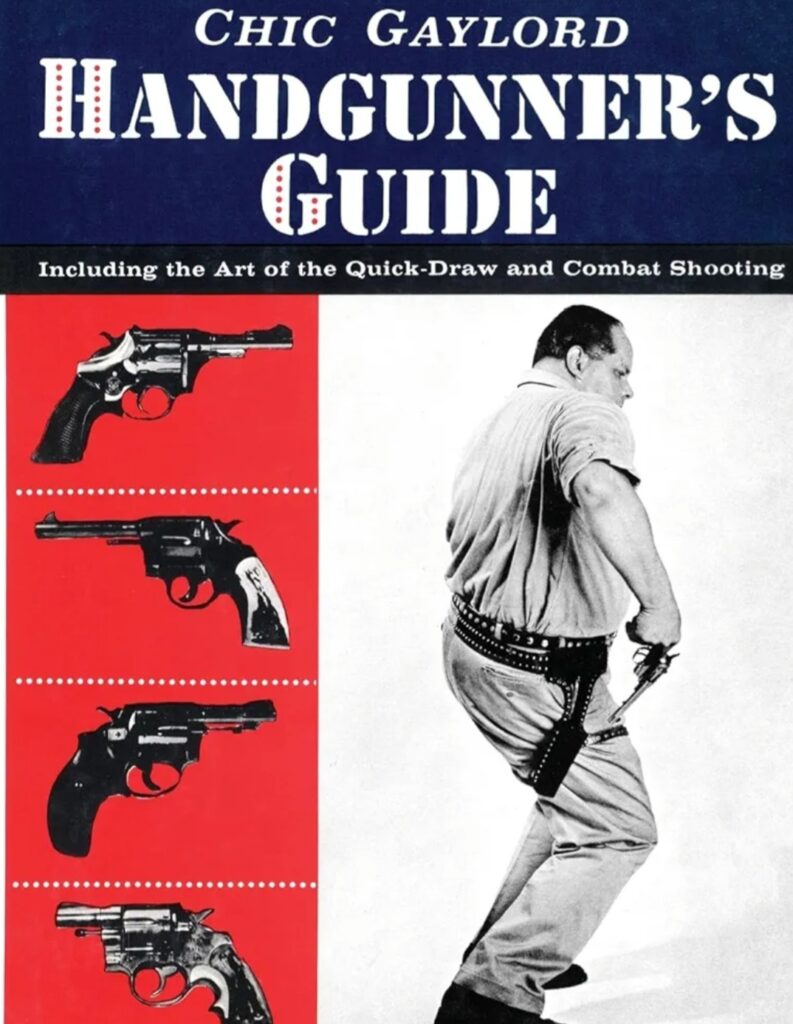
But don’t focus too much on the shooting portions- there’s some very dated stuff here, and unlike some of the other writing, there’s no hidden gems or insights that are still relevant today. Treat this as a historical text, and you’ll get a good idea of how shooters back then thought about things.
Handgunner’s Guide, by Chic Gaylord
Secrets of Double Action Shooting, by Bob Nichols, 1950
Similar to Mr. Gaylord’s book, this was one of the early texts that advanced double action shooting, as opposed to the more bullseye-focused single action shooting that was popular at the time.
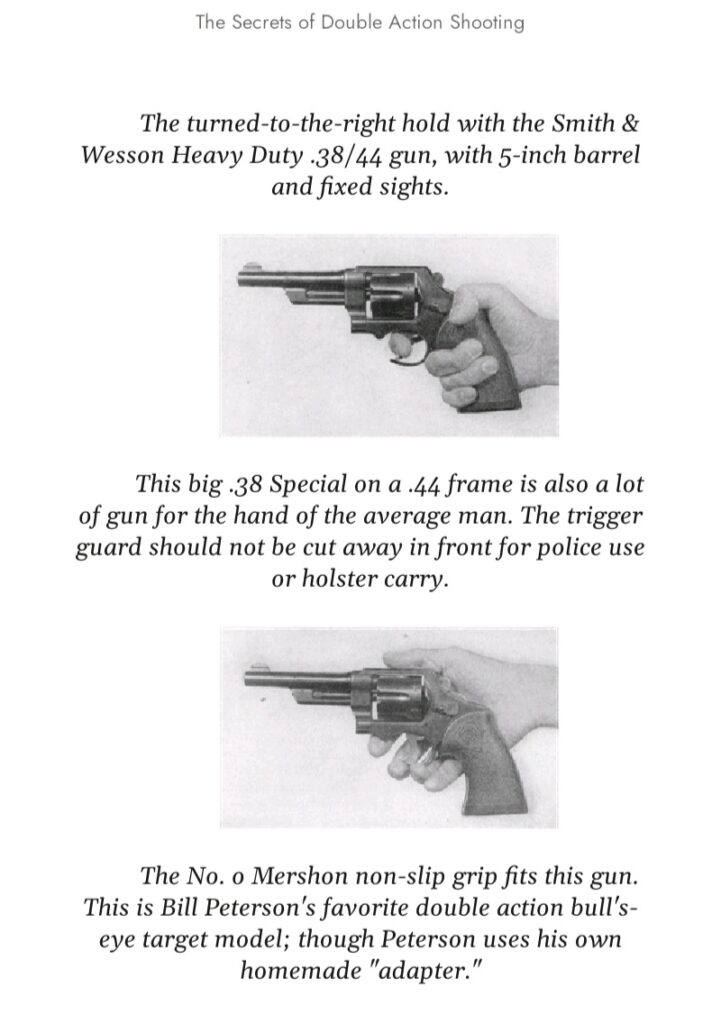
Now, to be clear, Mr. Nichols was still primarily talking in the context of bullseye shooting, but his ideas about grips, grip adaptors, and trigger control was forward thinking. And he does cover more service or defensive style shooting a bit. He really did break ground–at this point in history, only a few radical thinkers like McGivern, Keith, or Applegate saw DA shooting as anything but an emergency technique for hip shooting, but Nichols showed that a good shooter basically didn’t need SA at all.
This can be a bit of a repetitive book–the man makes it clear that single action bullseye shooters, Colts, and Smith short actions are the devil. And when you’ve read that once, you’ve read about half the book. Still, it’s a short read and it’s worth it alone for the pictures of the only verified Fitz’d Smith and Wesson in existence.
The Secrets of Double Action Shooting, by Bob Nichols
Firearms of the American West 1866-1894, by Louis Garavaglia and Charles Worman, 1985
Breaking into deeper history, I wanted to include at least one book in this setting, and this is the best Old West gun book I’ve ever read. It’s one of my personal favorites. There are probably more gun books written about this time period than there were Colt Walkers, and I’ve read almost all of them. But this one is the best, because it uses letters, articles, and advertisements from the time period.
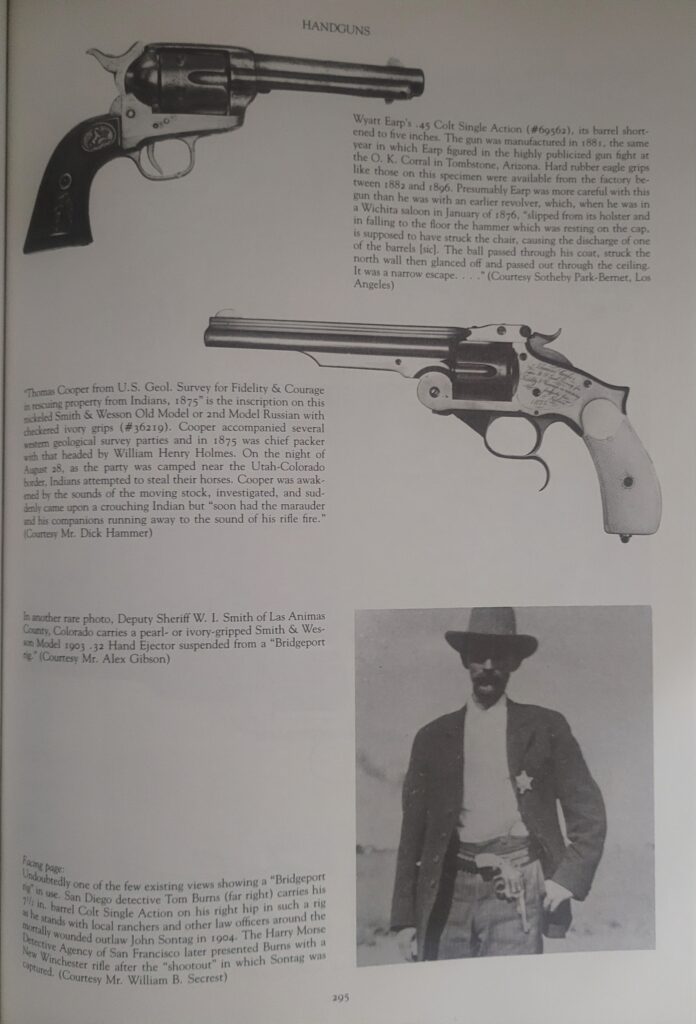
As opposed to just listing dates and numbers, you get to hear the voices of cowboys, gunman, and shooters from the Old West. This gives us insight into what Revolver Guys back then were like, and it’s fun to see them write letters to newspapers that sound a lot like Instagram comments today. It’s not a revolver exclusive book, but you definitely need a copy of this.
Firearms of the American West, 1866-1894, by Louis Garavaglia and Charles Worman
Burning Powder, by Doug Wesson, 1938
This is a quick read, and it covers some basics of shooting and handloading of the time. Full of great information, its primary purpose was to advertise to the reader the then-brand spanking new Smith & Wesson .357 Magnum.

The book is filled with stories and anecdotes of men doing incredible things with the innovative gun and cartridge. People that think .357 is too little gun for white tail deer need to read this book.
Burning Powder by Douglas Wesson
The Art of Revolver Shooting (1901), and The Modern Pistol and How to Shoot it (1919), by Walter Winans
I’m putting both of these on here, because of one of the earliest lines of the second title–to wit, “The revolver is now obsolete, and there is no point in learning how to shoot it.” Mr. Winans was a highly accomplished international shooter, and he considered his later book a successor to the first.

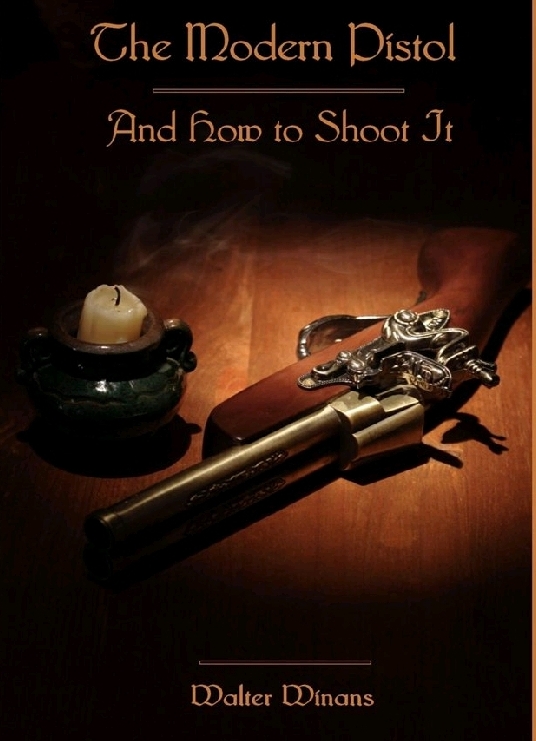
While the first is more interesting to RevolverGuys, the second book contains some evolving ideas on competition shooting and gear, with things like running deer targets getting attention. He also describes grips and sights that are almost a dead ringer for more modern gear- his description of a large silver ball inside a U-notch sight is almost identical to the modern Trijicon HD-style sights. Yeah, he was wrong about revolvers, but these are some of the oldest shooting titles in existence, and they give a look into shooting culture both in America and internationally.
The Art of Revolver Shooting, by Walter Winans
The Modern Pistol and How to Shoot It, by Walter Winans
The Service Revolver and How to Use It, by CD Tracy, 1917
A fun book with the most depressing backstory. Written right at the darkest point of WW1, when the advantages of a handgun for trench fighting were clearly demonstrated. Tracy was a British Officer who wrote one of the earliest texts for training a uniformed force in down and dirty close fighting, focusing on the Webley Revolver. He predates the Shanghai duo by a few years. Ahead of his time on some things- visible sights, grips, and targets being easy ones- the Brits probably knew more about short range shooting at this point than anyone in the world.
While still somewhat a slave to his cultiure, some of the more now outdated ideas Tracy brings up made sense at their time. He still emphasizes single action shooting at all but closest ranges, but anyone who has ever tried to use the DA pull of a Webley understands where he’s coming from. The book’s a little hard for modern eyes to read and has some Continental English writing tendencies like Needless Capitalization of Certain Words, but like Winans’ books, it’s a good look at how the rest of the world thought about gunfighting at the time.
The Service Revolver and How To Use It, by C.D. Tracy
The Standard Catalog of Smith and Wesson, by Jim supica and richard nahas
Mr. Supica and Mr. Nahas are currently on the Fifth Edition of the Standard Catalog, and this will certainly change over time–whenever you read this, just buy the most recent edition.
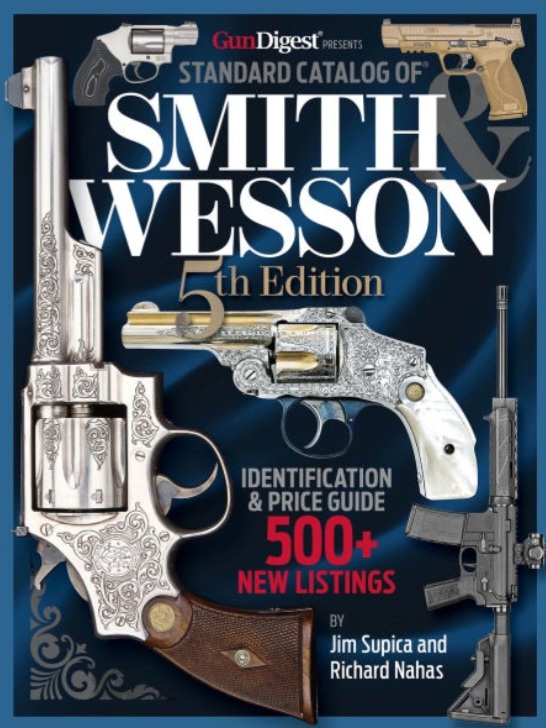
This is the standard reference for Blue and White Revolvers, and you need one if you have even a passing interest in Smiths.
Standard Catalog of Smith & Wesson, 5th Edition, by Jim Supica and Richard Nahas
The various Colt books by Gurney Brown
These would include Colt’s Double Action Revolvers (The Post War Era), Colt’s Python: King of The Seven Serpents, and more.
Despite being a member of the Colt Collector’s Association, I freely admit the Colt rabbit hole is one I haven’t gone down. But I’ve owned Mr. Brown’s book on Colt’s Post War DA’s, and it was great. And for serious collectors, they are fantastic. Even just for the pictures, these are worth having.
Gurney Brown’s books at Cherry’s Fine Guns
History of Smith and Wesson, by Roy Jinks
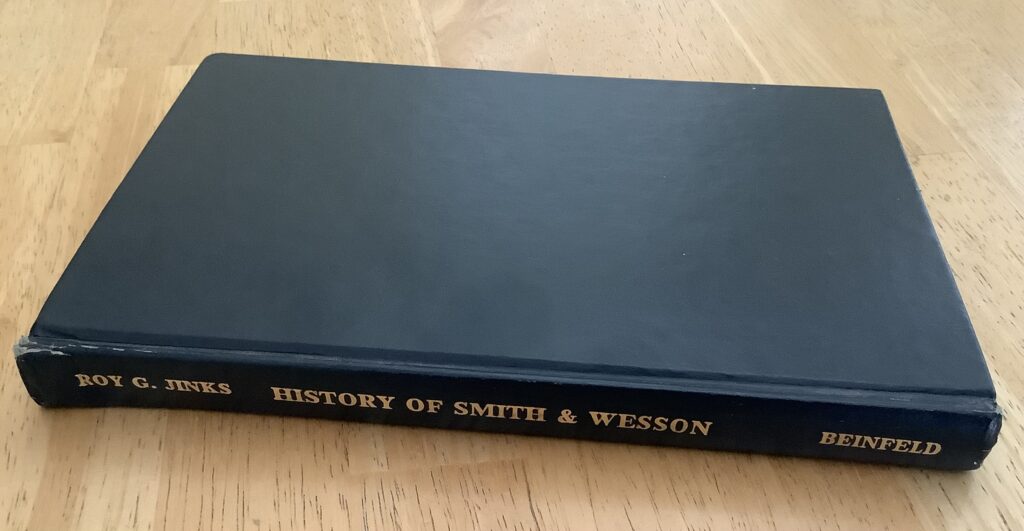
This is another book that’s been through many revisions–look for the most recent edition you can find. This text focuses more on company history than the Standard Catalog. Roy Jinks is synonymous with Smith and Wesson, and the various editions of his book explain more about why the company did certain things the way they did. It’s a great look at the company’s thinking, written by a man who knows it best.
History of Smith & Wesson, Revised Tenth Anniversary Edition, by Roy G. Jinks
The Peacemaker and its Rivals, by John Parsons, 1950
A comprehensive history of America’s gun, this was written at a time when the grand old Model P was discontinued, and America was obsessed with the Western.
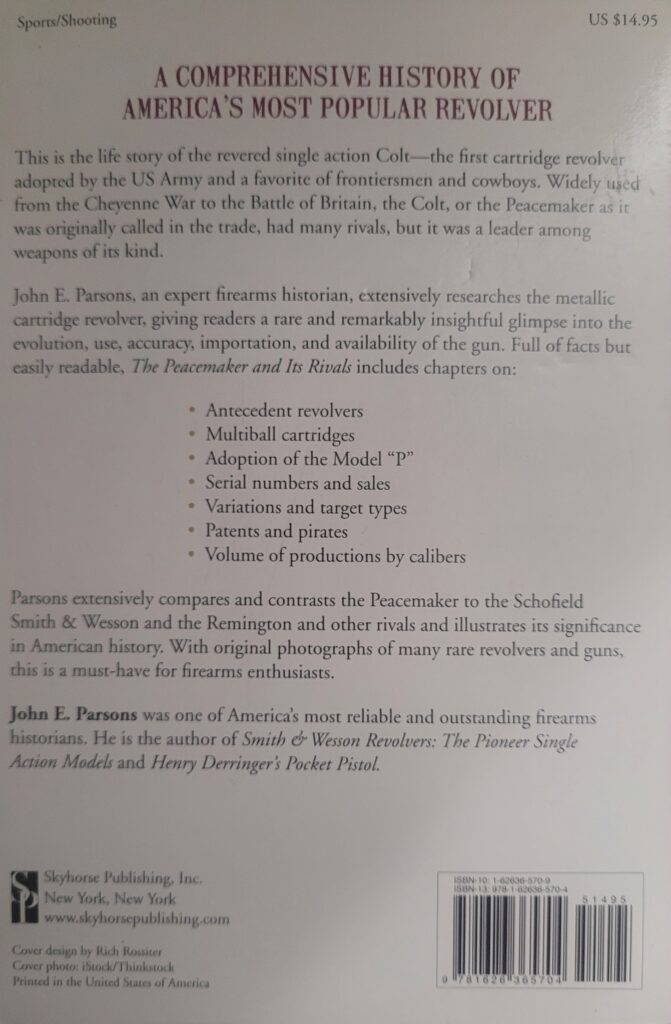
There are many books on the Peacemaker, but this one speaks the language of the time. It also covers comparisons to the Remington and Smith revolvers of the time, which makes for good reading.
The Peacemaker and Its Rivals, by John E. Parsons
The Custom Revolver, by Hamilton Bowen, 2001
This is the only book I don’t physically own or have ever owned, but I have read it and its reputation speaks for itself. Hamilton Bowen’s name should be familiar to every RevolverGuy, and The Custom Revolver has been a classic for years.
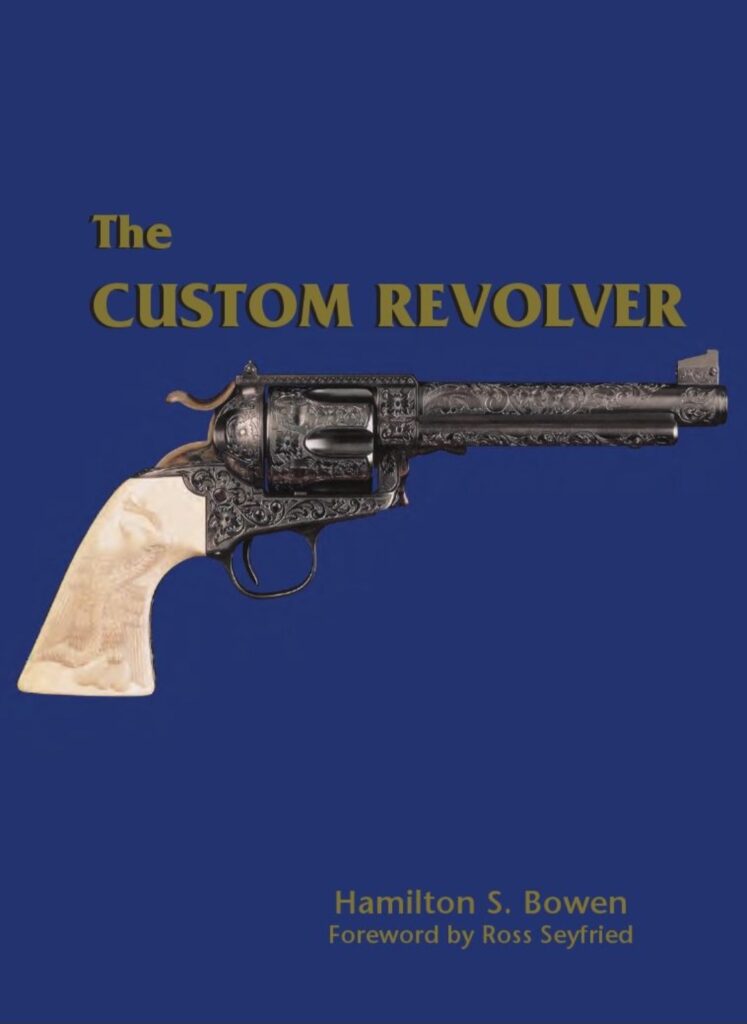
Hamilton Bowen is one of the very few pistolsmiths in the world who can take a block of steel and whittle metal away until you have is a gun, and in his book he gives up all his secrets. In particular, the chapters on caliber conversions and max-caliber revolvers are gold for people who face West each night and bow to John Linebaugh. The book is ludicrously expensive now, almost prohibitively, but if you see one at the local swap meet or gun show for even a halfway decent price you should buy it. You know you’ve achieved legendary status when you can just say “Bowen’s book” and people know what you mean. Thank God the Kindle Edition is cheap.
The Custom Revolver (eBook), by Hamilton S. Bowen
Old gun magazines
This is cheating a bit, but revolvers were the dominant handgun for years and the only consistent media that existed, pre-internet, were gun magazines. Cheap and available, the next time you see a stack of gun rags on the table at the gun show, browse through em and look at the articles. If you see something interesting- buy it! Print media can’t be destroyed easily, and us owning the information in those articles is the only way to keep it for future generations.
start your hunt!
I’ve tried to leave links or sources for everything I can. I know a lot of them are Amazon links, and I don’t like that either, but a lot of small shops sell these books pre-owned through Bezos’s behemoth. So, help out the little guy and buy used if you can. If you just can’t stand Amazon, eBay and local used bookstores are your friend. I’ve also linked the physical copies whenever I can, but many of these titles are available digitally as well. But if you can, buy the paper.
Well, that should be enough to get you all started. I know I left off many books, some for content, and some for availability. Skeeter Skelton’s books, for example, contain tons of good information, but like Bowen’s they’re very expensive and not revolver exclusive per se. Massad Ayoob’s old books, or the various older Gun Digest Book of Combat Handgunnery editions, were left out for similar reasons of not exclusively revolver content. I also left off most of the more gunsmithing manual-esque books, like the Kunnhausen books or anything by Nonte, since they are more technical guides than they are true books. I had to put Bowen’s on the list though, just felt wrong leaving it off. I also left off more niche-focused books, like Elgin Gates’ Metallic Silhouette book, the array of handgun hunting books, or the various Cowboy Action Shooting guides. While they are revolver-centered, they’re more focused on sports or pursuits that just happen to involve revolvers.
Finally, while this is a reading list about physical books- there’s tons of good stuff on the web as well. RevolverGuy, American Fighting Revolver, Snub Noir, Gun Tales, and many more are the gun magazines of today, where the high level and intelligent conversation and writing happens, away from the lunacy of social media. So even if some of these old tomes don’t tickle your fancy, hit up the right parts of the internet and you’ll find some great stuff.
I had a lot of fun writing this list, but part of the appeal of being a bookworm is the thrill of the hunt. I just know there’s a book or text I’m missing–I happened upon Gurney Brown’s books almost completely by accident when I wandered into Cherry’s one day. So, if you think I’m missing a major title, tell me in the comments!
I know reading is a dying pastime–I’m an unwilling part of the generation that’s killing it. People are used to scrolling fast, quickly consuming surface level information, and not lingering on one thing for too long. Multiple studies have been done showing that speed-focused social media like TikTok or Instagram is actively hurting people’s ability to sit and read a book. And man, it hurts to know that a whole generation of shooters won’t know what it’s like to curl up somewhere and fall asleep reading the great words of Taffin, Keith, Jordan, Skelton, and all the greats. So, if you have even a passing interest in RevolverGuy stuff, buy one of these books and read it.
Just don’t buy ALL of them- I still need a copy of Bowen’s book that I can afford, so leave one copy of that for me!
*****
*It should go without saying, but some of the information in the older books can be outdated, obsolete, or just plain unsafe. Just because I recommend a book doesn’t mean you should slavishly do everything that author writes–keep the context of the time and thinking in mind as you read.

Good Morning Darren.
Thank you for your recommended book list of guns. I too suffer from that ailment know as Bibliophileia. It is a hard one to cure, in fact if it gets its hooks into you deep enough you can forget the cure and keep buying and reading books.
I once possessed a significant collection of books, the majority of which were firearm or history related. Enjoyed looking for old editions from long ago. A house fire back in the 1990s took everything including lots of great guns and good books.
Have or have had most every book you reccomended, will continue looking for those missing.
One that anyone who shoots double action revolvers in double action mode needs greatly is “The Secrets of Double Action Shooting”, by Bob Nichols. It is in reprint so it is readily avaliable and reasonably priced.
Welcome on board.
I’m sorry to hear about that fire, that sounds like a real loss.
Yeah, being a book worm is odd these days- last weekend I drove about an hour away and did a run through all the used book stores and thrift shops in that area. Friends looked at me like I’d grown a thrid eye when I told them how I was spending my Sunday.
Great write up Darren!
No matter what subject you’re interested in, having a core group of trustworthy reference books on the topic is very helpful. Darren’s book list seems like a good one for folks interested in serious revolver lore.
Just yesterday, I worked from 1500 to 2330 in my den, installing a new bookcase so I could move a collapsing landslide of books from my ever-shrinking floor to some proper shelves. Of course, this required me to empty out all the other bookshelves, so I could regroup the collection and give it some kind of organizational logic.
I’m awash in fine books, and am always eager to add more.
Hello, my name is Mike, and I’m a bibliophile (thanks for the word, Tony)!
Great list, Darren! You’ve included many of my favorites. Perhaps someday I’ll work on a Part 2, to add some of my unlisted choices. A beginning shooter would do well to follow your lead with this selection!
I’m firmly convinced that you can separate a proper scholarly researcher from a bibliophile just by seeing how organized their bookshelves are- needles to say, mine are a mess.
Writing this list made me realize I need another book shelf too….
Thanks for the excellent read about some excellent reads, Darren. You have reminded me that I need to pony up and invest in some of John Taffin’s work as well as update my Standard Catalog of S&W. Agree heartily on Hamilton Bown’s book- that guy can write about them as well as he makes them. I would add Jim Cirillo’s “Guns, Bullets, and Gunfights” to your great list.
It was sooooo close to making the list, especially with the early chapter on his custom hybrid revolvers- but I wanted to make sure there was a fair split in the list with training, history, collecting, etc, and since Cirillo’s book isn’t exclusively wheelguns it just barely didn’t make it.
Still, it absolutely belongs on every gunmans shelf along with Kirchner’s Stakeout Squad book .
Plenty of illiterates hold reading in disdain, more than once I’ve sent a message or written a reply only for the receiver to complain “you’re typing a novel at me” because the TL;DR generation with the attention span of a sparrow can’t focus long enough to finish a paragraph. When did reading become a punishment, I wonder.
Reading might be a punishment for many people, Jeb. More than 25 years ago when I was in grad school a couple professors mentioned that 49% of adult Americans were either illiterate or functionally illiterate. At that time functional illiteracy meant one could not read beyond a 4th-grade level.
I’m part of that generation, and the shrinking attention span and inability to process complex arguments or viewpoints drives me insane.
Sometimes, you can tell a book by its cover, like when it’s Jim Cirillo holding his Model 10:
“Tales of the Stakeout Squad”
Great list Sir! Thank you for sharing it with us! I too have accumulated more books then I have shelf space for. I am going to have to do some remodeling very soon, but a proper shelf for the treasure of writings like you just listed will be worth the work!
I appreciate the list Darren. While I had most of the books as you know, I was not aware of Dan Wesson’s. Being an advocate of the 357 Magnum and 38/44, looks like I’m off on another search. Great article! Add Jim Cirillo’s first book.
I like your list and will acquire some of them, but where’s Skeeter’s books?
Like Cirillo, they were very close, but a few things just barely slid them off:
1. I’ve only read Hoglegs, Hipshots and Jalapenos, and that was just borrowing, so I didn’t feel qualified to list since I’ve never owned any of them.
2. They aren’t revolver exclusive per se.
3. They are getting prohibitely expensive and rare, I wasn’t crazy about putting books on the list that would frankly be unobtainable for most people.
I love Skeeter Skelton’s writings though, I still keep an eye on old Shooting Times magazines at gunshows just for him. And if anyone reading this is interested, you can find a great deal of his work at darkcanyon.net
As an avid collector/accumulator of gun books (I call myself a hoplobibliophile)…
…who sometimes blogs about the recent additions to his collection on his personal website…
…and needs to do more of that…
…This is a DARN swell list! Thank you very much to Darren for writing it, and to Revolver Guy for publishing it. I’m adding several more books to my want list.
My only complaint is the inclusion of Fitzgerald’s *Shooting*. And I only complain about that because I have been trying to find a good first edition of that for MONTHS now.
NOT that I’m BITTER or anything. 🙂 I’ll take a reading copy to tide me over, but for my library I really want a good first. And yes, I know that’s going to be pricy, but I come from a background of book collectors who think $300 is a cheap price for some of the classic SF firsts.
(And I have my Bowen. It’s very nice, as the French knigits would say.)
The mention of *History of Smith and Wesson* makes me feel like I should bring this up, since I don’t know how far the news has spread outside the collector’s circle, but: we lost Dr. Roy Jinks on June 24th of this year. The company posted a nice tribute to him on LinkedIn.
==Dwight Brown
“Hoplobibliophile!” I love that, Dwight–kudos to you for that one!
Appreciate the heads up about Dr. Jinks–A sad loss for the gun community, indeed.
Mike
(“now go away, or I shall taunt you a secon’ time-ah.”)😆
I second loving hoplobibliophile, that’s great!
I feel your pain on old books- I’m glad Shooting has had modern runs, I’ve been trying to find even semi-affordable copies of Hell I was There or Skeeter’s books for years. I accecpt this stuff is expensive, but this is getting ridiculous.
An excellent reference book is “Colt’s New Service Revolver: A Particularly Strong, Heavy Weapon” by Timothy Mullin (2009).
Thank you! I knew about the Magnum book but I had no idea he wrote a New Service book.
As a 1911 guy I keep an eye out for a cheap copy of American Beauty. One day…..
A few of the listed are some of my favorites and I’m always looking for more. The book that got me started on hunting and guns (that was probably just as attributable to JW westerns) was an old first printing of ‘A Boy and His Gun’ I found in the school library in about 4th grade. Years later I found another and enjoyed it just as much as I remembered. Books and the stories within take us places and open so many new proverbial doors. I find it almost impossible to discard a book I’ve enjoyed so I keep them with the promise of reading it again someday. Too much magic in a book…
I think Mike Venturino’s book on shooting sixguns ought to be part of the canon.
Excellent list! I’m familiar with most of these but not all, so you’ve added some great reads. A friend of mine once joked that he hated when people made book recommendations to him because it would put him in “book jail”: he knew that the person would come back and ask, “Did you read it yet?” and apparently that caused him a certain amount of dread and made him feel like he had to read the book. But I’d happily do time in book jail with these selections.
Though not entirely handgun- or revolver-related. R.L. Wilson’s books Colt : An American Legend and Ruger and His Guns are beautifully illustrated and full of all sorts of “fine points” on those companies’ classic revolvers–good companions to the books on Smith & Wesson that you mentioned.
As much as I enjoy R. L. Wilson’s firearms books (I own four), one has to be careful with his assertions. Without going into a lot of detail here, for years Wilson was involved in murky gun transactions and frauds involving private sellers and museums. It all caught up with him around 2006 when he was convicted of fraud and spent a year in federal prison.
So, of the listed books you weren’t familiar with, have you read any of them yet? 😉
I am older than you, and started out With Elmers books, I now have all but Safari.
Of the ones listed that I haven’t read
Firearms of the American West 1866-1894, by Louis Garavaglia and Charles Worman, 1985 is now on the way.
I’d heard of Ed McGivern’s “Fast and Fancy Revolver Shooting” for years, and when I saw a copy in Barnes & Noble I snapped it up. (It’s apparently still in print, or was a few years ago.) I have to say, as a writer, McGivern was a good pistol shot. I found the main text almost unreadable, but the captions to the many photos were much more instructive. And some of the photos would give today’s “safety Nazis” heart attacks and strokes at the same time, such as the photo of McGivern shooting at a pane of bulletproof glass that his assistant is holding in front of his face.
All in all, a good time, both for its shooting insights and its look at the shooting world of the 1930s.
Darren, welcome to the stable and thank you for a fine essay and an excellent list.
About the only books in my bookcase that you haven’t mentioned are “Experiments of a Handgunner” by J. Roper and “The Pistol Shooter’s Treasury” edited by Gil Hebard. Both deal with revolvers and self loading pistols and are worth a look. I also like “Protect Yourself With Your Snubnose Revolver” by Grant Cunningham.
Looking forward to your next article.
Thank you! I’ve read Hebbards but not not Roper’s. I’ll have to grab a copy.
Next article of mine is coming next Saturday last I heard, so mark your calendars! It’s got a real legend featured in it, I think everyone will enjoy
Chapter two of Jim Cirillo’s “Guns, Bullets, and Gunfights” is titled “Hybrid Weapons”, where he describes in detail his “Smith & Dan” .44 Magnum project. Jim owned a Model 29 and a Dan Wesson 44, and sought to combine the best aspects of each to create the ideal sidearm for high-risk NYPD stakeouts. Jim liked the DW’s superior accuracy and softer recoil, but the Model 29 was handier and had a better trigger, so he married the two designs by installing the Dan Wesson barrel and heavy sleeve onto his Model 29. He was really enthusiastic about this gun, and hoped that someone would run with his idea and produce ready-made conversion kits. Cirillo includes a good photo of his awesome Perfect Packin’ Pistol, alongside the .44 Mag wadcutters he created for it…I’d say The Big Apple’s armed robbers were very fortunate NYPD’s Stakeout Squad was disbanded before they had to face this fearsome revolver!
For me, as an avid researcher and writer about ‘holstory’ and gunleather, let me mention that it was Gaylord’s 1960 book that turned me into a professional holster designer/maker. My family had moved from London in 1966 to Oakland CA (the latter was the truly strange place and every bit the Dirty Harry milieu of the first film) and unoccupied for the summer vacation period before starting an American high school, I visited the local library and encountered Chic’s book. The designs, which are from what I later dubbed ‘the New York School of Design’ was so different from those of Myres et al that I now call ‘the Wester School of Design’ that I was inspired to take up the skill myself by 1968. And to take a job with Bianchi in 1970, working my way up to Chief of Design for JB. Several of my designs for Bianchi in the ’70s were inspired by the New York School — so Chic’s book itself had a major impact on the future of holstory itself. My own book about gunleather is the more sophisticated telling of all the books since Chic’s which was the first of them.
Speaking of, Red, your efforts will be in our spotlight next week!
Your article and the responses that it generated prompted me to count my firearms related books. First thing that I realized, several of my buddies still haven’t returned books that I “loaned” to them!
My private library has a few gun books, but most deal with police related incidents and related tactics. In fact, when I first met Mike at Revolver Fest I had a small display of firearms books, naturally featuring his Tactical Analysis of the Newhall Shooting.
Thanks for reminding us that there are many opportunities to keep on learning.