
Back in May of 2020, I penned a review of Holstory, the premiere reference to gunleather of the Twentieth Century, cowritten by R.E.D. Nichols and John Witty. I was seriously impressed with the book, which represented the most detailed study of gunleather I’d encountered to date, and was grateful for the significant effort that Nichols and Witty put into it. It has remained a treasured reference in my library.
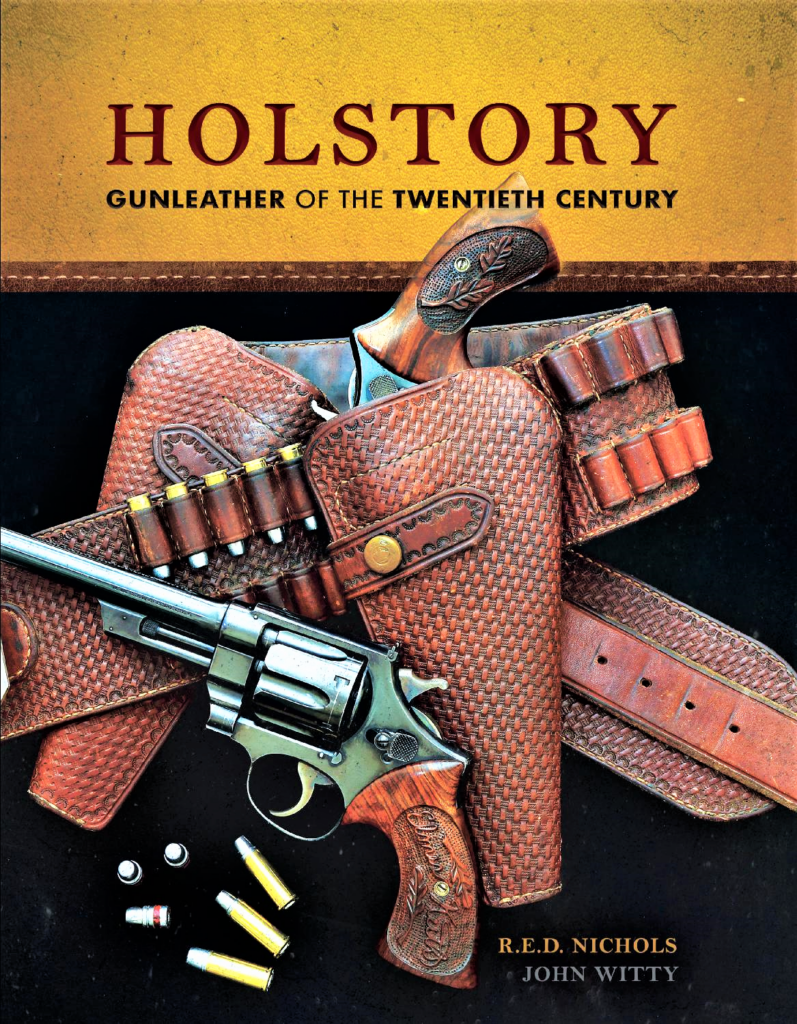
In 2022, the team released a Second Edition of Holstory, which improved on the first by adding two additional chapters, and in late 2025, the Third Edition of Holstory was published, which is the topic of today’s review.
VALUE ADDED
The Third Edition of Holstory adds a Prologue and Epilogue to the already sizeable work, and enriches the value of this reference.
While the First and Second Editions of Holstory restricted their focus to 20th Century makers, designs, and developments, the Third Edition expands the breadth of the study to include important information about 19thCentury gunleather that was previously unreported.

This additional study is found in the Prologue of the Third Edition, which is 23 pages long. The Prologue divides its attention between two very different categories of makers: The mail-order, industrial giant of the time, who served a national market, and; The small, independent saddleries that served local clients. We’ll discuss this in greater detail, momentarily.
The Epilogue in the Third Edition showcases highlights of Nichols’ rich career in the gunleather business, starting from the days where he first tinkered with leather, to the days when he advised some of the industry’s largest companies as an expert consultant.
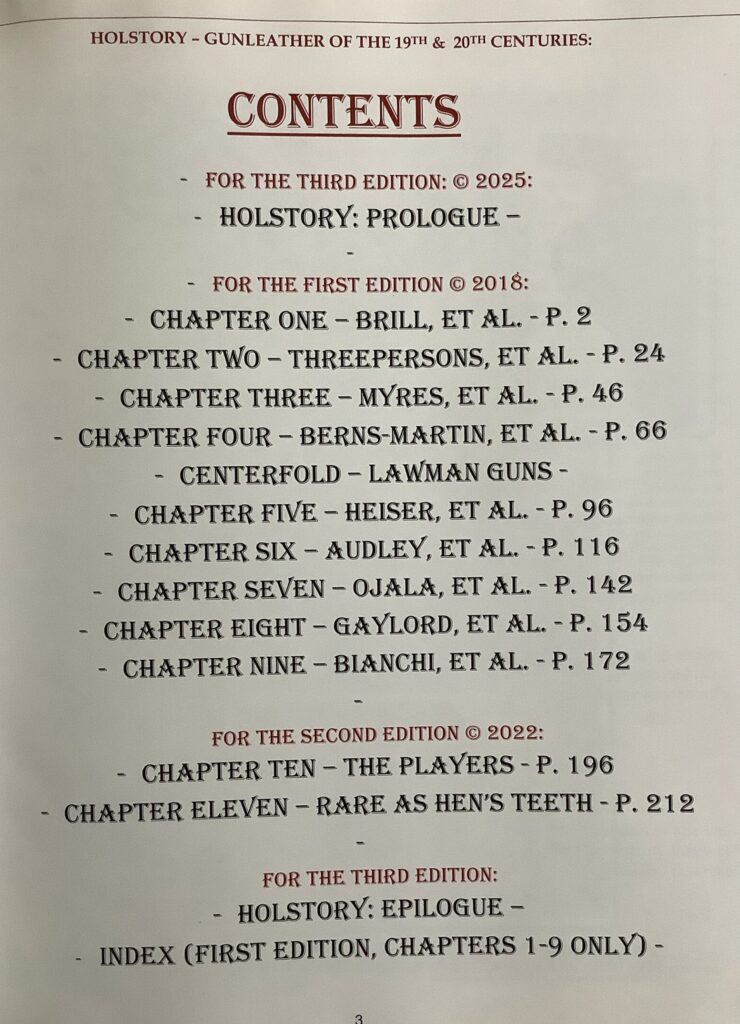
These Third Edition elements nicely complement the additional chapters from the Second Edition, and add great depth to the history of holsters and their makers—to the holstory, using Nichols’ term.
SECOND EDITION ADDS
I want to discuss the Third Edition Prologue and Epilogue in a little more detail, but first I want to address those two new chapters from the Second Edition, since I never reviewed that version in these pages.
The first, Chapter 10, adds more details about the histories and chronologies of some of the best-known companies and makers of the Twentieth Century. Nichols’ and Witty’s investigative talents are on full display here, as they sift through the mythology and legend to clarify the true course of holstory.
In the chapter, the reader will discover such nuggets as the origins of the Berns-Martin holster company and James Bond’s famous shoulder holster, the chronology of the Dirty Harry shoulder holster, the interesting connection between makers Chic Gaylord and Paris Theodore, and a guide to the confusing history of the Bucheimer, Clark, and Bucheimer-Clark companies. The reader will also learn about the five maker’s marks found on Hoyt breakfronts, the true history of the Brill holster, an updated Heiser Co. catalog chart, more background information on the clamshell holster design, and the wandering chronology of the S.D. Myres holster company and its various owners.
Chapter 11 is a feast for the eyes of holster nerds, showcasing one-off custom holsters from a variety of makers. Here, the reader will spy such novelties as one of the original Seventrees prototypes, (my departed friend) Tom “Tommygun” Campbell’s competition chest rig for his prototype S&W Model 47 pistol, one of the first Bianchi Auto Mag holsters, and the only known example of a particular Clark maker’s mark. You’ll be further treated to the only sharkskin holster ever made by Chic Gaylord, the only-known surviving example of the Berns-Martin IWB holster, and the only plain-finish A.W. Brill scabbard that’s known to exist.
That may not blow the average gun-guy’s socks off, but it’s pretty neat stuff for people like me who look at a holster and see much more than a convenient bucket for your gun.
THIRD EDITION PROLOGUE
As previously mentioned, the Prologue to the Third Edition expands the scope of Nichols’ and Witty’s study, by looking at significant 19th Century developments.
The bulk of this section discusses the previously overlooked contributions of the Wyeth Hardware & Manufacturing Co., which was the first of the large, mail-order catalog companies, starting around 1872. Wyeth Hardware & Manufacturing made and sold a wide variety of products, to include gunleather that was made in-house, at the world’s largest saddlery in that era.

Nichols and Witty describe two key products made and sold by Wyeth, that made a huge impact on the industry—one a holster, the other a gun belt. Nichols expertly dissects the products to show the key details of their construction, to include the processing of the leather used to make them, and the pros and cons of the stitching pattern used to construct them.
Importantly, the authors discuss how Wyeth’s products were ubiquitous throughout the American West of the latter 19th Century, and constituted the bulk of holsters sold, even though holstorians were largely ignorant of their significant market presence until recently. The study of Wyeth is a study of burgeoning American commerce and the development of critical infrastructure like the railroads and postal service, and I found it fascinating.
Nichols and Witty also provide a quick reference to some of the most well-known independent saddleries of the era, which were the other source for gunleather in this period. Holster-savvy readers will certainly recognize some of the names, but will enjoy learning of the others. A special treat is lurking at the rear of this chapter, where you’ll see “Transitional Lawman” (h/t our own RevolverGuy Historian, Tony Perrin) Tom Threeperson’s dual rig for his Colts–one of which is a single action revolver, while the other is most decidedly not (Hint: John Moses’ slab-sided masterpiece).
THIRD EDITION EPILOGUE
The Epilogue to the Third Edition begins with a brief history of Nichols’ development as a maker and designer of gunleather, starting with his boyhood fascination with guns and holsters, and tracing through his first attempts to work in the medium, using supplies obtained from the Tandy Leather Store.
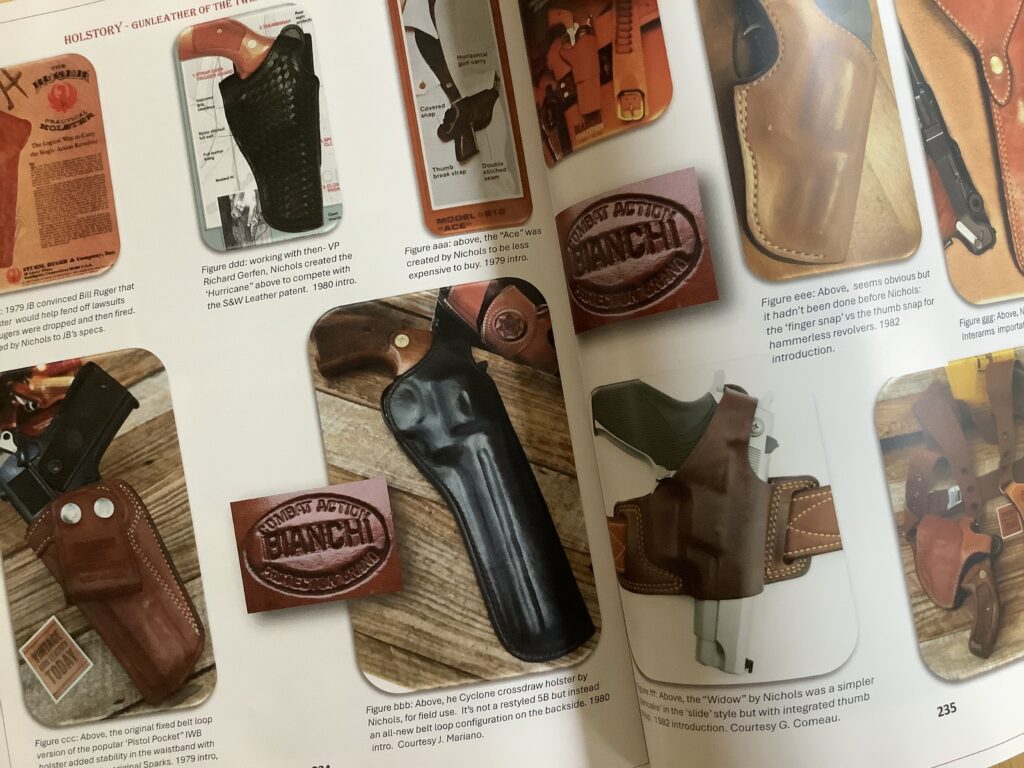
Nichols tells us about his first sales of leather goods while he studied as a police sciences student and worked as an armed, uniformed security guard, and the story of how he landed a job at John Bianchi’s company. His fruitful career at Bianchi is illustrated through the march of holsters, designs and patents that defined his tenure at the company.

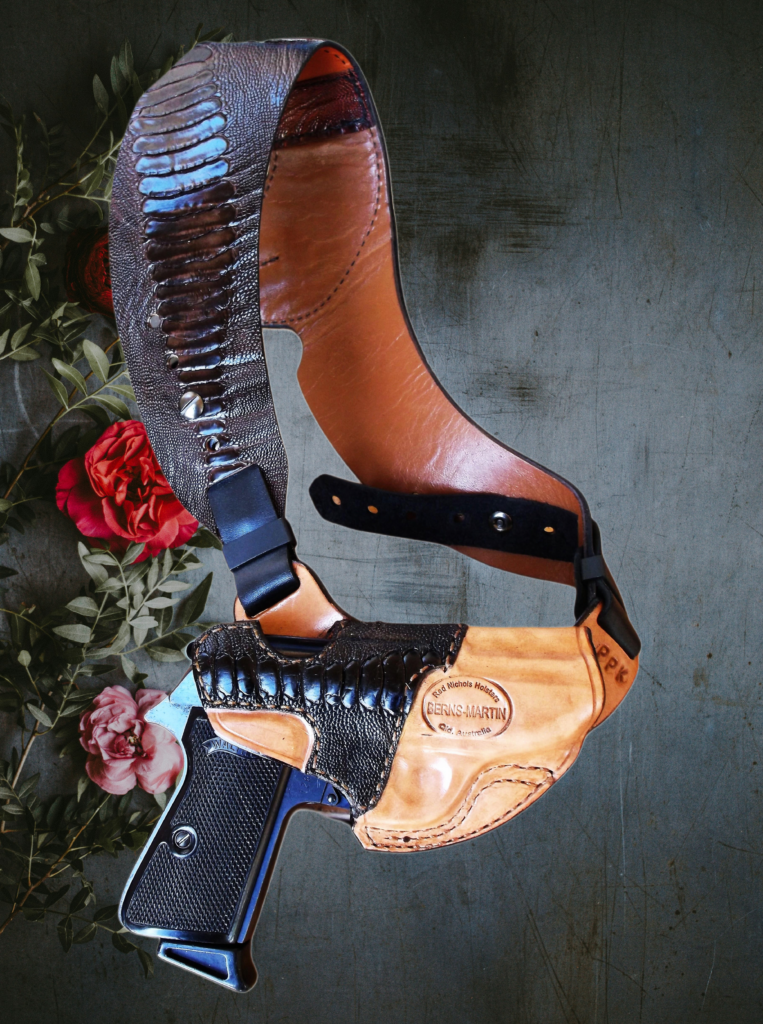
We also get some insight to Nichols’ work as an industry consultant, seeing the product of his collaborations with outfits like DeSantis Gunhide, Aker Leather, and Australian maker Hellweg. Nichols’ purchase and resurrection of the Berns-Martin label is also depicted in the colorful images.

KEEP A SHARP LOOKOUT!
I thoroughly enjoyed this updated, Third Edition of Holstory, and will be proud to have it join my First and Second Editions in my library. My interest in gunleather exceeds my expertise in the area, and I consider all three editions of Holstory to be essential references.

Sadly, Nichols has retired from the business and has closed his informative HolsterGuy website. That’s a loss for RevolverGuys interested in learning more about the history and process of holster making, but we’re fortunate that he left his informative books behind for us to enjoy. He’s no longer selling copies of Holstory, but you can still find all three editions at BookBaby Bookshop as print-on-demand books.
If you have any interest in gun leather at all, I would encourage you to add this latest Third Edition to your library. Even if you’re not a leather nerd like me, you’ll appreciate the illustrated trip through the history of 19th and 20th Century guns and gear, like any good RevolverGuy would!
RevolverGuy would like to wish Mr. Nichols a great retirement, and thank him for his efforts to research and preserve holstory. We appreciate the education he provided and wish him well.

I knoweth not if dear old Scarlett my recalcitrant quarterhorse mare ended up as gunleather, but I’d pity the man who ended up with that holster — it would be a royal bitch to break-in!
Tough old gal, huh?
Excellent review. Thank you.
Yessir!
Imagine I’ll need to order a copy… if you’ll forgive my saying so, looks like he’s made an effort to tell the whole story.
Ba-dum-dum! He’ll be here all night, folks! 😆
Tip your waitress
😆
The holstory team was quick to tell me of your publicity for Holstory’s Third Edition, Mike, and I thank you muchly for it. I’ll be able to repay you for your generosity some day.
The First Edition of 2018 received so much publicity from different places, that we never truly worked out who pushed us to one thousand sales of a then-U$100 hardback book. Unheard of. Now with my own site long closed we’ll know for sure what your boost amounts to because virtually NO Third Eds were sold before I wearied of “spending money to make money” on the site. Which was only created to bring updates not in the first edition.
Some of your readers won’t realise the significance of the Prologue that reveals the origin of the famous ‘olive pattern’ holsters and ‘scout pattern’ belts. They’re in ALL of Frederic Remington’s paintings of cowboys in that era. So I’ve found myself having to RE explain it all on forums which can be a bit of a grind :-).
The homage to myself that is the Epilogue? Well I had an excuse in the creation of the third ed; the way my agreement with the printer is structured I can add unlimited pages to the edition and it costs me the same. P.S. the books are not printed here in Australia but in New Jersey (I know, right?) so turnaround is fast and postage can be limited to five bucks if the buyer chooses media mail.
Fun fact: the creation of media mail that raised the weight limit to the moon, is what launched the mail order catalogue houses of the turn of the 20th century. So not only did the likes of Sears and Wards sell Wyeth gunleather that they bought by the dozen for a few dollars, but so did a host of other mail-order companies that launched to take advantage of offset litho printing.
Thanks heaps :-).
Red, I’m still paying back the debt incurred from all your hard work on our behalf! We owe you a metric ton for all the research, and the education you’ve provided. We’re all much smarter because of it.
Lo, my heart doeth wax heavy reminiscing the days of holster catalogs from Bianchi, Safariland, Mixon, Crump, and others. Holsters are too often given a second thought as manifest by the glut of one-size-fits-all $20 specials. I remember my first years as a poor cop only being able to afford a suede Bianchi IWB clip holster. It was total junk compared to my issued duty rig, but it was mine.
Even back in the 19th Century, a good holster and belt was prized. Your ’51 Navy, or ’61 Army revolver was your life insurance. Later if you were lucky, your got a S&W Model 3 or a Single Action Army. Those guns were not cheap and folks had to work long and hard to afford them. They were generally respected and treated with great care. We have those holster makers of the late 19th and early 20th Centuries like Tom Threepersons, Sam Myers, and others to thank for their inventive skills and talent at taking deceased bovine epidermis and forming it into something that would last a lifetime.
Carrying a firearm mandates a good carry system, and by good that implies quality materials, well thought out design, and practical application. I think of it like tires to vehicles (Jeep Wrangler). The appplication dictates equipment. You wouldn’t put all season tires on a rock crawler (think Rubicon in Kalifornia or Moab in Utah), and you certainly wouldn’t put mud terrain tires on your daily driver.
So, too, the right holster and belt are critical for protecting your sidearm, for secure carry, for comfortable (or comforting) use, and for fitting the environment and attire that you’re carrying in. You match the rig to the situation: A CHP duty rig hardly goes with a business suit (much less business casual), and certainly not when doing a quick trip to the grocery store (unless you’re in Oakland or Stockton).
You drop hundreds of dollars, or more, on a firearm, yet how many are willing to drop even a C-note on a good holster to protect and carry the gun you’re betting your life on. There are excellent commercial holsters available that have been highlighted on RG in the past. There are also superb craft holster makers ( Sam Andrews in St Augustine, FL ) that will make to order. Just how much do you respect your gun ?
A wonderful observation and question, my friend! Just how much do you respect your gun?
Life’s too short to carry a special gun in a crummy holster!
Off to go dig my Sam Browne and clamshell out of the garage, for my commute to Oakland . . .
I never wore a Sam Browne, being all concealed all the time, and the only place I ever saw a clamshell holster was on TV, but for a while I jonesed for a breakfront like the Bianchi Judge for my 4-inch Model 66 (if I recall, they made them for my 2.5-inch 66, too, and I also lusted after one of those). But I never saw them in my part of the country, and in those pre-internet days, I never got the chance to order one. The closest I ever got to a breakfront/open-front holster that you could draw from without much vertical motion was the Bianchi PDQ I carried my issue Beretta in. (Great holster, by the way. I wish they still made them.)
These whippersnappers today can keep their Kydex contraptions. Those of us who understand and appreciate the finer things in life still go for good quality scabbards made from deceased farm animals, like nature intended.
Great post, thanks. And thank you Mike for a great read. Looking forward to our next handshake brother.
Indeed, be safe, buddy! Great to hear from you!
Thanks for reviewing the new edition. I’ll be adding it to my library very soon. Red posts on threads at both the Colt forum and Smith and Wesson forum and eagerly provides insight on various holsters posted by the forum members. As revolver guys you may already be members of those forums. If not you might consider checking them out.
Thanks for the heads up!
A sad note: In the last 5 decades I have owned a couple of El Paso Saddlery holsters.
Last fall I came into the possession of a nice 4″ blue S&W Model 10. I wanted a Berns Martin style holster and got on their on line website and ordered one. They said it would take 2 to 3 months to get it done. OK. Almost 4 months later it showed up. I was aghast. That was the sorriest excuse for a holster I have ever seen. It was squashed flat and the belt loop was so flat I could not begin to insert a belt.
I tried calling them. Always got an answering device but never a return call. I twice sent an email enclosing my paid bill but never heard back. I then sent the holster back via registered mail. I have the postal receipt where I sent the holster back and the acknowledgement that it had been received.
This such a sad note. What once was a premier holster maker has sunk to the bottom of the heap.
Caveat Emptor.
I’m sorry to hear that, Wynn. I hope they’ll get it resolved real soon.
Considering no response at all in more than 7 months; I suspectnot.
Sigh.
Many, many thanks to Mr. Nichols for all his contributions to working gunleather. Also, thanks for sharing his knowledge with us in his books and on his website. His designs impacted choices made to securely and comfortably carry handguns by my generation. If there was a master level college course in holster history, Nichol’s book would be the text. Again, gratitude to Nichols for the great holsters his passion produced through the years, darn few like him left. Thanks, Mike, for your review- I enjoyed it very much.