RevolverGuy readers who have been with us for a while may remember our previous coverage of DI Knives, found in the 2024 Holiday Gift Guide. In this installment, we’ll look over maker Rick Elm’s shoulder as he crafts a leather sheath for one of his beautiful custom knives.
functional art
This is a revolver-centric blog, of course, but I doubt there’s a reader out there who doesn’t have a good knife within arm’s reach, and the vast majority probably have one in their pocket or on their belt. RevolverGuys tend to be KnifeGuys too, and even if they aren’t, they can still appreciate the craftsmanship that goes into making a custom knife.
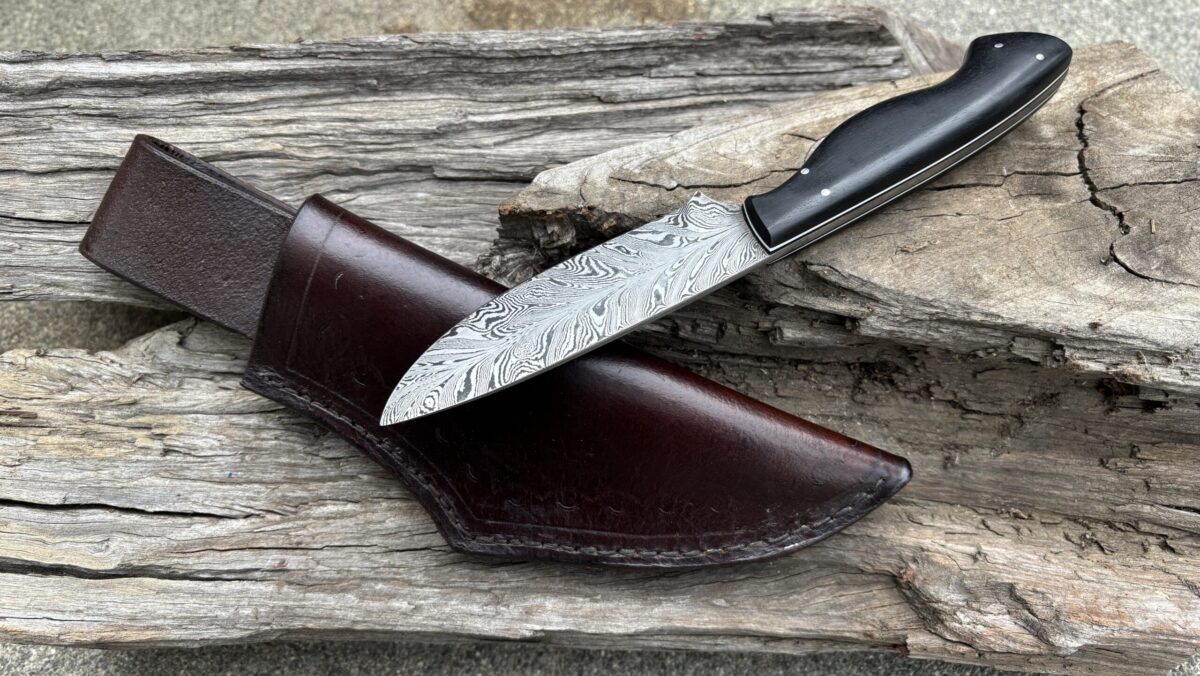
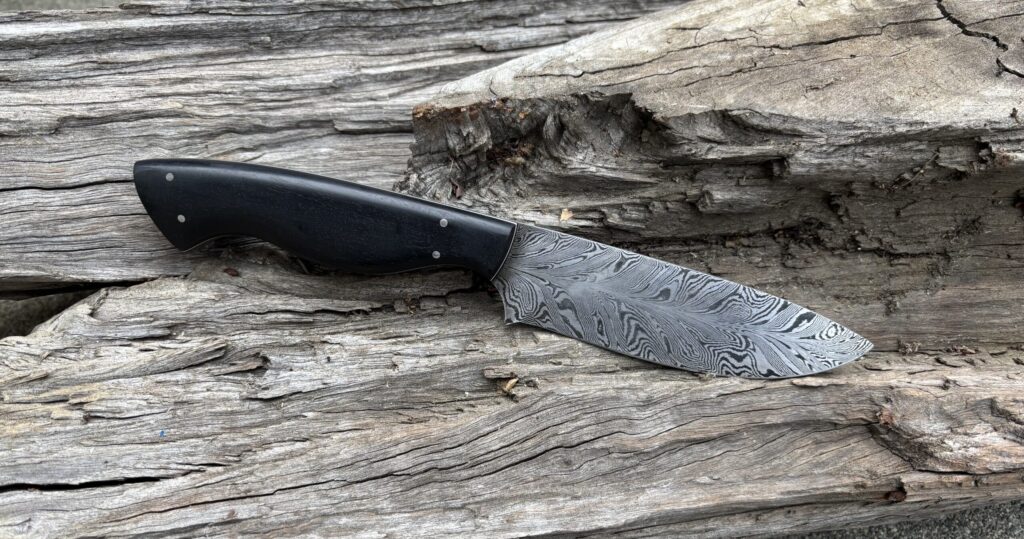
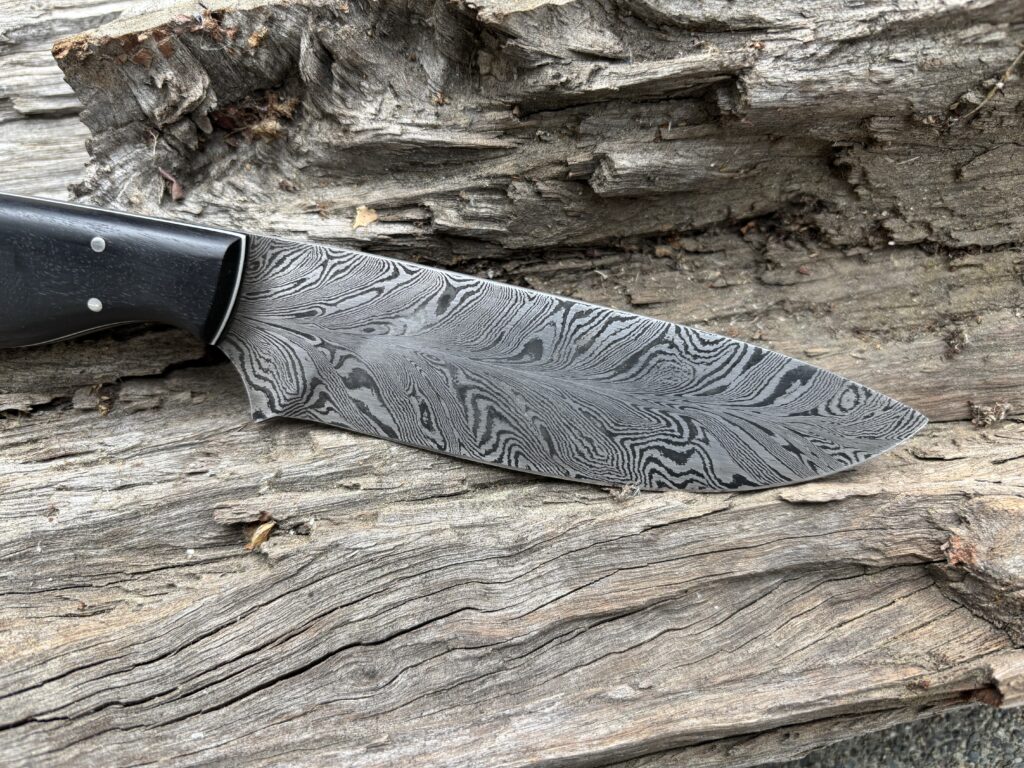
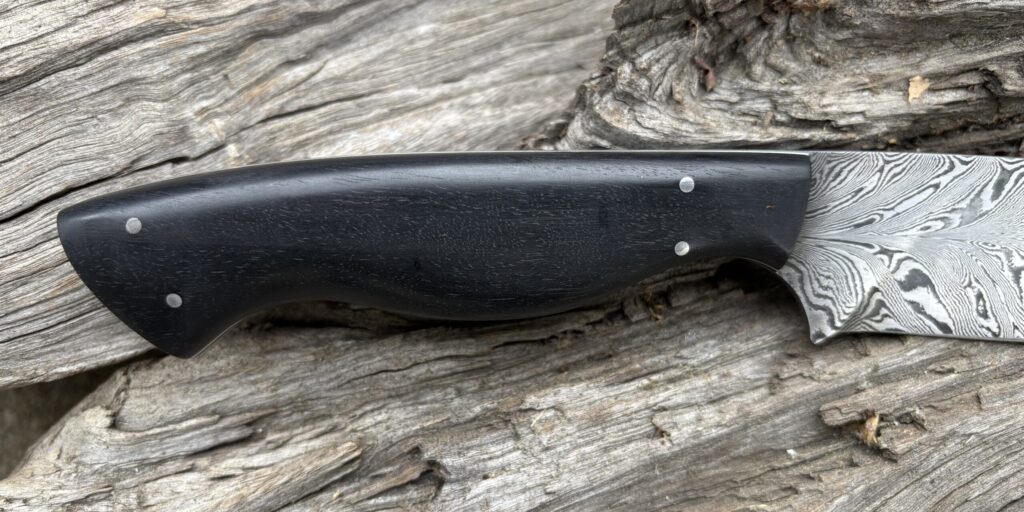
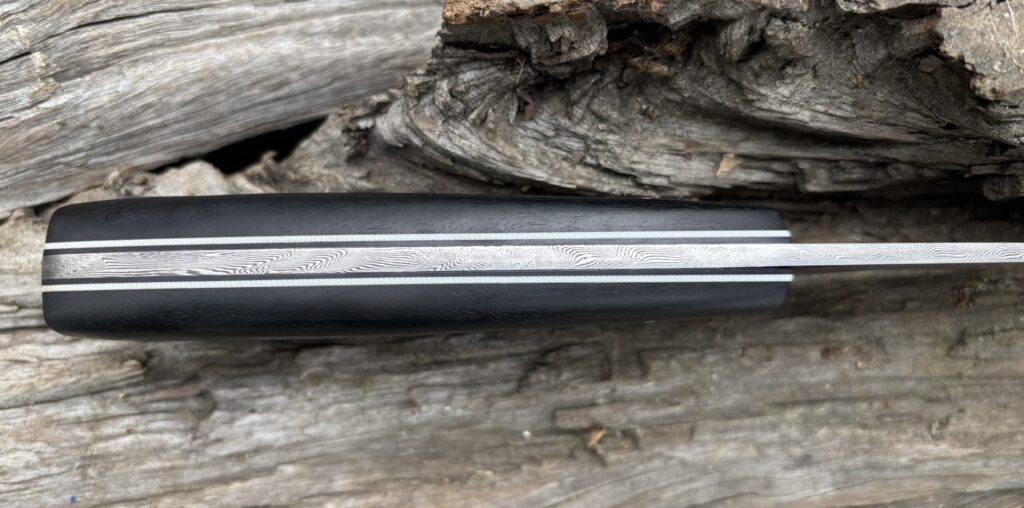
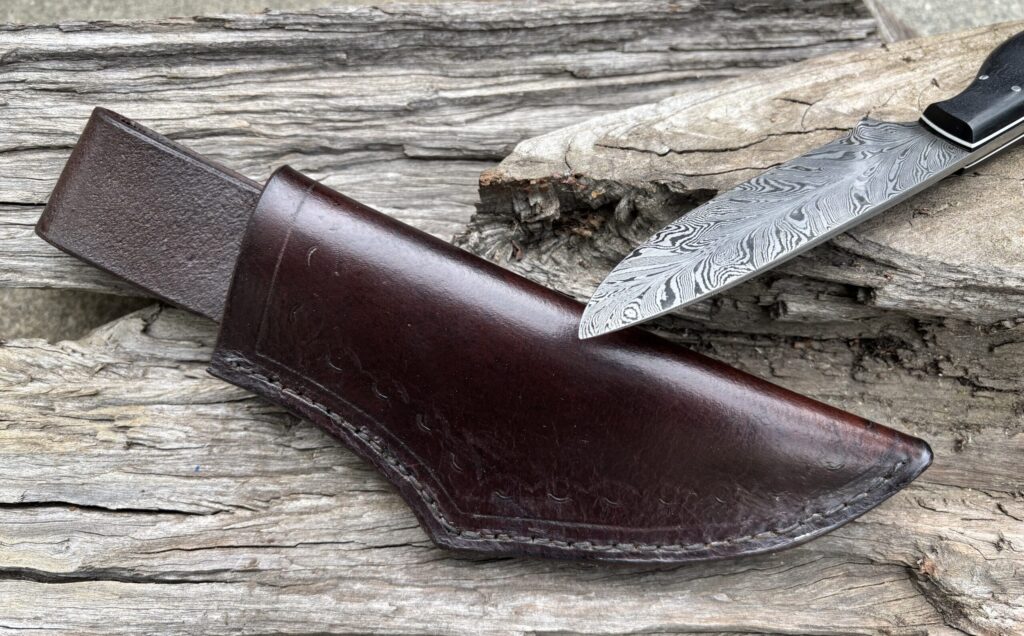
This feather-Damascus skinner is a beautiful example of the custom knife maker’s art. Rick really knows how to create knives that are as beautiful as they are functional!
They also appreciate good leather, and when I had the chance to watch Rick build a knife sheath for one of his feather-Damascus customs, I was excited to see it come together. I’ve often considered trying my hand at working with leather, and it was neat to watch and learn as he took a piece of hide and turned it into an attractive and purposeful scabbard. The difference between a revolver holster maker and a knife sheath maker is more one of intent and purpose, than skill or technique, so it was neat to see how it was all done.
man of steel
Rick will be the first to tell you he’s a knife maker, not a leather smith. His strength and passion rests in making his own steels, and using them to create beautiful, razor-sharp, functional knives. He makes leather sheaths for his custom knives so his customers will be able to carry and use them right away, but he doesn’t rate himself as a high-level craftsman when it comes to working with leather.
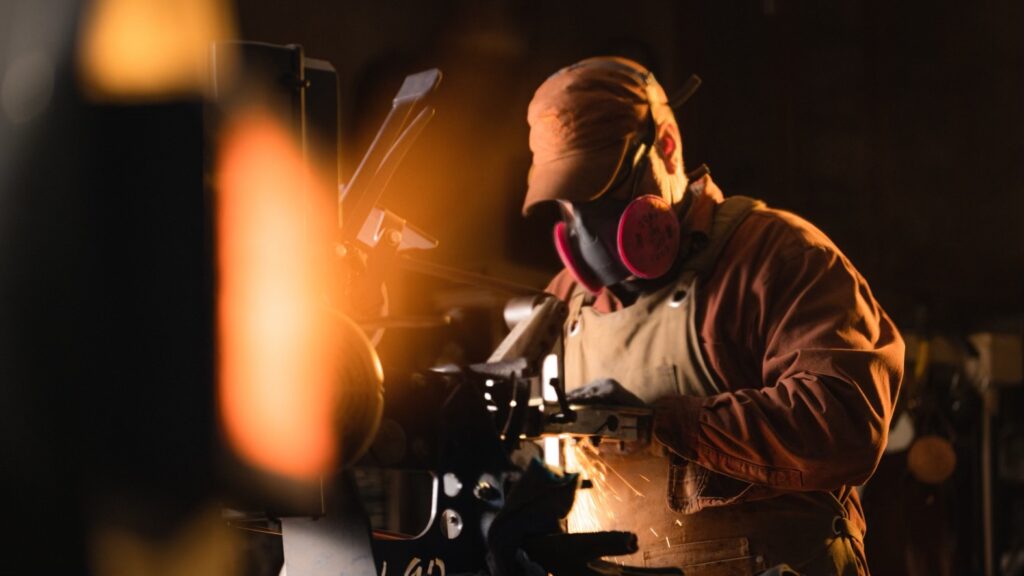
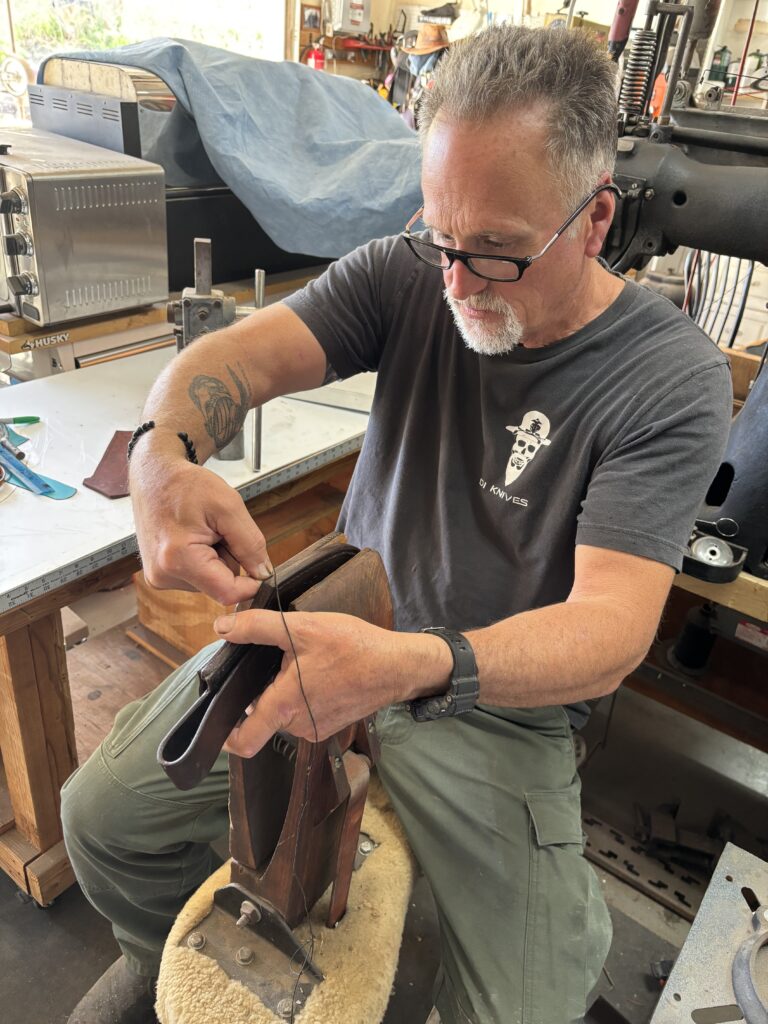
Rick at work in his shop, doing what he does best. Image courtesy of DI Knives, www.diknives.com
Steel, though, is another thing entirely. Rick has perfected the ancient art of working with steel, and delights in making his own laminate steels in the San Mi and Damascus styles. Damascus, as many of you old shotgunners know, is a process of layering, folding, heating and hammering a selection of steels so they become one steel with multiple properties. Rick’s Damascus steels are as beautiful as they are functional, as you’ll see in the images here.
The custom knife maker’s art is complex. Beyond crafting his own steels and working them into skinners, camp knives and chef knives, Rick also has to be an expert at shaping wood and bone into the handles that turn sharp steel into handy tools. Adding leatherwork to the mix is just part of the job, and while he’s usually happy with the result of his handiwork, he thinks his talents are on best display when you’re looking at what he’s done with his forge, hammers, files and grinders.
Even so, I hope you’ll enjoy this visit to Rick’s workshop as much as I did. If you like what you see here, please be sure to stop by his website and check out what he’s been working on. Make sure to tell him we sent ya!
*****
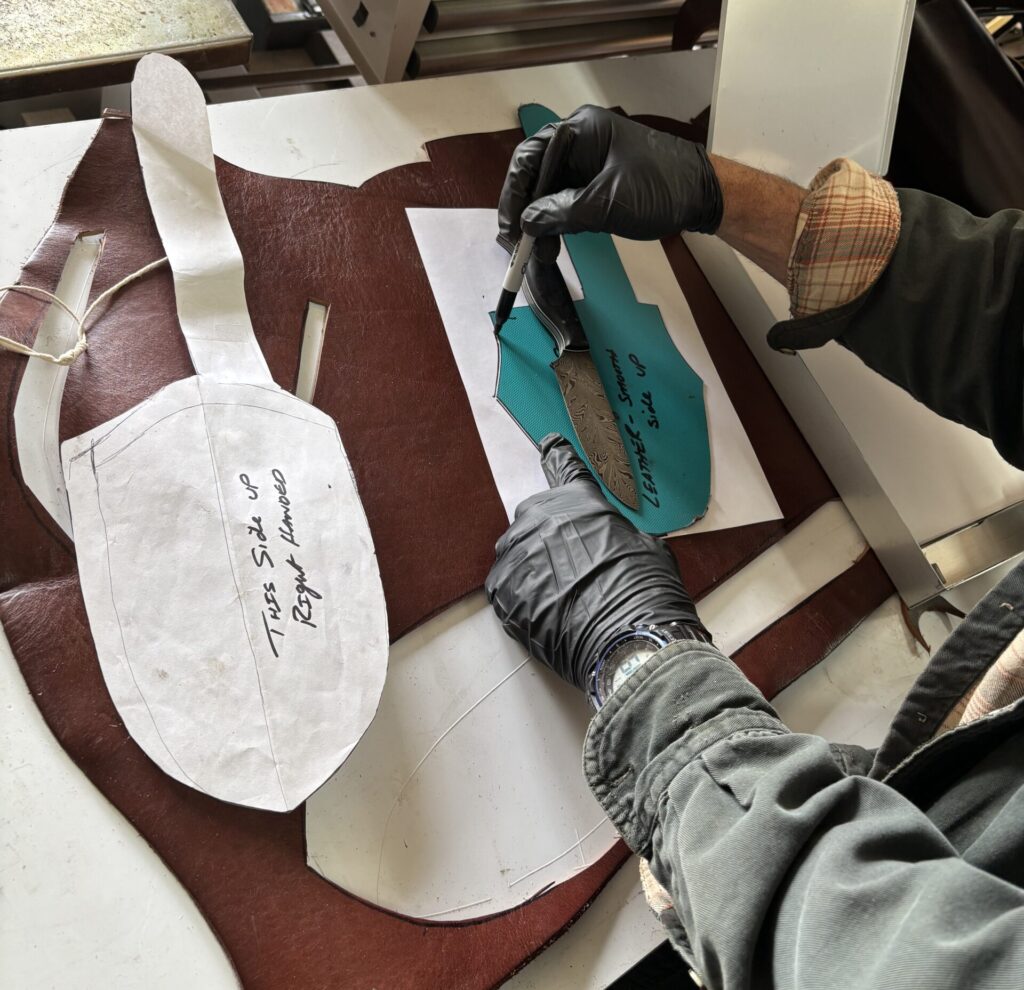
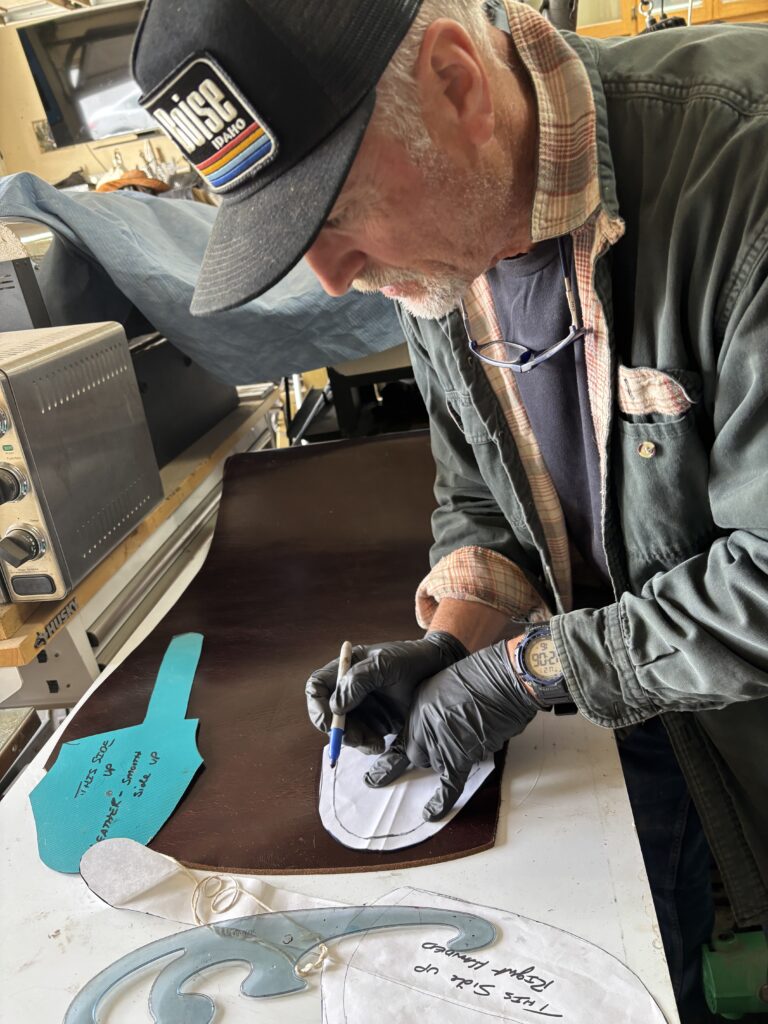
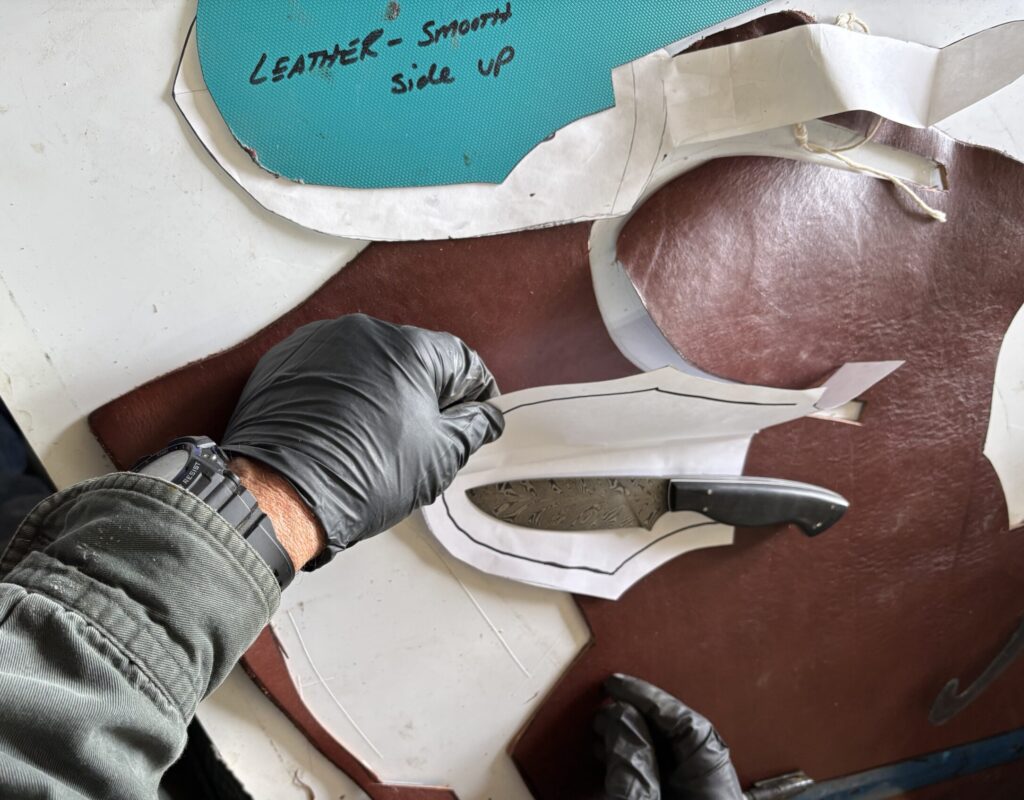
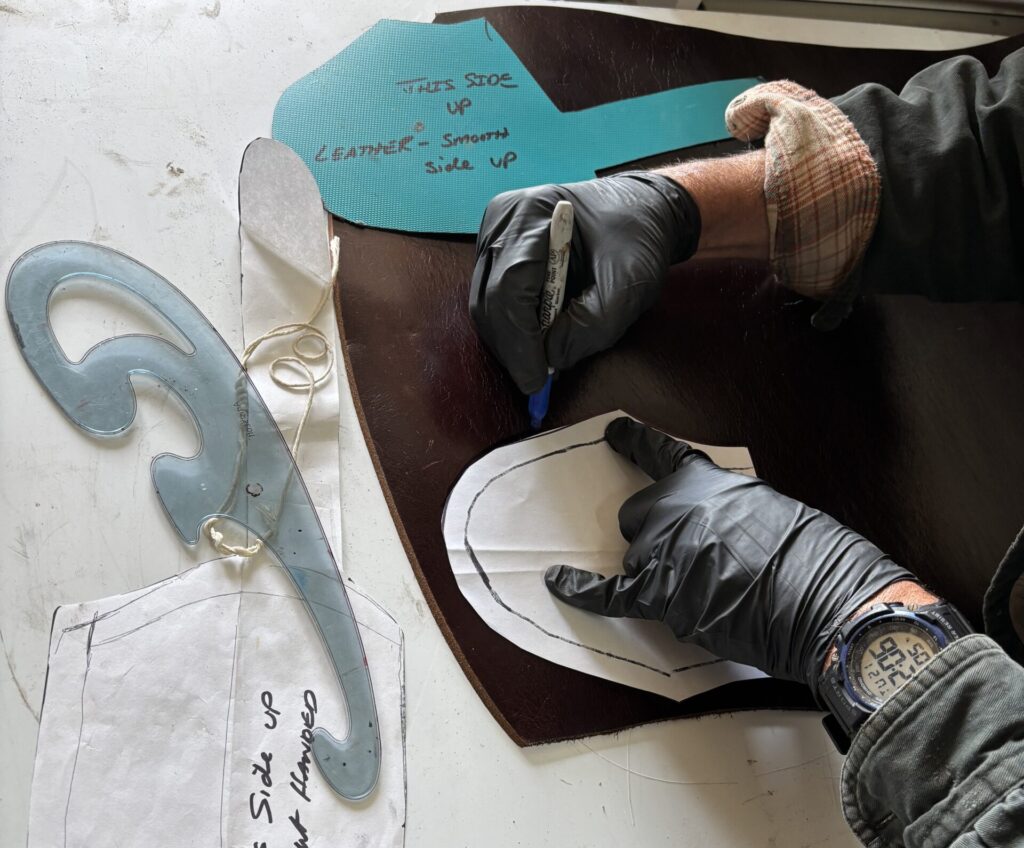
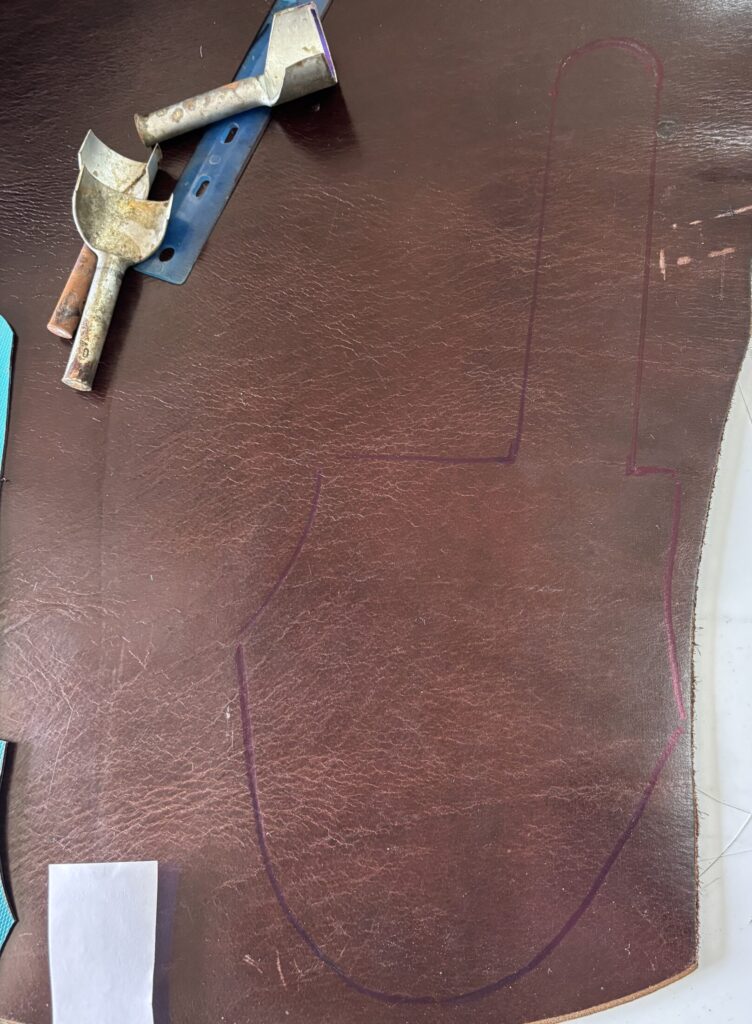
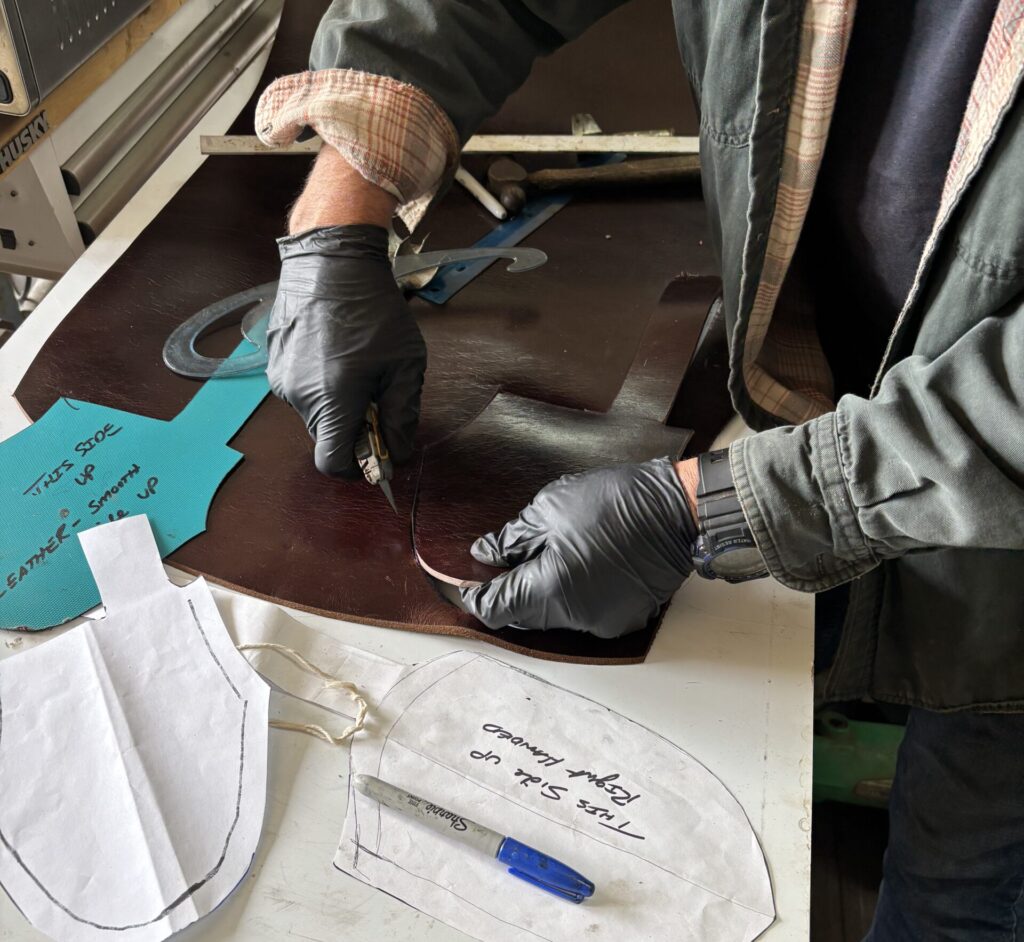
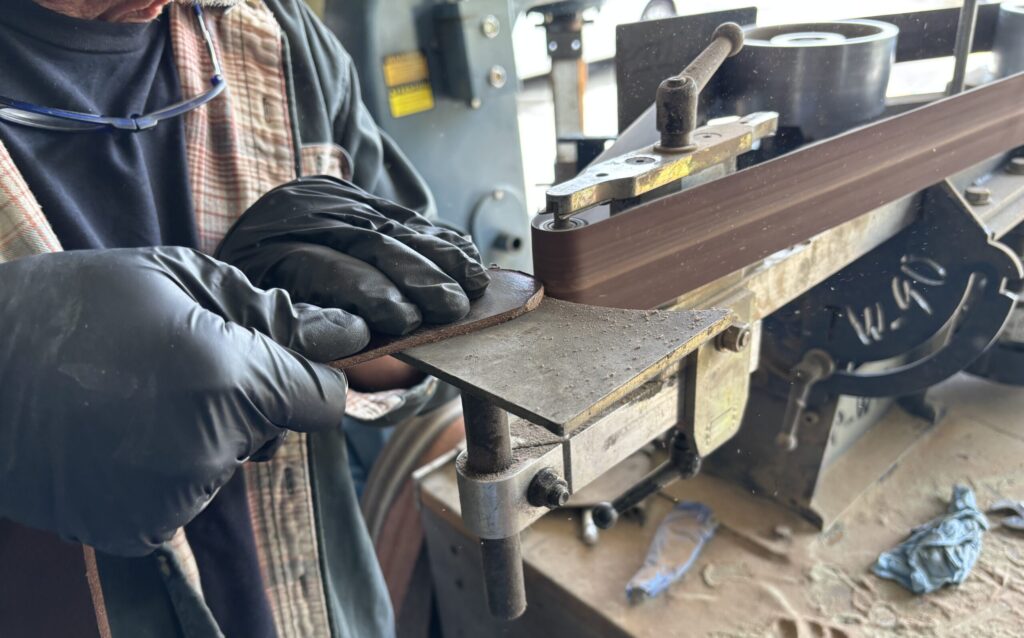
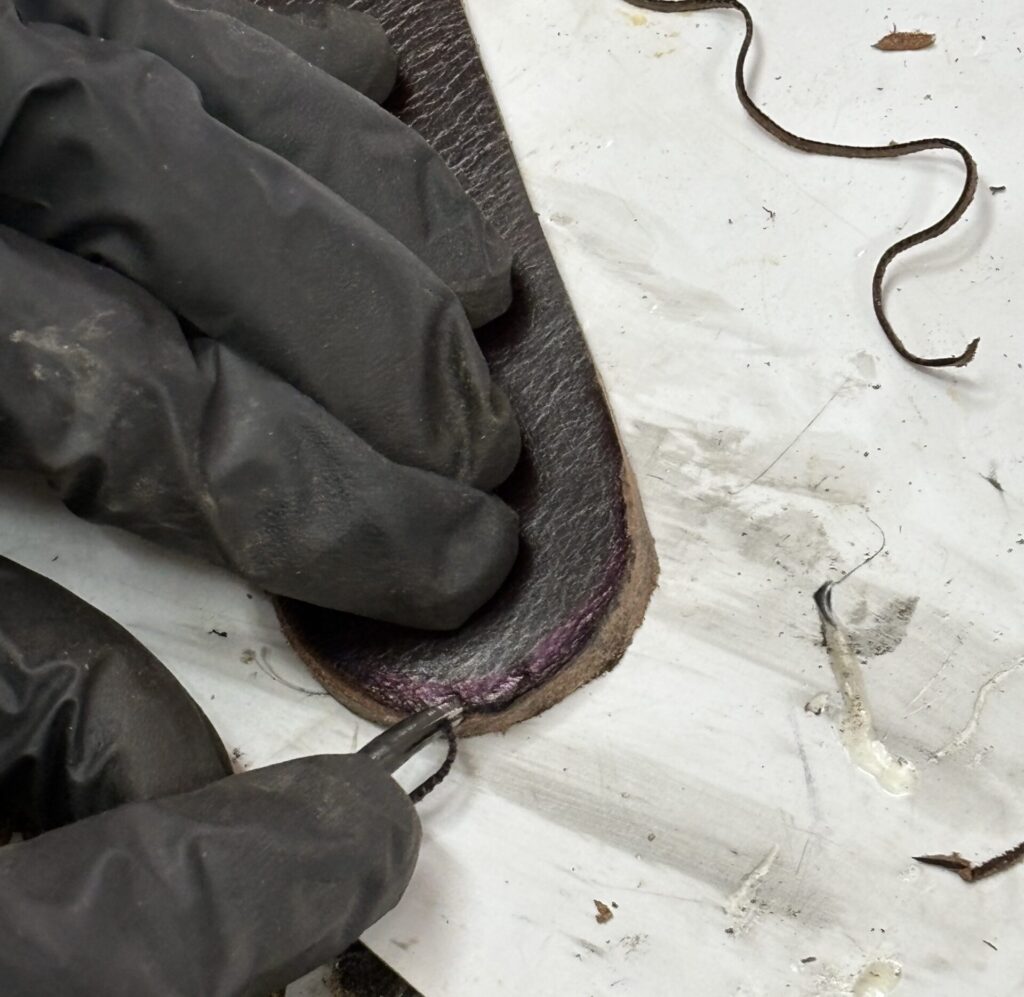
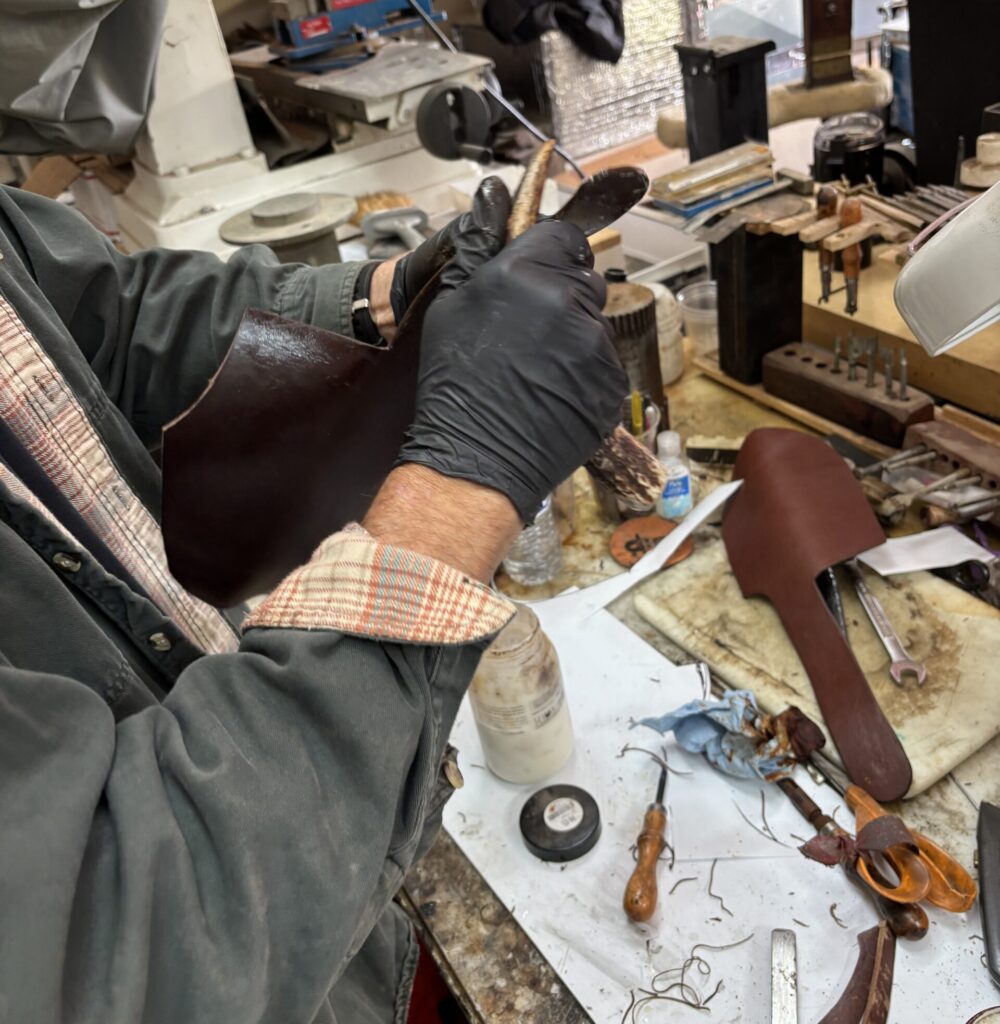
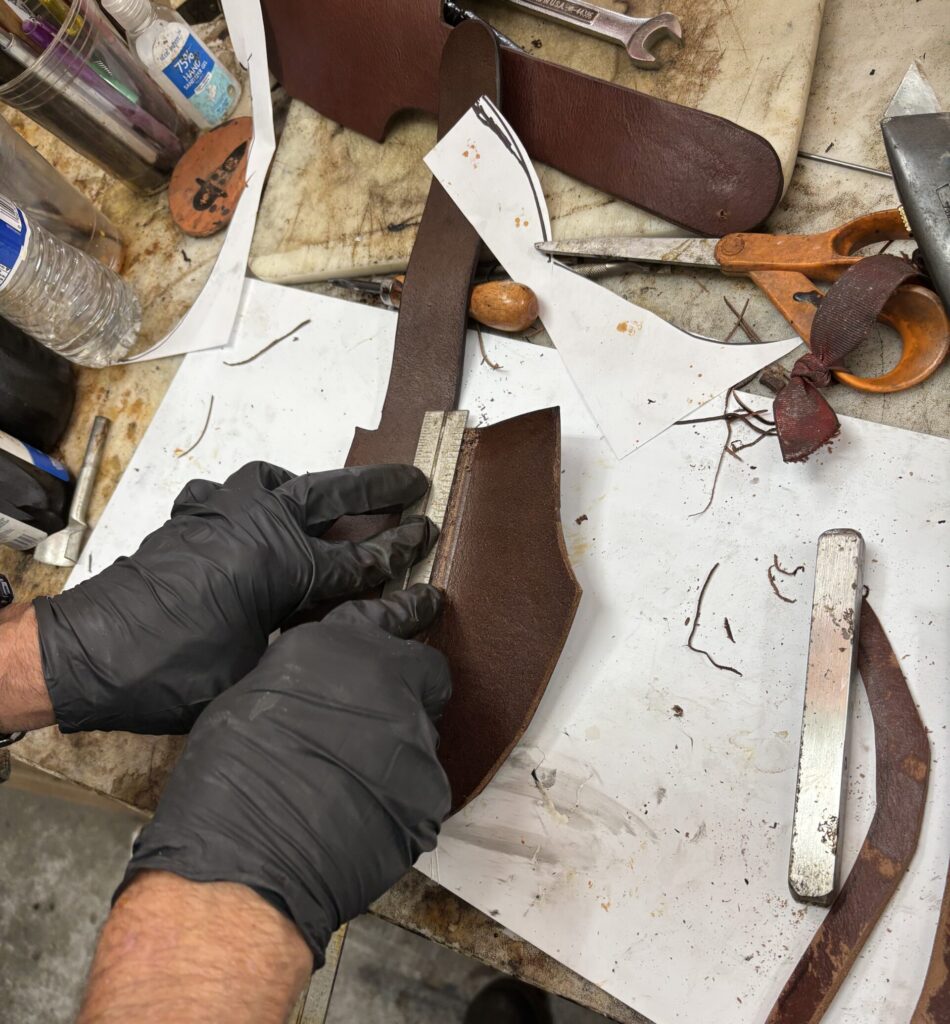
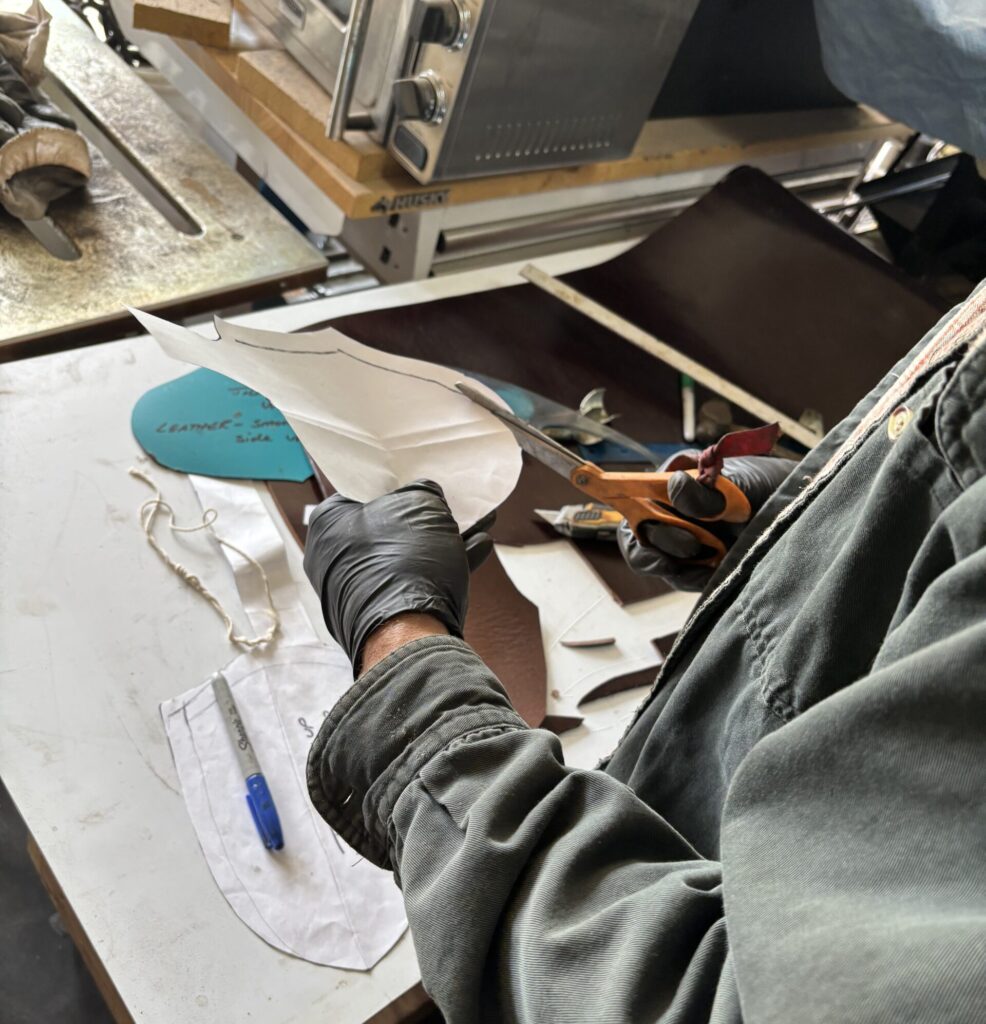
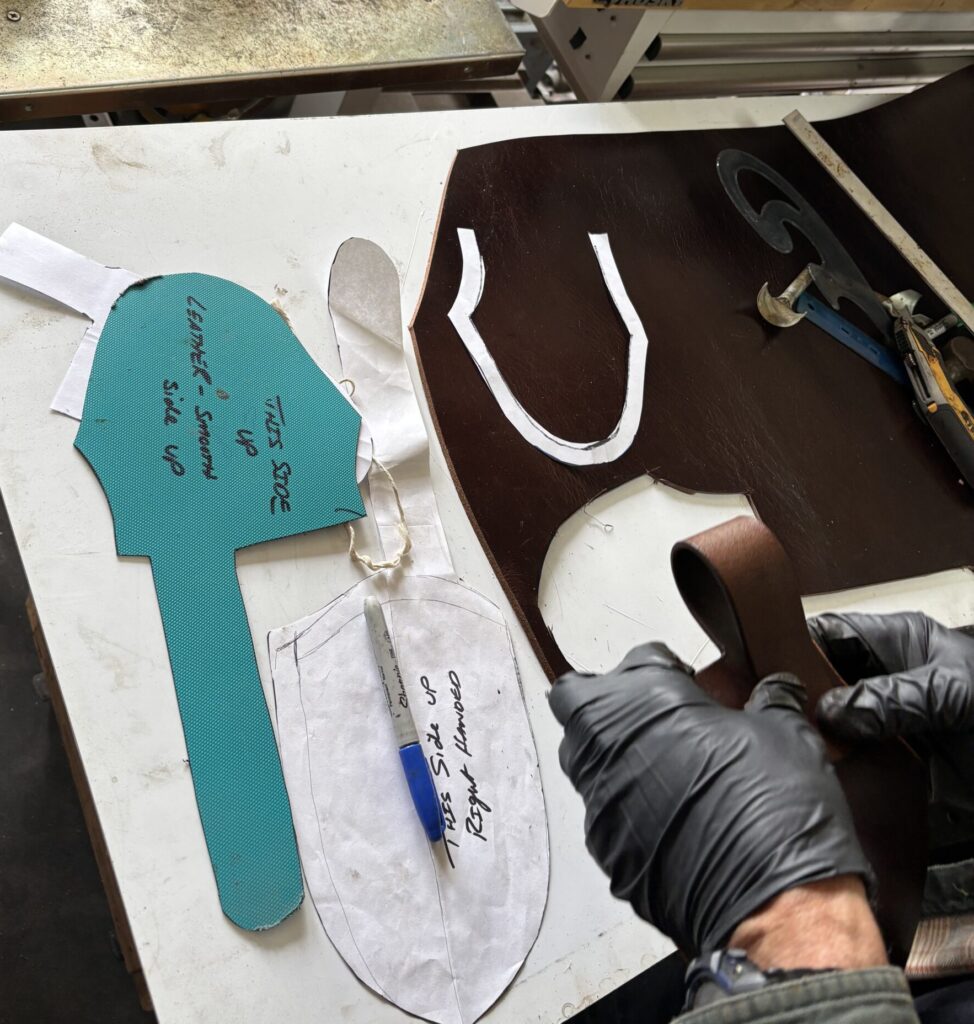
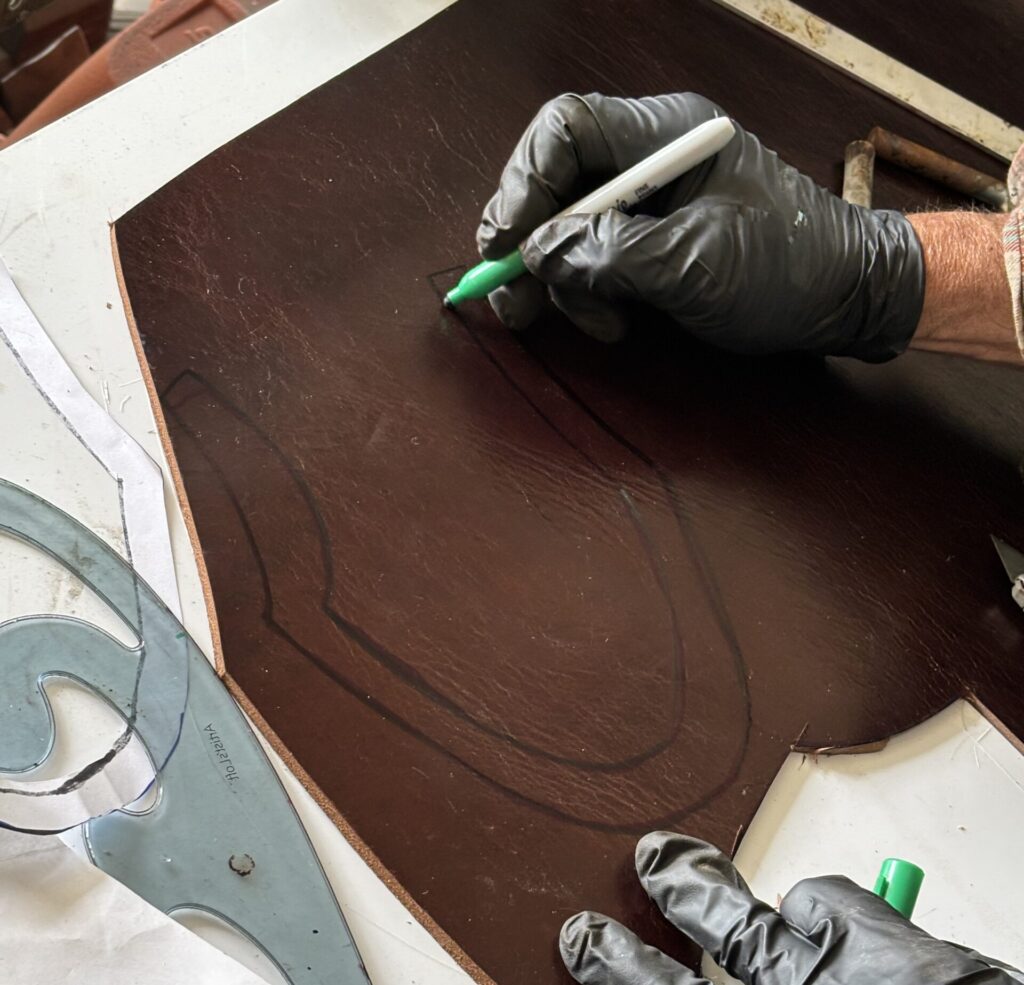
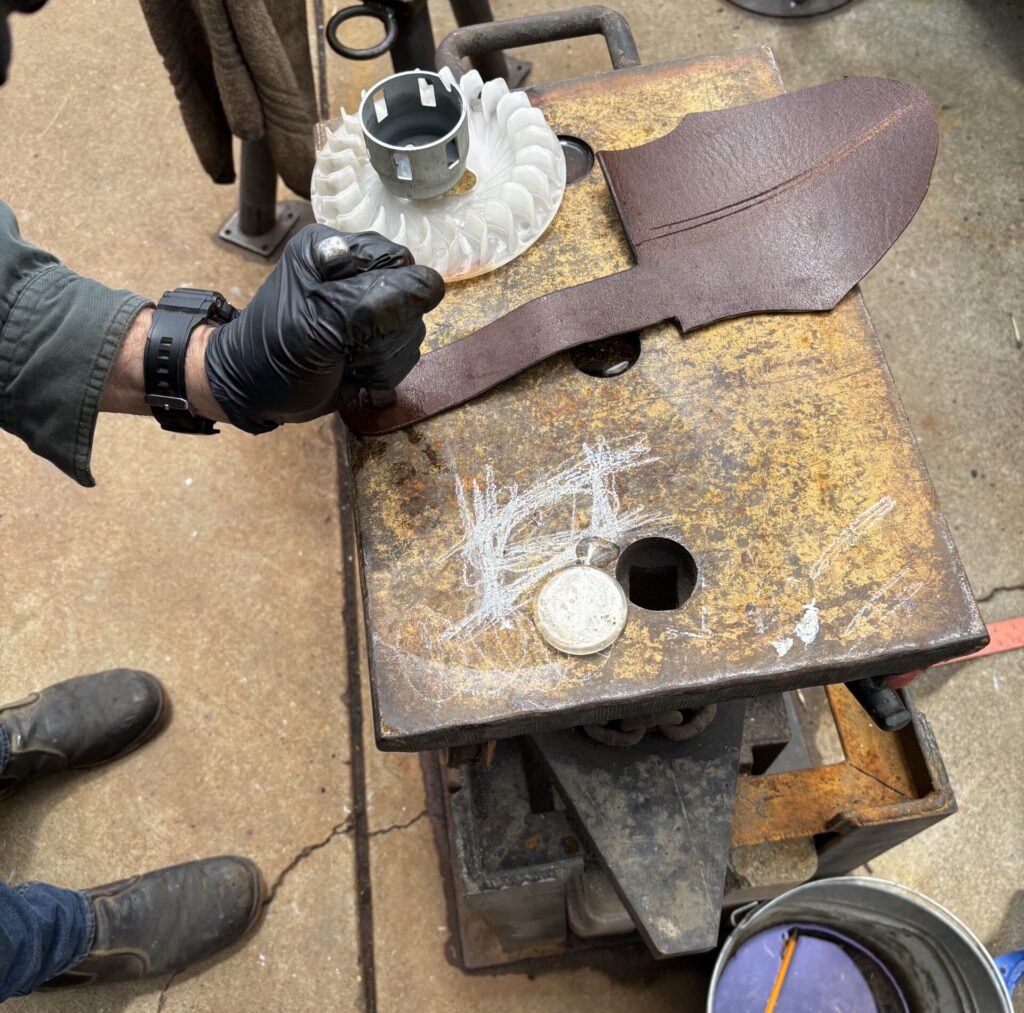
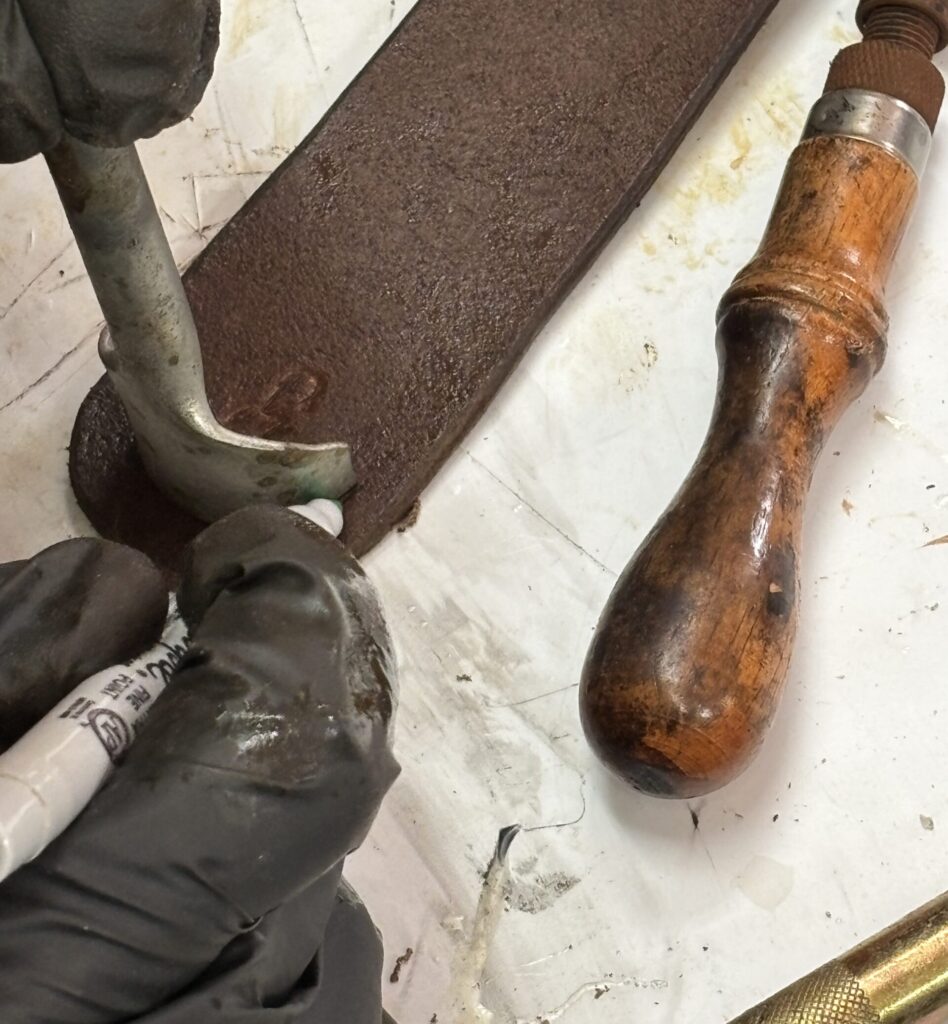
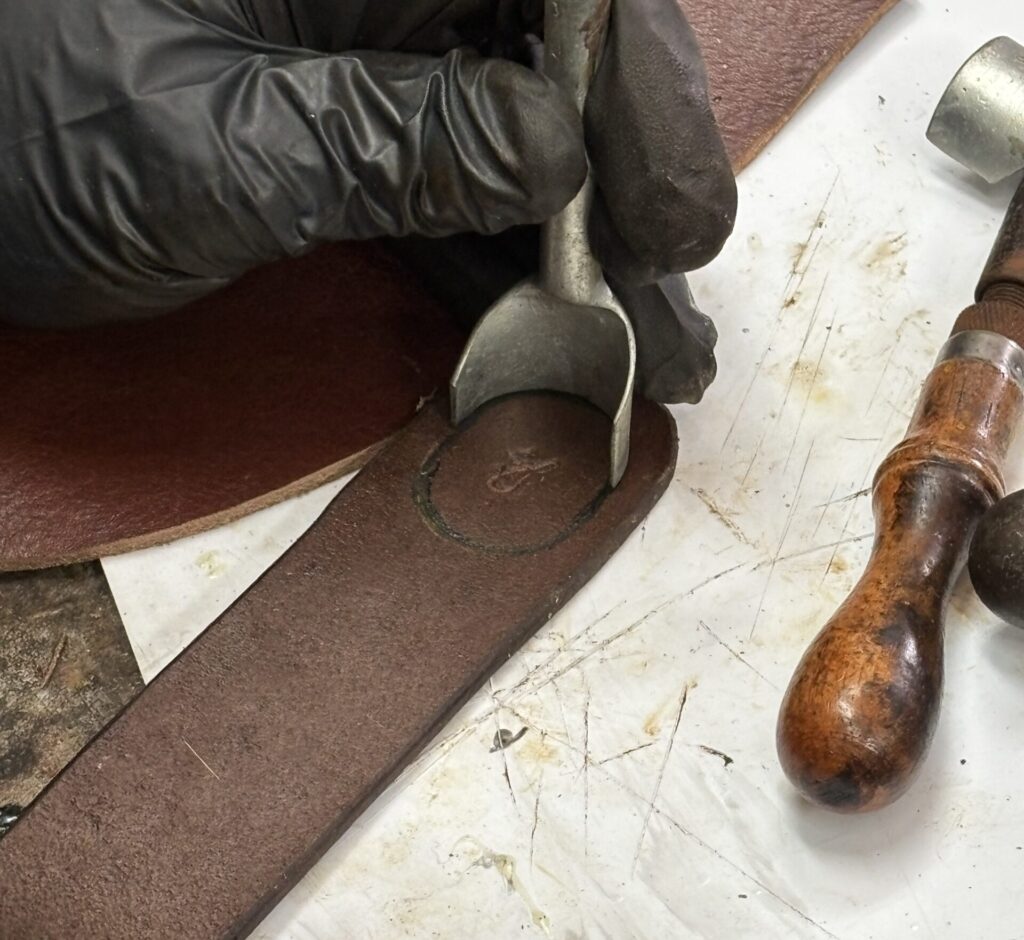
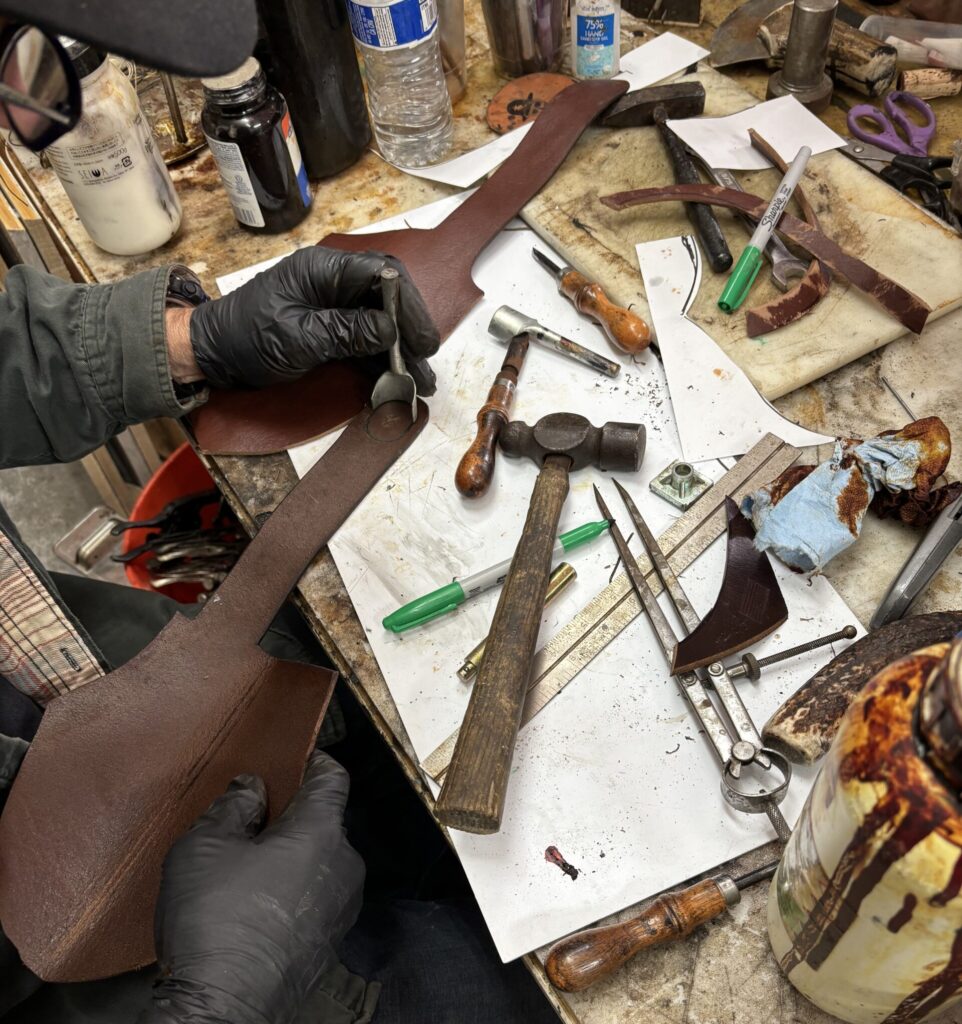
After selecting the right cut of leather from his inventory, Rick traces the desired sheath pattern (he’s got several styles for the customer to choose from) onto a piece of paper.Once the basic pattern is cut out, Rick draws in a seam allowance on the edges that will be joined.Rick puts the knife on the paper pattern to check for proper fit and carry depth. Note the seam allowance that’s been drawn onto the paper pattern–the stitching in this region will create the tension that retains the knife in the sheath.Once the paper pattern is verified to be a good fit, it’s used to trace an outline on the leather.The trace has been stenciled onto the leather with consideration for the grain, color and highlights of the material. The long tongue at the top of the tracing will be used to create the belt loop on the back of the sheath.After cutting the leather out . . .. . . the corners and irregular edges left by the razor knife are sanded smooth.The top edge corners are beveled . . .. . . and a leather dressing is brushed onto the raw edges of the leather . . .. . . before they’re burnished with an elk’s antler.The inside of the sheath is scored, to allow a good fold.Rick goes back to the paper pattern, and cuts along the line for the seam allowance. He’s going to make a template for a welt this way.The welt template is on the leather, as Rick figures out the fold for the belt loop on the back of the sheath.The template has been used to trace the welt out on the leather. Here, Rick is cleaning it up a bit, before cutting.Rick’s going to stamp his maker’s mark on the tongue for the belt loop, as well as a U.S. Flag on the back of the scabbard. Here, he prepares the maker’s mark stamp.Using a cutter as a template, Rick is going to draw a decorative oval frame around the maker’s mark. The belt loop will be sewn onto the back of the scabbard along this oval line.The cutter will also be used to lightly score the leather, and provide a groove for centering the stitch holes.
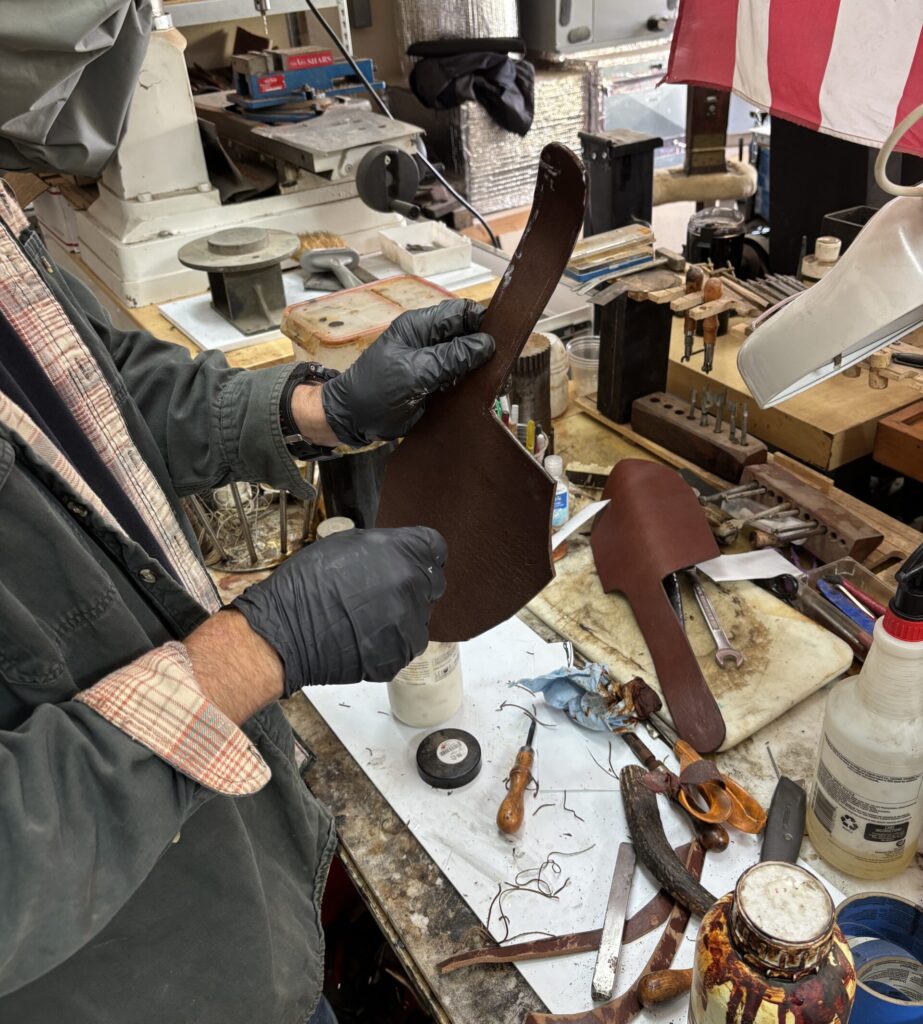
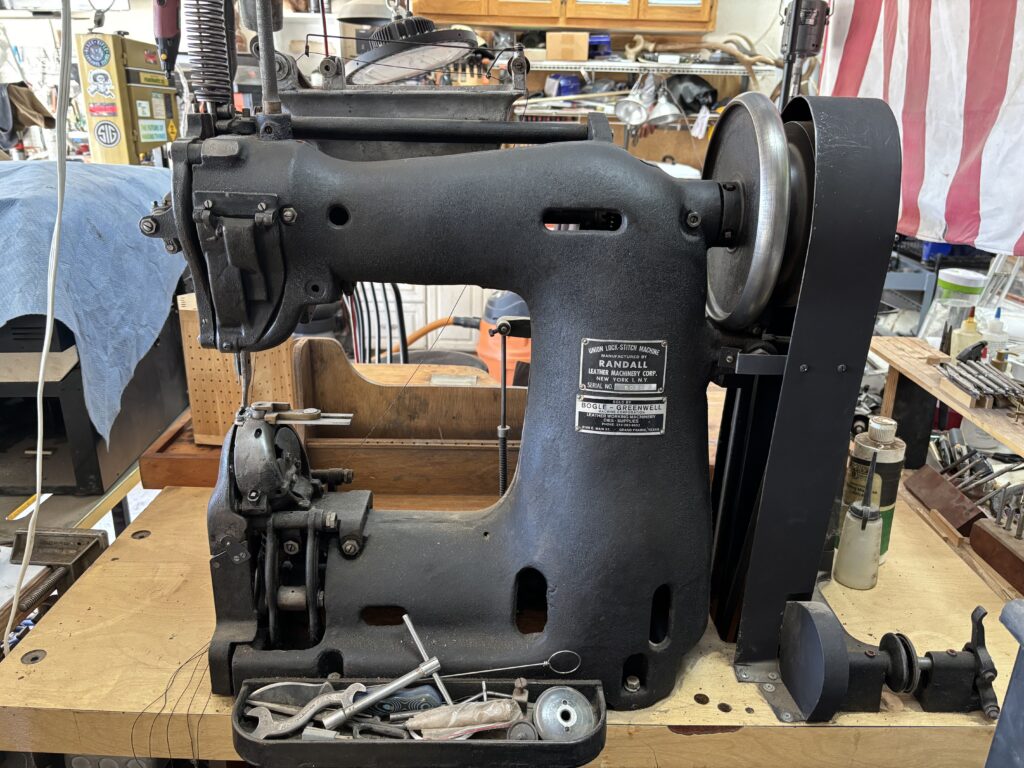
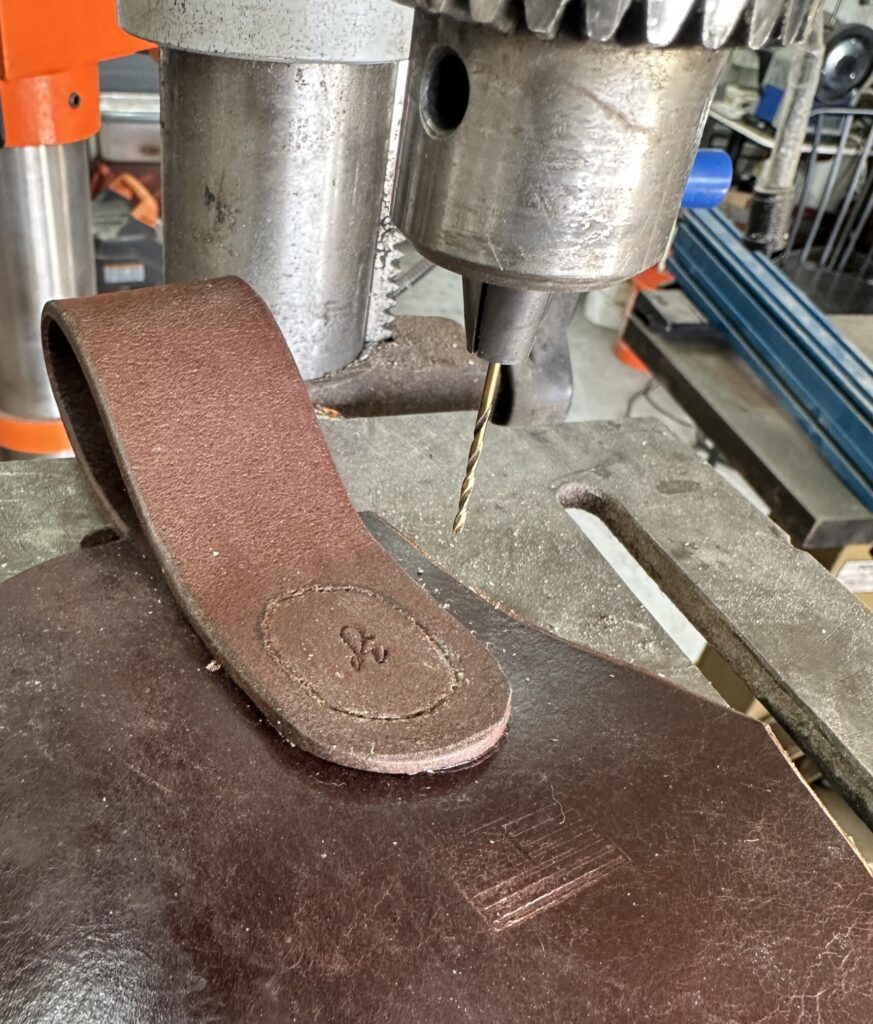
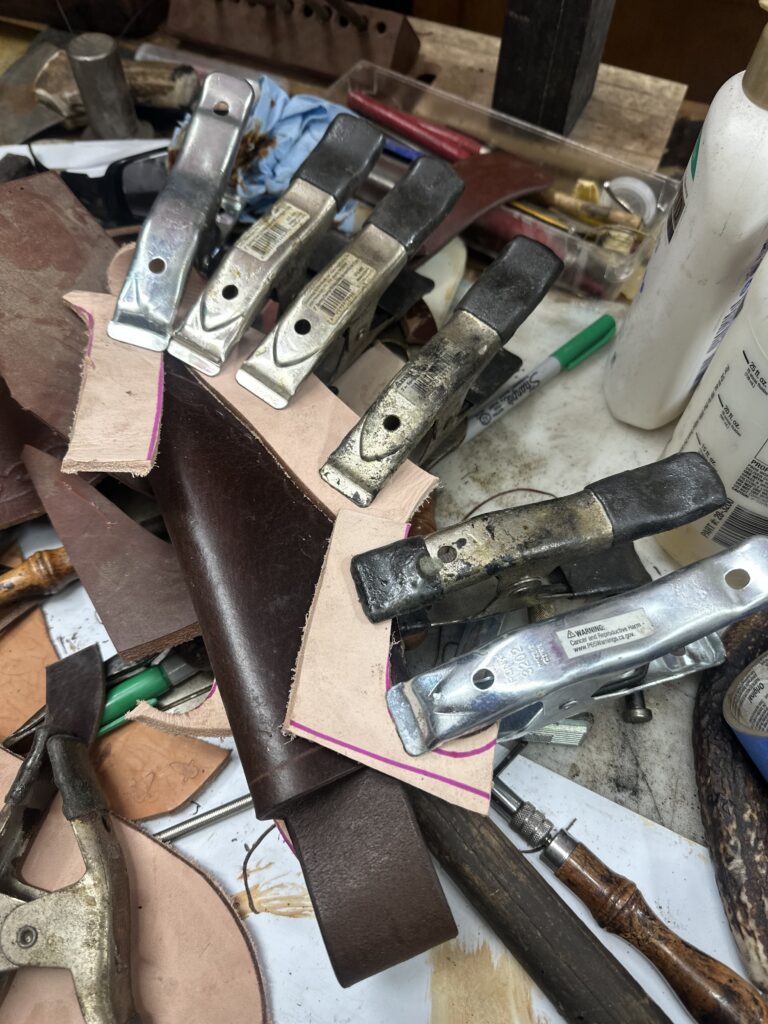
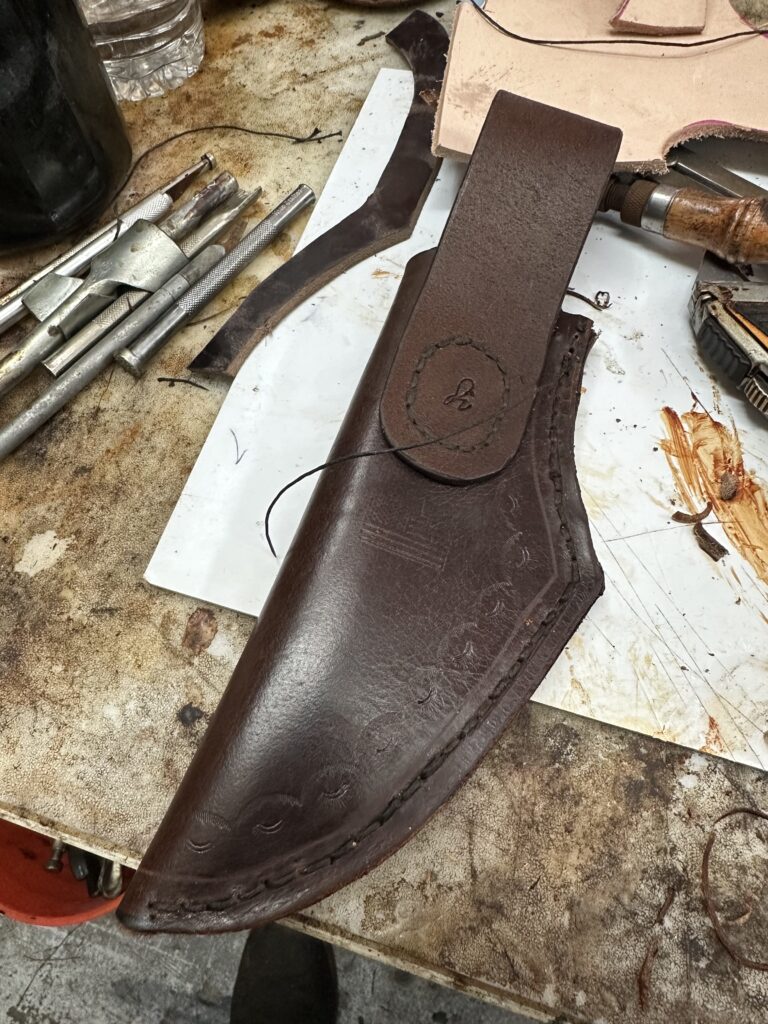
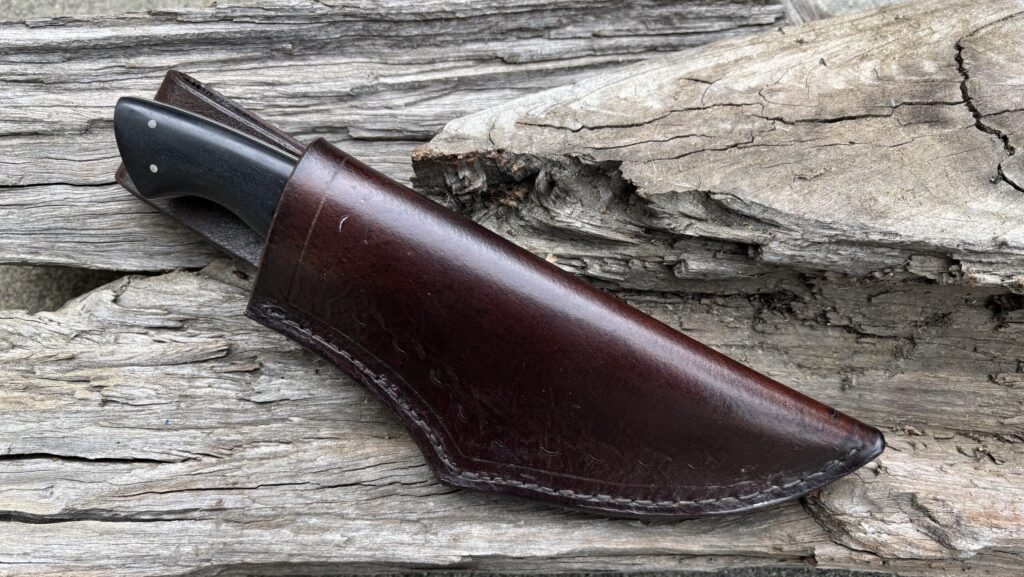
Rick’s vintage Randall harness stitcher would normally be used for the leather sewing tasks, but is being repaired, so . . .. . . he’ll do it the hard way, using a drill press as an awl! Here, the belt loop has been glued to hold it in place for the drilling of the stitching holes. Note the maker’s mark and U.S. Flag stampings in the leather.The welt is glued in place along the edges, and the sheath body is folded and glued. These clamps will hold everything together as it dries overnight. Once the glue is dried, he’ll go back to the drill press to punch all the holes along the edge, for sewing.Here, Rick is hand-sewing the sheath with the aid of his vintage stitching horse. When everything is secured, he’ll smooth, dress, and burnish the edges of the sheath.I didn’t capture a photo of it, but Rick stamped a simple pattern along the border of the sheath before the edges were glued and sewn. you can see it here, along with the maker’s mark and U.S. Flag stamp, on the back of the sheath. Some of the stamps he used for the border scroll are visible on the left side of the work bench.When finished with the assembly, Rick will give the sheath a dip in hot wax to make it more rigid and weatherproof. A quick buff gives it a beautiful shine. This sheath will do an excellent job of protecting and retaining the beautiful knife that will ride inside.Every fixed-blade knife needs a good sheath. This one is a worthy home for the DI Knives custom that it will carry.
Author: Mike
Mike is a bonafide revolver nut, and the Senior Editor at RevolverGuy.com. Mike's a retired Air Force pilot and a CA POST-certified law enforcement instructor, who regularly teaches classes for LE students throughout the state, and classes for armed citizens as well. Mike's the author of Newhall Shooting: A Tactical Analysis, the definitive study of the infamous, 1970 California Highway Patrol shootout in Newhall, California, and previously wrote the "Tactical Analysis" column at Police1.com for 8 years. He enjoys teaching, writing, and partnering with friends in the gun industry to both improve existing products, and create new ones for RevolverGuys to enjoy. He's grateful to have met so many great people through his writing and work in the industry, and appreciates the loyalty, interest, and participation of the RevolverGuy audience.
View all posts by Mike
10 thoughts on “DI Knives Leatherwork”
You are correct Sir! At least with this Revolver Guy, I am a Knife Guy too! A knife is daily carry along with my revolver. That Damascus blade is a beauty and his work is amazing! Thank you for sharing it with us!
This is a good primer on making sturdy knife sheaths , and one that reveals a few missing steps concerning my own modest efforts.
For many decades following WWII with the glut of surplus military knives on the market, there were few custom knives and sheaths available. Fortunately nowadays many quality US-made knives, custom and production, exist to fit just about any budget.
Most knife owners would benefit by learning how to properly care for and sharpen their knives by using stones, diamond hones and leather strops–and avoiding bench grinders that chew up and eventually ruin blades. Many videos and instructions on knife care are available online.
I have to admit I’ve been cheating for years with a set of ceramic sticks. They’re good enough for my working knives, but I’d surely get struck down by lightning if I ever tried to sharpen a custom knife like one of Rick’s using that system!
Ceramic sticks work quite well, though they seem to remove a little more metal than natural stones or diamond hones. A sharpening steel rod (with no nicks on the shaft) does a good job too. It’s not necessary to “white knuckle” the knife blades on these tools to achieve a good edge.
Avoid creating a razor knife edge as that will dull quickly with use. The most durable and functional knife edges have a “little tooth” to them, that is, mini serrations. Think of the edge as a tiny sawblade.
The artistry in Damascus is not as much the layering of the steel, but how the layering pattern shows up in the finished product. It is as much of an art as a Hamilton Bowen custom Blackhawk.
Leather sheath and holster making is more or less divided into two main camps. Mass production, machine cut and sewn such as Bianchi, DeSantis, Galco, and others; the other camp is the one-at-a-time hand made. Having spent a good bit of time at Andrews Custom Leather in St. Augustine, FL, and watching Sam Andrews cut out each holster blank, and the steps to the finished product, I am continually amazed at the hand crafted attention to detail. If you watch the remake of the Magnificent Seven with Denzel Washington, you’ll notice the high end leather – all made by Sam Andrews.
Then again, I’m partial to deceased bovine epidermis because I have gun leather from Sam that’s 30 years old and still being worn daily. I suspect my wife will have me buried with them as well.
Mr. Elm goes to a lot more trouble than I do to make a sheath for a knife. I just stick the knife in a cardboard toilet=paper-roll core, mash it flat, duct tape the end, and I’m done. For longer knives, I tape two cores together (duct tape is your friend).
It’s always fascinating to watch a craftsman at work, and Mr. Elm is certainly a craftsman.
It’s kind of unfair that one guy has enough artistry and talent to make beautiful Damascus knives and the sheaths for them too. Us poor untalented (and ungrammatical) slugs need love, too!
Like s.bond, I’m partial to holsters and sheaths made from deceased farm animals; I find them more comfortable, more visually appealing, and just all-around more satisfying than man-made materials like Kydex or nylon.
Thank you for giving us (me) this detour from your usual content. It’s why I haunt your website; there’s always something new and interesting here.
I’m glad you enjoyed the detour! Rick is really talented, and always amazes me. The whole process of making his own steels and shaping them into blades strikes me as a mix of art, science, and alchemy.
If I get used to taking detours, there’s no telling where we’ll end up, so you probably shouldn’t encourage me too much. 😁

You are correct Sir! At least with this Revolver Guy, I am a Knife Guy too! A knife is daily carry along with my revolver. That Damascus blade is a beauty and his work is amazing! Thank you for sharing it with us!
He’s a real artist, Mark. The Damascus is even better looking in person! Glad you enjoyed it.
This is a good primer on making sturdy knife sheaths , and one that reveals a few missing steps concerning my own modest efforts.
For many decades following WWII with the glut of surplus military knives on the market, there were few custom knives and sheaths available. Fortunately nowadays many quality US-made knives, custom and production, exist to fit just about any budget.
Most knife owners would benefit by learning how to properly care for and sharpen their knives by using stones, diamond hones and leather strops–and avoiding bench grinders that chew up and eventually ruin blades. Many videos and instructions on knife care are available online.
I have to admit I’ve been cheating for years with a set of ceramic sticks. They’re good enough for my working knives, but I’d surely get struck down by lightning if I ever tried to sharpen a custom knife like one of Rick’s using that system!
Ceramic sticks work quite well, though they seem to remove a little more metal than natural stones or diamond hones. A sharpening steel rod (with no nicks on the shaft) does a good job too. It’s not necessary to “white knuckle” the knife blades on these tools to achieve a good edge.
Avoid creating a razor knife edge as that will dull quickly with use. The most durable and functional knife edges have a “little tooth” to them, that is, mini serrations. Think of the edge as a tiny sawblade.
The artistry in Damascus is not as much the layering of the steel, but how the layering pattern shows up in the finished product. It is as much of an art as a Hamilton Bowen custom Blackhawk.
Leather sheath and holster making is more or less divided into two main camps. Mass production, machine cut and sewn such as Bianchi, DeSantis, Galco, and others; the other camp is the one-at-a-time hand made. Having spent a good bit of time at Andrews Custom Leather in St. Augustine, FL, and watching Sam Andrews cut out each holster blank, and the steps to the finished product, I am continually amazed at the hand crafted attention to detail. If you watch the remake of the Magnificent Seven with Denzel Washington, you’ll notice the high end leather – all made by Sam Andrews.
Then again, I’m partial to deceased bovine epidermis because I have gun leather from Sam that’s 30 years old and still being worn daily. I suspect my wife will have me buried with them as well.
Sam’s leatherwork is top notch! We need to revisit him again.
Mr. Elm goes to a lot more trouble than I do to make a sheath for a knife. I just stick the knife in a cardboard toilet=paper-roll core, mash it flat, duct tape the end, and I’m done. For longer knives, I tape two cores together (duct tape is your friend).
It’s always fascinating to watch a craftsman at work, and Mr. Elm is certainly a craftsman.
It’s kind of unfair that one guy has enough artistry and talent to make beautiful Damascus knives and the sheaths for them too. Us poor untalented (and ungrammatical) slugs need love, too!
Like s.bond, I’m partial to holsters and sheaths made from deceased farm animals; I find them more comfortable, more visually appealing, and just all-around more satisfying than man-made materials like Kydex or nylon.
Thank you for giving us (me) this detour from your usual content. It’s why I haunt your website; there’s always something new and interesting here.
I’m glad you enjoyed the detour! Rick is really talented, and always amazes me. The whole process of making his own steels and shaping them into blades strikes me as a mix of art, science, and alchemy.
If I get used to taking detours, there’s no telling where we’ll end up, so you probably shouldn’t encourage me too much. 😁
Pleasure to see this process, always great to learn something new!