If you’re a RevolverGuy who was born after the turn of the century, you probably missed out on the joys of pouring over a catalog that was printed on paper. There’s no doubt that today’s manufacturers can provide MUCH more information and imagery on their electronic websites, but there was just something special about thumbing through the pages of a worn catalog and letting your mind wander through the daydreams it inspired.
I spent a lot of time with my nose buried in gun catalogs and gun magazines when I was growing up, and I’m fortunate that I was able to hang onto some of them for posterity. Somehow, they survived a series of military moves, water leaks, rat wars, and garage cleanups, and I’m grateful for it.
Beyond their sentimental appeal, they’re great resources for researching company and product history, and documenting specifications and prices. They also give us a snapshot of what the industry and greater gun culture looked like at the time.
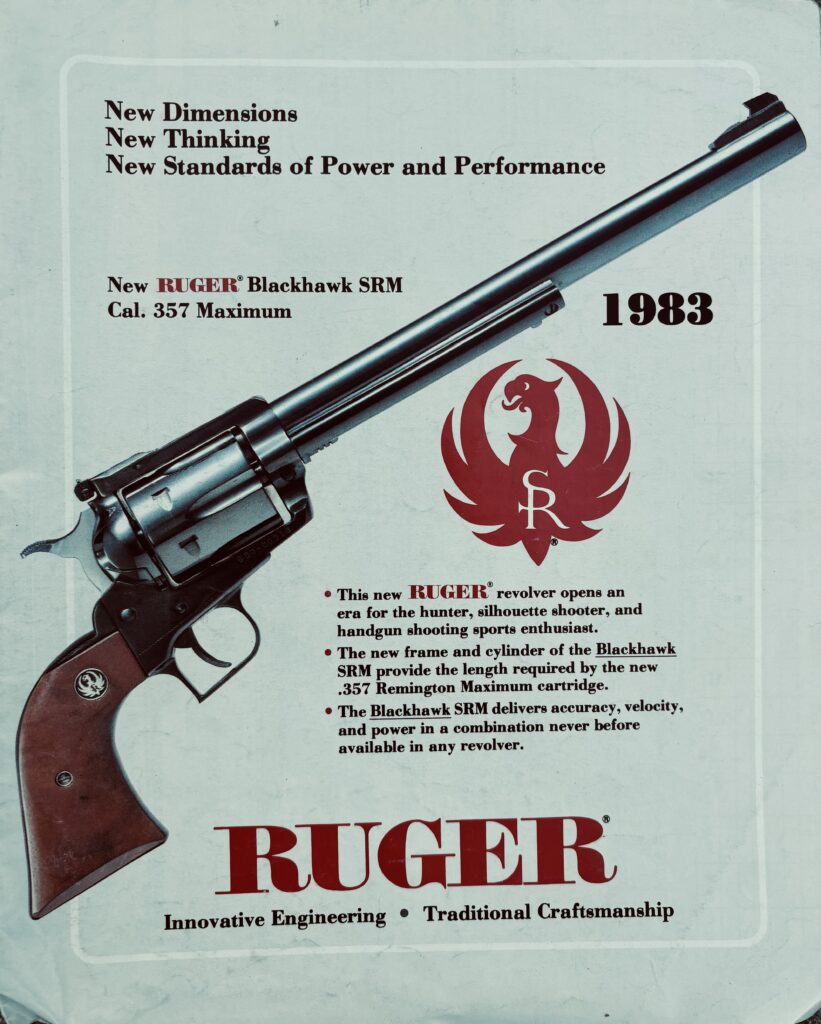
With these thoughts in mind, I thought it might be fun to take a look at the earliest Ruger catalog I managed to preserve. This one’s from 1983, and it offers an interesting contrast to the current lineup of Ruger offerings.
SCALE
The first thing that jumps out at me is how small the catalog is. Ruger didn’t have nearly as many offerings back in 1983 as they do today. Setting aside the handful of long guns and their sole autopistol (the Mark II rimfire), Ruger offered a limited selection of medium and large frame double actions, and small and large frame single actions.
While Ruger offered both blued and stainless models of their revolvers, in a suitable variety of barrel lengths, the list of available SKUs was still pretty limited. A 21st Century RevolverGuy has become accustomed to choosing from a large menu of options (grips, finishes, sights, barrel configurations, cosmetic changes, calibers, etc.), but the 1983 catalog was less “31 Flavors,” and more “Chocolate, Vanilla, or Strawberry.”
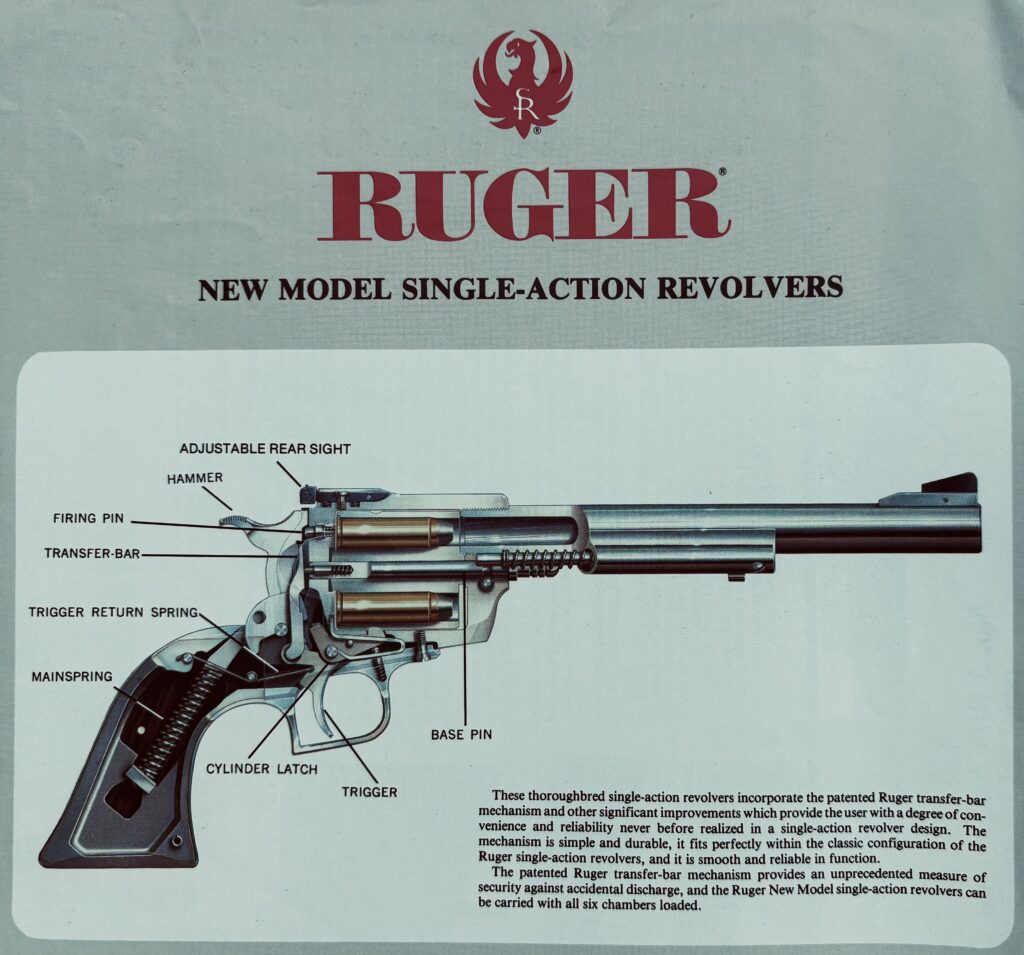
It’s natural for the number of SKUs to multiply over time, as manufacturers cater to smaller and smaller niches, and try to keep buyers interested in buying, but there was something delightfully refreshing about browsing through such a simple catalog. I guess the older I get, the more I appreciate simplicity.
MISSING FRAMES
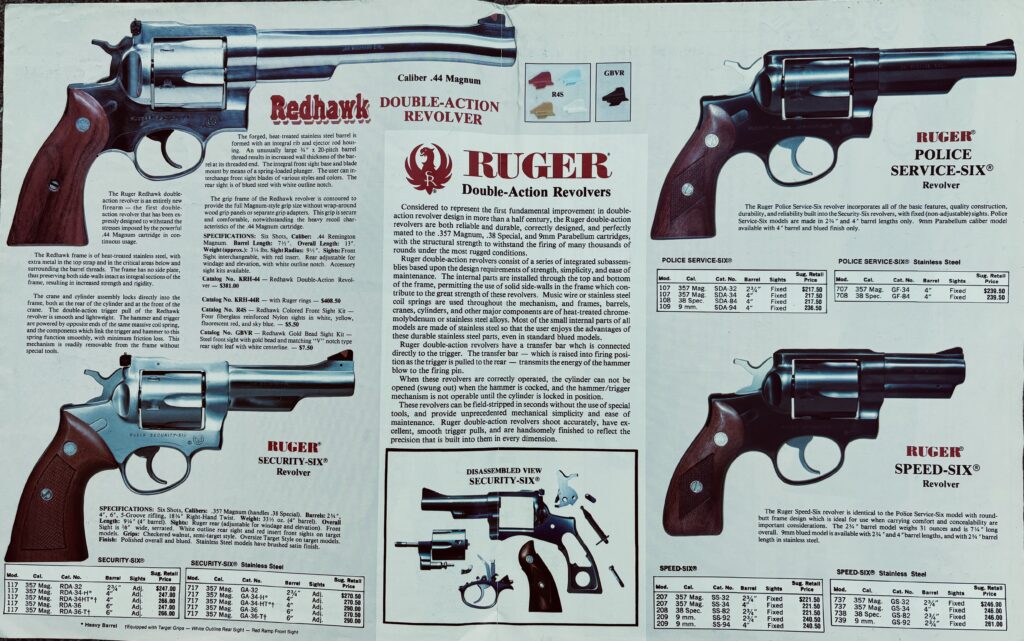
There were no small frame or medium-large frame double actions in the 1983 Ruger catalog, which is particularly interesting, because these guns are the core of their double action catalog today. Regrettably, you can’t find a true medium frame double action in Ruger’s lineup anymore, but the small frame SP101 and LCR, and the medium-large frame GP100, which were nonexistent in the third year of The Gipper’s presidency, totally dominate Ruger’s double action sales now.
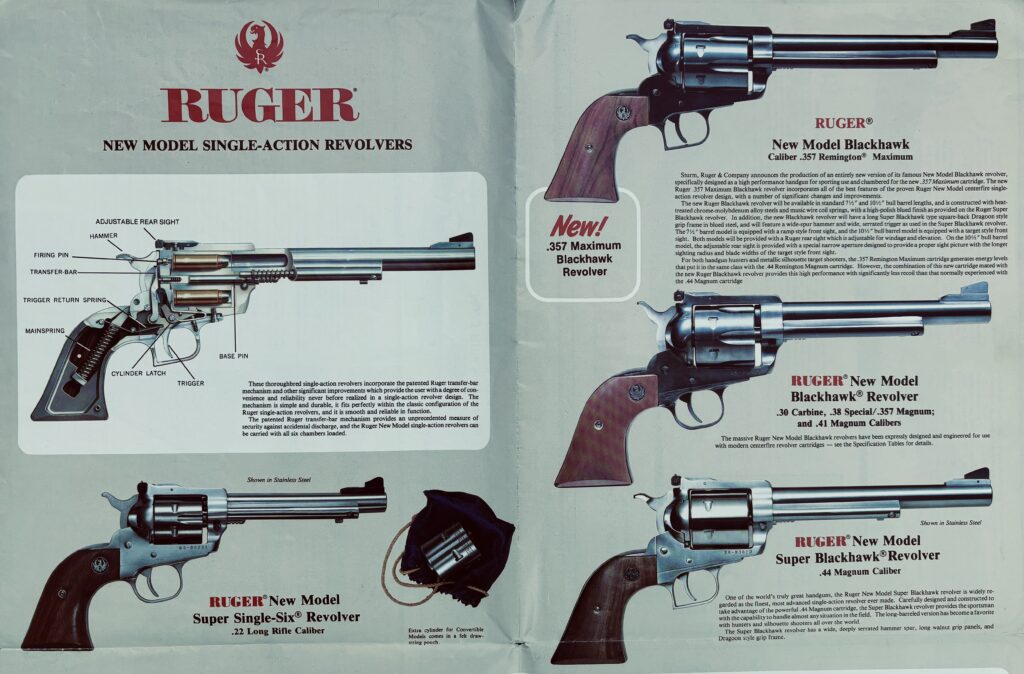
Interestingly, while the medium frame has disappeared from Ruger’s double action catalog in the years since 1983, the opposite happened on the single action side. By 1983, the medium frame “Flat Top” had been gone for a while, and all the Blackhawks–even the .357s– were being made on the large frame. That sad state of affairs was corrected in Ruger’s 50th anniversary year, and RevolverGuys can now find both fixed and adjustable-sighted single action medium frames in the current Ruger catalog, thankfully.
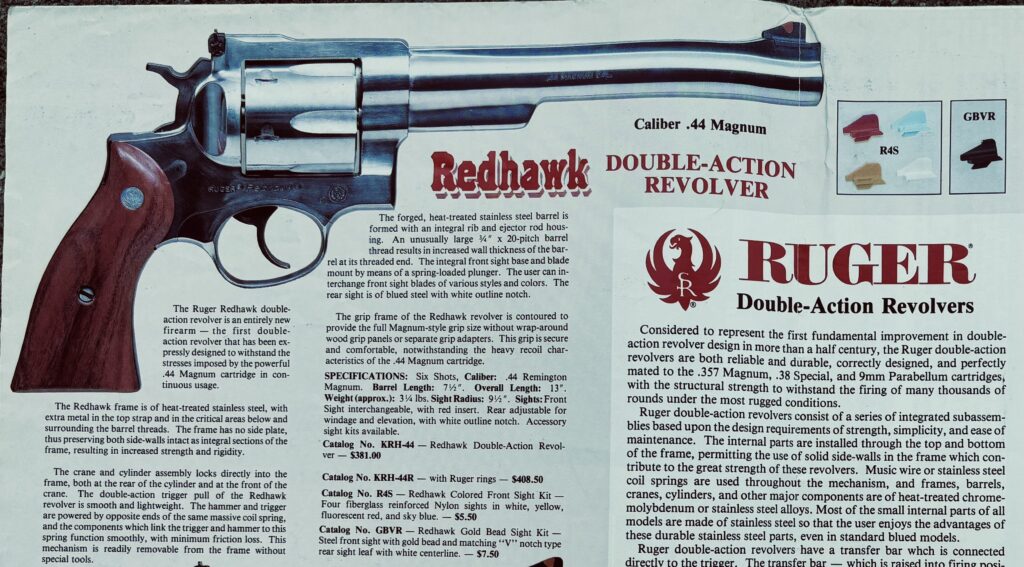
The elegant, but super strong, Redhawk was there in 1983, but the brutish Super Redhawk hadn’t been hatched, quite yet. Things to come.
SMOKEWAGONS
The oft-missed, Ruger Old Army cap and ball revolver was still around back when Steve Harris’ galloping bass lines first had me mesmerized and banging my head with enthusiasm (they still do–Up the Irons!).
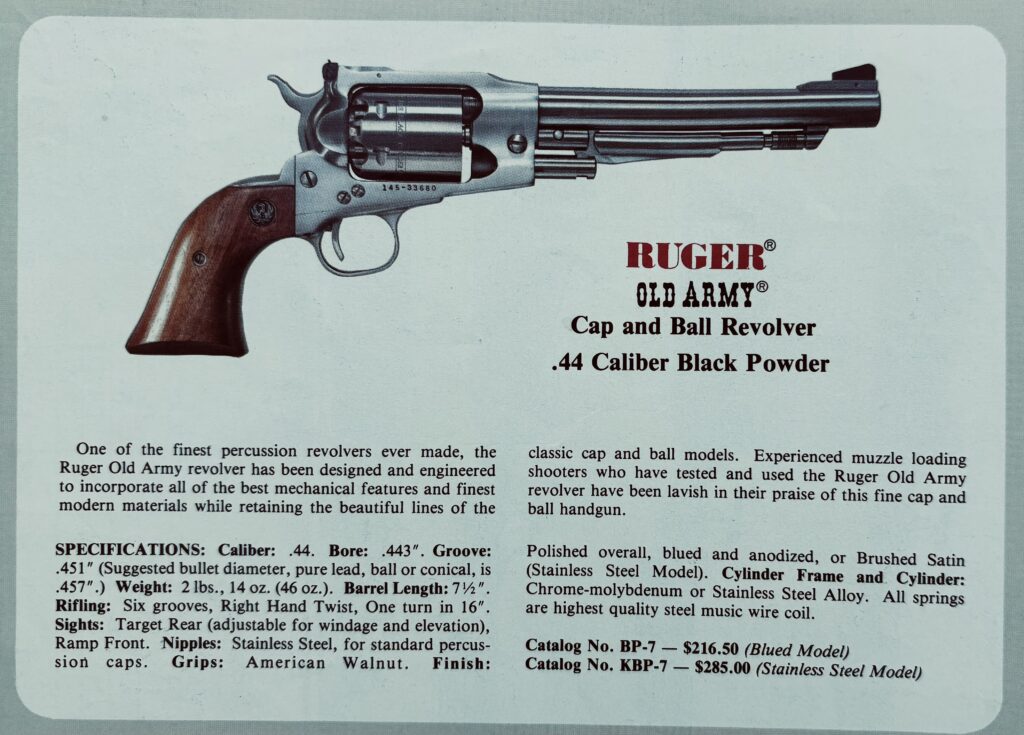
There’s probably never been a better percussion revolver manufactured anywhere, anytime, than the Ruger Old Model. You could get yours in blued or stainless back then, for under $300. You’d be lucky to find a good one for three times that, today, but they’re still worth it.
While I’ve never done much muzzleloading, my interest in it has grown as my “tactical” cup has runneth over, and I think it’s a shame that Ruger got out of the game. I know they wouldn’t sell many of them, and it wouldn’t make any sense to the accountants to invest in bringing them back, but it would be neat to see a percussion gun with the Ruger logo on it again, someday. It seems like a natural fit for the classic brand.
CALIBERS
With the plethora of calibers available to us now, 1983’s selection looks pretty meager. The venerable .45 Colt isn’t there, nor is the .454 Casull, which was just making its first factory appearance in the wonderful Freedom Arms revolvers that year (Ruger wouldn’t add the Casull to the catalog until 1997).
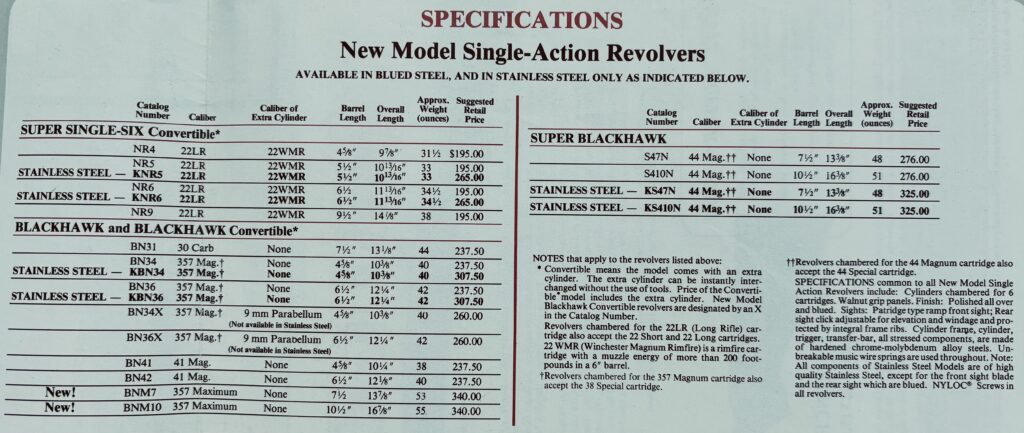
The mild .32 H&R Magnum wouldn’t show up on the scene until the following year, and its obnoxious big brother, the .327 Federal Magnum, was still 25 years away. Ruger’s own namesake big bore, the .480 Ruger, was also two decades from being a reality.
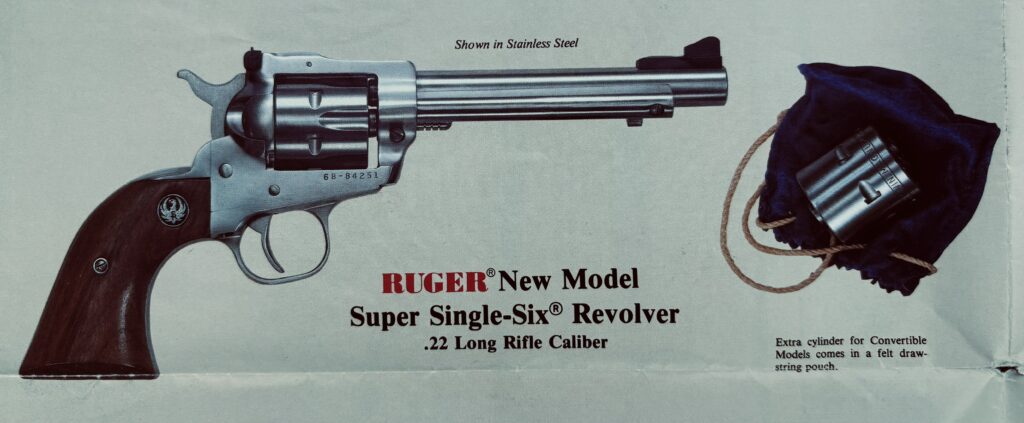
But everything I’ve ever needed was there in 1983. A .22 LR for fun and economical training, a .22 Magnum for small game, a .38 Special / .357 Magnum for duty, and a .41 Magnum for hunting (or a .44 Magnum, for you overachievers). The only thing I’d really miss is the .45 Colt, but Ruger would fix that soon, when the Cowboy Action games really took off.
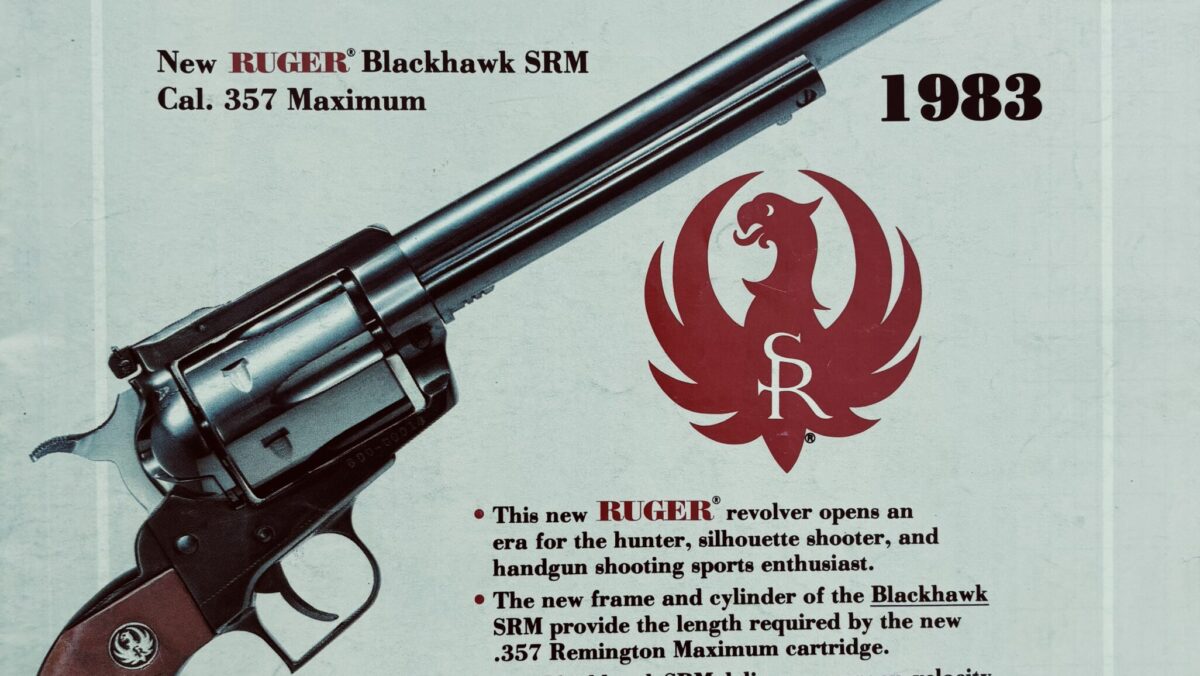
Of interest, 1983 was the introductory year for the .357 Remington Maximum cartridge, jointly designed with Big Green. Elgin Gates’ wildcat went mainstream with a case that was 0.300″ longer than the .357 Magnum’s, and threw its slugs many hundreds of feet faster. It was immediately popular with the metallic silhouette shooters, but the cartridge developed a reputation for flame cutting the frame and didn’t last very long. The .357 Maximum’s ballistics live on, however, in newer, straight-wall rifle cartridges like Remington’s .360 Buckhammer and Winchester’s .350 Legend.
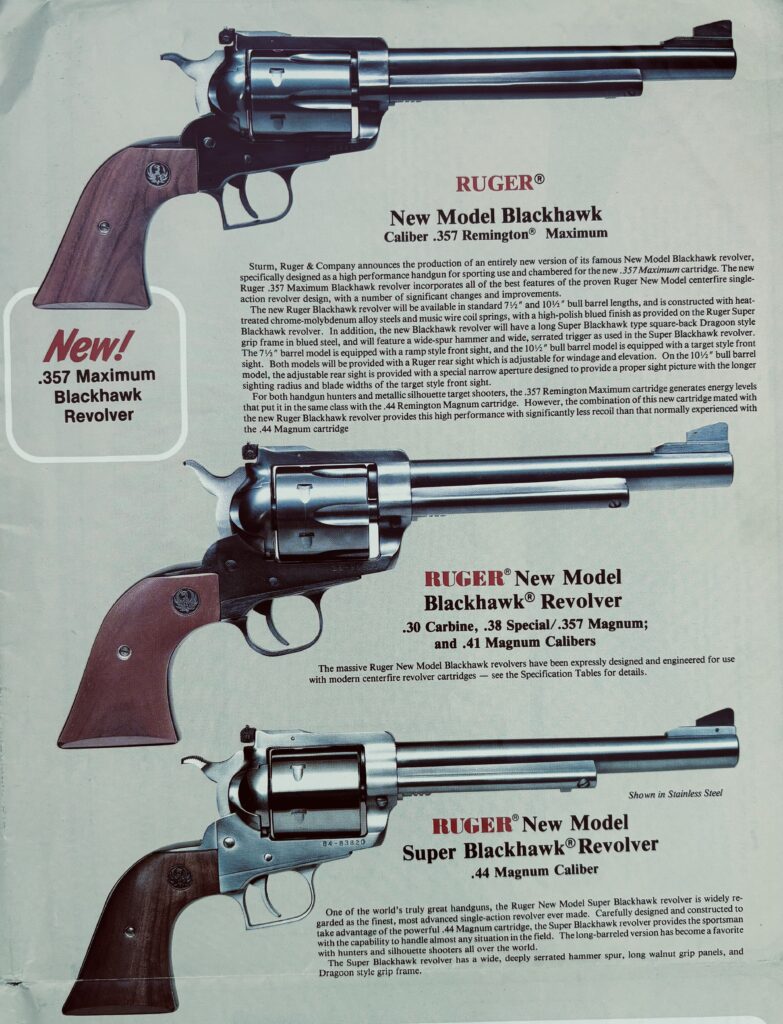
Sharp-eyed readers will see the .30 Carbine Blackhawk in the 1983 catalog as well. I’ve never fired one of these, but understand they REALLY barked. In an era when .30 Carbine ammo is no longer plentiful and cheap, I don’t think this chambering is missed by many.
THOSE WONDERFUL SIXES
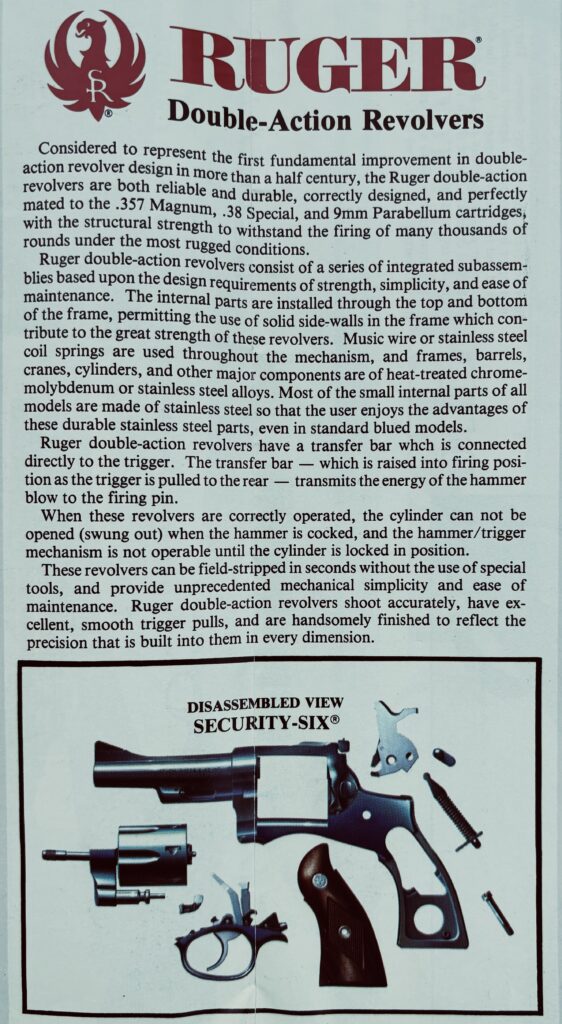
The biggest regret I have, when reading through the 1983 catalog, is that I didn’t buy a 2-3/4″ Speed Six and a 4″ Security Six when they were readily available. While my first handgun was a Ruger (New Model Single Six), I was much more interested in the Colt and S&W double actions back then, and kinda overlooked the rugged medium frames from Ruger. I knew they were there, and recognized they were durable, affordable, and reliable, but was more smitten with the offerings from Springfield and Hartford.
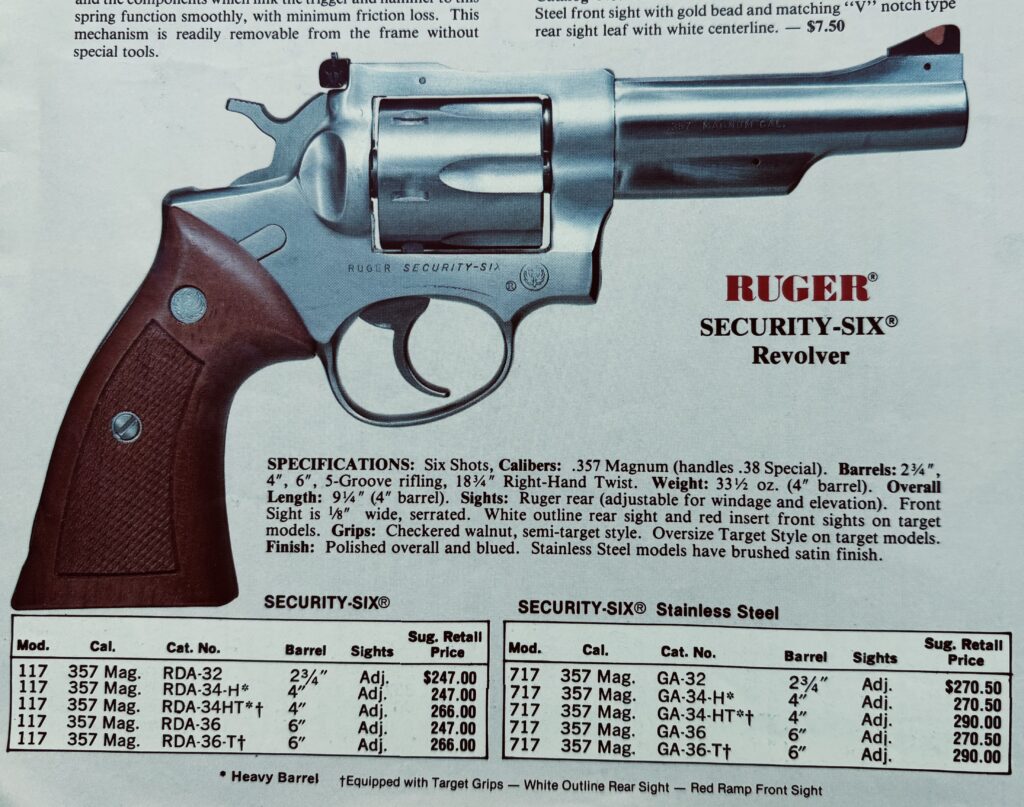
As the saying goes, you don’t know what you got ’til it’s gone, and that applies doubly for the Ruger Sixes. In time, I’d come to understand that the Smith & Wesson medium frames weren’t nearly as strong as the Ruger medium frames, which gave the Ruger’s their own special appeal, even if they weren’t as sexy.
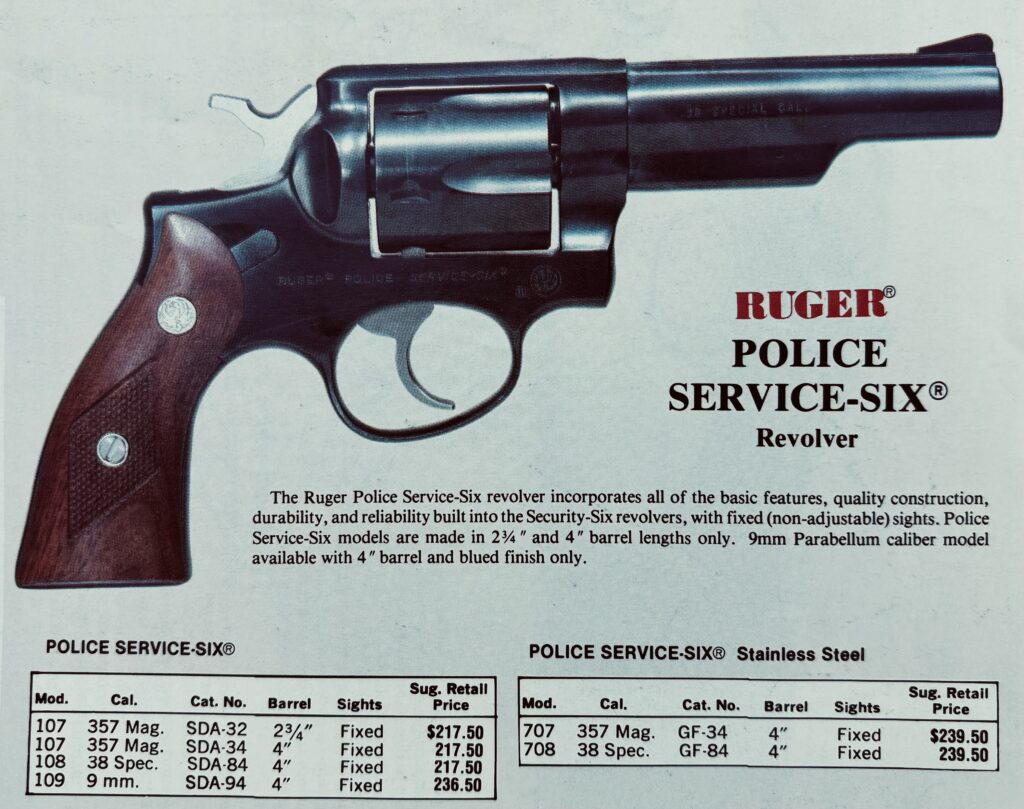
We all celebrated the strength and “shootability” of the medium-large GP100 when it rose to challenge the Smith & Wesson L-frame a few years later, in 1985, but we overlooked the superior portability of the guns they replaced. Ruger makes some abbreviated GP100s for carry, these days, but there’s no comparison between them and the departed Sixes. Give me a 2-3/4″ Speed Six over a Wiley Clapp GP100 any day of the week! I’d rather carry a 4″ Security Six over a 4″ GP100 as well–it would take anything I’d care to shoot through it, but would save me 7 ounces on the hip and handle more nimbly.
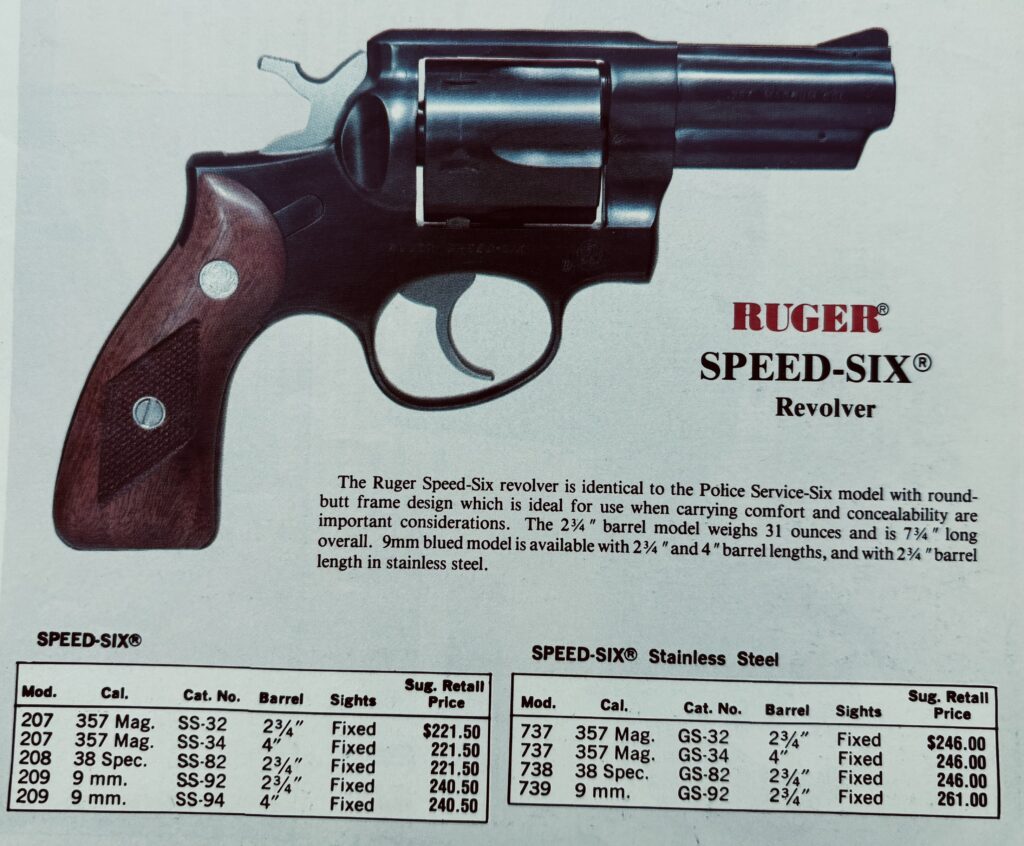
The Six-series tools and machinery were sold to the French after the GP100 was introduced, which allowed them to produce the Manurhin MR88 / Special Police F1 for their domestic commercial and police markets. We’ll never see the classic Sixes come back in their original form, but I still hope we’ll see an updated, medium frame “Six” from Ruger someday. A stretched SP101 would be just the ticket, but I suspect a “Six 2.0” would look more like a stretched LCR design, from a materials and design standpoint (I just hope it’s more handsome).
ON BALANCE
I miss some of the older guns from the 1983 catalog, but I do have to admit there’s a lot to appreciate in today’s Ruger lineup. Even at the height of my nostalgia, I’m not sure I’d be willing to make a wholesale trade of the new catalog for the old, but I’d sure like to see a few comebacks from the previous era. I’d also like to see Ruger get back to building them as well as they used to, but that’s another story.
The biggest gap in today’s Ruger revolver catalog is a true medium frame double action, and I’d like to see them fix that. Frankly, though, the company is much more focused on developing the long guns and autopistols that make up the majority of their sales (about 10X and 3.5X, respectively, compared to their revolver sales), so I won’t hold my breath. From a business perspective, that makes sense, but as one of the faithful, I’ll continue to lobby for the revolvers that define the Ruger label. Tilting at windmills, you know . . .
The way I see it, there’s no shortage of companies that can sell me an autopistol or rifle, but there’s darned few who can sell me a good revolver. The 1983 catalog might be a wrinkled memory for most, but some of us still remember, and hope the 80s will make a comeback someday.

I’d be grateful if Ruger brought back the quality of their firearms made circa 1983, plus their medium-frame Six line. One of my biggest regrets is selling my late 70s, stainless 4-inch .357 Magnum Security Six for reasons I can no longer recall, though probably foolish reasons.
Regarding Ruger quality, it appears that Ruger let that slide with the passing of Bill Ruger, Sr. in the early 2000s. Yet I remain hopeful that Ruger Firearms will turn over a new leaf and produce guns like it did more than 40 years ago. My newish Marlin SBL lever-action rifle demonstrates that Ruger can make the good stuff of yore if it wants to.
Alas, that trip down memory lane. I have a few ads even older than that (by about 15 years). As a kid in the late 1960s, Ruger’s offerings were slim, but to me, they oozed of strength, simplicity, and the ability to take a beating. Super Single Six Convertible, .357 Blackhawk Coonvertible, 10/22 Carbine, and a Mk 1 .22 autoloader. One felt like they were ready for anything.
I look at my S&W M66 clan and while asthetically svelte, they can’t hold a candle to Ruger’s Six series revolvers in terms of strengh and durability. I had to send one GP 100 back to Ruger due to timing issues in the very early 1990s after years of shooting IPSC with a duty rig and uber full power .357 loads (to make major class). They were built like tanks, and I was always surprised more police departments didn’t issue them. I’m not fond of the underlug, but it is what it is.
I will admit that my two GP-100 revolvers (4″ and 3″ stainless) have digested more heavy .357 rounds than my S&Ws will ever dream about. Even my .357 Blackhawk has served as my load testing over the decades, having shot loads out of it that I wouldn’t let near a S&W, even the N-Frame.
As for the .30 Carbine Blackhawk – it is deafening, even with multi layered ear protection. It didn’t stay in the fold long. Never went in for the .41 Magnum, but a slicked up .44 Super Blackhawk is an absolute joy to shoot ! I don’t think Ruger ever gained traction in the centerfire autoloader scene, and I’m still reserved about the RXM, but when it comes to revolvers – nothing beats them IMHO.
I wish Ruger would bring out a true medium frame .357 . . . either upscale the SP101, or slightly shrink down the GP100 . . . a 3″ KP100 would be darn near perfect.
Mike, growing up at the same time as you, this article really struck a chord with me. Speaking of chords, huge respect for the Iron Maiden reference, and for quoting Cinderella lyrics in a gun article!!! Very appropriate for the time frame, and like Ruger’s lineup back then, our music was peerless. I might’ve leaned more towards new wave, but I appreciate your head banging. I cut my teeth on my dad’s single six convertible and fired my first centerfire rounds (148 gr. wadcutters) through his 4″ blued Security Six. One of the first revolvers I acquired on my own was a New Model Blackhawk in .45 Colt shortly after they became available. My memories are infused with Ruger firearms from that era. It was a treat to peruse those old print catalogs and dream! It’s funny how forty some years later many of us are pining for the medium frame “Six series” Ruger’s and realizing how good they were. They were very good, as they remain today. Thanks for starting this Saturday off right!
Very interesting read Sir! You brought back so many memories mentioning the New Army cap/ball revolver. I had one as a teenager. It was given to me by an uncle because there was something wrong with it and the hammer would not stay cocked back when you thumbed it back. I had it repaired and fired it some but regretfully, I let it get away from me. I did have the pleasure of carrying it cross drawn on as a “back-up” on a couple of my early deer hunts. Thank you again!
I was about eleven when this catalog came out and remember looking through it again and again. The Security-Sixes had evolved by that point to have the dished RH recoil shield, the red-ramp front sight and white-outline rear, the slightly heavier barrel profile with the sloped ejector rod shroud, and the target stocks with the cutout on the bottom so the serial number could still be read with them on. Probably about the ultimate version of that revolver!
For whatever reason, I also pined after a Speed Six in 9mm (I’d probably just get the .357 today). Ruger’s round-butt grip frame never struck me as being all that different from the square-butt, and I wondered why they didn’t just go with it for all models. With the Speed-Six, you could put on Pachmayr Compacs which were a nice size and decent looking, too. My circa-1980 Security-Six is blued (and currently wears Hogues, which are decent ergonomically but have that ugly hump on the right), but if it were stainless, I’d be tempted to get out the grinder and make the conversion to RB.
Silhouette was THE big thing around us at that time, and Super Blackhawks were in demand–as were Thompson/Center Contenders. I don’t see many of either today!
Thanks for the memories!