If you’re a RevolverGuy who was born after the turn of the century, you probably missed out on the joys of pouring over a catalog that was printed on paper. There’s no doubt that today’s manufacturers can provide MUCH more information and imagery on their electronic websites, but there was just something special about thumbing through the pages of a worn catalog and letting your mind wander through the daydreams it inspired.
I spent a lot of time with my nose buried in gun catalogs and gun magazines when I was growing up, and I’m fortunate that I was able to hang onto some of them for posterity. Somehow, they survived a series of military moves, water leaks, rat wars, and garage cleanups, and I’m grateful for it.
Beyond their sentimental appeal, they’re great resources for researching company and product history, and documenting specifications and prices. They also give us a snapshot of what the industry and greater gun culture looked like at the time.
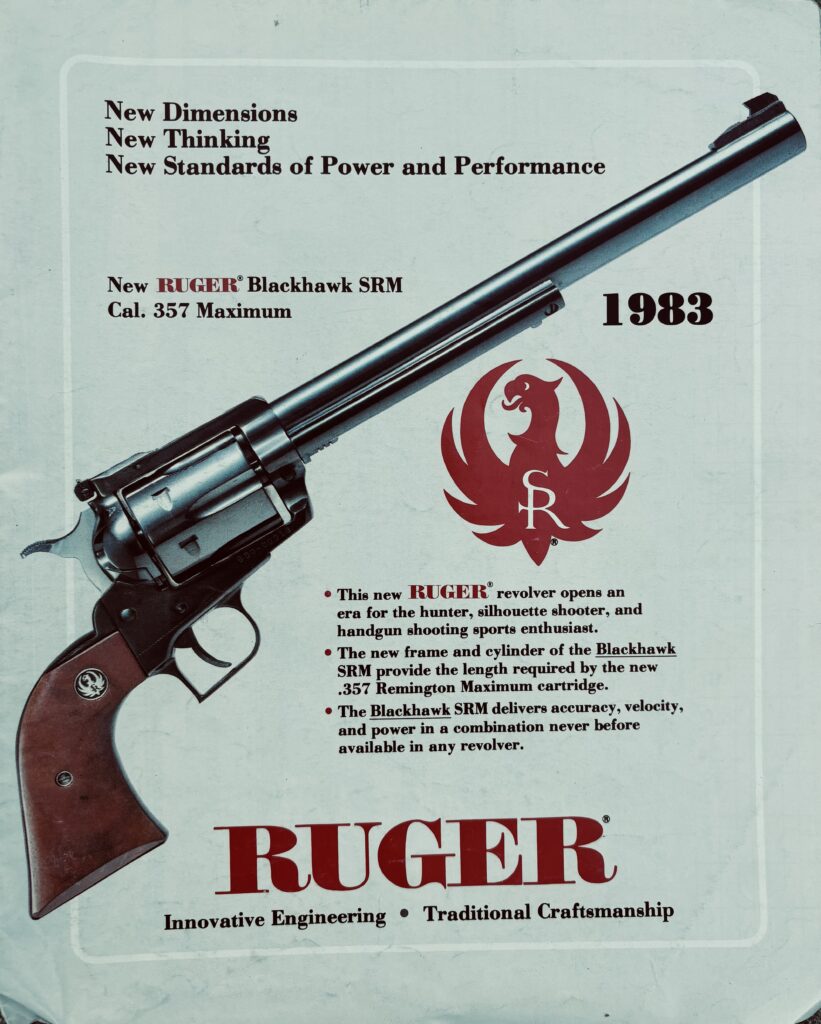
With these thoughts in mind, I thought it might be fun to take a look at the earliest Ruger catalog I managed to preserve. This one’s from 1983, and it offers an interesting contrast to the current lineup of Ruger offerings.
SCALE
The first thing that jumps out at me is how small the catalog is. Ruger didn’t have nearly as many offerings back in 1983 as they do today. Setting aside the handful of long guns and their sole autopistol (the Mark II rimfire), Ruger offered a limited selection of medium and large frame double actions, and small and large frame single actions.
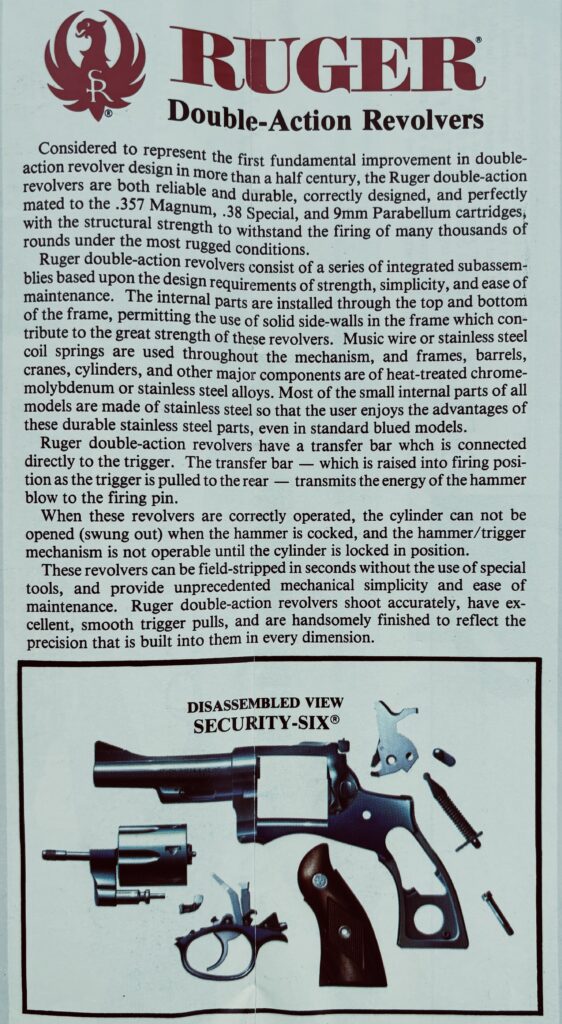
While Ruger offered both blued and stainless models of their revolvers, in a suitable variety of barrel lengths, the list of available SKUs was still pretty limited. A 21st Century RevolverGuy has become accustomed to choosing from a large menu of options (grips, finishes, sights, barrel configurations, cosmetic changes, calibers, etc.), but the 1983 catalog was less “31 Flavors,” and more “Chocolate, Vanilla, or Strawberry.”
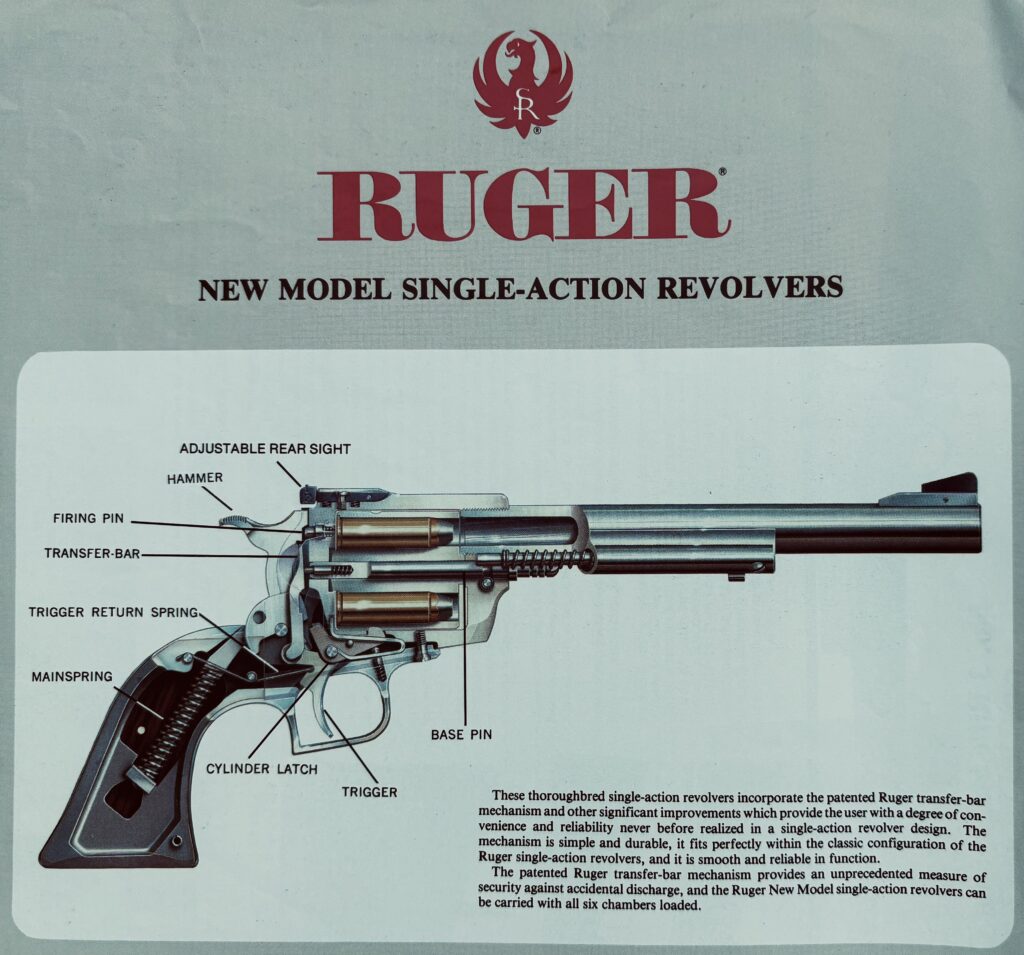
It’s natural for the number of SKUs to multiply over time, as manufacturers cater to smaller and smaller niches, and try to keep buyers interested in buying, but there was something delightfully refreshing about browsing through such a simple catalog. I guess the older I get, the more I appreciate simplicity.
MISSING FRAMES
There were no small frame or medium-large frame double actions in the 1983 Ruger catalog, which is particularly interesting, because these guns are the core of their double action catalog today. Regrettably, you can’t find a true medium frame double action in Ruger’s lineup anymore, but the small frame SP101 and LCR, and the medium-large frame GP100, which were nonexistent in the third year of The Gipper’s presidency, totally dominate Ruger’s double action sales now.
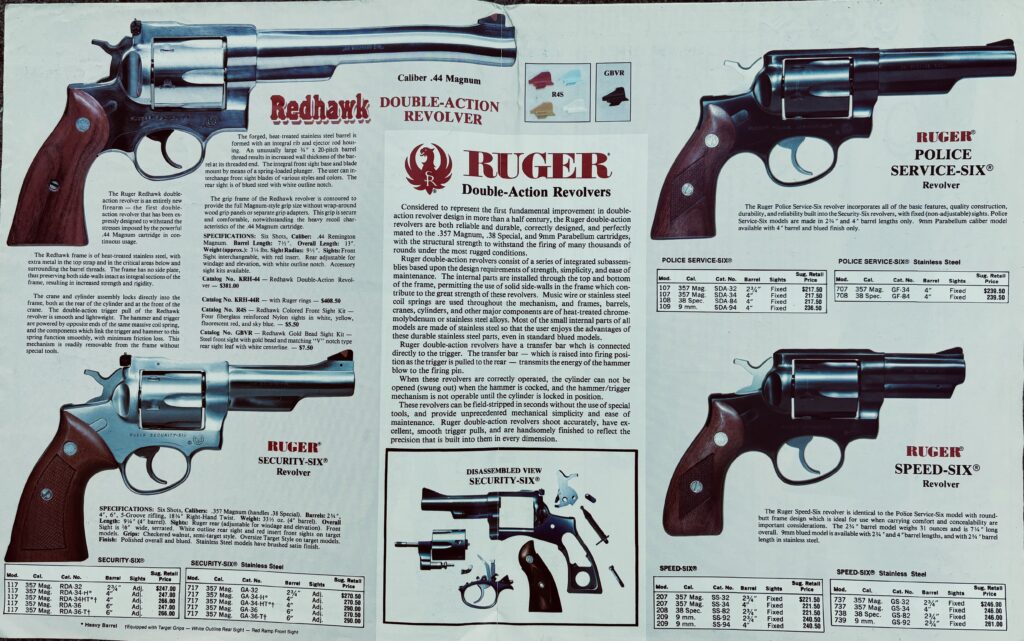
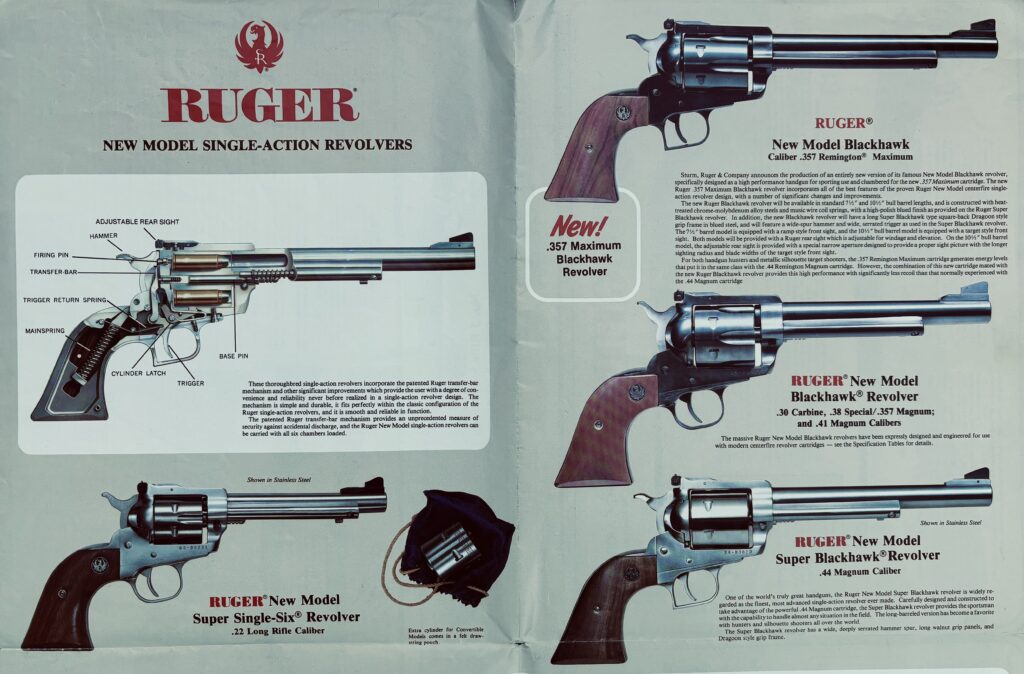
Interestingly, while the medium frame has disappeared from Ruger’s double action catalog in the years since 1983, the opposite happened on the single action side. By 1983, the medium frame “Flat Top” had been gone for a while, and all the Blackhawks–even the .357s– were being made on the large frame. That sad state of affairs was corrected in Ruger’s 50th anniversary year, and RevolverGuys can now find both fixed and adjustable-sighted single action medium frames in the current Ruger catalog, thankfully.
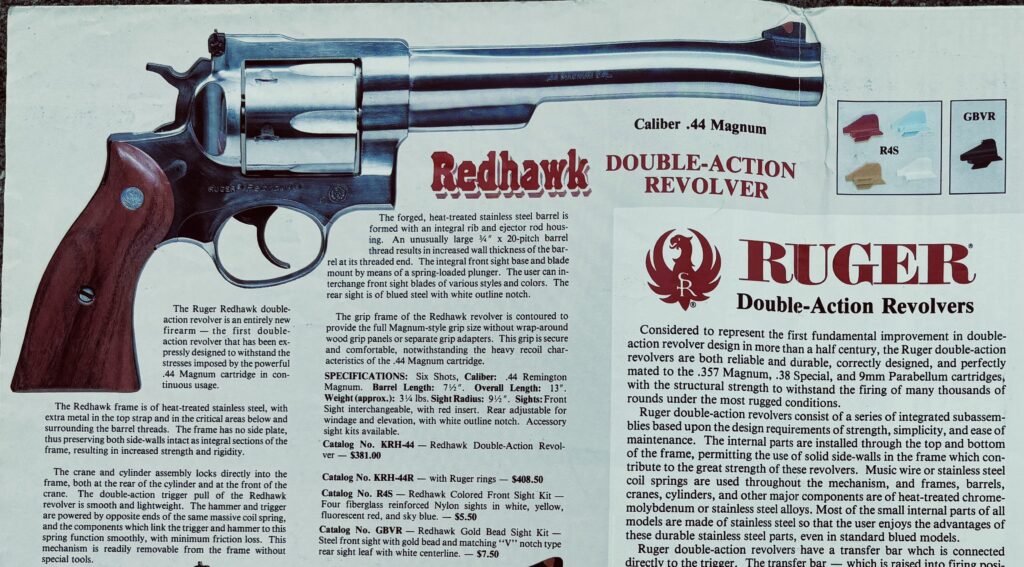
The elegant, but super strong, Redhawk was there in 1983, but the brutish Super Redhawk hadn’t been hatched, quite yet. Things to come.
SMOKEWAGONS
The oft-missed, Ruger Old Army cap and ball revolver was still around back when Steve Harris’ galloping bass lines first had me mesmerized and banging my head with enthusiasm (they still do–Up the Irons!).
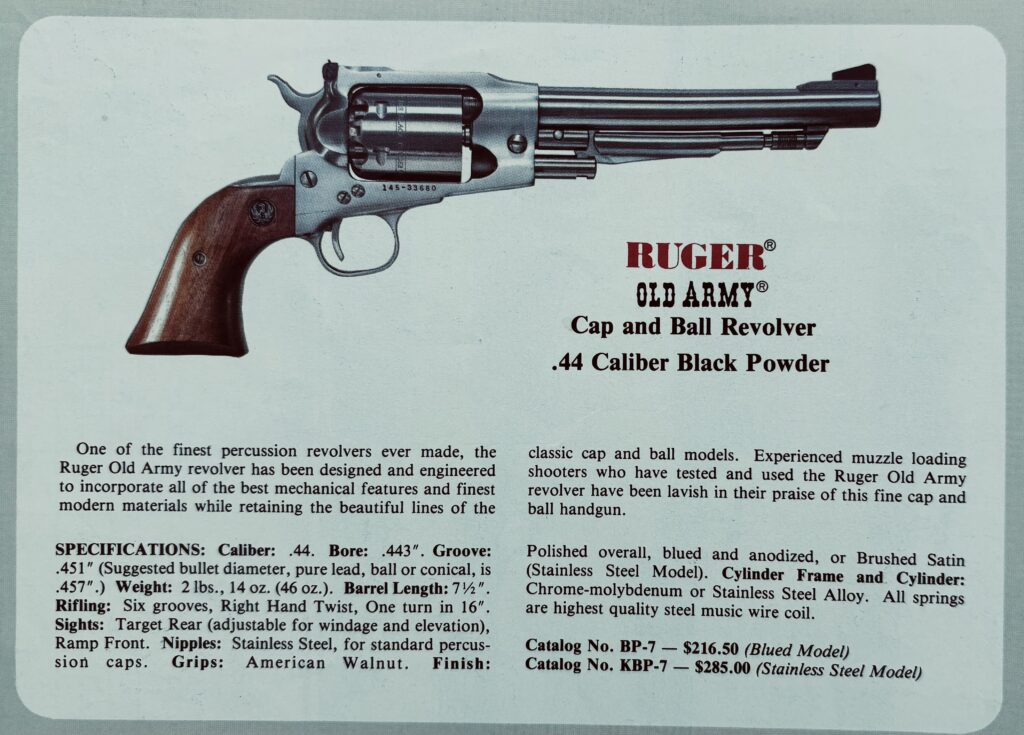
There’s probably never been a better percussion revolver manufactured anywhere, anytime, than the Ruger Old Model. You could get yours in blued or stainless back then, for under $300. You’d be lucky to find a good one for three times that, today, but they’re still worth it.
While I’ve never done much muzzleloading, my interest in it has grown as my “tactical” cup has runneth over, and I think it’s a shame that Ruger got out of the game. I know they wouldn’t sell many of them, and it wouldn’t make any sense to the accountants to invest in bringing them back, but it would be neat to see a percussion gun with the Ruger logo on it again, someday. It seems like a natural fit for the classic brand.
CALIBERS
With the plethora of calibers available to us now, 1983’s selection looks pretty meager. The venerable .45 Colt isn’t there, nor is the .454 Casull, which was just making its first factory appearance in the wonderful Freedom Arms revolvers that year (Ruger wouldn’t add the Casull to the catalog until 1997).
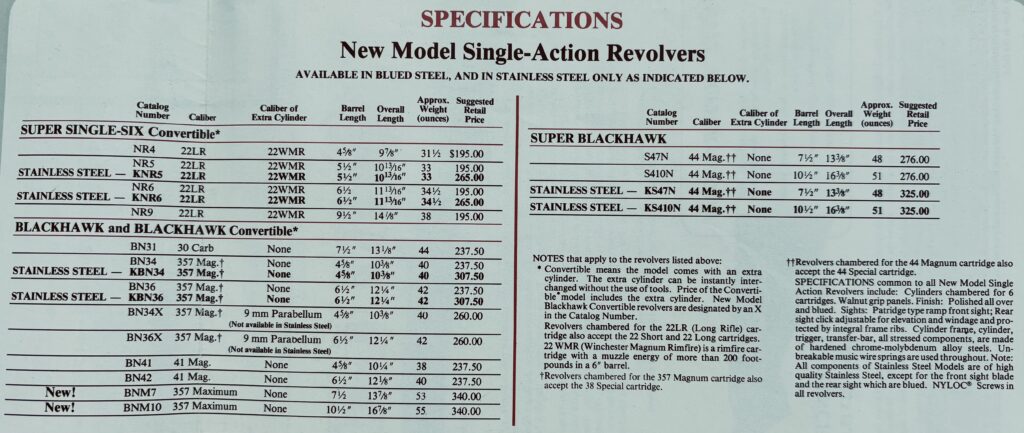
The mild .32 H&R Magnum wouldn’t show up on the scene until the following year, and its obnoxious big brother, the .327 Federal Magnum, was still 25 years away. Ruger’s own namesake big bore, the .480 Ruger, was also two decades from being a reality.
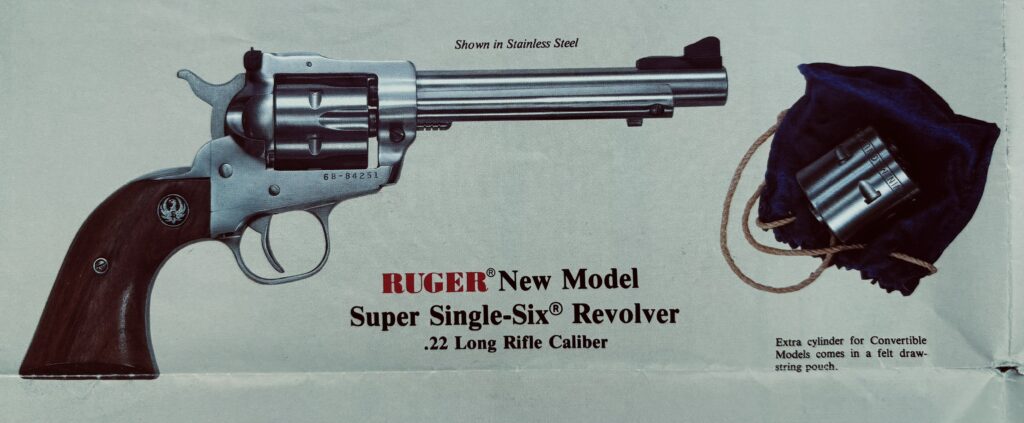
But everything I’ve ever needed was there in 1983. A .22 LR for fun and economical training, a .22 Magnum for small game, a .38 Special / .357 Magnum for duty, and a .41 Magnum for hunting (or a .44 Magnum, for you overachievers). The only thing I’d really miss is the .45 Colt, but Ruger would fix that soon, when the Cowboy Action games really took off.
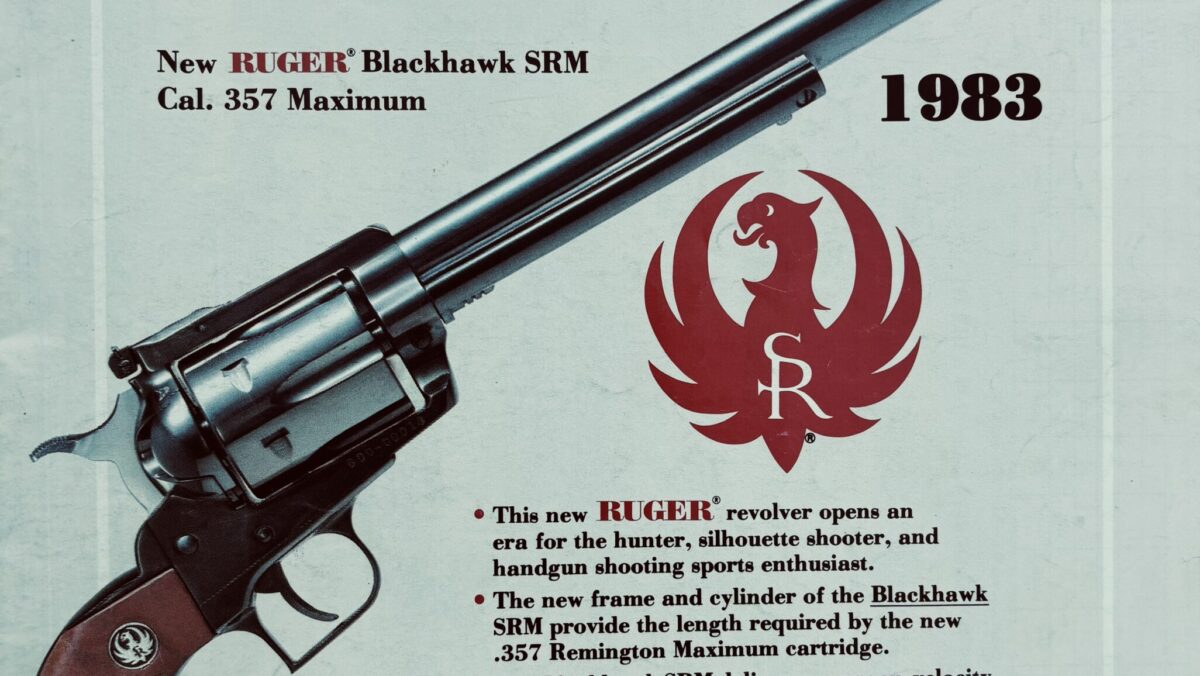
Of interest, 1983 was the introductory year for the .357 Remington Maximum cartridge, jointly designed with Big Green. Elgin Gates’ wildcat went mainstream with a case that was 0.300″ longer than the .357 Magnum’s, and threw its slugs many hundreds of feet faster. It was immediately popular with the metallic silhouette shooters, but the cartridge developed a reputation for flame cutting the frame and didn’t last very long. The .357 Maximum’s ballistics live on, however, in newer, straight-wall rifle cartridges like Remington’s .360 Buckhammer and Winchester’s .350 Legend.
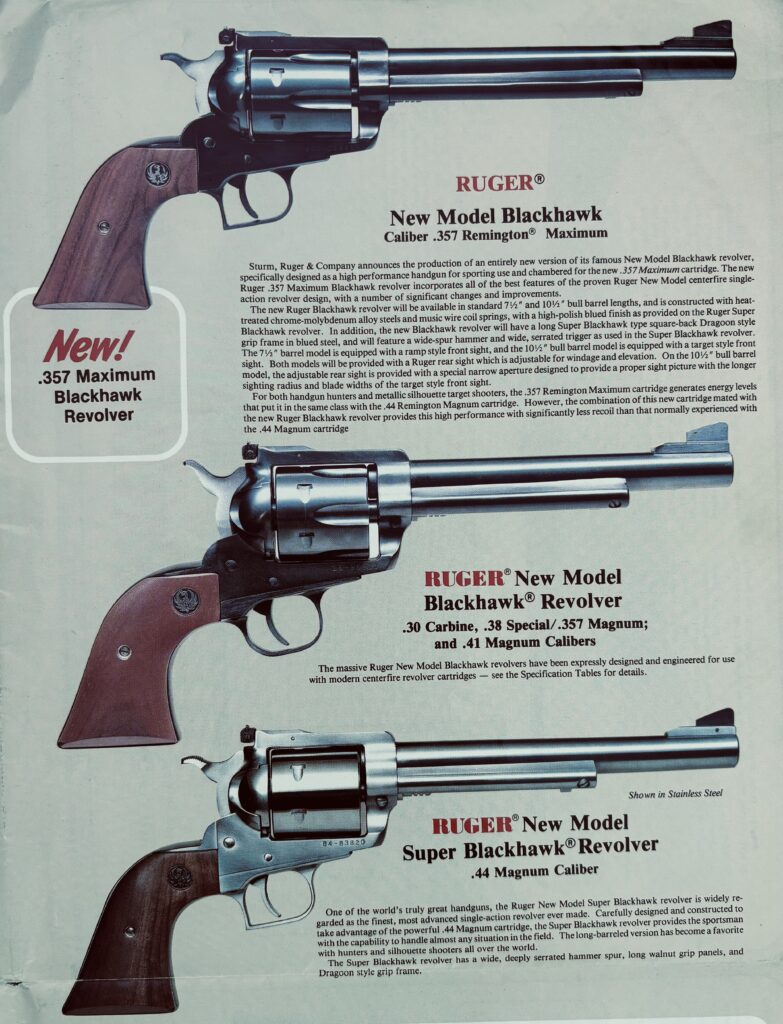
Sharp-eyed readers will see the .30 Carbine Blackhawk in the 1983 catalog as well. I’ve never fired one of these, but understand they REALLY barked. In an era when .30 Carbine ammo is no longer plentiful and cheap, I don’t think this chambering is missed by many.
THOSE WONDERFUL SIXES
The biggest regret I have, when reading through the 1983 catalog, is that I didn’t buy a 2-3/4″ Speed Six and a 4″ Security Six when they were readily available. While my first handgun was a Ruger (New Model Single Six), I was much more interested in the Colt and S&W double actions back then, and kinda overlooked the rugged medium frames from Ruger. I knew they were there, and recognized they were durable, affordable, and reliable, but was more smitten with the offerings from Springfield and Hartford.
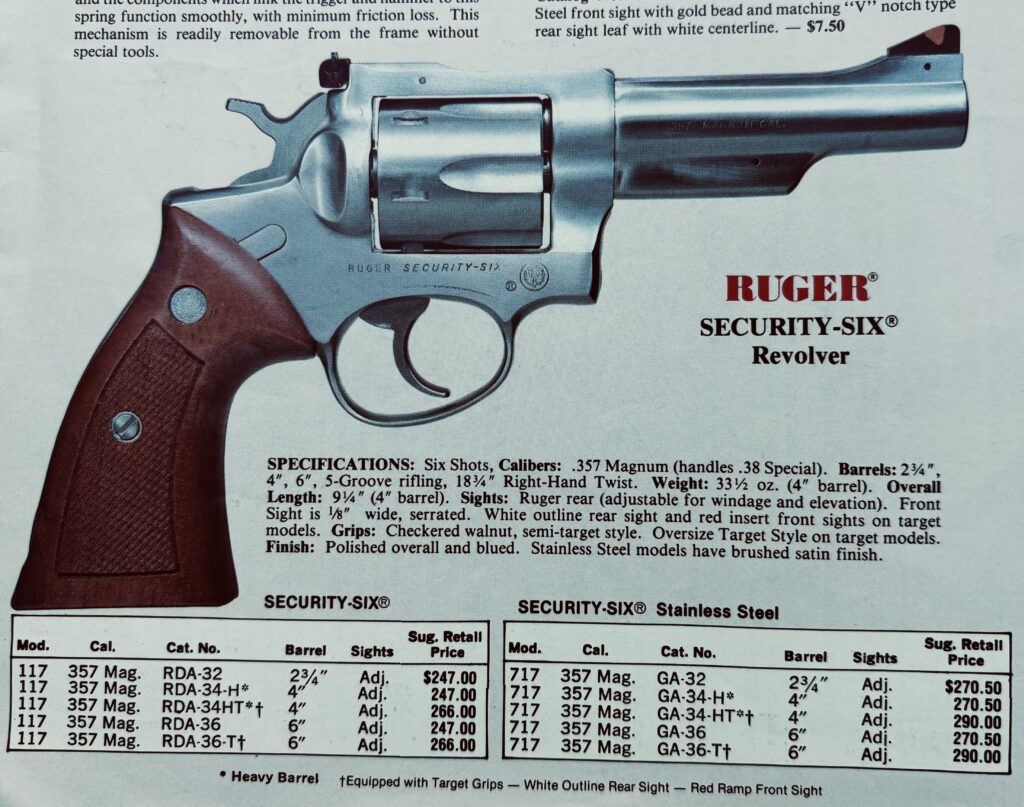
As the saying goes, you don’t know what you got ’til it’s gone, and that applies doubly for the Ruger Sixes. In time, I’d come to understand that the Smith & Wesson medium frames weren’t nearly as strong as the Ruger medium frames, which gave the Ruger’s their own special appeal, even if they weren’t as sexy.
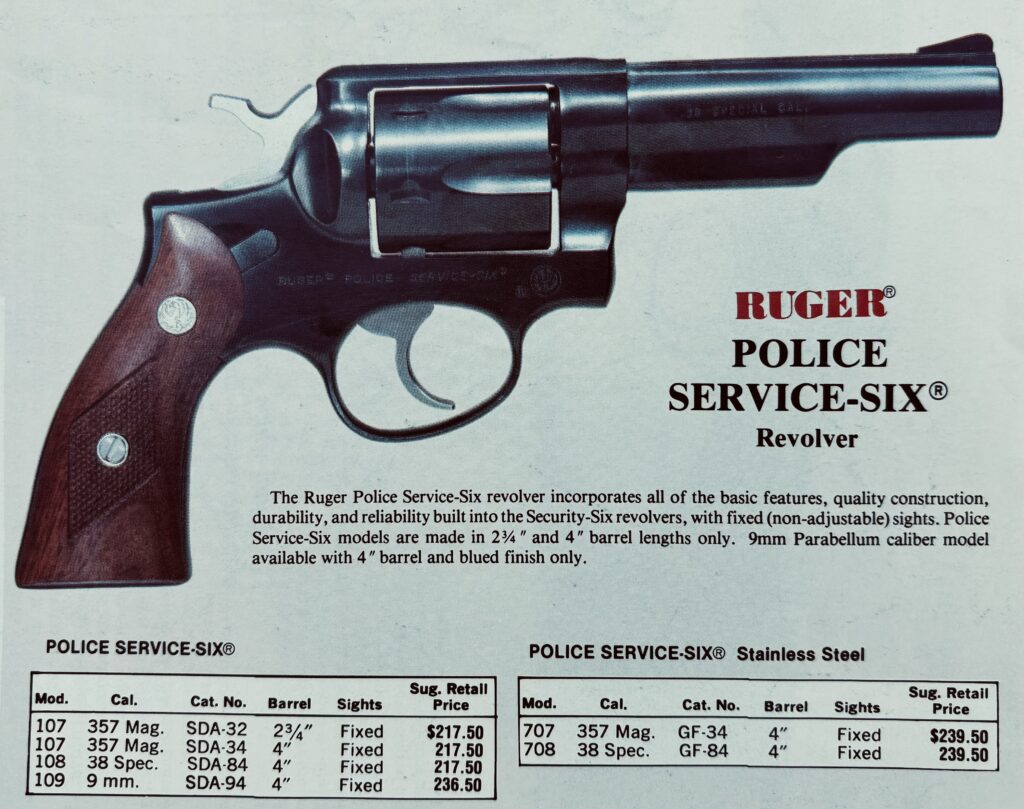
We all celebrated the strength and “shootability” of the medium-large GP100 when it rose to challenge the Smith & Wesson L-frame a few years later, in 1985, but we overlooked the superior portability of the guns they replaced. Ruger makes some abbreviated GP100s for carry, these days, but there’s no comparison between them and the departed Sixes. Give me a 2-3/4″ Speed Six over a Wiley Clapp GP100 any day of the week! I’d rather carry a 4″ Security Six over a 4″ GP100 as well–it would take anything I’d care to shoot through it, but would save me 7 ounces on the hip and handle more nimbly.
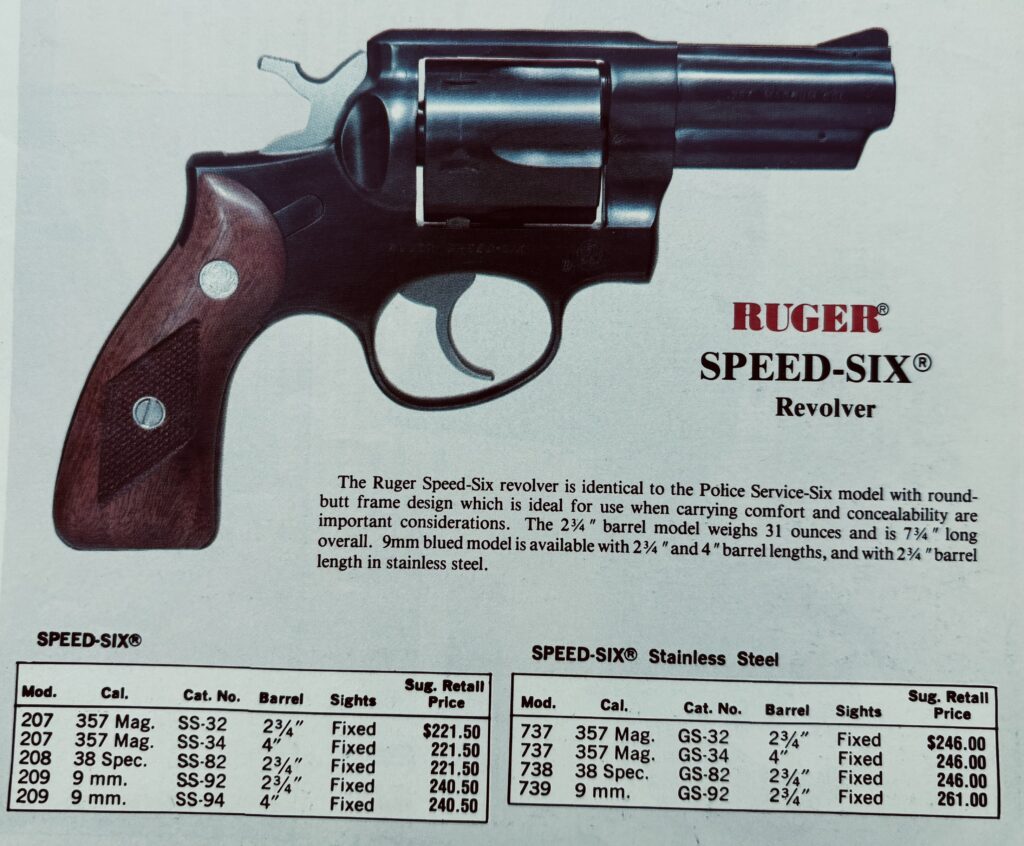
The Six-series tools and machinery were sold to the French after the GP100 was introduced, which allowed them to produce the Manurhin MR88 / Special Police F1 for their domestic commercial and police markets. We’ll never see the classic Sixes come back in their original form, but I still hope we’ll see an updated, medium frame “Six” from Ruger someday. A stretched SP101 would be just the ticket, but I suspect a “Six 2.0” would look more like a stretched LCR design, from a materials and design standpoint (I just hope it’s more handsome).
ON BALANCE
I miss some of the older guns from the 1983 catalog, but I do have to admit there’s a lot to appreciate in today’s Ruger lineup. Even at the height of my nostalgia, I’m not sure I’d be willing to make a wholesale trade of the new catalog for the old, but I’d sure like to see a few comebacks from the previous era. I’d also like to see Ruger get back to building them as well as they used to, but that’s another story.
The biggest gap in today’s Ruger revolver catalog is a true medium frame double action, and I’d like to see them fix that. Frankly, though, the company is much more focused on developing the long guns and autopistols that make up the majority of their sales (about 10X and 3.5X, respectively, compared to their revolver sales), so I won’t hold my breath. From a business perspective, that makes sense, but as one of the faithful, I’ll continue to lobby for the revolvers that define the Ruger label. Tilting at windmills, you know . . .
The way I see it, there’s no shortage of companies that can sell me an autopistol or rifle, but there’s darned few who can sell me a good revolver. The 1983 catalog might be a wrinkled memory for most, but some of us still remember, and hope the 80s will make a comeback someday.

I’d be grateful if Ruger brought back the quality of their firearms made circa 1983, plus their medium-frame Six line. One of my biggest regrets is selling my late 70s, stainless 4-inch .357 Magnum Security Six for reasons I can no longer recall, though probably foolish reasons.
Regarding Ruger quality, it appears that Ruger let that slide with the passing of Bill Ruger, Sr. in the early 2000s. Yet I remain hopeful that Ruger Firearms will turn over a new leaf and produce guns like it did more than 40 years ago. My newish Marlin SBL lever-action rifle demonstrates that Ruger can make the good stuff of yore if it wants to.
I agree, Spencer. The Marlins show us they can still make good guns out of wood and steel. We just need them to turn those skills back towards revolver production.
Alas, that trip down memory lane. I have a few ads even older than that (by about 15 years). As a kid in the late 1960s, Ruger’s offerings were slim, but to me, they oozed of strength, simplicity, and the ability to take a beating. Super Single Six Convertible, .357 Blackhawk Coonvertible, 10/22 Carbine, and a Mk 1 .22 autoloader. One felt like they were ready for anything.
I look at my S&W M66 clan and while asthetically svelte, they can’t hold a candle to Ruger’s Six series revolvers in terms of strengh and durability. I had to send one GP 100 back to Ruger due to timing issues in the very early 1990s after years of shooting IPSC with a duty rig and uber full power .357 loads (to make major class). They were built like tanks, and I was always surprised more police departments didn’t issue them. I’m not fond of the underlug, but it is what it is.
I will admit that my two GP-100 revolvers (4″ and 3″ stainless) have digested more heavy .357 rounds than my S&Ws will ever dream about. Even my .357 Blackhawk has served as my load testing over the decades, having shot loads out of it that I wouldn’t let near a S&W, even the N-Frame.
As for the .30 Carbine Blackhawk – it is deafening, even with multi layered ear protection. It didn’t stay in the fold long. Never went in for the .41 Magnum, but a slicked up .44 Super Blackhawk is an absolute joy to shoot ! I don’t think Ruger ever gained traction in the centerfire autoloader scene, and I’m still reserved about the RXM, but when it comes to revolvers – nothing beats them IMHO.
I wish Ruger would bring out a true medium frame .357 . . . either upscale the SP101, or slightly shrink down the GP100 . . . a 3″ KP100 would be darn near perfect.
A friend once gave me a box of .357 reloads that another friend had made up for him. He’d been shooting them in his 6″ Security Six and reported they were “a little hot.” I delayed shooting them until we were together at the range, then proceded to fire the first ones in his gun. The load was so hot that I honestly didn’t know how the gun held together. My 686 played dead on the bench, hoping I’d bypass it altogether.
I did. I gave him back the rest, and I’m sure he burned them up in that tough old Ruger.
Mike, growing up at the same time as you, this article really struck a chord with me. Speaking of chords, huge respect for the Iron Maiden reference, and for quoting Cinderella lyrics in a gun article!!! Very appropriate for the time frame, and like Ruger’s lineup back then, our music was peerless. I might’ve leaned more towards new wave, but I appreciate your head banging. I cut my teeth on my dad’s single six convertible and fired my first centerfire rounds (148 gr. wadcutters) through his 4″ blued Security Six. One of the first revolvers I acquired on my own was a New Model Blackhawk in .45 Colt shortly after they became available. My memories are infused with Ruger firearms from that era. It was a treat to peruse those old print catalogs and dream! It’s funny how forty some years later many of us are pining for the medium frame “Six series” Ruger’s and realizing how good they were. They were very good, as they remain today. Thanks for starting this Saturday off right!
Haha! I knew I could count on you to cipher that one, buddy! Those catalogs held the stuff of dreams if you were Only a Lad back then. In a Big Country, dreams stay with you, eh?
Very interesting read Sir! You brought back so many memories mentioning the New Army cap/ball revolver. I had one as a teenager. It was given to me by an uncle because there was something wrong with it and the hammer would not stay cocked back when you thumbed it back. I had it repaired and fired it some but regretfully, I let it get away from me. I did have the pleasure of carrying it cross drawn on as a “back-up” on a couple of my early deer hunts. Thank you again!
I wish I’d been smart enough to squirrel one of those away, Mark. I was still in the “blackpowder is dumb” stage, and didn’t realize my own ignorance.
I was about eleven when this catalog came out and remember looking through it again and again. The Security-Sixes had evolved by that point to have the dished RH recoil shield, the red-ramp front sight and white-outline rear, the slightly heavier barrel profile with the sloped ejector rod shroud, and the target stocks with the cutout on the bottom so the serial number could still be read with them on. Probably about the ultimate version of that revolver!
For whatever reason, I also pined after a Speed Six in 9mm (I’d probably just get the .357 today). Ruger’s round-butt grip frame never struck me as being all that different from the square-butt, and I wondered why they didn’t just go with it for all models. With the Speed-Six, you could put on Pachmayr Compacs which were a nice size and decent looking, too. My circa-1980 Security-Six is blued (and currently wears Hogues, which are decent ergonomically but have that ugly hump on the right), but if it were stainless, I’d be tempted to get out the grinder and make the conversion to RB.
Silhouette was THE big thing around us at that time, and Super Blackhawks were in demand–as were Thompson/Center Contenders. I don’t see many of either today!
Thanks for the memories!
Glad you enjoyed the trip, Etienne! I must admit I was confused by the 9mm in a revolver back then, and couldn’t understand why anyone would go to the trouble. I could walk into the LGS and buy a box of .38 Spl reloads for about $7, but a box of 9mm cost me about $10 or $11, so why would I want the 9? Plus, there were all those weird clips and such . . .
Wish I’d bought a couple and stashed them away. Who knew the 9mm would become the most dominant and affordable choice? I’d probably still prefer the .357 model myself, but would like to play and experiment with the 9mm version for a bit. I have an LCR in 9mm, but the gun is too light for that cartridge, and I’d like to give it a go in a medium frame steel gun.
Thank you for this trip down memory lane. When I turned 21, the first handgun I bought was a 4-inch, blued Security-Six. A couple of years later, when I started protecting and serving an ungrateful nation, I carried it for a while, but my agency had a distinct dislike for Ruger products (don’t know why), so I switched to a Model 66. The only real advantage the Model 66 had was that the K-frame was sort of the Glock 19 of that era and holsters, grips, and speedloaders for it were everywhere. The Security-Six fit in almost all K-frame holsters, but the grip frame was different and instead of the ubiquitous K-frame speedloaders, it took speedloaders sized for the Colt Trooper, which were a lot harder to find, especially in that pre-internet era.
These days my only wheelies are small-frame cinco-shooters and if I feel the need for a full-size gun I carry a plastic auto (please don’t burn me at the stake for heresy), but my current favorite carry revolver is an SP101. (And, ironically, the last revolver my agency issued before going auto was a Speed-Six.)
Like everyone here, I wish Ruger would bring back a Six-sized revolver, either an upsized SP101 or a downsized GP100. When I become king . . .
Thanks again for a fun read.
1811, I’ve got the MK III loader from HKS, but now I just need to find the Six for it.
I know you’ll understand that logic is flawless.
Your RevolverGuy Card is still intact. We’ve all got those plastic fantastics in our life. In fact, they’re kind of a necessary evil, because they help us to appreciate our revolvers even more.
Your logic is in fact flawless. If you have a speedloader that fits a Six, it only makes sense to buy a Six to fit it. Otherwise, a good speedloader is going to waste. Waste not, want not.
Well that sure brought back memories. I still carry a 1983 stainless Speed Six .357 on occasion. It still works like it should and is butter smooth from 40+ years of shooting. I have no idea how many rounds have been down the barrel but is has never failed me and it still has my complete confidence. A 2.75″ blued lowback from 1973, a 4″ stainless from 1977 and a 6″ stainless of 1985 round out my Six series. All of those are Security Sixes in.357 magnum. I doubt we will ever see the likes of those again. Thanks for the great article.
Clyde, I’ve never shot one of the low backs. What’s your take on how they feel / shoot?
Okay, I’ll show my ignorance here: What’s a lowback?
The grip frame on the Six Series guns was changed early on, and the original frames are commonly referred to as “low backs”. A low back frame has a recoil shoulder that’s lower, which allows the web of the hand (especially a larger one) to overlap it, and get pinched by the base of the hammer, according to those who’ve shot them. The new frame design raised the recoil shoulder a bit, to prevent this.
I’ve not had a chance to play with one, myself, and have always wondered how bad the issue was. Unfortunately, for their owners, the latter grips (including virtually all the aftermarket options) won’t fit the low back frame, absent some kind of makeshift spacer.
Thank you. It’s always fun to learn new things.
The first revolver I ever bought was a GP100, stainless, with a 6 inch barrel… and I still cherish that thing (six inch six shot, the pistol of the beast?). The Iron Maiden albums are all scattered about, I’m afraid- lots of moves for me too. Thanks for the catalog images.
Let him who hath understanding reckon the number of the beast, for it is a human number. It’s number, is three hundred and fifty-seven.
HA! Well said!
Love seeing this!
The Sixes really were the perfect combination of size efficiency, durability, and quality. Just pure revolver perfection.
Thank you again for lobbying to get Ruger to fill that big gap between the LCR/SP and the GP100. It’s too good of an idea to give up on!
I think so too, but have come up dry after almost two decades of lobbying. Maybe I need to start working on Beretta’s leadership?
Please do! With Ruger now producing revolvers in small batches (and with questionable QC) it might be our only hope.
I wonder if something like a MR88 could be brought to market at a price that doesn’t require selling a kidney?
They’re pretty proud of those guns. I think our only hope of a reasonable price is if Beretta decides to build them here–probably not very likely, at the moment, but let’s see how this whole Ruger-Beretta agreement plays out . . .
Illustrated printed Catalogs were probably where a line from “Silence of the Lambs”, uttered by the character Hanibal Lecter, What do we Covet, that which we see.
They inspired us to one day to hope to have one of those new SA revolvers when were were young fans of incessant television westerns.
My favorite that I saw in print was a convertible Single Six in Stainless. Like a dummy I let it go. What a great one.
You are bringing back some great memories Mike. Thanks.
Indeed, Tony. I recently purchased my first Model 39, and it was driven solely by memories of studying the Bianchi and S&W catalogs of my youth, where I saw it featured prominently.It didn’t hurt that the grip feels fantastic in my hand.
Tony, the illustrated print catalogs that caught my attention and always left me in dreamland were the most excellent Gander Mountain full color sales magazines of the late 70s and early 80s. Their advertised wares always had me mentally checking into a camping or hunting trip. Grandpa would always save the Gander Mountain stuff for me as he knew it was an adventure in the making. Always good stuff!
Among a lot of other cool things, the book Ruger and his Guns contains the annual stockholder letters that Bill Ruger sent out every year giving an internal look at the year behind and forward.
In addition to covering financial status and corporate shakeups, it gives a good look at what the company thought about new products. (Ruger really thought that the P-series was gonna be a big deal for example).
And the company really liked the S-Six DA guns, to the point where Bill Ruger just didn’t understand why anyone would buy new Colts or Smiths over his gun. Not just out of company loyalty- he really thought he had a better mousetrap. Hell, maybe he did.
I too would love to see Six series guns come back, or even MR88s get imported. While we’re dreaming, Ruger would set them up to use K or L sized loader instead of those Mk3 Colt sized ones, offer them in RB or SB, use GP100 sights, and have 2 3/4 or 3 inch options on launch in addition to normal barrel lengths. I’d buy a pair of 3 inch RB Security Sixes as soon as they were announced, and be on the phone with Michael Burgess for chamfering and action work as soon as I picked em up. And I would weep, for their would be no more worlds to conquer.
That’s a cool insight about the Sixes, and I heartily approve of your suggestions! While we’re at it, let’s just wish that Ruger would hire Michael as a consultant to the project, so he could bake that goodness into the cake.
Alas, there’s a disturbance in the force. The Ruger website has been updated to show almost all revolver SKUs as “Limited Availability” or “Currently Unavailable.” It seems the pendulum is swinging the wrong direction.
Perhaps Ruger is prioritizing higher profit firearms in today’s market? I mean, why churn out a couple dozen, I dunno, GP100s and SP101s when you can make a bunch of Ruger RXMs that will sell better; and are cheaper to make.
Meanwhile, Taurus has no problem cranking out both revolvers and pistols these days.
The autos definitely offer more profit margin, and there’s more consumer demand for them, so it’s not surprising Ruger’s focus has shifted that way.
Ah…Ruger. love ’em. I have older ones and newer ones. They all get their time in leather.
Great article! Brings back some very fond memories of sorting through all things firearms on paper once upon a time. And a time capsule returning us to the great ’80s is always enjoyable. One of my Rugers that gets a lot of attention is my 2.75 stainless Security Six. Something almost perfect about that one.
Keep up the good writing! Always makes me either think or smile.
I agree catalogs were cool for all the promise they offered. I also enjoyed them as artifacts documenting promises made but not kept. I recall a Ruger catalogue announcing the arrival of a new model Bearcat complete with a spare 22 magnum cylinder. Another proclaimed an imminent XGI, a beefed up Mini-14 in 308 Winchester. Oh, the pleasures of long lead time publication deadlines.
Ha! Indeed. It seemed like Kimber was the King of Vaporware there, for a while. I lost track of the pistols that were announced, but never built, despite full page ads hyping them on the back of every gun magazine.
A .308 Mini-14 would be interesting, but would have to be beefed up quite a bit, and might not handle like the trim little carbine anymore.
My recollection is many years ago Ruger tried to design a Mini-14 carbine in .308 but couldn’t get it to cycle well and abandoned the project.
I have one of those beefed up .308s… only it’s made by Springfield. 😃
It could have been this article that influenced me–or the devil made me do it–but today I purchased a ca. 1982 Ruger .22 Single Six Convertible in stainless. As far as I can tell the piece hasn’t been fired since it left the factory and is in like-new condition. Even better, the revolver came with the original yellow carboard box, the tiny cardboard box holding the Magnum cylinder, the owner’s manual and the rest of the paperwork, all of it in fine condition. There’s no discernable endplay in either cylinder, the lock work is very tight, and the fit and finish are noticeably better than the new stuff.
Off to the range soon.
What a WONDERFUL find!! You won’t be disappointed!
Which barrel length does it have, buddy?
Its barrel is 6 1/2 inches long, though it seems longer. Hope the piece is accurate and plan to find out this week.
Also, got a very good deal on it from an online auction last Sunday held by a gun store six miles from my house.
My “new” Single Six’s barrel is six and a half inches long and has nice black walnut factory grips, not the laminated wood used much later.
Just like mine! You’ll love it!
I’m not a single-action fan; I’ve never owned one, and I’ve only ever shot two (a .22 Colt and a .38 Special Uberti) in my life, but I’ve always lusted after a Ruger Bearcat, and I didn’t see one here. I know you can’t reproduce the entire catalogue, but I looked up the Bearcat’s history, and it’s fascinating.
The Bearcat was introduced in 1958. When Ruger went to the transfer bar system in 1974, it was dropped from the line. Bill Ruger later stated that the Bearcat was the first gun designed for the transfer bar system, but the marketing department forgot to include it in the 1974 catalogue and distributors’ material. When no orders came in for Bearcats, the company assumed no one wanted them and dropped them from the line. (This is from Wikipedia.) They weren’t reinstated till 1993, which is why the 1983 catalogue doesn’t contain any.
Fascinating how one screwup can change history.
I never knew that story! Fascinating! The Bearcat never tickled my fancy, but I was head over heels with the Single Six.
I certainly see the practicality of the Single-Six over the Bearcat, but I just don’t like adjustable sights on single-action revolvers. It just seems wrong to me, like putting a spoiler on a stagecoach.
Single-action revolvers should have fixed sights, like Col. Sam intended, and should stay away from newfangled innovations that clutter up the smooth lines. (Plus, I dearly love 4-inch barrels.)
(As Groucho said, those are my principles, and if you don’t like them, I have others.)
Hah! A spoiler on a stagecoach–that’s wonderful!
I have a Bearcat, pre-transfer bar. When I taught the authorized training program to qualify for the Arizona CWP, I used it to demonstrate the manual of arms for a single-action revolver, including load four, skip one, load one and lower the hammer on an empty chamber.
A really enjoyable read, Mike!
Like many, I have a fondness for the Six-series. My last pickup was an immaculate 6″ Bicentennial edition, bought from Art Bridge at Bridge Sportsmen’s Center in Paso Robles. Art would always call me when something cool showed up on his consignment shelf, and that flawless Security Six exceeded expectations!
Sadly, Art passed away suddenly last spring, he was a true class act who wore a stainless 1911 in his shop.
Anyway, ‘tis a shame that Ruger shipped its Six-series tooling to the French, I would rather they had sent the torture device known as the Dragoon grip frame to them!
Hahaha! That woulda been a good choice, Ricky. Here’s to Art, and all men like him! He’s enjoying Heaven’s Gun Club, as we speak.
Several years ago, I was able to pick up a blued Security Six with 2.75″ bl and a blued Security Six with the 4″ heavy barrel and target grips. I went over my pain threshold to get them, but I knew it was an opportunity unlikely to come my way again. That was six years ago. Haven’t come across a nice Six ( SS, Police, Speed, blue or stainless) since. I also like the GP. I have two of those as well, but I’m with you Mike. I also wish Ruger would bring back at least one of the Six models.
A heads up for revolver guys (and other gun folks): A couple days ago, the online American Rifleman noted, “Effective immediately, Ruger is ceasing production of its LCR, SP101, GP100 and Bearcat revolvers. The company plans to complete its final production runs of the following models for 2026: SR1911, LC Carbine, PC Charger, PC Carbine, LC Charger, Redhawk, Super Redhawk, Blackhawk, Super Blackhawk, Single-Series revolvers, Vaquero, No. 1, 77-Series rifles, Hawkeye and Ruger Precision Rifle.”
If you were thinking about buying any of these Ruger firearms, it would be wise to get one now before they dry up. Once the new ones are gone, I suspect prices will escalate on used stuff. Parts for these guns eventually may become scarce, too.
An employee at a large gun store in my area told me that their sales are way down because of the poor economy caused by the tariffs and war in Iraq.
FWIW, Ruger is reportedly “suspending” production of the LCR, SP101, GP100, Bearcat, Redhawk, Super Redhawk, Blackhawk, Super Blackhawk, Vaquero and Single-series revolvers. That would appear to leave only the Prescott-produced Wrangler-series, single-action revolvers in Ruger’s revolver lineup.
Spencer, Stephen, it’s kind of a sad day for RevolverGuys.
If I had to speculate, I’d say at least some of these products will return in modified form down the road–probably redesigned so they can be manufactured via modern practices, to include robotics, CNC and MIM. They’ll be built much more like a Wrangler, than a traditional Blackhawk or GP100.
I don’t expect any of that will occur until the dust settles on this outstanding Beretta agreement.
Honestly, the current revolver products have not been good for years. The traditional quality has just not been there. Perhaps this pause will allow Ruger to get their arms around the problem, and return to building these guns the way they should be built.
To the extent that Ruger returns to the revolver market, your assessment is likely accurate. If DA revolvers return to production, it will be interesting to see if they all go to the LCR trigger system.
While it may take a great deal of time, history shows that there is nothing better to stimulate interest in a slow-selling model than to drop it from production.
Since I’m an old guy, I can recall the days when Ruger products had the reputation of being over-engineered, bull strong, and priced so the average working stiff could afford them. While those Rugers–and here I’m specifically referring to their revolver line–of yesteryear lacked the fine metal polishing of S&W and Colt, they always seemed to function well when out-of-the-box new and were incredibly durable.
The only gripe way back in the day with Ruger’s revolvers, especially their single-actions, is their hammer coil springs were too heavy. The cheap and easy way around that was to buy lighter springs from Wolff Springs or another outfit. And people can still do that.
Nevertheless, it appears that not too long after 2000, following the passing of Bill Ruger, Sr., the company’s production quality diminished, new Ruger firearms malfunctioned more often, and the prices jumped so much that there was little or no difference between the pricing of a Ruger and other American gun company products . So, goodbye to affordable, reliable guns for the working stiff.
Maybe if Beretta (allegedly the “oldest active” gun company in the world) does take over Ruger the quality (but probably not the prices) will improve. That’s what happened when CZ bought out Colt.
Well, this really hits different now.
A sad time to be a revolver guy. Here’s to the sunny slopes of long ago.
William, I don’t think this is “goodbye,” so much as, “see you later.”
Some of these guns will certainly come back after they’re updated for modern manufacturing. Nobody–including Ruger, right now–can say when, but my money says it probably won’t happen before the Ruger-Beretta handshake agreement expires in a little less than three years, and the dust settles from it. Beretta now controls 25% of Ruger shares, as of this week, and they will certainly populate the Ruger BOD with some new people when the agreement expires. The new BOD will heavily influence the direction that Ruger will take, but it would just be pure speculation at this point to guess what that will look like. The gun market can change so quickly from one year to the next, that none of us know what it will look like at that point. We’ll have completed a presidential election by then, and national/global events that we can’t begin to forecast will heavily influence the market. It’s just impossible to predict the direction that a Beretta-controlled BOD will take.
All we know, at this point, is certain Ruger products won’t be made for an undetermined period of time. This is pretty normal in business, and I don’t think it will be a permanent state of affairs. I expect these products will get another look down the road, and some will return if they can be made at a price the market will sustain. Probably not all of them, but some of them.
Speculation:
The Single Six, for example, seems like a long shot, to me. The Super Wrangler has supplanted it for the majority of consumers, and I don’t expect Ruger will rush that one back into production.
I think it’s likely we’ll see a New, New Model Blackhawk someday, but it will be built differently–more like a Wrangler is built now.
I think it’s likely we’ll see a LCR 2.0.
The timeline for this is anyone’s guess, but I wouldn’t think in terms of months. It will likely be years, and we might even be in a new decade before it happens.
But it could all change direction on a dime!
And I’m still holding out for a new, DA Six-series!