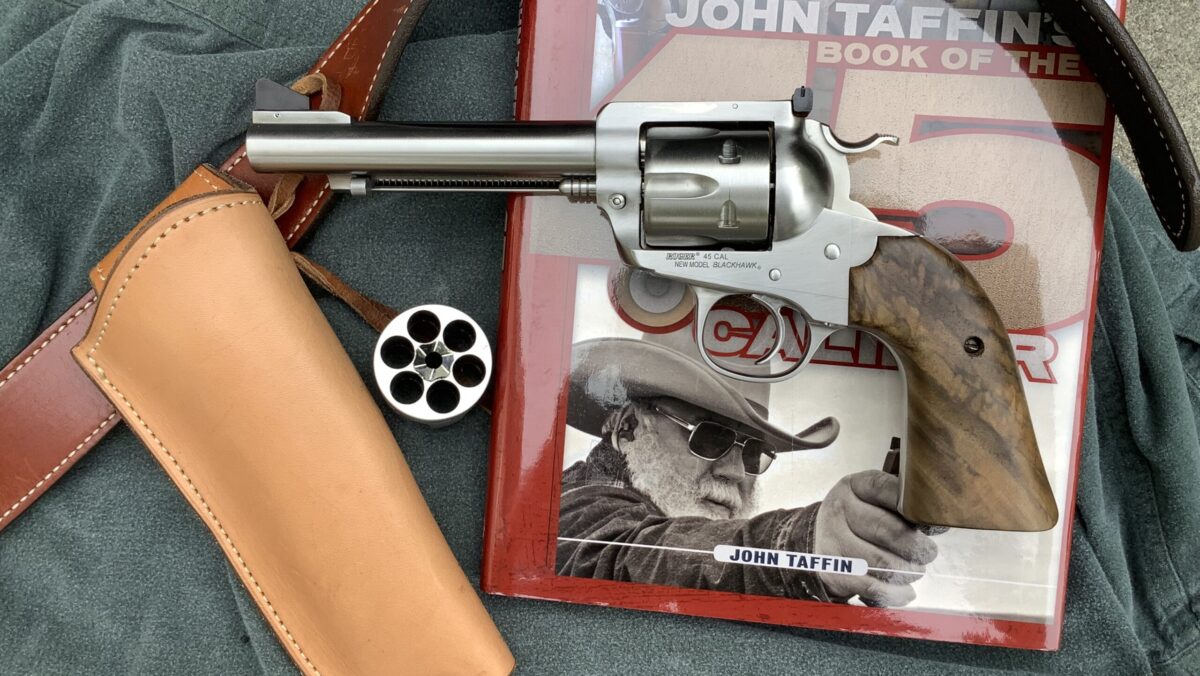
We were diminished on March 10, 2025, when we lost Mr. John Taffin, one of America’s finest gun writers, and an enthusiastic proponent of all manner of revolvers, particularly those of the big bore variety. Shortly before his passing, Lipsey’s honored John’s contributions to the shooting community with a special Lipsey’s Exclusive that’s the focus of our attention, today—The Lipsey’s Exclusive John Taffin Ruger Flattop Perfect Packing Pistol.
THE JOHN WE KNEW
Before we dive into the pistol, it’s fitting that we honor the man that inspired it.
John was a school teacher, by trade, and didn’t start his gun writing career, in earnest, until later. While he was published as early as 1967 (in GUNsport magazine), and wrote extensively for J.D. Jones’ and Elgin Gates’ newsletters, it was really his work for Guns magazine (beginning in 1983) and American Handgunner magazine (beginning in 1985) that brought him to the greater shooting community’s attention.
Indeed, this is where I “met” John, as an avid reader and subscriber to both of those magazines. Whether John was writing a special assignment article, or one of his numerous columns (such as The Sixgunner, Taffin Tests, or Campfire Tales), I always knew I was about to be treated to some entertaining, engaging, and educational writing when I saw his byline.

While John was a credible authority on a wide variety of topics, he really shined when it came to discussing revolvers (both double and single action), handgun hunting, lever action rifles, and handloading. Once in a while, a playful editor like Roy Huntington would give John an assignment that stretched beyond his normal scope, and force him into less familiar territory (I remember several assignments about polymer self-chuckers, including some real budget models, that John was compelled to take on—certainly against his will!), but even when John was swimming in strange waters, he always managed to do a great job.
One of John’s gifts, as a writer, was his ability to generate reader excitement and interest, no matter the topic. As someone who was strongly interested in double and single action revolvers, John automatically had my full attention when he was writing on those subjects, but he had to earn it a little more when he was writing about other topics. I was never a handloader or hunter, for example, but I still read John’s articles on those subjects like I was, because he always managed to hook me. He had a clever way of drawing information from many corners, and providing something for everyone in each of his articles–they were “well-seasoned,” and there was always a nugget hiding in there that would make it worth the read, even if you weren’t too excited about the main topic. I’ve got a feeling he could have made an article about tax preparation fun to read.

Another feature of John’s writing is that you very quickly got a sense of the man from his work. John’s writing was liberally sprinkled with his love and devotion to the “Four F’s”—Faith, Family, Friends, and Firearms. Nary an article passed without a reference to his beloved wife, “Diamond Dot,” their children and grandchildren, and their shared family history and values. It was obvious to every reader that he was a man with Christian values, who surrounded himself with friends who’d abide by the same moral code that he held himself to. John’s love of country and the freedoms that are uniquely protected in our great nation (to include faith and firearms) jumped out from every page. When he wrote about such things, it felt like he was expressing your own thoughts and values.
I never got to meet or speak with John, but like many readers, I felt like we were old friends. He had a way of connecting with his audience through the written word that made him seem familiar and welcoming, like someone you’d known well for a long time. As evidence of that, shortly after my dad passed away, I wrote a letter to John (“care of the Editor” at Handgunner) and told him about some of my favorite sixgun memories with my dad, because sharing them brought me joy during a sad time, and he seemed like the kind of guy who would appreciate the stories. He handled my outreach with interest, grace, and kindness, and sent a most thoughtful letter in return that confirmed my estimation of the man and his character.
He was a friend I never met.
THE SHOOTISTS
John’s commitment to the Four F’s led him to write a letter to a small collection of friends in the summer of 1985, asking for their response to a hypothetical question about a theoretical gathering of friends who were dedicated shooters. “If you could attend,” asked Taffin, “and bring only two sixguns, what would you bring?”
Taffin had solicited the responses to use them as the basis for an article about his fictional “Shootists Holiday,” but suggested in his closing that, “Perhaps someday we can make this a reality . . .” The story ran in October of 1985 in The SIXGUNNER (the official newsletter of J.D. Jones’ Handgun Hunters International) and generated so much interest that the theoretical Holiday quickly became a reality. In June of 1986, a little over a dozen invitees gathered at Bob Baker’s (Freedom Arms) range for the very first Shootists Holiday, and the group had so much fun shooting and visiting that it became an annual event, thereafter.

Taffin became the first Chairman of the group, and it grew, by invitation only, throughout the years. The Shootists endeavored to maintain the pillars of Faith, Family, Friends and Firearms, and attract shooters of character—the type who would “Stand in the Gap,” as described in Ezekiel 22:30. Even when Taffin’s declining health eventually prevented him from fulfilling the duties of Chairman, and traveling to the Holiday, he retained the role of Chairman Emeritus in the organization that was founded based on his vision.
THE IDEA
The Shootists are important to our present conversation about Lipsey’s Exclusive Ruger Flattop Perfect Packing Pistol, because the idea for the gun was born in the minds of Shootists, and executed by them, as well.
After John retired from writing in early 2024, it occurred to Lipsey’s Senior Vice President (and Shootist) Jason Cloessner that a special project gun was needed to commemorate John’s prolific career and his significant impact on the industry. Cloessner already had some ideas in mind, fueled by a summer 2022 visit to John with fellow Shootist Bobby Tyler, where they discussed John’s ideas on the best qualities and features of handguns, but he wanted additional inputs, so he called Brian Pearce.
Pearce was a Shootist too, and, in fact, had been an attendee at the very first Shootists Holiday. As a renowned gun writer, single action afficionado, and longtime friend of Taffin, he was the right guy for Cloessner to approach in the Summer of 2024, to start the brainstorming process that would eventually lead to the special gun.

It had long been a staple of John’s writing to speculate about the guns that met his criteria for being the “Perfect Packin’ Pistol” (PPP)—a generalist gun that you’d want to carry to handle any shooting chores that you were likely to encounter. Per Taffin’s description:
Basically, a Perfect Packin’ Pistol is a handgun—either sixgun or semi-auto—with an easy handling barrel length between 4” to 5-1/2” chambered in a cartridge capable of handling anything you may run into. It’s packable, portable and potent. It may be chambered in anything from .22 LR up to .500 Wyoming Express. While the former may work well in several parts of the country, the latter would certainly be most desirable in Alaska where you’d encounter something able to bite, claw or stomp.
John delighted in his quest to find the one, true PPP throughout most of his writing career. He identified dozens and dozens of suitable candidates, but never ceased to look for the next one which might be even more perfect. The PPP concept (which originated on a trip to visit John Linebaugh that Taffin and Pearce took together in July 1985) became synonymous with John Taffin, and any gun that would pay tribute to the man would have to comply with its requirements.
THE PLAN
The gun that Cloessner and Pearce began to create on paper would be a PPP, and one that was clearly “Taffinesque” in its features.
As one of the most prolific and knowledgeable single action enthusiasts in the gun press, and a man who had championed the brand for years, it made sense that the commemorative PPP would be crafted from a Ruger New Model Blackhawk. That Blackhawk would have to be chambered in a Big Bore cartridge, on account of Taffin’s longstanding preference for them.
The gun would need a 4” to 5-1/2” barrel, per Taffin’s specs, a durable finish, and adjustable sights to support the wide range of bullet weights and velocities that were necessary to tackle jobs both big and small. Since the PPP would occasionally be expected to throw some horsepower around, the Bisley grip frame that John preferred for harder-kicking loads would be a must.

As a tribute to a special man, the duo wanted the gun to be a unique offering, which hadn’t appeared in the catalog before. However, they also wanted the gun to be produced quickly, since it was important to get the project completed while Taffin was still around to enjoy it. This meant that the configuration had to fall within the boundaries of what Ruger was already making, to avoid an extensive engineering and manufacturing workup.
The gun would also feature custom components and accessories made by Shootists who worked in the industry, as a special nod to Taffin’s creation of the organization, and the promotion of its ideals.
When Cloessner approached Ruger with the idea, they were very enthusiastic about doing the project. They immediately committed to building the gun, and moved it to the front of the line, so they could rush a gun into John’s hands. Everyone was excited to have the opportunity to honor him for all his contributions to the industry.
THE GUN, REVEALED
When it was all said and done, the Lipsey’s Exclusive Taffin PPP took the form of a Ruger New Model Blackhawk Flattop, chambered in .45 Colt, with a matching cylinder in .45 ACP.
The mid-frame Flattop would be fitted with a Bisley grip frame and hammer, an adjustable rear sight and a pinned front sight, and a choice of barrel lengths between 4-5/8” and 5-1/2”.

A special JT-prefix would be used for all the serial numbers, and custom walnut stocks from Tyler Gun Works would ride on the stainless gun.
With the generalities aside, let’s take a more detailed look at the gun and its features.
MID-FRAME HISTORY
The frame of the Lipsey’s-Taffin PPP is the most critical element of the gun, and deserves some special attention.
To do this, we need to set our calendars back to 1955, a year that Taffin was fond of reminiscing about in his articles. It was in that year that Bill Ruger released his first centerfire, single action revolver, the Blackhawk. The Blackhawk followed closely behind the 1954 launch of Ruger’s .22 caliber Single Six revolver, and was built on a slightly larger frame than the rimfire, so it could accommodate the Blackhawk’s .357 Magnum chambering.
The Blackhawk was nearly identical to the Colt SAA in its general form and size, but incorporated significant changes in materials and construction that made it a stronger gun than the Colt. The Blackhawk’s frame had a flat top, much like the SAA’s profile, but was relieved at the rear to accept an adjustable sight from the MICRO Sight Company (located in California, when we still ruled the gun industry).

A year later, in 1956, Ruger released a .44 Magnum version of the Blackhawk that was built on a slightly larger flat top frame than the .357’s. With this introduction, Ruger was now making single action revolvers in three different frame sizes–.22 Single Sixes on the small frame, .357 Blackhawks on the medium frame, and .44 Magnum Blackhawks on the large frame.

The so-called “Flattop” Blackhawks were popular from the start, and Ruger made them with only minor changes until 1963. In ’63, Ruger changed the topstrap on the .357 Blackhawk to include a set of protective “ears” for the adjustable rear sight, and slightly changed the grip frame to set it back a smidge, and create more room between the front strap and the rear of the trigger guard (the so-called XR3-Redesigned, or XR3-RED grip frame). Ruger also discontinued the Flattop .44 Magnum Blackhawk in ’63, in favor of the .44 Magnum Super Blackhawk, which had been in production since 1959.
Thus, in 1963, the “Flattop” era came to a close at Ruger, and all the Blackhawks (including the Super Blackhawk) would have protective ears, or “ribs,” at the upper rear corner of the top strap. The ribs did a better job of preventing the rear sight from getting damaged, but the cosmetics were not as appealing to traditionalists, who preferred the Flattop look.
MISSING THE MID-FRAME
The medium-frame, Flattop .357 Blackhawks took on a near-legendary status after 1973, when Ruger introduced the New Model Blackhawk frame, which incorporated a transfer-bar safety system that made them true sixguns. In a move that spoke to manufacturing efficiency, if not tradition, the medium-frame was discontinued as part of this change, and all centerfire calibers (to include .357 Magnum) were now housed in the large, New Model frame.
The large, New Model frame was strong, and many shooters appreciated being able to safely load the cylinder with a full six rounds, but a number of gun writers lit candles for the discontinued, medium-frame, Flattop .357.

This included notables such as Skeeter Skelton, who was a big influence on John. When Skeeter passed in 1988, John took the torch from him and championed the old, medium-frame Flattop, which was lightweight, quick handling, and good looking. Many a Taffin article lamented the passing of the cherished Flattop .357—a gun I’ve actually never owned, and have only fired once, but still cherish as a result of John’s impassioned writing, over the years.
THE RUGER PHOENIX
As the 50th anniversary of the Blackhawk’s introduction neared, John led the pack of writers clamoring for a reintroduction of the medium-frame, and his efforts were rewarded with a special, 50th Anniversary Edition Blackhawk in 2005.
The 50th Anniversary Blackhawk was launched in two flavors—a medium frame, .357 Magnum Flattop New Model, and a large frame, .44 Magnum Flattop New Model. Both of these guns were fitted with the old, XR3-style grip frame that more closely mimicked the shape of the Colt SAA.

John was over-the-moon about the 50th Anniversary Blackhawks, and the story of their reintroduction became a staple in Taffin articles for decades to come. The medium-frame Flattop was back, and nobody was more thrilled about it than John. His enthusiasm for the gun was so contagious that I went out and bought one right away, even though I was firmly established in the double action camp by then, and hadn’t done any serious single action shooting for almost 20 years. John thought it was an important development, though, so I bought one before Ruger decided to discontinue it again.

Fortunately, the response to the 50th Anniversary guns was so strong, particularly the .357, that Ruger elected to return the medium frame to the catalog as a regular item (at least for a few years—it’s gone again, except as a distributor exclusive—they tend to do that).
THE BISLEY FLATTOP
As a fan of both the reintroduced, medium frame, New Model Flattop and the .44 Special cartridge, Jason Cloessner pursued Ruger, on behalf of Lipsey’s, to build the distributor a gun that serious sixgunners had wanted ever since the Blackhawk first appeared on the scene.
Indeed, it was Skeeter Skelton himself—the man that John Taffin credited as his inspiration (“It was Elmer Keith who lit the sixgunning fire in my heart, however it was Skeeter Skelton who continually fanned the flames”)—who wrote an article about converting Old Model .357 Flattops into .44 Specials in 1972, because Ruger stubbornly overlooked making the combination. Skeeter’s popular call for a mid-frame .44 Special captured Taffin’s imagination, and John would throw another piece of wood on the fire every time it started to dim, throughout the 1990s and early 2000s.
With Skeeter and John’s pleas echoing in his heart, Jason convinced Ruger to build a run of .44 Special New Model Flattops on the medium frame for Lipsey’s in 2009. The Exclusive guns were blued, with 4-5/8” and 5-1/2” barrel options, and they sold very well—so well, in fact, that Ruger decided to make them a catalog item in 2010.
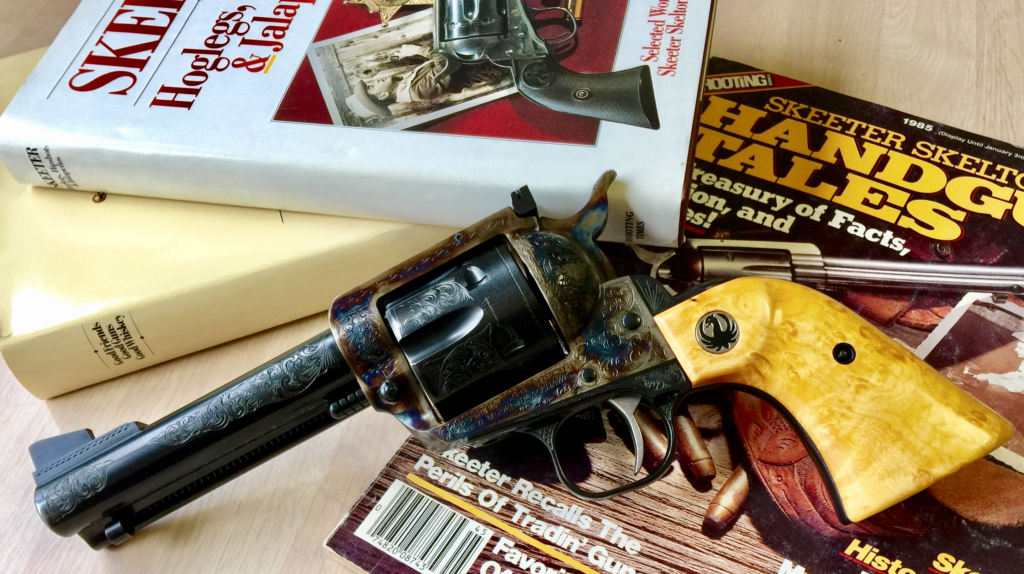
After the .44 Special Flattops hit the market, Jason found himself talking to the head of Ruger revolver production at a promotional event, who inquired if Jason had purchased one of the guns for himself yet? Jason replied that he wanted one, but the demand had been so high for them that he didn’t want to steal one for himself, and besides, he was more partial to the Bisley grip frame than the SAA-style, XR3 grip frame.
The Ruger product manager offered to build Jason a mid-frame Bisley in .44 Special on the spot—actually, two of them, because Jason couldn’t decide which barrel length he preferred the most. When Jason received the guns, he showed them to the rest of the Lipsey’s sales team, and they liked them so much that it was decided to contract with Ruger for a run of them. The Lipsey’s Exclusive .44 Special Bisley Flattop was another hit when it was introduced in 2010, and became the first Ruger mid-frame Flattop to be mated with the Bisley grip frame.
THE LIPSEY’S TAFFIN PPP
With John being such a dedicated fan of the medium frame Flattop design and the Ruger Bisley grip frame (“For me at least, the Bisley Model is definitely the best Ruger single action sixgun ever produced to handle heavy recoiling loads,” he wrote in his 1997 book, Big Bore Sixguns), this was the natural starting point for the Lipsey’s Taffin PPP project. Both Cloessner and Pearce figured that Taffin would heartily approve of the combination, and the shooting public would be attracted to it, as well.

The question that remained, then, was one of caliber. As a result of Skeeter’s influence, and a lifetime of shooting experience that taught him the significant benefits of the mild .44, Taffin had been a longstanding fan of the .44 Special cartridge. The .44 Bisley mid-frame combination had already been done though, back in 2010, and Cloessner and Pearce wanted the Lipsey’s-Taffin PPP to be as unique as the man it was built for.

The obvious choice then, was the .45 Colt—a cartridge, like the .44 Special, that Taffin had done his best to promote, over the years. John had enthusiastically endorsed the classic as a “grand cartridge,” which (like the Colt SAA that it arrived in) was so special that it was “not invented,” but rather, “like electricity and atomic energy, [was] discovered.” (Big Bore Sixguns, p.34)

Taffin had spent a long career extolling the virtues of the .45 Colt in print, showing the reader how it could be loaded from mild to hot, with bullets that were light, heavy, or somewhere in between. It was a handloader’s paradise and a sixgunner’s favorite, and it had not been chambered in the medium frame Bisley, yet (Lipsey’s had previously done a .45 Colt medium frame Exclusive with the XR3 grip frame, but not the Bisley).
During the summer 2022 visit, Taffin told Cloessner and Tyler of his fondness for the .45 Colt / .45 ACP convertible Blackhawk, which made a lot of sense in the present ammunition draught. Calibers like the .44 Special and .45 Colt were almost completely unavailable at the time, when the demand for ammunition far outstripped the industry’s ability to supply it. While .45 ACP was in high demand as well, and sold for inflated prices when it could be stocked, it was still much easier to obtain than unicorn ammo like the .45 Colt, for the shooter who didn’t handload.
So, the stars were aligned for the .45 Colt, and there was no better cartridge for the Lipsey’s Taffin PPP.

The Taffin PPP would take advantage of the Blackhawk’s adjustable rear sight, which would allow a shooter to explore the wide performance band of the .45 Colt, and also make it easy to dial in the gun for .45 ACP loads fired through the additional cylinder. The front sight would be pinned to the ramp, making it relatively easy to customize the height of the blade for chosen loads.

The dictates of the Perfect Packin’ Pistol naturally pointed towards medium-length barrels that would make the gun easier to carry and employ, and if Cloessner couldn’t be pinned down to a favorite length, then the customer wouldn’t be either. Stainless guns with both 4-5/8” and 5-1/2” barrels would be offered, so every shooter could cast his own vote on what a PPP looked like. All the guns would feature special, JT-prefix serial numbers, as well.
THAT BISLEY GRIP
The Ruger Bisley grip reminded Taffin of the grip on Elmer Keith’s #5, one of the most storied sixguns in existence. The Keith #5 grip actually started as the S.H. Croft #3 grip, with Croft being the East Coast sixgun enthusiast who spent a month at Keith’s home in Oregon with a collection of four customized Single Action Army revolvers that Keith delighted in shooting.
The grip on the third Croft gun was a mashup of a SAA trigger guard and front strap, and a Bisley back strap that was altered to follow the SAA grip angle. The Croft #3 grip pointed more naturally than the sharply angled Bisley that had been developed for target shooters, but also had a more pronounced shoulder that prevented the gun from rolling muzzle-up in the hand during recoil, like the SAA grip did. Keith liked the combination so much, he tasked Croft to supervise the building (Croft’s gunsmith, Mr. R.F. Sidgley, did the work) of his #5 on the pattern.

Taffin appreciated Ruger’s take on the Bisley and felt it compared closer to the Croft #3 / Keith #5 than the Colt Bisley grip it was named after. He noted the Ruger Bisley’s front strap was straighter than the Colt’s, and the grip was slightly larger than Keith’s #5. His extensive shooting with the Ruger Bisley showed that the grip directed recoil straight back into the palm of the hand, and reduced muzzle flip, making it the best choice for quick follow up shots with heavy-recoiling loads.
The Bisley grip on the Lipsey’s Taffin PPP needed a classy set of stocks (John preferred calling them “stocks,” over “grips”) to make the package complete, and the solution would come from John’s fellow Shootist, Bobby Tyler.

Bobby was a gunsmith of note, who had really come to prominence by virtue of his color case finishing work. His Tyler Gun Works operation specialized in finishing guns and building full customs, to include elegantly engraved works of art that were stocked with custom grips made by Tyler’s staff.
In an effort to expand their grip offerings, Tyler purchased the rights to Shootist Ted Adamovich’s BluMagnum patterns, after he passed, with the intent of resurrecting Ted’s take on Deacon Deason’s Bear Hug grip designs. This time though, the grips would be CNC-milled then hand-finished, to make them easier to produce at scale, and more affordable than a 100% custom grip.
Taffin had always been an enthusiastic fan of Deason’s and Adamovich’s stocks, and introduced the gun world to them through his writing. In fact, John was probably responsible for most of the orders that came into those shops. Putting the Tyler Bear Hug grips on the Lipsey’s PPP was a match made in Heaven, and one that was sure to put a smile on John’s face.

Tyler chose a rich walnut for the grips, and added a bit of a palm swell to them. Inside each grip panel, a silhouette of John Taffin was engraved into the fancy walnut. The grips were built without an emblem, to promote the custom appearance the gun deserved.
JT-0001
The Lipsey’s – Ruger – Tyler Gun Works team got the first guns built in time to present Serial Number JT-0001 to John on 14 November 2024, along with a special commemorative holster from Mike “Doc” Barranti at Barranti Leather Company.

Like Cloessner, Pearce, and Tyler, Barranti is one of John’s fellow Shootists as well, and his John Taffin Commemorative No. 5 holster is a beautiful and practical way to carry the Taffin PPP. The smooth leather lined holster is embossed with a silhouette of Taffin on the back, and numbered to match the serial number of the gun.

Taffin was visibly moved at the presentation of the gun and holster, which he delighted placing the gun into. One could almost see the wheels turning in his head as the words of Keith, Skelton, and other legends mixed with John’s own thoughts on the Perfect Packin’ Pistol, and his gratitude for the friends who brought the gun to life. The Lipsey’s Taffin PPP was everything he’d advocated for in a Perfect Packin’ Pistol for decades, and while the gentlemen who visited John to make the presentation didn’t ask him for a ruling, it’s quite possible that it was the best PPP he’d seen yet.

John’s terrestrial search for the Perfect Packin’ Pistol lasted another four months, before the Good Lord brought him home. I suspect he and the members of Heaven’s Gun Club are still on an ethereal hunt, though, because the Perfect Packin’ Pistol was always about the quest, not the destination.
CARRYING THE PPP
I was fortunate to obtain my sample of the Lipsey’s Taffin PPP in May of 2025, and quickly ordered my own Barranti No. 5 to carry it in. The holster carries my 5-1/2” stainless sample in comfort and style, and has been the perfect accent to the gun.

While the medium frame saves some weight compared to the large frame Rugers, the Taffin PPP is still a chunk of steel. It’s definitely “packable,” but if you’re used to carrying steel snubs and polymer pistols on a daily basis, like I am, the 43+ ounce gun (plus six rounds of big bore ammo) is definitely going to feel like more of a load.

The Barranti holster does a nice job of handling it, though. While I normally prefer a straight-drop holster, the forward cant on the No. 5 is particularly useful when you’re trying to get 5-1/2 inches worth of barrel out of the leather. The fit of the gun in the holster is exacting, but the leather hammer thong is a nice piece of insurance to make sure the gun stays there throughout the most vigorous activity.


The Barranti No. 5 the most expensive holster I’ve ever purchased, but it fits the gun like it was born inside of the leather, and I’m proud to wear it. It’s the work of a true artisan, and an excellent sample of the craft’s highest standards.

SHOOTING GROUPS WITH THE TAFFIN PPP
When I first received the PPP, I lacked a robust supply of .45 Colt ammunition (what little I had was already earmarked for some shooting I’d be doing with a new levergun in that caliber), so I started my shooting with the .45 ACP cylinder installed, just as Taffin and Cloessner had provided for. This is a particularly nice feature of the PPP, as most of us have a decent supply of the more affordable autopistol cartridge in our inventory already (and if you don’t, you should probably fix that because, well . . . America!).

My first time out with the gun, I found the sights were a bit off in windage and elevation from the factory. I made some quick corrections and started to get my 230 grain ball loads hitting closer to the point of aim, before moving onto another gun that I’d brought along to test.
On subsequent trips with the gun, I left the sights alone. I shot more .45 ACP ball on the second range trip, and wasn’t confident that the azimuth errors I was seeing were a sight issue, because I wasn’t doing a very good job on the trigger that day. Instead of chasing the sights, I figured I’d just work on being a better trigger actuator, and let the groups fall where they may.
On my third and fourth trips to the range it became evident that the sights definitely needed a slight windage correction. However, I left them where they were to keep everything consistent, since I’d already started shooting groups for record with my limited .45 Colt ammo supply. Besides, I knew my selection of .45 Colt loads were going to land at different elevations anyhow, and I figured I could fine tune both the elevation and windage adjustments once my testing identified the pet load/s I wanted to zero for.

I mention all of that, because you’ll see all the groups in the photos are a little off to the right of center, and that’s not a problem with the gun, just an indicator that I have some unfinished work to do with the windage adjustment.

At 10 yards, the Taffin PPP did a nice job of shooting 1.0” to 1.5” groups with everything I shot through it. With the nominal .45 ACP 230 FMJ zero (which actually turned out to be about 0.5” below point of aim–POA–when I benched the gun), it shot CCI Blazer .45 Colt 200 grain JHPs about 2.0” below POA, Federal .45 Colt 225 grain JSPs and some of Kevin’s .45 Colt 200 grain RNFP reloads about 1.5” below POA, and Steve Shields’ High Desert Cartridge Company .45 Colt 250 grain FP TMJs about 0.5” above POA.
In short order, it appeared that the .45 ACP 230 grain FMJ and the High Desert Cartridge Company .45 Colt 250 grain FP would probably be able to share the same zero, making them an excellent pairing in the PPP. One would shoot slightly high, the other slightly low, but both would print inside my wobble zone. I could shoot the cheaper .45 ACP ball for practice, and reserve Steve’s excellent .45 Colt loads for “the real thing.”
As the distance stretched out to 25 yards, so did my groups, but the general trends remained consistent. The Federal 225 grain JSPs shot about 2.5” below my .45 ACP zero and Kevin’s 200 grain RNFPs shot about 3.5” low.


The .45 ACP FMJ and High Desert Cartridge Company 250 grain FPs hit to roughly the same elevation, but the cheap ball ammo was clearly outclassed by the High Desert load, which stacked 4/5 rounds on top of each other on one attempt, before the monkey working the gun screwed up the 5th shot and sent it a few inches high.


A more accomplished sixgunner, like my pals Tank Hoover or Shane Jahn, could certainly put my effort to shame (speaking of Tank, make sure to read his review of the gun here), but the bottom line with all of this is the Lipsey’s Exclusive Taffin PPP will shoot very well if the shooter does his part and feeds it quality ammunition. The gun’s accuracy would not disappoint its namesake!
Incidentally, the sights on the Taffin PPP offered a good picture, but my middle-aged eyes did tend to lose the black-on-black sights on the B-8 bullseye at times, and I’ll probably paint the front sight as I normally do, with a layer of white followed by a layer of orange-red, to enhance visibility. Some shooters will be very happy to see the front ramp sight blade is pinned to its base, which will allow them to substitute different designs or heights to meet their shooting needs.
SHOOTING IMPRESSIONS
Having done most of my single action sixgunning with the traditional XR3 grip frame, which mimicks the classic Colt SAA format, I was interested to spend some time with the Ruger Bisley grip frame and see how its qualities differed from the “plow handle.”
Like the Colt SAA it copied, the XR3 grip frame was designed to “roll” in the hand under recoil, with its narrow neck and flared base. As the muzzle tracks upwards, the hammer spur is rotated closer towards the web of the hand, putting it within closer reach of the firing-hand thumb for cocking (remember, these guns were originally intended to be fired with a single hand, while the other was full of horse reins).

Heavy-recoiling loads tend to focus their anger on the web of the hand with this grip design, and in the worst cases, can drive the hammer spur down into the web of the hand, causing great discomfort for the shooter. Additionally, the rear of the trigger guard can smash into the middle finger on the initial thrust, which crowds the back of the guard pretty closely on the traditional SAA / XR3 grip, because the sinus is pretty short, front-to-back.
The Bisley frame helps to negate these tendencies, by providing more room between the fingers and the rear of the guard, and fighting the rolling tendency with a strong shoulder on the back strap. The shape of the Bisley grip frame tends to direct the recoil force straight back into the palm, which seems to be especially appreciated by the shooters launching powerful ammo downrange.
As Jason explains, an additional advantage that experienced single action sixgunners appreciate is the Bisley-style grip tends to be less susceptible to point of impact changes as a result of grip pressure. Because the traditional plow handle stocks tend to rotate so much in the hand during recoil, the shooter’s grip pressure can make a big difference–a tight grasp that fights the gun’s rolling tendency will often result in a lower point of impact than a looser one which allows the muzzle to rise more freely. In contrast, the Bisley grip directs recoil forces straight into the palm of the hand, and the muzzle is less apt to rise, regardless of the shooter’s grip pressure. This results in greater point of impact consistency, particularly with harder kicking loads.

The Tyler Gun Works Bear Hug stocks on the Lipsey’s-Taffin PPP add an additional benefit for recoil control, because they’re nice and wide from top to bottom—especially through the shoulder, where the SAA-style grips are typically narrow. This broad surface helps to distribute the felt recoil over a greater area, which is friendlier to the hand.
I didn’t shoot any hard-kicking ammo during my outings with the Lipsey’s-Taffin PPP, because I’m just not interested in hammering my hands and wrists for no reason. I’ve had my dances with heavy .44 Mags and .454 Casull in the past, and it’s just not my thing. I’m not built to handle that kind of recoil, which is why I appreciate the .45 Colt so much anyhow—it’s got all it needs to get the job done, without all the extra punishment.

Even so, I found the Bisley grip frame definitely handled the recoil differently than the SAA / XR3 does. The most energetic ammo I shot was probably the Federal 225 grain JSP, and it gave me a shove that I felt more in my palm, and less in the web of my hand. It wasn’t unpleasant by any means, but it did give me an appreciation for how the Bisley grip frame and Tyler Gun Works Bear Hug stocks change the recoil game. If I was going to be shooting barnstormers, I think I’d want to do it in a gun set up just like this one. I can see why John liked the configuration.

One thing I did notice about the Bisley/Tyler combination is that it created a grip that was about as wide as it was deep. This made it a little more difficult to center the gun in the hand by feel, when I was first drawing it from the holster. With grips that are longer, front-to-back, than they are wide, it’s easier for the hand to figure out where the leading and trailing edges are, and plant the web of the hand in the right spot to make sure the gun’s aligned with the forearm when it clears the holster. Gripping the Bisley/Tyler gun didn’t give me that feedback, and sometimes I’d have to adjust my grip a bit after the gun was out of the holster—something that would probably straighten itself out as I worked with the gun more, and became more familiar with it.
The action on the Lipsey’s-Taffin Bisley was standard Ruger, meaning it was pretty good from the start, but felt like it slicked up a bit as I shot the gun. The hammer definitely became smoother to cock as the gun broke in. Speaking of, the sides of the hammer rubbed a bit on the frame, evidenced by some shiny highlights on either side. I suppose some shims would help to center it up and improve things, but I think the best thing I can do is to keep shooting the gun, as it will help both the shooter and the gun to smooth out (and the former definitely needs more work than the latter).

The lowered spur on the Bisley-style hammer was convenient to reach, but took a little adjustment on my part, as well. My thumbs kept aiming higher for the spur, since they were used to reaching for the taller part on the traditional pattern guns—a habit that would soon be corrected with more practice, on my part. The lowered spur definitely made it easier to cock the gun without disturbing my firing grip too much, which was obviously the design intent for the original Colt Bisley’s, named for England’s premiere competitive shooting range, where one-handed, single action firing was the practice.
FIT, FINISH, COSMETICS
The Lipsey’s-Taffin PPP is a handsome gun. Ruger’s brushed stainless is an attractive, even finish, and provides a nice background to highlight the beautiful walnut stocks.
The stocks on my sample have beautiful grain, and were expertly fitted to the frame.

The JT-series serial number on my gun is a neat tribute to John, and so is the Taffin silhouette hidden on the inside of the stocks. The world can’t see John’s likeness from the outside, but I know it’s there, hiding beneath the beautiful wood.
A FINE TRIBUTE, TO A FINE MAN
Somehow, that seems appropriate. Taffin’s spirit pervades the gun without the use of any distracting logos or gaudy barrel markings. The same goes for the beautiful, numbered holster that Doc Barranti made for it—the Taffin logo is discreetly hidden from view, and we’re left to appreciate the quality of the holster without unnecessary distractions.
That’s the kind of man John was. He let his work speak for itself, without any noisy or flashy self-promotion. The world was able to judge the man by the quality of his works, the quality of his character, and the quality of the people he surrounded himself with. It was there for all to see.

In that sense, I think the Lipsey’s Exclusive John Taffin Ruger Flattop Perfect Packing Pistol is the perfect tribute to our departed friend. My hat’s off to Jason and the team he put together to make it a reality. Well done, gentlemen!

No doubt John Taffin would slap his seal of approval on this Lipsey’s Ruger Bisley Flattop made in his honor, which I think sums up his concept of a Perfect Packing Pistol. When I’m in big bear country, I carry a similar iron: a Ruger Bisley Vaquero chambered in .44 Magnum and stoked with 320-grain Corbon lead slugs.
Thanks, Mike. An excellent article to honor a truly good man. John Taffin picked up the torch for Elmer Keith and Skeeter Skelton seamlessly and influenced (enriched) our generation with his writings and his values. Hats off to the men that made this happen,- Cloessner, Tyler, Pearce, Barranti and the Ruger crew. They might have made THE PPP with this one.
Really excellant article Sir!! I know the PPP concept may have different criteria for different folks, but I was really pleased to see you pair a lever action rifle with yours! I find my 357mg carbine travels with me much more then any semi-auto rifle these days. I like the idea of someday hunting with my PPP but just haven’t made it happen yet. Thank you again!
Glad you enjoyed it Sir, thanks for the comment!
The levergun is still a perfect compliment to a SA revolver–a timeless combo!
Reading this took me back to my youth in the 1950s and 60s when westerns ruled the B&W television, and the Single Action Army was THE gun. It started a love affair with the single action that went towards the Ruger.
To me, the Ruger Blackhawk and John Taffin’s Perfect Packin’ Pistol, define a sidearm that can endure anything – societal collapse, nuclear mishaps, being dropped, getting soaked forging a river, endless holster wear, and consuming quantites of ammo that would choke an original Colt. It’s a sidearm that is simple in terms of its parts, is simple and easy to operate, easy to pop the cylinder out for cleaning, easy to maintain, and defines endless reliability and its ability to stand up to anything short of a band saw or cutting torch.
My first two revolvers were, in order, a Ruger Super Single Six Convertible 4-5/8″, and later a Ruger Blackhawk 357/9mm Convertible (fitted with Super Blackhawk hammer), also 4-5/8″. I have less than no idea how many rounds have been launched out of those two platforms over the last 6 decades, but every range trip seemed to have one or both tag along. Buckets of old wheelweights got melted down over the years and cast into .358″ semi wadcutters for reloading on the cheap.
While I know I can’t afford one of the Lipsey’s PPP models, none the less it represents probably the one sidearm that’s atop my list to grab if I wanted a peaceful therapy sesssion on the range, or if civilization went Tango Uniform.
If the balloon ever goes up and I’m far from home with no support, the one piece I’d most want to have is my stainless Ruger Single-Six Convertible in .22 LR/.22 Magnum.
Revolver maestro John Taffin opined that the Single-Six is virtually indestructible, and with reasonable care should be able to be passed down through generations.
The Blackhawks are great guns, and I’m glad to have them in my battery. My Single Six gets more use, though. Is there anything quite as fun as a Single Six?
A Jeep CJ7, in the woods, with the top off, with a Ruger Single Six ?? 🙂
I wasn’t lucky enough to snag a Taffin PPP, but I do have a Lipsey’s 4-3/4″ Flat Top in .44 Special, and it is indeed “special.” A perfect packin’ piece for the mountains and woods.
Thanks for a nice tribute to not just a fine single action, but the man himself.
Thank you Sir! Mr. Taffin deserved it. Glad you enjoyed it.
I’m sure he would’ve been equally enamored with your .44!
As perfect as the Taffin PPP is, a few alternative choices would make it more perfect for me. First, my peepers are much happier something bright and shiny embedded in a post front sight these days. Second, for a gun meant to be carried more than shot it would be fractionally more portable with an aluminum alloy grip frame and ejector rod housing. Sacrilege I know, but a bazillion satisfied Blackhawk owners might just be on to something. Finally, while I enjoyed Ross Seyfried wrist-wrenching big bore loads in my pre-arthritic youth, a 357/38/9mm version might prove the most popular option in today’s market. Guess I’ll save this iconoclastic take on a PPP for the Annual Holiday Wish List…
All good points, Michael. Fortunately, there’s lots of room under the PPP tent!
Great tribute!
Great article!
Great gun!
Darn good shooting Mike!
Thanks pal!
Another great article, good Sir. This one is already book marked for future reading. The JT Ruger, as elusive as it has been for many of us is indeed what I would call my PPP and I think Mr. Taffin might just agree. And pairing it with a 45 Colt Marlin… nothing could be more appropriate. Well done!
I wish they were more readily available. Perhaps that will be fixed, someday. Thank you for the kind words about the article–I was disappointed thst it didn’t get a better response, and appreciate you reaching out about it.
Mike, I have read many of your articles but this one was written with heart… moreso than usual. Especially considering it’s sister article Homecoming Day-wow! What a fitting tribute! Anyone who has any idea who John Taffin was should appreciate both of these articles immensely. Many of us who never personally knew Mr. Taffin still feel a connection to him that certainly lives on in your writing as he lives on in our memories as well as JT’s own written works; works that have the uncanny ability to put us in the field with him.
I’m humbled Dan, thank you! So glad you enjoyed those pieces, and appreciate your kind words about the work. I look forward to producing more articles that connect with the readers, like these!
Every article you write is a masterpiece and this Taffin PPP of yours is the masterpiece of masterpieces! Superbly well written, which means it was really fun to read while also covering everything from the history to the attributes of the PPP.
Thanks pal, MUCH appreciated! I’ll send you that check tomorrow. 😆
Mike, thank you for your fine tribute to Mr. Taffin. I have been fan of his work since the 1980s, if memory serves. His book, Big Bore Sixguns, is a top shelf read. It has helped pass the time on many a snowy day here in Idaho.
Kind Regards, Will
Thank you Sir! Great to hear from you!
I first met John Taffin when he was still working as a teacher in Boise. That was the late eighties, and I was a student at Boise State University. Ran into him Shapels Gun Store (closed in 2005). I recognized him from his beard and cowboy hat.
Years later I called him (he was in the phonebook believe it or not) a couple times with questions. He not only answered my questions but just shot the breeze with me. Very nice guy. R.I.P. Mr. Taffin
Thanks for the memory, Jeff. By all accounts, he was a great guy!