This is a brief, and long overdue, review of a product that RevolverGuys are really going to benefit from. “I was there at the start,” when Harrison Jones of Harry’s Holsters began his work on his IWB Speedloader Carrier, and while I’ve been tardy in writing about it, as I tackled other obligations, I’m very excited about this product. So, let’s dive right in and have a look.
BACKGROUND
In June of 2025, I asked Harrison if he would consider manufacturing a copy of a popular speedloader carrier that had been discontinued and was missing from the market for a number of years. The simple request started a conversation about the Pros and Cons of various design features, and our druthers for how to carry and use speedloaders for our favorite revolvers.
Over the course of several months, we traded ideas and images back and forth, as Harrison used CAD to design a number of concepts, and developed prototype samples to see how they’d work in the real world. The conversation was lopsided–I’d send him an amateurish drawing on a napkin, and he’d send back a professional-looking CAD drawing, or a photo or video of a sample. I’d respond with my comments and questions, which he would expertly answer and use to fuel more development. Harrison did all the lifting, and by the time the final design emerged, it looked nothing like what I’d originally proposed.

MANUFACTURING REALITIES
One of the things that interested me the most about this back and forth was the opportunity to see how an experienced designer and manufacturer thinks. As the designer and maker of some of the best holsters and concealed carry accessories on the market (many of which, we’ve reviewed in these pages), Harrison understands how to translate an idea into a manufactured product. An enthusiast like me can come up with a fancy idea, but it takes an expert like Harrison to convert that idea into something that’s actionable.
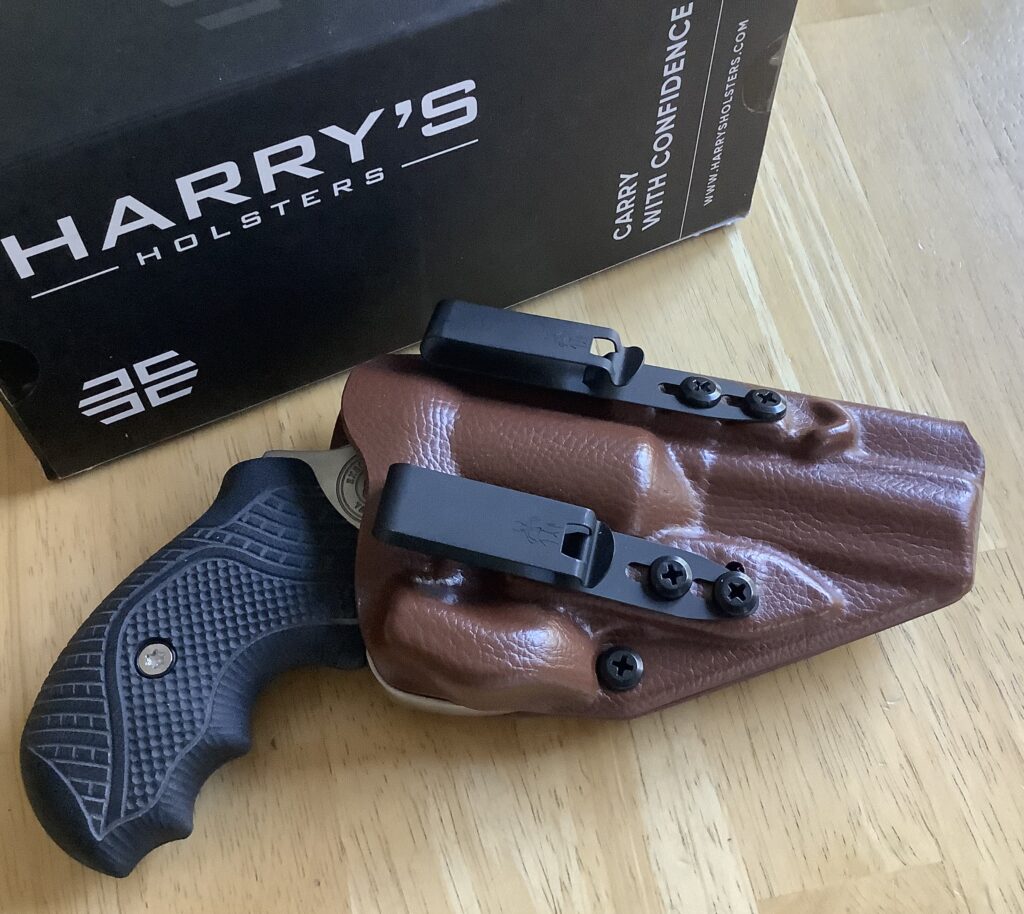
For instance, my initial ideas assumed that some kind of folded and molded kydex would be used to manufacture the pouch, but Harrison understood this wasn’t a practical path forward. Bending kydex works well enough for small scale production, but is too labor intensive, slow, and expensive for large scale production. If he was going to manufacture the speedloader pouch with those methods and materials, he’d have to price it so high to cover expenses that it would never sell.
Harrison realized a switch in manufacturing materials and methods would be necessary to achieve success, and very early in the discussion he focused on 3-D printing as the solution. Knowing how it would be built had a significant influence on the design, both adding and restricting possibilities.
TIMELINE
Just before the October 2025 RevolverFest event, Harrison mailed me a sample of the final IWB design for both a J-frame and a K-frame. At the event, he also supplied a sample of an outside-the-waistband carrier that I think was an interim stage in the design process, that they made a small run of, for testing.

Unfortunately, I started to fall behind on RevolverGuy chores right about that time. Between the holidays, work, and some family issues, my productivity slowed and my T&E projects took a back seat. I was receiving a number of good products to test from a variety of makers, but couldn’t get to all of them in a timely fashion. Using a first-in, first-out priority system, I finally started to catch up in the early Spring of 2026, and I’m glad that I was finally able to spend some quality time testing the IWB carriers that Harrison delivered way back in November. Many of you have probably been using these already, since Harrison has been selling them since the end of 2025, and I’m hoping you’ll contribute your own thoughts about them in the comments.
THE AIWB MISSION
One of the things that’s important to establish about the design right away, is that my initial inquiry to Harrison was focused on developing a proper speedloader carrier for Appendix Inside the Waistband (AIWB) concealed carry.1
There are a number of speedloader carriers that can serve well when you’re carrying a concealed gun on or behind your hip, but the universe of appropriate carriers begins to shrink when you carry your gun up front, in the space where the loader pouch would be normally be carried if your gun was at 3:00 (9:00 for you Southpaws) or further back. That natural hollow between your abdominal muscles and your hip bone is a great place to carry a loader pouch, and can even help to hide an outside-the-waistband (OWB) speedloader carrier to some extent, but if you fill it with your gun, instead, the question of where to put the carrier becomes more complex.
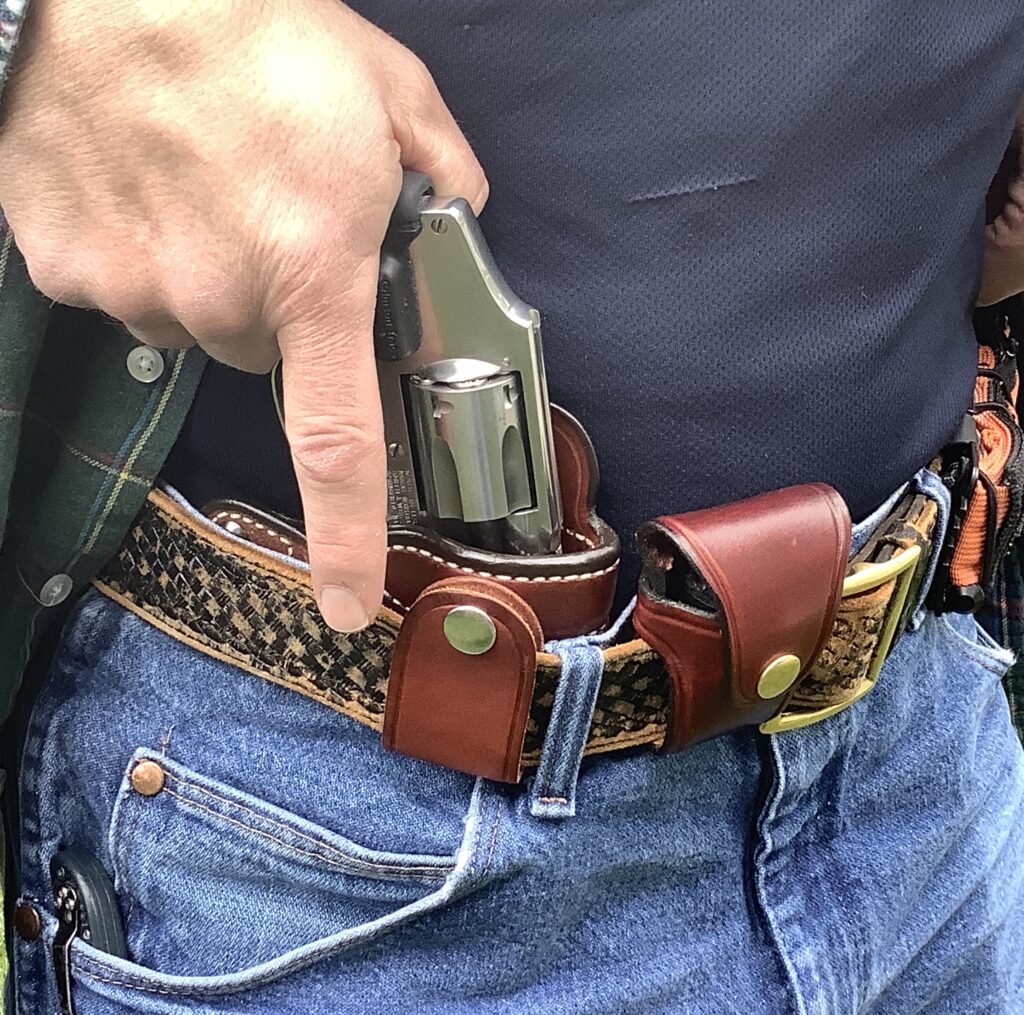
Many designs, particularly those that carry the speedloader OWB, just won’t hide very well in that 12:00 to 1:00 region, where your abdominal muscles create a high point. The access will be excellent, but the pouch will print through your clothing, since you placed it on an anatomical peak.
Moving the pouch close behind the AIWB gun may allow you to take some advantage of that hollow between your abs and your hip, but may crowd the grip too much, and get in the way of access and a clean draw.
Moving the pouch further behind the AIWB gun, closer to 3:00, can encourage the concealment problem again, due to the point of your hip. Moving the pouch even further beyond 3:00 will aid in concealment, but your access to it will become more difficult.

To resolve these issues, I think the most promising place to carry a speedloader on the belt, when you’re carrying your gun AIWB, is to take advantage of the hollow created by the gun’s cylinder, immediately forward of the gun.

If you carry your gun at 2:00, for example, your belt will be taut between the peak of your abdomen at 12:00, and the curve of the cylinder at 2:00. This will create a hollow behind your belt, from around 1:00 to 2:00, that’s the perfect place to carry a speedloader. Filling that hole on the inside of the belt won’t add to the concealment footprint, and will position the loader where it’s easily accessible. Furthermore, it will keep the loader free and clear of the grip area, so it won’t foul your draw.
After many failed experiments with OWB carriers, carriers that split the belt (like the Safariland Split-Six or Don Hume Pack Six), and OWB carriers that I reversed and carried inside the belt, I was still looking for a good IWB option that I could place immediately forward of my AIWB gun. This was the problem that I asked Harrison to solve when we first started talking about speedloader carriers in June of 2025.
THE DESIGN
As I expected, Harrison delivered in spades.
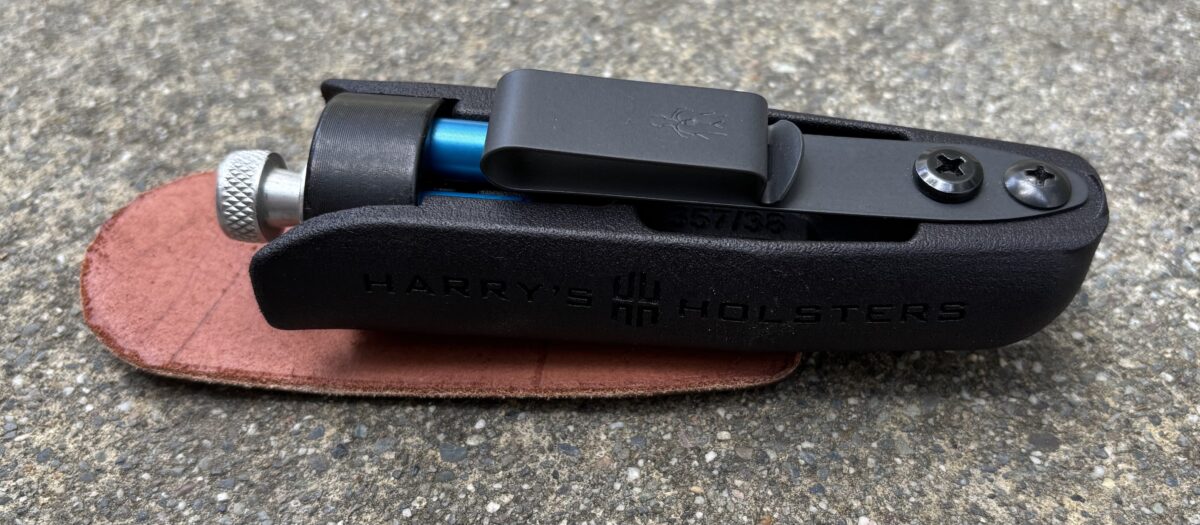
The Harry’s Holsters IWB Speedloader Carrier is composed of a tall and thin body with an IWB clip on the outside, and a leather backer on the inside. The body is 3-D printed, and sized to accept a specific model of speedloader. My two samples were for HKS J-frame and K-frame .38/.357 revolvers, but there are available carriers for 5-Star and Safariland loaders, and .32/.327 caliber options as well.

The body of the carrier is much longer than the speedloader it carries, on the order of about three-times as long. This is necessary to stabilize the carrier inside the waistband and anchor it in place. The long body creates a lever that your lower abdominal area can bear against, to tilt the carrier inwards towards the body, using the belt as the fulcrum. This enhances the concealment of the carrier and helps to lock it in place so it doesn’t shift around.

The long body also serves as a mounting point for the DCC 1.5” belt 1-Series Gear Clip, which is anchored at its bottom by two screws. The clip allows the body of the carrier to sink deep behind the waistband, and positions the loader so the bullets in the cartridges rest just above the top edge of the belt. This high ride for the speedloader enhances your ability to get a good pinch grip on the body of the loader, to withdraw it from the carrier (which is more desirable than pulling the loader out by its release knob, in a design like the HKS).

The clip can be pivoted on the carrier body to angle it about 30 degrees to the left and right, so the loader will be carried at the desired cant. This allows great flexibility for the shooter to tailor the draw angle from the loader to optimize the motion, or to allow a broader range of carry locations–a loader carried behind the hip, for example, could be canted forward to provide access that wouldn’t be possible if the carrier was fixed in a straight up and down alignment.


The body of the carrier has a specially-tailored recess for the style of loader that will be carried in it. There are individual chambers for each of the cartridges (i.e., 5 cells for a J-frame .38 loader) built into the loader, and a central post that centers the loader and holds it neatly in place. On my HKS-style carriers, the central post helps to reduce the cartridge rattle that results from the cartridges wiggling in the loader. I haven’t seen the carriers for the Safariland Comp loaders, but the central post is presumably relieved, in comparison to the HKS models, to prevent the Comp loaders from discharging in the pouch.


The leather backer adds an element of comfort for this IWB carrier, and also helps to protect the loader and its ammunition from direct contact with sweat (salt) that could cause corrosion. The leather backer also aids in establishing a good grasp on the loader body, as I’ll explain shortly.

HOW IT WORKS
The HKS loader is retained in the carrier by virtue of small engagement lips that are molded into the two ears of the carrier body. When the loaded HKS speedloader is inserted into the carrier, the ears on the carrier body flex outboard as the loader is pushed down inside of them. When the loader is fully seated, the ears snap back inboard, and lock it in place with the engagement lips bearing on the top surface of the loader body.

This arrangement is secure enough to keep the loader in place during normal activity, without requiring excessive force to draw it from the carrier. It’s easy to pinch the loader body between your thumb and index finger, and pull it straight through the subtle engagement lips to remove it from the carrier.

Harrison advises that the carriers for the 5-Star and Safariland loaders are slightly different in how they retain and release their loaders. Because these other loaders are made from different materials and have different shapes, they can have a different feel when they’re drawn from the carrier. The 5-Star, for example, tends to come out easier if it’s drawn straight up out of the carrier, and will require more force if you’re pulling at an angle. The Safariland Comp loaders tend to have a “softer” release, because of the polymer used in their construction.
I’m not sure if it was an intentional part of Harrison’s design, or just a fortunate byproduct, but the clip on the carrier adds to the retention of the speedloader. The tension of the belt presses the back wall of the clip into the cartridges in the loader, when it’s sitting in the carrier. This additional inward pressure from the clip helps to hold the loader in place until you act to withdraw it.

I’d estimate that a third, possibly more, of the retention force comes from the pressure exerted by the clip, and the pressure exerted by the leather backer. To illustrate, if you hold the loaded carrier by its bottom and give it a light flick with your wrist, the speedloader will sail right out of it, but if you simulate some belt pressure on the clip with your thumb and repeat the experiment, the loader will remain in place.2
Harrison tells me that during testing, he’d throw the carrier, with a loaded speedloader inserted, up into the air about 10 to 15 feet, and let it land on the concrete. He says the speedloader never came out of the carrier when he did this. It comes out easily when you pull it straight up out of the carrier, but it resists coming out any other way.
In any event, I’ve been wearing the carrier as part of my daily routine for over a month now, and have yet to have the loader fall out of the carrier. I don’t expect the loader will stay in place if I have to wrestle with someone (most gear won’t!), but I can walk, jog, bend over, get in and out of the car, and do all the rest of my normal daily activities and the loader stays in place.
USING IT
The loader stays put when you want it to, but it’s really easy to get the speedloader out of the carrier.
My favored technique for getting the HKS loader out of the carrier is to rotate my wrist so that my thumb is inboard, and run it down behind the loader in preparation for pinching it between my thumb and index finger. The leather backer is an aid in this process, because it keeps the area behind the carrier clear of obstructions (clothing) for my thumb to slide down into position. My thumbnail contacts the top of the leather backer and pushes it into my belly, then slides down the backer into position behind the loader.


Once it’s there, I just pinch the loader between the thumb and index finger, then draw it out the top of the carrier. There’s no big hitch as you clear the engagement lips that hold the loader in place—they’re very gentle speedbumps that you just pull straight through, without any effort.
Once the loader is out of the pouch, you can mate it to the cylinder and complete the reload. If you’ve grabbed the loader in such a way that your fingertip rests on the bases of the cartridges, it will help you index the loader properly, using the technique I’ve discussed previously in these pages (if you want to learn more about it, I’ll be teaching it at Revolver Roundup and RevolverFest, so come out and join us).


An advantage of lifting the loader out of the carrier by its body, instead of the release knob, is you decrease the risk of accidentally discharging the loader before it’s in place on the gun. Additionally, that index technique that I favor will help you get it lined up with the cylinder much faster than holding the loader by the release knob and just stabbing it at the back of the cylinder.
LIVING WITH IT
I’ve already mentioned that the carrier has held my HKS speedloader securely, and has been easy to draw the loader from, but it’s also important for me to comment on how it carries.

The Harry’s Holsters IWB Speedloader Carrier has been very comfortable to wear. Since it fills the gap created by the AIWB holster, it doesn’t feel like it adds any real bulk—it just lives in the shadow of the holster. The long body of the carrier doesn’t jab me when I sit down, and doesn’t get in the way of my seatbelt (any more than the holster already does) when I’m in the car.
The leather backer keeps the knurled HKS release knob off my skin when the carrier is worn underneath my t-shirt, and the central post in the body helps to hush that “HKS rattle” that gets amplified by some carriers.

Importantly, the carrier conceals well, even under just a t-shirt. It doesn’t print any more than the gun already does, which is quite an accomplishment. I’ve never found another carrier that I could wear in that position that didn’t create a noticeable bump under my t-shirt, but the Harry’s Holster IWB Speedloader Carrier does a nice job of hiding in that void between the buckle and the holster.
I think it might hide even better if I could sink it just a little lower on the belt—not too much, since I don’t want to bury it behind the belt and ruin the access to the loader, but just a little. This would require a longer clip with mounting holes that are displaced about half an inch or so. It doesn’t look like Discreet Carry Concepts makes a longer one sized for 1.5” belts, but I suppose I could go looking for one.


However, I’m happy enough with the carrier, as-is, that I don’t feel a compelling need to do that. This is a really good product, and it does the job better than anything else I’ve seen. It’s comfortable, quiet, easily accessed, and secure. It conceals well under light clothing, and allows me to quickly retrieve a loader and get my gun charged.
What’s not to like about that?
CHECK IT OUT
If you’re an AIWB carrier and you’re in the market for a good speedloader carrier, you’ll definitely want to check this one out. Even if you prefer to carry your revolver OWB on your strong side, crossdraw on your weak side, or somewhere else entirely, the adjustable cant on the clip will make it work for you. I’m thinking it would be a great addition to the inside of a fanny pack, for example . . .

Harrison has always had an excellent eye for detail and design. His holsters are favorites around here, and now his speedloader carrier is too. Make sure to stop by his website and have a look, and be sure to let us know in the comments what you think of this carrier, if you’re currently working with one.
*****
ENDNOTES
1.) As I use the term “Appendix” here, I broadly mean carrying in the position between the belt buckle and the hip on the strong side. I personally carry my gun between about 1:00 and 2:30 (using the accepted clock system that puts the belt buckle at 12:00 and the hip at 3:00 for a right-hander), depending on the gun and the clothing, and generally consider that to be “Appendix Carry” for my purposes, but I recognize that some folks will operate on either side of that and still consider it as “Appendix.”
Some will split hairs and use terms like “Forward of the Hip” to differentiate carry in that far region from about 2:00 to 3:00, from what they term to be true “Appendix,” between 12:00 and 2:00, but I’m generally not that specific about it.
I’m not going to referee the discussion about what’s “Appendix” and what is not, and will just use the term in the hopes that we can all get a visual picture of what we’re talking about when I say, “appendix carry.”
2.) This is the speedloader carrier equivalent of the “upside down holster test” that many folks get wrong, when they’re testing to see if a holster’s friction will retain the inverted gun. What they often fail to understand is that the belt’s tension on the holster is an important part of what keeps the gun in the holster, so just shaking an upside-down holster and watching the gun fall out is not a valid test of the holster’s retention properties.
In this same vein, the Harry’s Holsters IWB Speedloader Carrier derives a portion of its retention properties from the pressure that’s being applied by the belt when it’s worn, so simply turning the carrier upside down and shaking it to see if the loader falls out is not a good test of how well it will keep the loader in place during regular activity.

With that size/length, it should hold multiple speed loaders. A minimum of two reloads.
A missed opportunity..
I’d disagree with you on that, Travis. I think designing a carrier that would stack two loaders on top of each other would result in compromises that would lessen the efficiency. You couldn’t build a central post into the design, for example, and an IWB carrier that put a second loader below the belt line would make access difficult.
We considered that, but you’re talking about a whole new level of complexity with a spring to push the 2nd loader up and a way to secure it while still being able to get it out when needed. A great idea in theory but once you get to execution the problems start popping up.
The design time and added parts would push the cost to a crazy amount if it can be done. I’m pretty sure we’d have to design a speed loader specifically for this type of carrier to make the concept work. The knobs on top of most speed loaders make it difficult to keep everything in place.
Count me among those who don’t worry overmuch about recharging a bellygun quickly. As our betters remind us, we’re more likely to run out of time than we are to run out of ammo. I’m comfortable with six rounds in an eight round Tuff Strip most days. That said, this loader carrier is a well thought out piece of kit for them a may need to reload in a hurry. The “unused” length may be counterintuitive, but so was sticking a foam pad on the body side of an AIWB holster – making it thicker to make it conceal better. $0.02, YMMV.
Indeed! Thanks Michael!
Only possible disadvantage I can think of is this may not work for carriers who have an ample gut protruding over a belt, so it might be best suited to us skinny ectomorphs.
I’d say this pretty much goes for any IWB product. It may not work as well for some body types, but provides an option for others.
Given that these are loader specific, I’d go broke. J & K frame HKS, K frame Safariland, and an ammo can full of J & K frame Jet loaders. (Loaders for casual, business, and formal occasions)
Other than that, (Mrs. Lincoln), it’s a splendid concept for someone who has only one brand and one size of speed loader, and who wants it as deep concealment as possible. No snaps, no velcro, low drag. I’m not quite seeing an advantage to being able to change angles, but I still carry my wheel guns in FUDD mode.
I get it, I’d much rather be able to stock one SKU and have a one-size-fits-all product that’d be easier for customers to justify and reduce our logistics headaches and cost on the backend.
Unfortunately, the tolerances between these different loaders are quite wide, so there isn’t a good way to get retention for more than 1-2 at a time. Thankfully, a lot of the 5-star and HKS equivalents are similar.
I am a huge fan of Harry’s Holsters. I carry one basically every day and they are my go-to holsters for AIWB revolver concealment. I typically don’t carry a speedloader concealed daily because of the difficulty hiding one under light summer clothing. a flat 2X2X2 pouch and/or a strip in a pants pocket is the norm for me. I’m going to be saving my pennies for one of these. Thank you Harrison Jones and thank you Mike for shining a light on this carrier!
Is one expected for the 6-round HKS 32-J speedloader, now that .32 H&R has come into fashion?
I loved the AHolster Bactrian pocket carrier for a pair of HKS 36 loaders when I was still carrying J-frame .38 Spl. guns but apparently was unable to persuade the owner that there’s a potential market to offer a .32 H&R/.327 Mag. version.
Yes, it’s already a catalogued item. There’s a carrier sized for the HKS 32J and 5-Star J2-327 loader in .32 H&R/.327 FM
Wow, just wow! I had been working with an acquaintance about a holster/speed loader concept that this product just filled. There were health issues in both families that stopped our progress. I’m very glad to see someone fill this obvious need.
BTW, I checked the website to make certain that K and L frame Safariland Comp II loaders were available.
I’ll certainly be a customer.
I recently received my carrier for a Safariland Comp 1. Personally, I think it’s the best speed loader carrier option on the market. I’ve played with the split six and second six options. They’re decent, but Harry’s is streamlined to a much greater degree. It’s efficient, effective, and conceals well. The only change I’d like to see would be mounting options. I greatly prefer pull the dot snaps attached to Raven Concealment struts, but I don’t believe the hole pattern on the current model could accommodate that mounting solution. I’d also like to try mounting it to some of the Henry Holster Tegris Enigma mounting solutions so I could try running the loader on my Phlster Enigma. All of that said, I think it’s an amazing carrier (and I am, unfortunately, willing to deal with my less than favorite mounting solution in order to use it). All that said, you guys really knocked it out of the park and I’ve been incessantly checking the website for when the K frame Comp 2 option becomes available.
Carlos, thanks for adding your personal experience with it. I value the extra feedback, because it’s nice for readers to hear more than just my opinion!
I almost forgot to mention this, but I would also love to see a k frame model available for the jet loader. I hate to be the guy who asks for more, but a guy can dream.
I too would like to see a versatile device that could carry many different speedloaders, but this is intriguing. I’ll have to pick one up and see what I can do with it. Thank you both for coming up with a new idea and making it work!
Harry gets the credit, I’m just an agitator. 😁
Mike and Harry — Thanks for this amazing article and for your responses to our comments. The care with which matters of review and design are discussed on this site brings me back again and again.
Thanks Bob, I’m glad you’re getting something out of it!
Wonder if it would hold a moon clip for a 9mm revolver maybe?
Just ordered mine for my Kimber ultralight, thanks for the article! I have a half dozen Harry’s holsters, they’re my favorite. Surprised I didn’t know these existed.
Let us know what you think of it!
Now we just need someone to make a clone of the old Jox loader pouches, and then we’d have perfect IWB and OWB options on the market!
I’ve never worked with kydex, but the fact that the jox pouches look so perfect but are no longer available is enough for me to consider trying to make some.
Danny, there’s a friend of RevolverGuy who’s about ready to go live with a product like that. I’ve got a prototype. Hang tight for a bit–We’ll announce it when he’s ready.
I appendix carry and LCR daily in the Icon 2.0 holster. Now, if only Harry could come up with something like this for the Zeta6 speed loaders, Id be sold in a heartbeat.
Im down for one when the comp 2 k frame one is available. Ive been carrying a cd2 in board, but inside my pants, for the last 8 years I think.
I tried that for a bit, and it was OK, but not great. If I was gonna do it a lot, I’d take a file and sandpaper to the folded metal corners and round them off.