The Guns, the Gear, and The Legend . . .
RevolverGuy has always treated wheelgun history and gear as important topics, in and of themselves, and has continuously promoted the use of revolvers for fun and recreation. However, it has never lost sight of the fact that revolvers are serious, lethal tools. I appreciate that, because I love shooting, competing, and- especially- training. Unfortunately, good training running a circle stack gun can be hard to find.
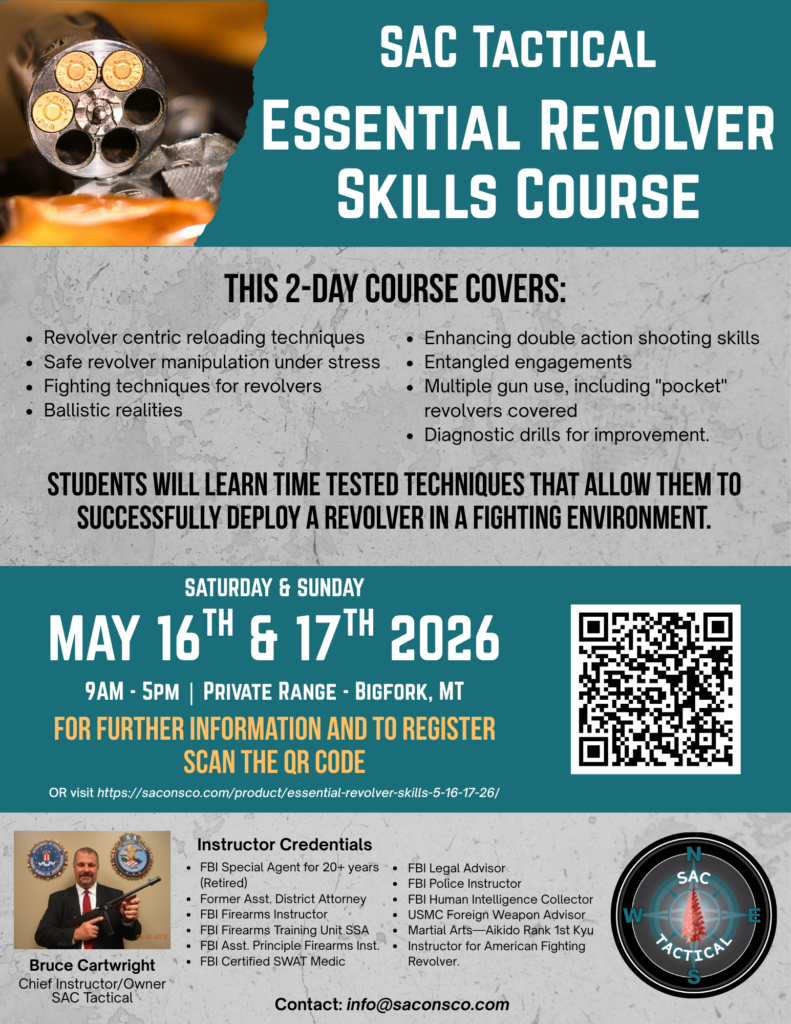
The equipment and guns are important, but being able to use this stuff is even more so. Accordingly, at RevolverFest 2025, my buddy Eli Duckworth and I got to talking to Bruce Cartwright of SAC Tactical. I already knew of Bruce from Tom Givens and an appearance he had on Lee Weems podcast. And we had some of the same training tree in common- a lot of the people that had trained Bruce, like the late great Pat Rogers, had a lot of influence in some of the schools I’d attended professionally. So, when he put out an open enrollment Revolver class, completely across the country from me- what’s a guy to do but hop on a flight and go shoot revolvers for 2 days?
Introduction
Now let’s be up front- this is not going to be an in-depth AAR of the class. Instead, this will be birds eye look at the class, an overview of the gear the students used, techniques employed, and a blurb about a very special guest appearance by Mr. Ken Hackathorn. (See that? That’s called “burying the lede” in writing. Now you have to read to the end. We gotcha.) While I will give an overview of the class for context, there won’t be a deep dive into the material, thought process, or anything else. This is for a couple of reasons:
1.) This is one of the first times SAC has run this class, and some things might be changing, so diving deep into some of the instruction might be pointless if it’s not going to be in the next iteration.
2.) I actually write in depth AARs very frequently for some closed FB groups. They get about half the comments and likes as some guy posting his new gun and asking what people think of it. Frankly, while it won’t stop me from writing, most people don’t actually care about training or shooting as much as they do gear. Hopefully doing this kind of hybrid format will keep people’s interest in equipment while stealthily sneaking in some actual shooting content.
With all that out of the way, here’s a 10,000 ft view of the class.
Training Day 1
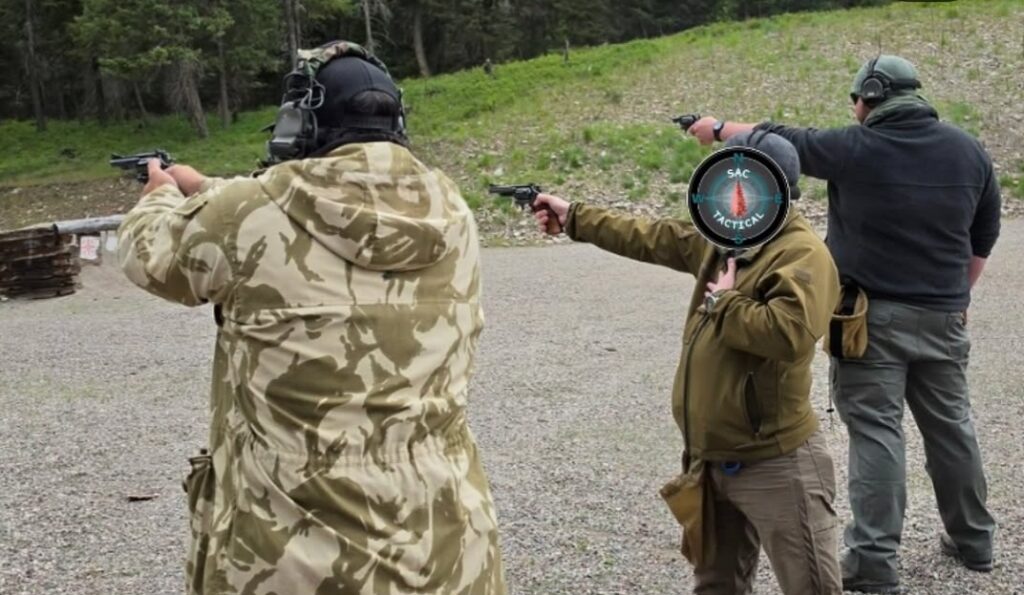
Day 1 started with a safety brief, introductions, and a quick overview of what gear we were using for the Cartwrights. Bruce was ably assisted by his son Will and Jack Andenero. Encouraging to me, one of the first questions asked was “Have you been on a timer before?”, as a way to gauge how everyone might handle guns under a little pressure. After the safety brief, we started out on B8s, shooting groups at various distances, and finished before lunch with a half version of the FBI Bullseye Course. There was a strong emphasis throughout on one handed work. Everyone was a very competent shooter, something even Mr. Hackathorn noted happily.
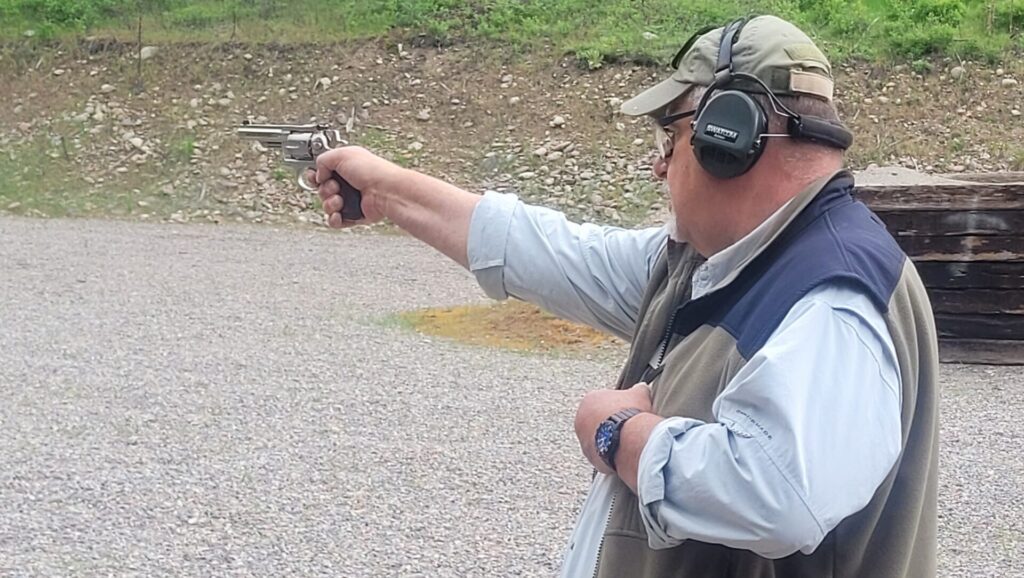
After breaking for lunch, we reconvened to shoot a walk back drill, pushing revolvers to distance. With the weather catching up, we went to the classroom to discuss loading with loose rounds. This was a new method I was aware of but never practiced, wherein the gun ends up in the left hand (for a righty) butt almost forward, and the trigger finger and middle finger cradling the cylinder and frame. This gives that hand a pocket to hold loose rounds with, and your strong just plucks the round out of the cup and puts them in the cylinder.
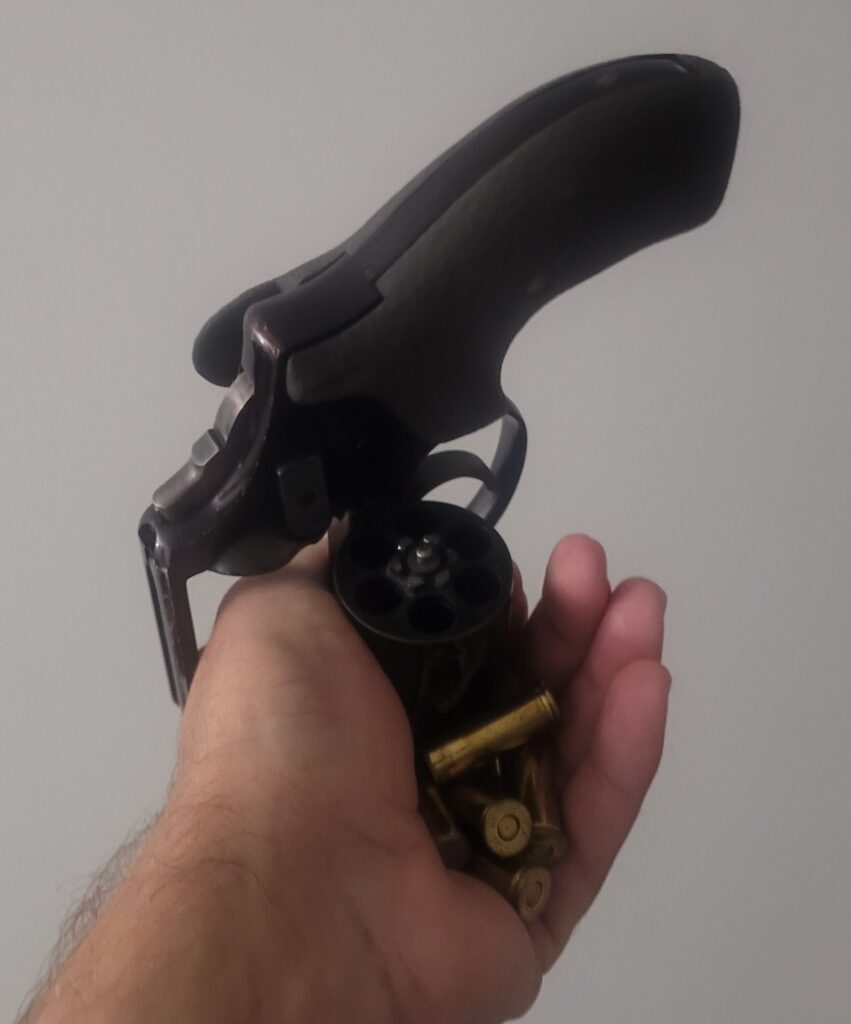
SAC also taught to always load diagonally opposite in the cylinder- Lugnut loading- so that if you have to close the cylinder in a hurry, 3 trigger pulls will get you at least one round, with another soon off. They got this technique from Greg Ellifritz. I read about it years ago- I THINK from Michael DeBethencourt but don’t quote me- but never actually used it. Frankly, I’m not sure about its practicality. The reasons given for it were in case you were issued or thrown a gun and loose rounds, or if a speedloader fails in your pocket. Just like knowing how to do weak hand one handed type 3 malfunction clearance with an auto, I’m glad I know how, but I’m probably not going to work that loading method into my practice routine.
TD 1 ended with a nice little exercise that combined all the loading methods into a drill they called Filthy 14, but you only fire 10 rounds, take the class if you want to find out why. I could tell you, but I’d have to kill you. After that, everyone broke for dinner where tall tales about beer, cars, and guns were shared for a couple hours.
Training Day 2
TD 2 started with shooting the Bakersfield qual a few times, where I shot a pair of 99s within time. One point away from perfect both times, go figure. After a little more shooting we started going into snub work, where I was once again reminded that a Smith Model 12 is the best snubby ever. We then did some light work shooting from retention, primarily with the Shivworks doctrine that the Cartwrights had been exposed to through Cecil Burch.
Finally, we wrapped up with various shoot offs, one on B8s at various distances, which I won. The big class shoot off was at steel, three steel targets, 10 yards, shoot one far side target twice, the other twice, shoot the middle steel once, reload, shoot the middle once again. I had a fast draw, good transitions, and a slick reload…which all fell apart when I missed not one but two shots off the reload, which allowed Eli to beat me by .4 of a second and get bragging rights. Everybody linked up, received certificates, shook babies, kissed hands, and parted ways.
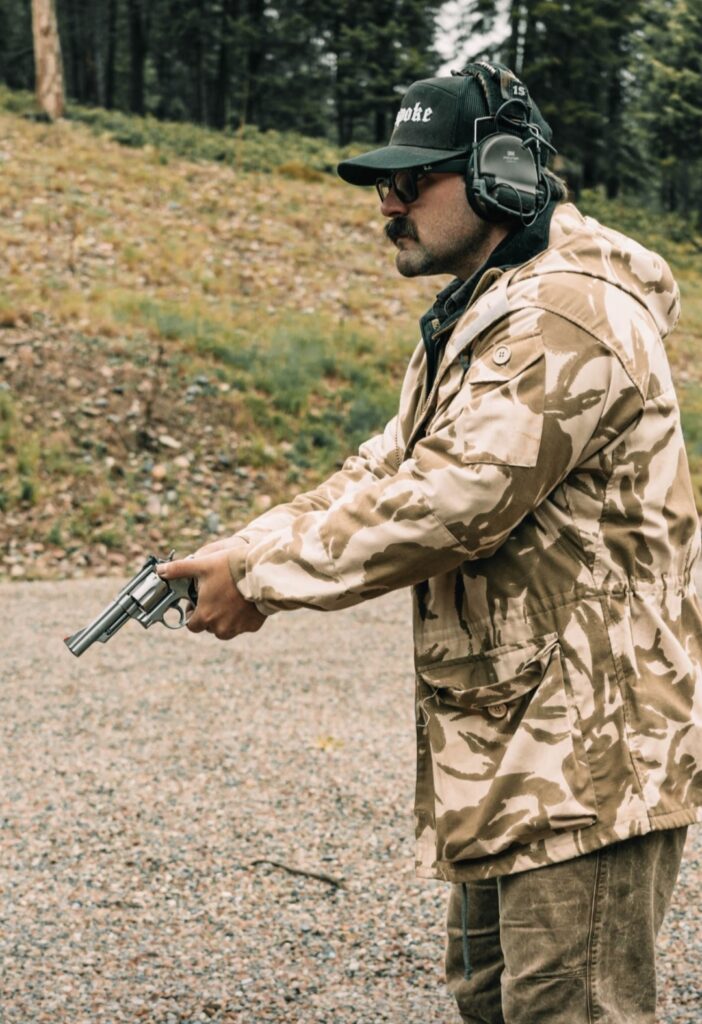
So, with that out of the way, let’s talk about the guns, loaders, gear, issues, and techniques.
The Blasters
Guns were the usual mix, but some cool stuff if you were in the know. Smith L and K revolvers were pretty standard for most of the students in a few configurations, mostly 4-inch guns. Steve Shields of High Desert Cartridge had a Model 28 he ran for a little bit in addition to a K frame, and one student used a 3-inch small frame Taurus for the entire class, because some men are just built different. The entire SAC cadre used Rugers, with Bruce and Jack running GP100s and Will using a Security Six.
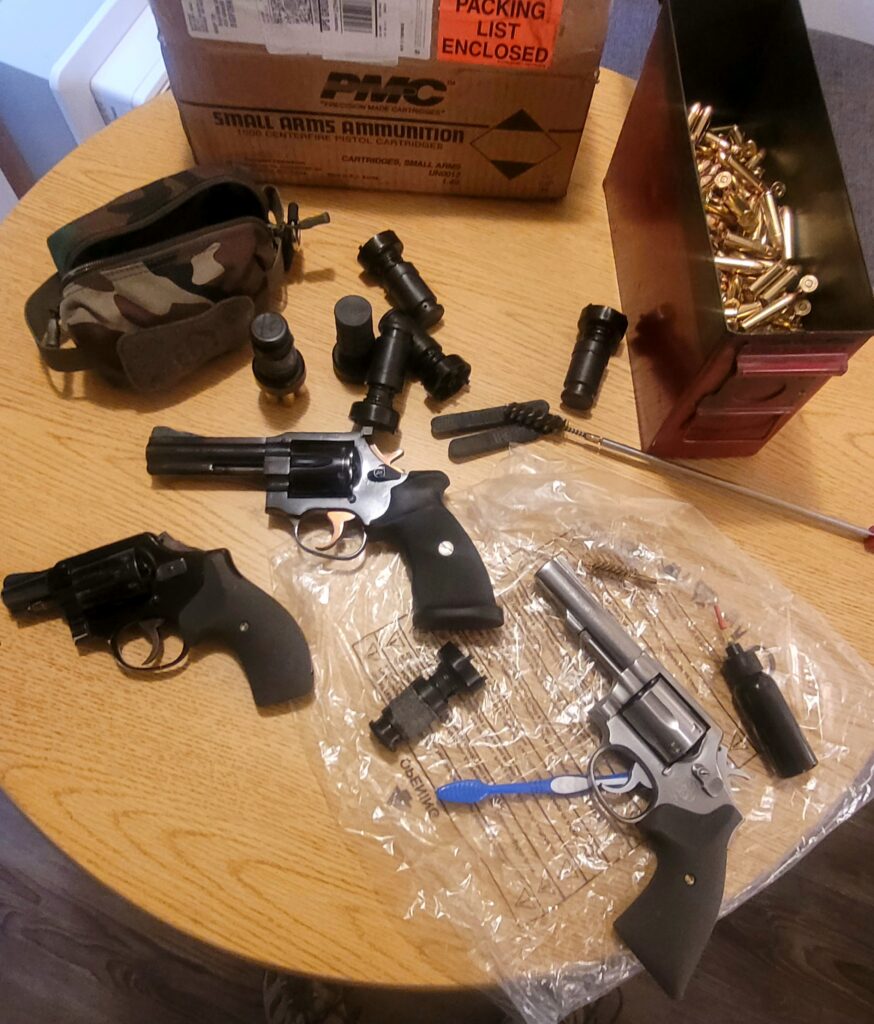
Grips were mostly Goodyear (rubber) grips from various makers. As usual, I had the only Manurhin, not only in the class, but the only one most people had ever seen. Ken had easily the coolest gun in the class- a Model 14 Dayton Special. That’s scarce enough on its own, but he had Fuzzy Farrant grips that were made specifically for Ken back in the day. That’s not just rare, it’s one of a kind. Eli ran a blued Model 15 marked for the LA Sheriff’s dept with Spegels, and when it started raining, he borrowed Ken’s Model 66, also with Spegels.
You want to know something terrible, reader? Between hanging out with Eli, some of his well-to-do friends, seeing some guys at the Colt Collectors show, and RevolverFest participants, I am officially bored with Spegels. I’ve handled so many that now that even though I think they’re great grips, they don’t elicit a “Oh wow, Spegels!” reaction from me like they used to. Same thing with Registered Magnums. I know, horrible problem.
Snubs were a lot more varied- a couple Taurus’s (Tauri?), some Smith J frame airweights in .38 and .32, I think one LCR, and a Smith Model 10 snubby used by Will. Here’s one I bet you didn’t see coming- Eli borrowed Kens Kimber K6s for the snubby portion, which he and Hack both admitted to liking. Just in time for Kimber to discontinue them. Go figure. I, of course, shot the Best Snub, my Model 12-no dash with Hamre Forge grips. This class did nothing to dissuade me of the notion that the Model 12 is the best carry revolver Smith ever made, and that they should bring it back immediately. Not an air weight L frame……not a heavy J frame…. the true, actual Airweight gun on the K frame, the best handling frame size and action you can get. Listen to the people, Smith and Wesson. We want new Model 12s. And there are dozens of us. DOZENS!
The Holsters
Well, rant over for that. Holsters were mostly outside the waistband. Ken used a Sparks (obviously), Eli used a Barranti with severe muzzle to the front cant, worn almost over his abdomen, to mimic his concealed appendix draw stroke. Most of the students used leather holsters at the 3-o clock, with some of the SAC staff using Kydex from Comp Tac/Speed Beez. I ran my Manurhin out of a custom job from Rob Hipp, Hipp holsters. This is his approximation of the old Bucheimer/Sloan holster, but with straight drop, and less bulky than some of the modern holsters of that style like the Sparks 200AW. Curiously, I did not see a single 200AW in class, which just makes me a little sad, ’cause that’s by far one of my favorite holster designs.
Loading Devices and Pouches
Speedloaders were the usual variety of HKS and Safariland Comp 2s and 3s. One student had the classic 5 Star Loaders, not the newer button ones. By the end of the class, it looked like most students that didn’t have Comp 3 wanted them, especially after being shown a few ways to carry them. Comp 3s are big but they’re about the size of a double stack magazine folks, it’s not THAT hard to carry one. Truthfully, a big part of my thinking when buying a new revolver is “Can I get Comp 3s for this gun?” If not, it’s not a deal breaker, but using inferior speedloaders sure does suck. I second Justin’s call that manufacturers really need to get on board with making better loaders and sending them out with the guns in the box.
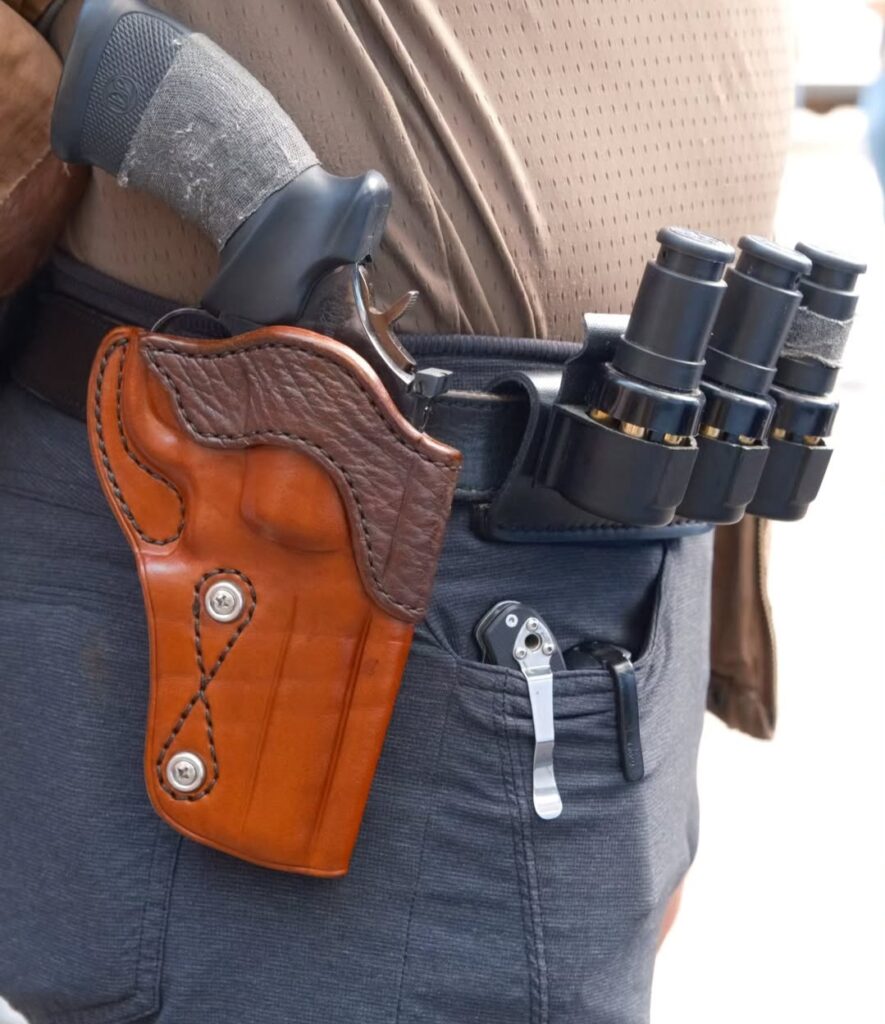
Anyway, Bruce used the excellent Simply Rugged Sidewinder pouches to show an option for carry. I used a couple of Comp Tac belt pouches, as did Ken. One guy had the sadly discontinued Safariland CD2 carriers. There were a couple of the Safariland 3 Cell carriers, and then a few Velcro or leather flap pouches. Not to pay myself on the back too much, but Eli, Ken, myself, Bruce, and the teaching staff all used Comp 3s, and kept wearing them even when we went out to dinner in concealed mode. Detectives, I think, would call that a clue.
I also used the excellent 2 shot IAC carrier, one of my favorite loading devices. In addition to the usual array of speed strips, I played with another student’s A-Holster Speed strips. I was familiar with their pocket holsters, but I didn’t even know they made speed strips. It was quick, but I was pretty impressed with it- I’ve got some for myself now that I’m playing with. A few other students had loops, and Eli had a Galco 2x2x2 pouch that came in handy a few times.
Maintenance Gear and Practices
The rest of the gear was pretty standard, normal electronic ear and eye protection. The savvy had cleaning kits and screwdrivers with them. I did my usual habit of quickly running a brush through the cylinders at lunch and taking an AP brush to the forcing cone, front of the cylinder, and under the extractor star. Doing this, and some quick drops of lube, will go miles in keeping your revolver running during classes and matches.
Equally important, check your screws before you put serious rounds through a wheelgun. Finally, having a zeroed pistol can be pretty important. I had my gun set for 158 Gr Speer Lawman +P, for ICORE, but the ammo I bought in town when arriving for class was 132 grain PMC. While not a big deal at close ranges, if you know your class will involve long distance work, check the gun at 25 yards. I found I needed to bring my POI down and left about an inch each.
Malfunctions and Issues
Problems…. always fun during revolver classes. I don’t think I need to tell the readers of RevolverGuy that wheel guns can be a little more finicky than modern autos– if you actually shoot them fast and often. In this class, the major downer was a Model 19 that had a constantly loosening ejector rod. Ken eventually took the student off to the side and showed him a field expedient way to tighten the rod- while it still presented some problems throughout the day, it was much less of an issue. It was definitely a more, uh, field expedient technique where he improvised a vice, clamped the rod between, and turned to tighten it.
That was the only serious gun problem. Two students had squibs, one with Magtech and the other brand I don’t recall. Ammunition quality these days has REALLY taken a dive. And now, with factory American ammo getting expensive, many students are turning to offshore ammo like SB, Magtech, Fiocchi, etc. While that stuff is actually pretty decent quality, they do run hard primers. Combined with Smith and Wesson’s recent quality issues, and light strikes are becoming a major problem for revolvers. This is also a good chance to remind everyone that if you shoot factory lead ammo, you’ll need to clean the gun more and harder. Thank God for people like Steve Shields of High Desert Cartridge and Ted Mcintyre from Lost River Ammo for bringing out good quality ammo for wheel gunners at affordable prices. Every other problem was shooter induced, the usual things like brass not ejecting all the way, speed strips tearing rounds off cylinders, etc.
Finally, techniques. Most of the students had pretty good gun handling, and reloading was pretty spot on too. A good bit of discussion came up around ejecting empty brass. Bruce favors hitting the ejector rod with a good smack but openly admitted that he used that on his Ruger’s with their supported cranes. If using a Smith, he said there was probably good sense in using thumb push techniques. There was also some talk about whether or not to leave the gun in the strong hand or switch it, which is generally influenced by speedloader design. Twist knob users should probably switch hands to capture the cylinder better, while push style loaders can do either. Even though Comp 3’s allow the shooter to leave the gun in the strong hand, I still switch, as I find it more consistent, easier to do moving, and allows me to use the same method for speedloader, strips, and loop carriers.
Just like RevolverFest, a real treat was just show and tell after class some days playing with guns. How about an FBI provenance Registered Magnum? A Triple Lock? Kens 14 with Fuzzy’s? Steve Shield’s 544 that he wrote up?
Visiting with Yoda
Of course, one of the real treats of the class was meeting Ken Hackathorn. If you’re reading this and you don’t know who Ken Hachathorn is, well, I don’t think there’s any help for you. He’s become very close with Eli in the last couple years, and he’s known Bruce for years, so having him in class was a real honor.
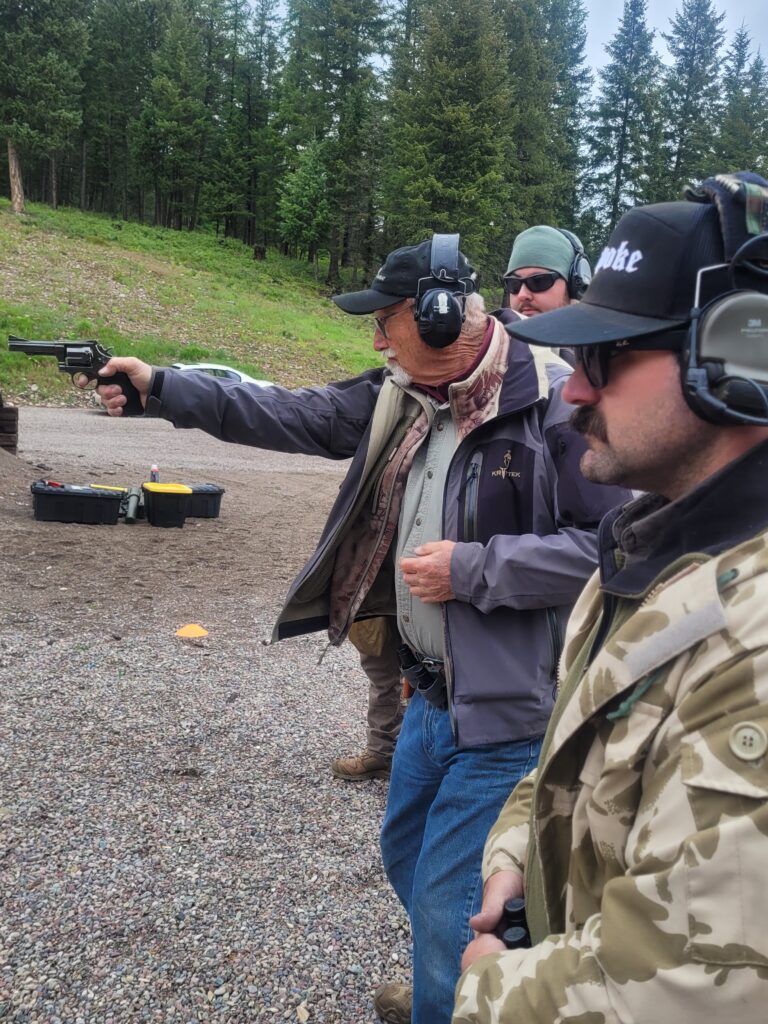
I’ll say this up front: Ken was a model student. It would have been sooooo easy for him to take over class or wave his hand and proclaim his technique as The Way. But he never spoke up unless Bruce asked him, was generous and accommodating talking to other students, performed drills as instructed, and as said took another student offline to help him deal with his loosening ejector rod. He told a lot of fun stories when prompted, but he never ate up class time or tried to be the center of attention. Also, while he’s no spring chicken, he kept up pretty well for someone turning 80 this year.
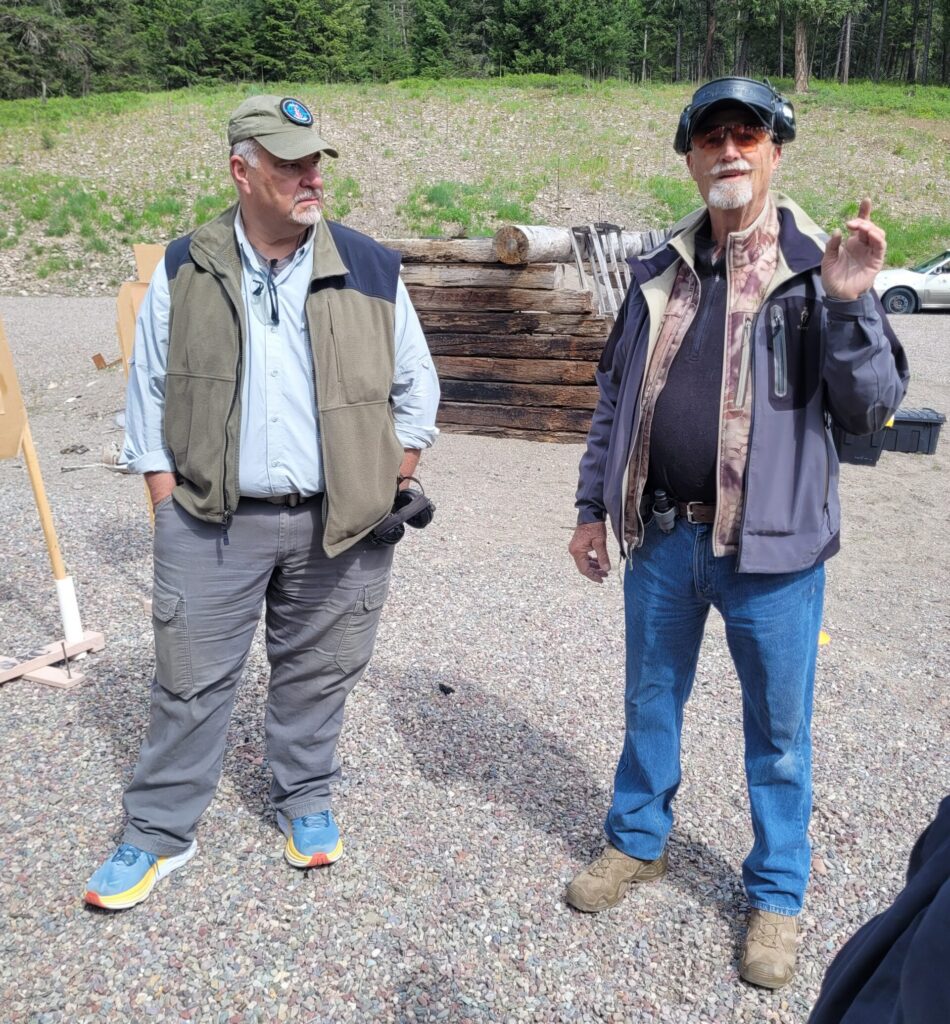
Eli and Ken were traveling together from Idaho, and they and I ended up staying in adjacent hotel rooms for the weekend. We also ended up riding together, cleaning guns in hotel rooms, and eating meals together. Getting to pick Ken’s brain offline, and hear some of his stories, was well worth flying Delta across the entire country. Plus, spending a couple days with Eli is always a fun time. If you’ve seen some of his high energy personality on videos and think he’s putting on a front or acting, let me assure you: he is not. I’ve spent many hours in a car with Eli, driving to some event or range, and he really is just like that…. God help us all.
Wrapping Up
Finally, all the support for the class was great. The hotel we stayed at, The Timbers, was fantastic, and had a discount for students. Since I was flying, I picked up ammo in town, and Bigfork Guns and Ammo was painless to deal with too- if you’re in the area, swing by. The whole town was welcoming and friendly. And it’s beautiful out there in the mountains. It’s been a few years since I’ve been in country like that, surrounded by tall hills and empty roads. It was a nice change of pace from the pine trees and dirt of North Carolina.

In conclusion, I had a great time at the class. Talking with other students at dinner, listening to Ken tell some wild stories at the hotel, seeing a good group of RevolverGuys train and getting better, it’s all the stuff you love to hear about. If you live near SAC Tactical, hit them up about training. Even if you’re not near them specifically, look around your area of the country if you’re interested in training, or search through articles here on the site. As always, whether shooting ICORE or training classes, RevolverGuys remain some of my favorite people to interact with in the shooting community, everyone’s just nice and relaxed. If you read this and thought it sounded like fun……go train and stay safe.

Darren,
Thanks for the review of the SAC two day. I’ve attended sessions run by Bruce Cartright at the past two Revolver Roundups. He and his crew do a great job of making simple tests challenging and difficult drills enjoyable. Meeting Ken Hackathorn would be such a treat.
Keep up the nice work. See you on the firing line.
Michael
PS There are HUNDREDS of us waiting on a new M12/315 NG, and thousands who would benefit from a rerelease.
My enthusiasm for such is quelled by S&Ws recent track record
Understood and sadly agreed. How about a new real Colt Cobra/Agent/Viper with an aluminum frame then?
I actually expected that last year. Hopefully we’ll see one soon.
Like Mike, I’d be worried about SW’s current QC, but I’m such a big fan that I’d buy 2 new production M12s with the full expectation that I’m going to be spending money to get them gunsmith’d/fixed out of the box.
What can I say? I’m also a 1911 guy, we’re used to this type of thing.
Hah!
I remember a time when Kimber fixed that, but it didn’t last too long.
Thanks for the review Sir! I enjoyed your take on the Comp III loaders and how they can be carried just as easily as a double stack magazine. I have at times during conversation, felt the need to explain or justify my choice for revolver and speedloaders to folks trying to conceal a double stack hi-cap pistol with a red dot sight and a mounted light.. I am certain even my 4in K-Frame takes up less space and is lighter to carry even with a Comp II or III on my belt. Keep up the great work and thank you again!
I’m come to appreciate slightly bulkier push loaders when I’m wearing a K-frame or GP100 belt gun. My first choice is the JetLoader, but they’ve become unaffordable of late. My second favorite, the Comp III wins on durability, availability, and cost. SLVariants are quick and easier to load by hand. All work neatly from Rob Leahy’s Sidewinder.
Very good review on SAC ! The reloading ‘cup’ technique was taught in my 1972 academy class by a lieutenant who could manipulate a revolver like I have never seen. This was in the aftermath of Newhall, and that tragedy was still raw to a troopers’ academy. The gun handling techniques taught were very similar to what is taught today. Learning reloading when your life depended on it, and this from our issued dump pouches; keeping the gun in action when everything else was going sideways were lessons I took to heart. Many of us used ‘unathorized’ speed loaders until they were finally adopted (officially). The Comp II is nice and compact, but the Comp III is a speed demon.
I am in full agreement on a Smith & Wesson Model 12 rebirth, rated for +P .38 Specials – with a 3″ pencil barrel. Bring it on.
Ken Hackathorn: Over the last few decades I’ve had the honor (and it was, to me) to attend many of his training classes for handgun, carbine and shotgun. I’ve attended classes under a lot of different instructors, but Ken is IMHO a master at all: a great teacher, the quintessential gentleman, and can reduce you to humility because what you thought you knew, well, you didn’t.
The day you stop learning is the day you need to hang it up.
Actually, even in class Newhall was brought up as a reason for the cup hand revolver technique. To which I replied that one of CHP’s changes from Newhall wasn’t to teach a new way to load loose rounds- it was to issue speed loaders 🙂
It really was a treat to have Ken in class; he was a model student. And his stories at night, some of the adventures that he got up to with S. Dave and the Haught’s and that crowd, were hysterical
Closing the cylinder with a few rounds and getting back to work would have done more for Officer Pence than any cup hand technique.
Same for drawing a backup gun.
This is a very good write up Darren. I was there as well. For all those revolver guys Darren can shoot that funky French gun like nobody’s business. It was a good class with a lot of good shooters. It was a great time. Meeting everyone was worth the price to entry. If you get a chance to attend a SAC class I highly recommend.
Thanks for the kind words! It’s all the gun, I’m just a monkey with a Stradivarius really.
Which is a distinct step above the room full of monkeys eventually typing Shakespeare we get most other places on the internet.
I had no idea this was about a 3 hour drive from me 🙁
Great AAR!
I believe he’ll be offering more soon, so keep an eye on the SAC website!
Thank you for highlighting the work that Bruce and his guys are doing, Darren. They are true practitioners of the martial revolver and really good dudes, to boot. I had the privilege of attending a short session they put on at last year’s Pat Roger’s Memorial Round Up- my experience mirrored yours. Thank you also for being a “young un” with a passion for revolvers in this day of the electric gun!
Great review! Appreciate the work you put in describing the class. Looks like a great opportunity for a sixgun minded person.
Be there next time, God willing and the river don’t rise.
This one took place two days after my encounter with a surgical robot that left me looking like I’d had a knife fight with a very small person in an elevator.
Regarding Smith’s QC, I’m currently troubleshooting a second-hand 432 UC for light strikes. Much hard work was done by the previous owner, and now by me. Got a couple more refinements in mind, but I’m coming to the conclusion that:
“It’s the ammo, stupid!”
Granted, doesn’t address other QC issues, such as actions locking up, incorrectly clocked barrels and the like.
Once again, sign me up for a modern but retro-looking M12 and an aluminum Cobra. Or two.
Lobo, check the headspace. Those guns were being built without the proper headspace gauge for a while and the headspace was a mess on a lot of guns. They should have never left the factory that way, but they did. A longer FP or stronger spring are popular measures, but can only “fix” a minor problem. Some issues require the factory to try again and do it right this time.
Thanks, Mike. Will do.
Headspace should be .060-.074 for the .32 H&R Magnum, from what I’ve found so far, with one source going as low as .056.
Kuhnhausen says most S&W centerfires should measure:
GO= .060
NO GO= .064 (some other sources say .066)
So, .056 and .074 don’t sound right, to me.
FYI, for recessed cylinders:
GO= .012
NO GO= .016
Mike–if this reply doesn’t belong here, feel free to delete it.
You got me moving in the right direction. Noticed the 432 had substantially more endshake then my well-loved PC 642. Had MTC cylinder end shake bearings on hand. Unscrewed the ejector rod, dropped in one shim, checked fit. Unsatisfied, I dropped in another, taking care to lube and seat it in the cylinder well. Ground a small amount off the thumbpiece to increase travel and insure the rod releases. Polished the end of the ejector tube.
Test fired S&B 100 gr SWC and Magtech 98 gr LWC. Only one light strike with the S&B, second cylinder load, when I staged the first shot. Fired on the second strike. No other malfunctions with that load, even when I staged the trigger.
Magtech gave trouble at first, including failing to fire on alternate rounds in rapid fire. Then the gun and ammo came to an understanding, and the WCs fired first time, every time.
Promising. Now to work on hitting POA/POI.
Sounds like progress, Lobo. The POI will take some work–a project I haven’t tackled yet, myself.
I like Safariland Comp II loaders, but the Comp 3s are too big for me. I like carrying my speed loaders in a pants or jacket pocket.
Also, I can attest to there being an ammo quality issue or something going on lately. I don’t know what it is. My Colt Python I bought earlier back in January would get constant light strikes with High Desert’s .357 ammunition; especially the 140gr load I like. It even got a few light strikes with Magtech .38 Special FMJ.
A gunsmith said my Python’s firing pin was too short, got a longer one from Colt and installed it. Still got light strikes with High Desert, and while Magtech .38 was fine, it would get light strikes with Magtech .357.
I also have an older Taurus 66 that has similar issues, although it had the added issue that sometimes it would fire the first round and then the cylinder wouldn’t rotate (couldn’t pull the trigger) and you’d have to open and close the cylinder.
None of my other revolvers have ever gave me issues like this. Not even my most recent purchase, a Taurus 66 Combat. That revolver shot High Desert, Magtech and Buffalo Bore ammo, .38 and .357, without issues.
I am legitimately baffled. My local gunsmith is seeing if there’s anything he can on his end with them. Not being able to shoot Magtech is kind of a big deal, because I buy a lot of Magtech (plus S&B and PPU) ammo because it’s more affordable than domestic ammo like Federal. Magtech has never given me crap. My Ruger LCR in .32 H&R has shot plenty of Magtech .32 Long and .32 H&R ammo without complaint.
What do you guys think? Is there something wrong with the revolvers I mentioned, or is ammo getting worse these days? Why is my Taurus 66 Combat fine with anything, but a freaking Colt Python which was twice the price of the Taurus (if you include the optic I bought for the 66C)?
Axel, how’s the headspace on that Python?
Steve makes very good quality ammo, but I received some .38 Special from him last year that gave me frequent light strikes. It turns out the culprit was the brass (JAG headstamp)–the manufacturer had made the primer pockets too deep, and the first strike would just fully seat the primer, with no bang. A second strike always lit it off.
Even a good loading operation will turn out bad stuff if the raw components aren’t good. We’re seeing lotsa stuff like that in the industry right now.
That JAG branded stuff is the brass from Ammo Inc, which in factory form is some of the most utter crap I’ve ever shot. Some of their 9mm wouldn’t run in a relatively stock Beretta 92. I didn’t even know it was possible to make 9mm that wouldn’t function in a 92.
My buddy Chauncey ended up with a bunch of that stuff in .38 Super that he saved the JAG brass for. He had nothing but problems with that brass for loading.
MagTech makes great ammo but they do run very hard primers which, combined with some of the drop safety changes, headspacing problems, and general QC of modern revolvers, does give a lot of wheelguns fits.
Taurus guns don’t seem to have these problems becuase, well, Magtech (CBC) is a Brazilian company as well, and I suspect all of Taurus’s test firing and checks are done with that ammo.
All the High Desert 140gr .357 I have are Starline brass, and I acquired them this year. Honestly, I don’t usually pay attention to brass. I just know I started buying ammo from Mr. Shields after I got my .32 LCR in January 2025, and my LCR hasn’t any issues with any ammo. I’ve shot quite a bit of Magtech .32 Long out of it, plus HD .32 H&R.
I don’t know how to check revolver headspace, but I’ll ask my gunsmith to take a look. Dealing with my Python has been very frustrating. It was just over $1400 after tax, and the D&L night sights were $561. The fit and finish is excellent. I love the way it spits out cases with just a tap on the ejector rod. Plus, the Python just looks cool.
Yet it’s not 100% reliable with whatever I put in it, like a revolver should be. Very frustrating.
The Pythons are very attractive, in all respects, but they lose their luster quickly if they don’t work. I’d definitely have him check the headspace, which is something he should know how to do if he’s gonna work on your Colt.
Your older Taurus 66 is locking up after it fires? Hmm, could be a few things, but I’d be curious to know if the primer cup is flowing into the firing pin hole in the bolster face, like the first L-Frames did with the Winchester ammo (which caused a recall for the L-Frames). When you open the cylinder, does it take lots of force to open? Does the fired primer look normal, or does it look like it’s getting sheared off?
No, the cylinder doesn’t take force to open after the issue I described.
As for sheared primers, I had to look that up since I’ve never heard of that before. I put my spent casings in assigned bags, so I had to fish around to try and find something that matched the images I found. I found one Magtech case where the primer “may” have been sheared, but the sheared primers I saw online looked like they had smudging on them and neither the Magtech case or any other had that.
It’s either sheared or it was struck two times in slightly different spots. Hard to say, but I’ll mention it to the gunsmith to look out for it. I left him all the ammo I tested, so he’s bound to run into the same issues.
Why not contact Colt about your Python’s ammo problem? If the revolver is defective, the shipping costs back to the factory and repairs should be honored by Colt under their product’s warranty.
I bought it used, so I have no idea if it’s still under warranty. It already got an extended firing pin from Colt too, and I’m concerned they’d just say it’s “in spec” and ship it back.
Folks:
Thanks to Darren for the great review of our class. I and my instructors love teaching revolvers (we teach other platforms as well, like auto pistol, carbine, shotgun, MP5s etc). You did great in the class.
Thanks to the other Revolver Guy readers/commenters for your interest and kind words. I and my staff instructors enjoy interacting with all of you.
We are looking at doing more classes, possibly this year and for 2027. Stay in touch with us and hopefully our paths can cross at a training class. Be safe and remember, as one of my mentors said, “the wheel came first”!
Bruce